
Planning a first pilgrimage to Israel involves more decisions than most American pastors and group leaders expect, and the questions that matter most rarely appear on any travel checklist. What does a typical day actually look like? What is genuinely included in a tour package and what gets added to the bill later? How does the itinerary change depending on whether the group is Baptist, Catholic, Methodist, or Pentecostal? This article walks through the practical questions that American congregations, church groups, and individual travelers ask most often before committing to a Holy Land tour, with direct answers drawn from more than three decades of organizing these trips for U.S. groups.
Reading time: 7 minutes
Key Points
- A Holy Land tour is a structured journey through the actual biblical landscape, not a themed vacation. The route covers distinct regions including Galilee, Nazareth, Bethlehem, Jerusalem, and the Judean Desert.
- Tour cost, length, and pacing depend on variables that must be discussed before any number is quoted. Seven days is viable but intense. Ten to fourteen days allows a more genuinely contemplative pace.
- Every itinerary Talya Tours builds is shaped by the specific Christian denomination of the visiting group, whether Catholic, Evangelical, Baptist, Pentecostal, Methodist, Lutheran, Anglican, Orthodox, or another tradition. Sites, worship arrangements, and guide focus all reflect that.
- Safety, physical demands, dress codes, and packing requirements are practical matters that every U.S. group leader should address before departure, not after arrival.
What is a Holy Land tour?
A Holy Land tour is an organized journey through the sites where the biblical narrative actually took place. It is not a vacation with a religious flavor added on top. It is a structured route across the land where the Old and New Testament events unfolded, guided by someone who can connect the ground under your feet to the text you have read your whole life.
The Holy Land covers a compact stretch of territory, which surprises most first-time American travelers. From the Sea of Galilee in the north to the Judean Desert in the south, you are crossing distances smaller than many U.S. states. A full tour usually weaves together five regions – Galilee, where much of Jesus’ ministry took place, Nazareth, where he grew up, Bethlehem, the place of the Nativity (Luke 2:1-20), Jerusalem, the spiritual center of the journey, and the Judean Desert down toward the Dead Sea.
It is both an education and a deeply personal experience. You learn the geography and history that hold Scripture together, and you stand in places like Capernaum (Mark 1:21-35) or the Garden of Gethsemane (Matthew 26:36-46), where the reading becomes something you can see. Groups that want a deeper connection to these biblical landscapes often explore our Christian Tours Israel programs, where the route is built around their own tradition rather than a fixed template.
The practical reason to use a professional operator is straightforward. When the visas, the licensed guide, the vehicle, the hotels, and the site bookings are handled for you, you are free to absorb what the land is actually teaching you, instead of standing at a closed gate at 4 p.m. wondering why no one warned you about the hours.
How much does a Holy Land tour cost?
There is no single number, and anyone who gives you one without asking questions is guessing. Cost depends on how you travel. For Holy Land tours, budget group travel built around 3-star hotels and shared coaches sits at one end. Premium private tours with 5-star accommodation, a private vehicle, and a dedicated guide sit at the other. Most American church groups land somewhere in the middle.
The variables that move the price are predictable – seasonal airfare, hotel rating, the size and type of vehicle, whether you need a specialized guide familiar with your denomination’s tradition, and entrance fees at each site. Arrival logistics through Ben Gurion Airport are part of the planning and rarely add surprise cost when arranged in advance.
The money you commit upfront is money that protects you from the far more expensive surprises that hit groups who improvise on the road.
What factors drive the cost of trips to the Holy Land?
The biggest cost drivers on trips to the Holy Land are the ones groups underestimate. A private vehicle and guide cost more than a shared coach, but for a congregation that wants its own schedule, the difference buys real freedom. Duration matters in a linear way – each extra day adds a hotel night, meals, and guide time. Dining plans shift the figure too, since half-board with dinner included runs higher than bed and breakfast.
Then there are seasonal surcharges, which is why we tell every group the same thing – book early. Locking in a date six to twelve months out protects your budget from the swings that hit anyone trying to reserve forty rooms in March for an Easter trip.
What is included in a Holy Land tour package and what is not?
Knowing exactly what your Holy Land tour covers prevents the awkward moments that derail a group’s morale. A standard package across the Holy Land usually includes a deluxe air-conditioned coach with WiFi, a government-licensed English-speaking guide, hotel accommodation, and pre-arranged admission tickets to the sites on the route.
What is typically not included tends to catch groups off guard – personal medical and travel insurance, gratuities for your driver and guide, international flights unless they are specifically bundled, and lunches, since most itineraries cover breakfast and dinner only. We list these plainly in writing before anyone signs, because a clear line between included and excluded is worth more than a low headline price.
Is 7 days enough for a Holy Land tour?
Yes, if you accept that seven days means focus, not coverage. A 7-day Holy Land tour can carry a group through the two essential regions – Galilee and Jerusalem – but it cannot do both slowly. Seven days moves. You will have early mornings, full days, and evenings that end with tired feet. It is spiritually rewarding for groups with the energy to match it, and for many American congregations it is exactly the right length.
Our The Highlights Tour shows how a well-ordered 7 or 8-day schedule can hold the core sites without feeling like a forced march. The key is sequencing – the order in which sites are visited matters as much as which sites are included.
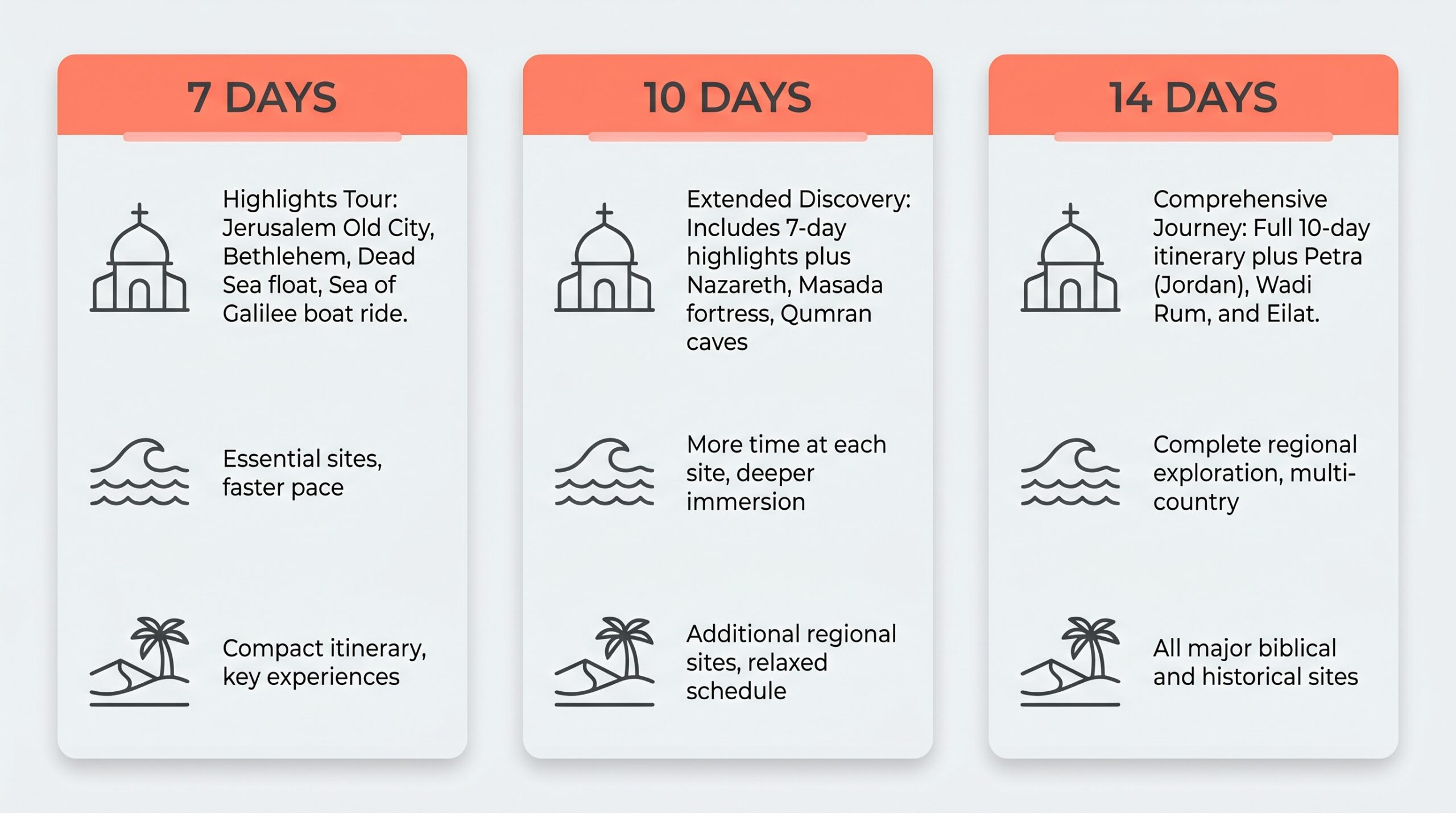
7 days vs. 10 days vs. 14 days itinerary breakdown
The extra days on longer trips to the Holy Land do not just add sites. They change the texture of the trip entirely.
| Duration | What it covers well | What gets added | Daily intensity |
|---|---|---|---|
| 7 days | Jerusalem and Galilee core | The essentials only | High energy required |
| 10 days | Core plus Dead Sea and Masada | Capernaum, floating in the Dead Sea, slower mornings | Moderate, sustainable |
| 14 days | Full north-to-south depth | Denomination-specific worship breaks, Bethlehem, quieter contemplative time | Comfortable, low burnout |
Ten to fourteen days is where the trip stops feeling like a checklist and starts feeling like a pilgrimage. You add Masada, you float in the Dead Sea, you spend an unhurried hour at Capernaum (Mark 1:21-35), and you give your group the worship breaks – shaped to your denomination’s tradition – that a seven-day plan simply cannot afford.
What is the best time of year for a Holy Land tour?
Spring, from March through May, and autumn, from September through November, give you the most pleasant temperatures for a Holy Land tour. These are also high season, which means crowds and higher rates. Summer, June through August, is dry and hot, especially down in the Judean Desert. Winter, December through February, runs cool and occasionally rainy, but rewards you with thinner crowds and lower prices across the Holy Land.
The other factor is the calendar of religious holidays. Easter, Christmas, and the Feast of Tabernacles pack out venues across Jerusalem and Bethlehem. A group that wants to be at the Church of the Holy Sepulchre during Easter week is competing with the whole Christian world. Climate data from the Israel Meteorological Service confirms the regional temperature swings, and we use it to advise on what to pack for the season your group chooses.
Planning a pilgrimage for your congregation?
Talya Tours builds every itinerary around your group’s specific Christian denomination – whether you are Baptist, Catholic, Methodist, Pentecostal, Lutheran, Anglican, Presbyterian, Orthodox, or another tradition. Reach out to discuss dates, sites, and what the right structure looks like for your group before committing to anything.
Is it safe to travel on a Holy Land tour?
Safety is the first thing on our mind, every day, for every group. On any Holy Land travel tours we operate, we monitor developments continuously, adjust routes when needed, keep clear of sensitive areas, and coordinate directly with local authorities. We will not make absolute promises, because no honest operator can. What we do is manage risk proactively, with people on the ground who know the situation hour by hour.
We also encourage American travelers to stay informed for themselves. Reviewing current travel advisories before you depart is a sensible habit, and it gives a group leader the confidence to answer the questions their congregation will inevitably ask.
Safety checklist for your upcoming Holy Land travel tour
Before any of our Holy Land travel tours depart, we ask every traveler to handle a short list of basics – keep digital copies of your passport, save emergency contacts in your phone, secure proper travel insurance, and stay within your organized program group at busy sites. The tourist information bureaus at Ben Gurion Airport operate around the clock and are a reliable first point of contact the moment you land. Small habits, handled before the trip, prevent the situations that turn a good day into a lost one.
What are the primary sites on a classic Holy Land tour?
A classic Holy Land tour carries you across a startling range of geography. You stand at the Dead Sea, the lowest point on the surface of the earth, and within a couple of hours you climb into the Judean Mountains toward Jerusalem. The Holy Land packs more history per mile than almost anywhere on the planet, and a good itinerary lets the contrast itself become part of the experience.
The sites that anchor nearly every route are the ones where the biblical story is most concentrated – the Sea of Galilee, Nazareth, the Jordan River, Bethlehem, and the Old City of Jerusalem. How they are sequenced, and how long your group lingers at each, is where a denomination-tailored itinerary earns its keep. A Lutheran congregation and an Assemblies of God ministry will not want identical time allocations, even at the same site.
Sacred places to cover in Jerusalem
Jerusalem’s Old City holds the dense core of the Holy Land. The Mount of Olives gives you the view that orients the whole city (Luke 19:37-41). The Garden of Gethsemane sits at its foot (Matthew 26:36-46). The Via Dolorosa traces the path of the Passion through the narrow streets, and the Church of the Holy Sepulchre stands at its end – a site whose multi-denominational chapels and long, layered history reward groups that understand what they are looking at.
Practical conduct matters here. Keep your voice low inside the churches, stay together in your tour line, and let your guide manage the timing in the crowded passages. These are active places of worship, not exhibits, and the guide’s role is to position your group where the experience is richest for your specific tradition.
Historic Christian highlights in Galilee and Nazareth
Galilee is where many of our Holy Land tours truly come alive. Nazareth holds the Basilica of the Annunciation, an enormous and architecturally striking church built over the traditional site of the angel’s announcement to Mary (Luke 1:26-38). Around the Sea of Galilee you reach the Mount of Beatitudes (Matthew 5:1-16), Capernaum (Mark 1:21-35), and Yardenit – the baptismal site on the Jordan River where many American groups renew their baptismal vows, often shaped into a full ceremony for Baptist and Evangelical congregations.
The contrast with Jerusalem is the point. Where the Old City is dense and intense, Galilee is open water, green hills, and quiet. Groups often tell us the Galilee days were the ones that stayed with them long after they returned home.
Should I choose a group tour or a private Holy Land tour?
It depends on what your congregation values most. A group Holy Land tour offers strong cost-effectiveness, built-in fellowship with believers walking the same road, and a fixed structure that takes the planning burden off your shoulders. For a church family traveling together, that shared experience is often the whole point.
Private Holy Land tours trade some of that economy for control. You choose your own start times, your boutique hotels, your pace, and you get far deeper one-on-one access to your guide. A Southern Baptist congregation of sixty and a Presbyterian fellowship of twelve will usually want very different formats, and there is no single right answer. We ask what the pastor wants the group to walk away with, then we recommend the structure that delivers it – and we shape that structure around the theological priorities of the denomination in front of us.
What should I pack for a Holy Land tour?
Pack for a country that swings warm in the day and cool at night. For a Holy Land tour, bring lightweight breathable fabrics for the heat of Galilee and the desert, a warm outer layer for the chilly Jerusalem evenings that surprise people every season, sun protection and a refillable water bottle for hydration across the long days, and a plug adapter for Israel’s outlets. A small daypack for site visits saves your back considerably by the third or fourth day.
Dress code essentials for holy sites
Modest dress is required across the Holy Land, not optional. At churches, synagogues, and mosques, shoulders and knees must be covered for men and women alike. The Western Wall Heritage Foundation publishes clear visitor guidelines on modest clothing, and the same standard applies at most sacred sites. Bring a light scarf or wrap you can throw on quickly at the entrance of any site. And wear walking shoes with real grip, because the ancient cobblestones in the Old City and the worn stone steps at biblical sites are unforgiving for the wrong footwear.
How physically demanding is a Holy Land tour?
More than most American travelers expect. A typical day on a Holy Land tour involves extensive walking on uneven walkways, steep paths, and ancient stone stairs polished smooth by centuries of feet. Masada is the clearest example. The Snake Path, documented by Israel’s Nature and Parks Authority, climbs roughly 350 meters over close to 900 steps, and it is genuinely difficult – which is why summer access is restricted during peak heat.
None of this means an older group cannot go. It means we plan around it. For travelers with mobility limitations, the cable car at Masada replaces the climb, and we build in rest stops, shaded waits, and a pace that fits the group in front of us rather than an ideal one on paper.
How do I choose the right Holy Land tour company?
Hold any company to a clear standard. Look for verified feedback from real American groups, fully licensed local guides, a secure deposit process, sensible rebooking terms, and on-the-ground support you can actually reach during the trip. Ask whether the person organizing your tour will still be reachable when something changes at 9 p.m. on a Tuesday in Tiberias.
Talya Tours does not hand every group the same program. Tourism is our only business, the company is owner-led, and Talya herself touches every itinerary. The single thing that separates us on Holy Land travel tours is that we build each route around the specific Christian tradition of the requesting group. A United Methodist congregation gets a different itinerary structure than a Catholic parish or an Orthodox fellowship – because the sites, worship arrangements, and guide focus that carry meaning for each tradition are genuinely different. You can read more on the About Talya Tours page about how three and a half decades of organizing tours for American groups shaped that approach.
Essential questions to ask before booking your tour
Before you commit to any Holy Land travel tours, get clear answers to a short set of questions. Is the guide government-certified? How large will the group be, and is that number capped? What exactly is included and what is not? What are the precise cancellation and refund windows, in writing, with dates attached? And specifically – does this company tailor itineraries to the denomination of the group, or do all clients get the same route? A company that answers these plainly is one you can trust with forty people and two years of savings.
What is a Holy Land pilgrimage and how is it different from a tour?
A sightseeing Holy Land tour moves efficiently from site to site, weighting history and context. A pilgrimage across the Holy Land slows down on purpose. It builds in time for Scripture reading at the site itself, for prayer, for quiet meditation, and for the ceremonies that matter to a particular tradition. The pace is the difference, and so is the intent.
This is where denomination shapes everything. A Catholic group will weight time at the Church of the Holy Sepulchre, the Basilica of the Annunciation, the Church of the Nativity, and the stations of the Via Dolorosa – often with Mass arranged at the right locations. An Evangelical or Baptist group more often centers on the Garden Tomb, a baptismal renewal at Yardenit, the Mount of Beatitudes, and Capernaum, with extended Scripture reading at each stop. A Pentecostal ministry may want long, open time for worship at the Mount of Olives or Gethsemane. Anglican and Episcopal groups frequently request morning prayer at specific sites, shaped by their liturgical calendar. For groups leaning toward the contemplative end, our Catholic Pilgrimage to the Holy Land shows what a spiritually focused, slower itinerary looks like in practice.
Can I customize a Holy Land tour itinerary?
Not only can you, we usually recommend it. Families, full church congregations, and small private groups all benefit from a Holy Land tour shaped to their own goals rather than a fixed catalog program. A United Methodist conference and an Assemblies of God ministry rarely want the same week, and a Presbyterian study group will approach the itinerary with entirely different scholarly priorities than either.
Customizing also means you can mix the ancient with the modern. Add a free afternoon in Tel Aviv, build in an evening for the city’s food scene, then return to the classic antiquities the next morning. The point of a tailor-made itinerary is that it fits the people traveling – including which sites carry the most theological weight for your tradition and how much quiet your group actually wants.
If your church or group is beginning to map out a pilgrimage or a professional delegation to Israel, we are glad to talk through dates, sites, and logistics before you commit to anything at all. You can reach Talya directly at [email protected] or through our contact page.
Frequently Asked Questions
A Holy Land tour is one of the most significant things an American congregation can undertake together. The land is small but dense with meaning, the logistics are manageable with the right preparation, and the experience of standing at sites you have read about your whole life is something that rarely needs embellishment afterward. The practical decisions – length, season, group format, denomination-specific routing, and what is genuinely included in the package – are the ones worth getting right before you depart. If your church, ministry, or group is beginning to plan a trip to Israel, we are ready to talk through the specifics and help you build an itinerary that fits your tradition and your travelers.
Ready to plan your group’s pilgrimage to Israel?
Send us your group’s details – size, denomination, preferred travel dates, and any specific sites or experiences your congregation has in mind. We will come back to you with a clear picture of what a tour built around your tradition looks like, with no obligation to book.

About the Author
Talya Felner
Talya Felner is the Owner and CEO of Talya Tours Services (TTS), a leading professional tour operator in Israel. With over 35 years of experience and more than 90,000 travelers served, Talya has built TTS into a trusted name for Christian pilgrimages, biblical tours, and conferences for American groups visiting Israel and the Holy Land. Her team designs each itinerary around the specific Christian denomination of the visiting group – whether Protestant, Catholic, Evangelical, Baptist, Methodist, Pentecostal, Lutheran, Presbyterian, Anglican, Orthodox, or another tradition – ensuring that sites, worship arrangements, and guides reflect what matters most to that congregation. From visas and accommodations to guides, transportation, and on-site coordination, TTS handles every detail so American pastors and group leaders can focus on the spiritual experience of their travelers.