
Planning a tour of Jerusalem well means knowing what the city actually asks of a group before the flights are booked. The Old City covers less than one square kilometer, yet it holds more than three thousand years of layered history, multiple active religious communities, and a calendar of observances that affects access, atmosphere, and logistics at every turn. American pastors and group leaders who understand those layers in advance spend their days in Jerusalem on the experience rather than managing surprises. This article covers the practical and logistical questions that come up most often when U.S. church groups and congregations plan a Jerusalem tour, from how long to stay and what to bring to how denominational priorities shape the itinerary.
Reading time: 7 minutes
Key Points
- Jerusalem rewards groups that plan the city before they plan the flights – duration, pacing, and site selection all depend on decisions made well in advance.
- The denomination of your group determines which sites receive priority time, what worship arrangements are possible, and how the sequence of the day is built.
- Practical details – shoes, dress code, timing, season, and what is and is not included in a tour price – have more impact on the experience than most groups expect.
- A private, denomination-aware guide changes the quality of the day more than any individual site on the itinerary.
Table of Contents
- What a Jerusalem tour actually is
- How long a Jerusalem tour should be
- What you will see on a classic Old City tour
- The best time of day to start walking
- The best season for trips to Jerusalem
- Private tour or group tour
- How much a Jerusalem tour costs
- What is included and what usually is not
- What to wear and bring
- Customizing for families, seniors, or accessibility needs
- Jerusalem tours for first-time visitors
- How to choose the right guide
- Is it safe to take a Jerusalem tour
- A good one-day itinerary
- How to book and what to confirm first
What a Jerusalem tour actually is
A Jerusalem tour is a guided journey through a city built in distinct layers – Roman, Byzantine, Crusader, Ottoman, and modern Israeli. Those layers sit on top of one another, often literally, and without someone qualified to read them, a group can walk past three thousand years of history and see only a crowded market and worn stone.
That is the honest case for professional guidance. Independent travel through Jerusalem is possible and many American visitors attempt it, but most finish the day having visited the Western Wall and the alleys without understanding how the two connect, or why the Church of the Holy Sepulchre sits where it does. As a tour operator that builds custom itineraries for U.S. groups, Talya Tours exists to close that gap. Tour options range from a focused three-hour walk to multi-day programs that place Jerusalem within the wider geography of the Holy Land.
How long a Jerusalem tour should be
The honest answer depends on your group, not on the city. A half-day tour of three to four hours covers one quarter of the Old City well. A full day of seven to eight hours lets you move between the Old City and surrounding areas. Multi-day programs are the only format that gives Scripture-based sites the time they deserve without a stopwatch running.
The variable most U.S. groups underestimate is physical fatigue. The Old City is cobblestone and stairs throughout, and forty minutes standing on worn, uneven marble tires a group faster than a flat two-mile walk on a level surface. For groups that include seniors or families with young children, our pre-planned daily tours in Israel are built with pacing as a deliberate element rather than an afterthought.
Choosing duration by group pace
Academic groups, seminary travel programs, and church groups with a strong scriptural focus should plan multi-day itineraries so that no site is rushed through. A Baptist pastor from Indiana once asked us to fit Gethsemane, the Mount of Olives, and the Western Wall into a single afternoon. We told him honestly – pick two. The third becomes a photograph instead of a moment. That advice held, and the group returned a second year with two full days allocated to Jerusalem alone.
What you will see on a classic Old City tour
A standard Old City Jerusalem tour moves through the four quarters inside the walls. The Western Wall anchors the Jewish Quarter. The route then works toward the Church of the Holy Sepulchre, the Byzantine Cardo with its restored Roman columns, and the Arab Souk with its covered lanes and market activity. A qualified guide does not simply name these places – he explains which empire built which wall and why the geography made Jerusalem a contested city across every century of its recorded history.
Just outside the southern walls sits the City of David, where ongoing excavations documented by the City of David National Park reach down to biblical-era foundations. For any group traveling with a scriptural purpose, that site is among the most concrete physical confirmations that the layers under Jerusalem are not a figure of speech.
Avoiding sensory overload
The most common planning error we see with American church groups is the checklist approach – twenty stops planned, none of them absorbed. A better structure anchors the day on three or four major sites and breaks the walking with a quiet chapel, a courtyard, or a simple rest stop. The rhythm of the day matters more than the count of sites visited, and groups that follow a slower pace almost always report a deeper experience than those that sprint through a longer list.
The best time of day to start walking
Early morning. There is no meaningful second answer. Beginning a walking tour of the Old City by 8 a.m. puts your group ahead of both the peak crowds and the midday heat. The market stalls are opening, the light is soft, and the Church of the Holy Sepulchre is quiet before the large bus groups arrive mid-morning.
Late afternoon has its own merits. The light over the Mount of Olives near sunset is the best of the day for photography and for sitting quietly with a Scripture passage that belongs to that view. One timing rule overrides everything else for planning purposes – on Friday afternoon, the city changes tempo as Shabbat approaches. Shops in the Jewish Quarter close early, the Western Wall plaza fills, and a guide who knows Jerusalem’s weekly rhythm manages that transition for you without disrupting the group’s schedule.
The best season for trips to Jerusalem
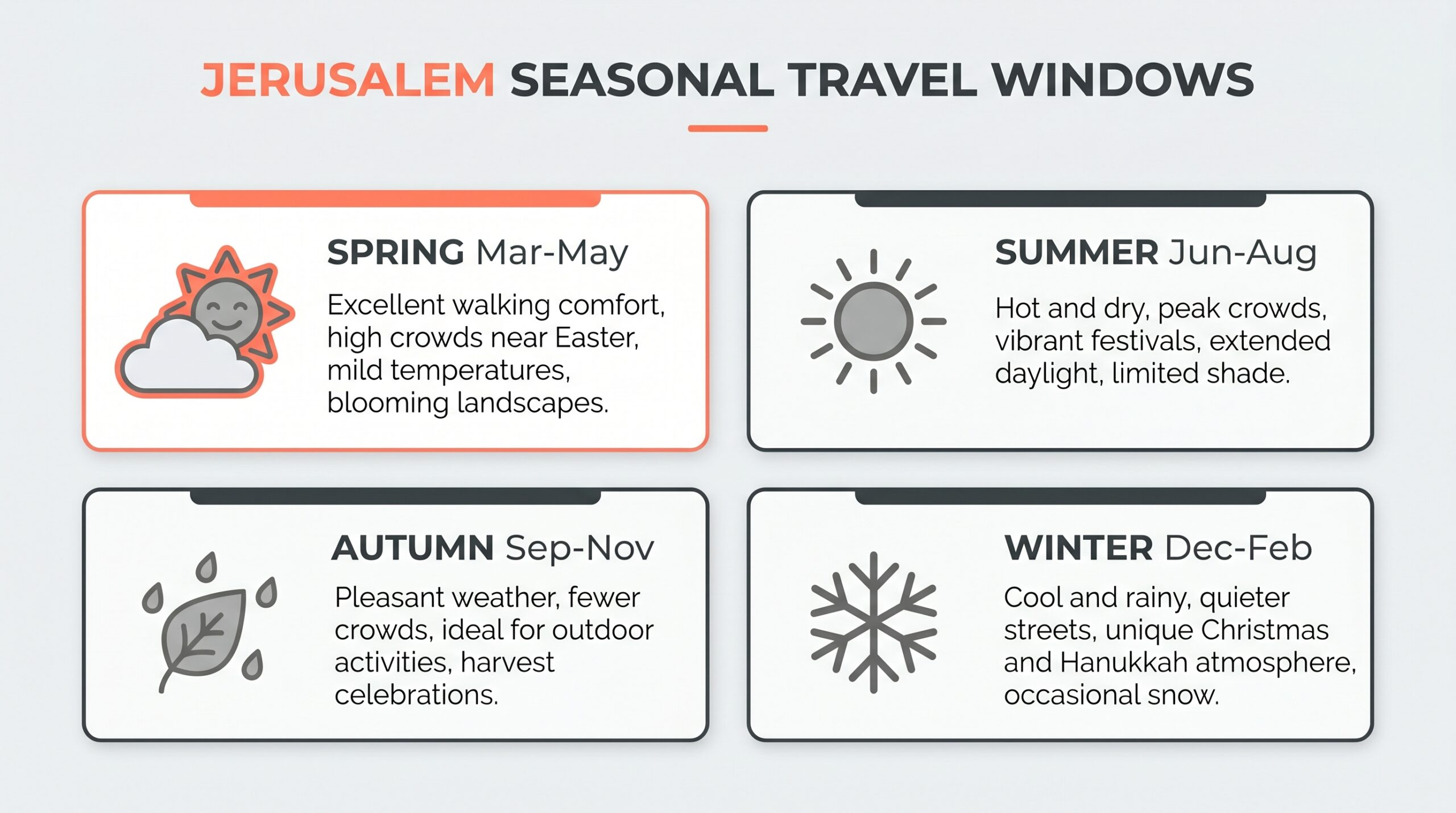
Jerusalem’s elevation and seasonal variation affect walking comfort and site access throughout the year.
Spring (March through May) and autumn (September through November) offer the most comfortable walking conditions. Those windows provide mild, dry weather suited to the pace that Jerusalem’s terrain requires. Summer brings dry heat and harsh midday sun. Winter brings genuine cold wind and regular rain – conditions that catch U.S. groups unprepared more often than any other seasonal factor.
Jerusalem sits at roughly 750 meters above sea level, and the Israel Meteorological Service documents how that altitude keeps the city cooler than the coastal plain while leaving it exposed to sharp winter temperature drops. January mornings in Jerusalem can approach freezing while Tel Aviv stays mild. When planning trips to Jerusalem, U.S. groups should also factor in the religious calendar – Easter and the Jewish autumn holiday cluster push both prices and crowds significantly, and accommodations for Holy Week should be secured at least six months in advance.
| Season | Walking Comfort | Crowds | Notes for U.S. Groups |
|---|---|---|---|
| Spring (Mar-May) | Excellent | High near Easter | Book 6 months ahead for Holy Week |
| Summer (Jun-Aug) | Difficult, hot | High | Start by 7 a.m., hydrate constantly |
| Autumn (Sep-Nov) | Excellent | Moderate | Watch the Jewish holiday cluster |
| Winter (Dec-Feb) | Fair | Low | Pack layers; expect rain and cold wind |
Private tour or group tour
A private Jerusalem tour gives a group flexibility, a narrative built around their specific interests, and the freedom to linger at one site without holding back forty other people. A scheduled group departure is more economical and follows a tested route. Both formats work, and they serve different types of travelers.
Families, corporate delegations, and church groups with a specific denominational agenda gain the most from private guiding. A budget-conscious solo traveler from the U.S. will often do better on a fixed departure. For those travelers, it is possible to join a tour in Israel on a curated schedule without commissioning a private guide for one person.
Who benefits most from private guiding
Denomination is one of the clearest reasons to choose private guiding. A Catholic parish group wants meaningful time at the Holy Sepulchre and along the Via Dolorosa stations, often with Mass arranged at a specific location along the route. An Evangelical or Baptist congregation more often prioritizes the Garden Tomb, with time set aside for extended Scripture reading. A Pentecostal ministry may want worship arranged at Gethsemane. An Anglican group may want a quiet liturgical service at one of Jerusalem’s historic churches. A private tour is the only format that can honor those differences without compromise, which is why every itinerary Talya Tours builds begins with a direct question about the denomination of the visiting group.
Planning a Jerusalem tour for your congregation?
Talya Tours builds every itinerary around the specific denomination of the visiting group – whether Protestant, Catholic, Evangelical, Baptist, Methodist, Lutheran, Presbyterian, Anglican, Orthodox, Pentecostal, or another tradition. Contact us to discuss your group’s dates, size, and theological priorities before you commit to anything.
How much a Jerusalem tour costs
Tour costs range from modest per-head rates on a shared group departure to premium private day rates that cover a dedicated vehicle, a licensed guide, and site entry fees. The final figure is driven by guide credentialing, vehicle specification, seasonal demand, group size, and the day of the week.
Pay attention to the auxiliary lines in any quote. Fuel, highway tolls, and language supplement fees often sit outside the headline price with some operators. Before signing anything for a Jerusalem tour or a longer Holy Land program, confirm whether the figure includes VAT, standard guide gratuity, and site admissions. On a multi-day cross-country trip with overnight stops, ask directly who covers the driver’s lodging. That single budget line has produced more billing surprises for American groups than any other item in the estimate.
What is included and what usually is not
Most operators include the licensed guide fee and the driving route. Entrance tickets, meals, driver gratuities, and hotel pickups are frequently treated as separate add-ons. The word that creates budget problems is “all-inclusive,” used loosely in a quote that describes something narrower in the detailed contract terms.
Before paying a deposit on any Jerusalem tour or multi-day program, get direct written answers on meals, drinking water, site admissions, driver accommodation on overnight routes, and any specialized security arrangement at sensitive locations. These are not small print items – they are the structure of the budget. Over more than 35 years of running tours for American groups, the unasked question has consistently been the expensive one.
What to wear and bring
Broken-in, non-slip walking shoes are the first priority. The marble at the Church of the Holy Sepulchre is centuries old and worn smooth – it is genuinely slippery, particularly in damp conditions. Add sun protection and modest, layered clothing, because Jerusalem’s holy sites enforce a dress code that surprises first-time visitors from the U.S.
The Western Wall Heritage Foundation asks visitors to dress respectfully, and the guidance from the Church of the Holy Sepulchre is applied firmly at the entrance – covered shoulders and knees for both men and women, enforced by the guardians at the door. Carry a refillable water bottle, small bills for market vendors, and a light layer for late-day temperature changes. In the Old City, the difference between a good day and a draining one is often decided by the shoes before the group takes its first step inside the walls.
Customizing for families, seniors, or accessibility needs
Meaningful customization for groups with mixed physical needs is possible, but it requires decisions made before arrival rather than on the morning of the tour. A Jerusalem plan can incorporate ramps where they exist, use vehicle drop-off points at accessible gate entrances, and adjust the pace deliberately. What it cannot do is rebuild the medieval alleys. The cobblestones and worn steps are part of the place and will not change.
For groups arriving by rail, the Jerusalem Yitzhak Navon station provides assistance for travelers with disabilities when arranged in advance. Before booking, ask the operator where the rest stops are, whether sensory breaks are built into the schedule, the physical grade of each walking path, and whether mobility aids fit in the assigned vehicle. A straightforward operator will answer all four questions without hesitation. For church groups with mixed physical needs, those four answers are the foundation of the plan.
Jerusalem tours for first-time visitors
First-time visitors benefit most from a Highlights itinerary that establishes the geography before it introduces the detail. A morning panorama from the Mount of Olives (Acts 1:9-12) gives the group a map of the city from above before they enter it. The Old City gates, the Western Wall, and the Church of the Holy Sepulchre follow in a sequence that builds understanding rather than testing endurance. Foundation first, cultural depth second – that order prevents exhaustion and prepares the group for any independent time that follows.
Most American church groups benefit from Jerusalem set inside the wider scriptural story, which is why our eight-day highlights tour links the city to Galilee and the Jordan River rather than treating it as a standalone destination. The best first Jerusalem tour teaches the map before the details, and the itinerary should always protect some unscheduled time – the quiet courtyard or unexpected view that no one planned for is usually what people from a first pilgrimage remember most clearly.
How to choose the right guide
Start with the license. Guides in Israel are certified through the Ministry of Tourism, and you can verify the credential standard through the official tour guide licensing service. An uncertified guide may know stories and local lore. He has not passed the formal training in history, site management, group safety, and professional conduct that the license requires.
After the credential comes the fit. A guide who matches the pace, curiosity, and spiritual seriousness of a church group changes the quality of the entire day. A licensed Jerusalem guide with the right temperament and denominational sensitivity is worth more to the experience than a famous itinerary with a mismatched guide. A serious operator will describe a guide’s specialization before you book – whether that is early church history for Catholic groups, Second Temple context for Evangelical and Baptist congregations, or liturgical site knowledge for Orthodox or Anglican visitors. The quality signals in a proposal are straightforward – organized itineraries, transparent fees, a contingency plan for weather or access changes, and responses that arrive promptly. That is how a reliable Jerusalem tour proposal reads.
Is it safe to take a Jerusalem tour
Jerusalem functions as a secure urban tourism city, and a structured tour adds a practical layer of safety because local guides monitor real-time conditions and manage the neighbourhood logic that a first-time visitor cannot. Professional operators maintain close contact with tourism networks and adjust routes when circumstances warrant it.
Every U.S. group traveling to Israel should check current travel advisories before departure. On the ground, the most common practical risk in Jerusalem’s crowded markets is ordinary pickpocketing – keep wallets in front pockets and bags closed. A guided Jerusalem tour with a licensed local operator is generally a calmer, more structured experience than going it alone, and the small frictions of navigating an unfamiliar urban environment are handled before they reach the group.
A good one-day itinerary
Begin with the panorama from the Mount of Olives. Move into the Old City for the late morning and early afternoon – the Western Wall, the Cardo, and the Church of the Holy Sepulchre in sequence. Break for lunch in the Armenian or Christian Quarter to minimize transit time and keep the walking distances manageable. Close the afternoon at the Machane Yehuda Market while it is active and the stalls are full.
Resist the urge to add a fifth stop. The best single-day Jerusalem plan holds a deliberate gap – time for an unexpected courtyard, a quiet moment at a site the group was not expecting, or simply sitting with what has already been seen. That gap is usually what American pilgrims carry home from Jerusalem, and a thoughtful itinerary protects it on purpose rather than filling it with another checkbox.
How to book and what to confirm first
Contact an established operator, then verify dates, group-size tier, guiding language, and cancellation terms before sending any deposit. Get the customized route, pickup points, and every included item confirmed in writing. A vague confirmation email at the booking stage is a warning sign, not a minor inconvenience.
What separates a denomination-aware Jerusalem tour from an off-the-shelf booking is how the itinerary is built before the group arrives. A Pentecostal ministry wanting extended worship time at Gethsemane, a United Methodist conference that values quiet theological context at each site, and an Assemblies of God congregation planning a baptism renewal at the Jordan River each receive a different sequence, different ceremony arrangements, and a different pace. Tourism is the only business we run, and every group is handled with direct personal attention from Talya. When American church groups return for a second or third pilgrimage, that direct relationship is consistently what they name as the reason.
If your church or congregation is beginning to plan a pilgrimage to Jerusalem and the wider Holy Land, Talya Tours is glad to talk through dates, sites, and the specifics of your tradition before you commit to anything. Reach Talya directly at [email protected] or through the Talya Tours contact page.
Frequently Asked Questions
How far in advance should an American church group book a Jerusalem tour?
For travel during Holy Week or the Jewish autumn holiday period, six months minimum is a practical rule. For travel in the autumn or in quieter spring windows, three to four months is often workable. The earlier you confirm, the more flexibility your operator has in building the itinerary around your denomination’s priorities and in securing the specific sites, arrangements, or worship locations that matter to your group.
Can Talya Tours arrange a private Mass or communion service during a Jerusalem tour?
Yes, and this is one of the specific reasons denomination matters to how an itinerary is built. For Catholic groups, Mass can be arranged at approved sites including specific altars within the Church of the Holy Sepulchre, subject to scheduling and prior coordination with the site authorities. For Protestant, Evangelical, and other traditions, communion or worship services at the Garden Tomb, Gethsemane, or other sites are coordinated in advance. Each arrangement requires lead time and direct communication between the tour operator and site authorities – it is not something that can be arranged on arrival.
Is a licensed guide required for a Jerusalem tour, or can a group go independently?
A licensed guide is not legally required for independent travel through Jerusalem’s public areas. What a licensed guide provides is interpretive depth that independent walking cannot replicate – the ability to connect what is physically in front of the group to the scriptural, historical, and denominational context that gives it meaning. For a congregation that has traveled from the United States specifically to walk through biblical history, losing that interpretive layer is a significant cost for a relatively modest savings. It is worth weighing carefully before the group decides to self-guide.
What is the minimum group size for a private Jerusalem tour with Talya Tours?
Private tours can be arranged for groups of various sizes, from small families and individual travelers to large congregations of 100 or more. The practical logistics – vehicle size, guide-to-participant ratio, and site access arrangements – scale accordingly. Contact Talya Tours directly with your group size and denomination to get an accurate picture of what a private itinerary would look like and what it would cost.
Do tour guides in Jerusalem speak English, and will they understand American denominational terminology?
Guides assigned to American groups are English-speaking, and qualified guides working with U.S. church groups have practical familiarity with the terminology and priorities across major American Christian denominations. A guide who regularly works with Baptist, Methodist, or Pentecostal groups from the U.S. understands the difference between what a Catholic pilgrimage group needs at a given site and what an Evangelical group would prioritize at the same location. That denominational literacy is part of what Talya Tours evaluates when matching a guide to a specific group.
What happens if a site we planned to visit is closed or inaccessible on the day of the tour?
Professional operators build contingency into the itinerary structure. Site closures in Jerusalem happen for religious observances, maintenance, and occasionally security reasons – all of which are knowable in advance or manageable on short notice with local knowledge. When Talya Tours builds your itinerary, alternative sites are identified in advance based on your denomination’s priorities, so that a closure at one location does not leave the group without a meaningful destination for that time slot.
Planning a Jerusalem tour well comes down to a handful of decisions made before any flights are booked – how many days to allocate, which denomination-specific sites and worship arrangements matter most, what the physical capabilities of the group require, and which season suits the travel style of the congregation. The city rewards groups that arrive with those questions answered. It is more generous with its depth when a guide can move at the right pace, linger at the right places, and connect what the group sees to the specific tradition they carry with them.
If your congregation is in the early stages of planning a pilgrimage to Jerusalem and the Holy Land, Talya Tours is ready to talk through the details specific to your group’s denomination, size, and budget. Every itinerary begins with a direct conversation. Reach Talya at [email protected] or use the contact page to start that conversation.
Request a Custom Jerusalem Itinerary
Tell us your denomination, group size, and preferred travel window. Talya will respond with a proposed itinerary built around your congregation’s specific tradition and priorities – no generic programs.
About the Author

Talya Felner
Owner and CEO, Talya Tours Services (TTS)
Talya Felner is the Owner and CEO of Talya Tours Services (TTS), a leading professional tour operator in Israel. With over 35 years of experience and more than 90,000 travelers served, Talya has built TTS into a trusted name for Christian pilgrimages, biblical tours, and conferences for American groups visiting Israel and the Holy Land. Her team designs each itinerary around the specific Christian denomination of the visiting group – whether Protestant, Catholic, Evangelical, Baptist, Methodist, Pentecostal, Lutheran, Presbyterian, Anglican, Orthodox, or another tradition – ensuring that sites, worship arrangements, and guides reflect what matters most to that congregation. From visas and accommodations to guides, transportation, and on-site coordination, TTS handles every detail so American pastors and group leaders can focus on the spiritual experience of their travelers.