
An agronomist from Iowa emails in January. He coordinates a study group of eleven growers and two extension agents, and he wants them standing inside a working desert greenhouse by April, not reading about one. He has a budget. He does not have a route. That kind of email is where most agriculture tours we organize begin. Israel agriculture tours are a distinct category of professional and educational travel, built around access to working farms, applied research stations, and agri-tech facilities that most visitors never reach without a well-connected regional operator handling the coordination.
Reading time: 5 minutes
Key Points
- Israel agriculture tours split into two fundamentally different programs – family-oriented farm experiences and professional or agri-tech delegation routes – and the itinerary should reflect which one you actually need.
- Specialist access to research stations and commercial operations requires advance coordination through an experienced regional operator, because most of these facilities are not open-gate visitor sites.
- Season controls what you can see. Harvest timing, weather conditions in the desert south, and crop cycles should shape the travel dates, not just the calendar.
- North and south Israel represent two different farming worlds. A strong itinerary connects the traditional mixed farming of the Galilee with the engineering-intensive desert agriculture of the Negev and Arava.
What is an Israel Agriculture Tour
An Israel agriculture tour is an organized, primarily educational route through the country’s working farms, research stations, and agri-tech facilities. Part of it is professional reconnaissance. Part of it is hands-on learning. Most American groups who book these programs come to understand one central thing – how a country with very little rainfall and a large share of arid land became a testing ground for sustainable food production that now influences farming practice on several continents.
The science behind what you will see is well documented and actively ongoing. Israel’s Agricultural Research Organization, the Volcani Institute, runs the core research on plant breeding, soil and water science, environmental management, and agricultural engineering. A well-planned tour explains the research context before you walk into the field, so the test plot makes sense when you are standing in front of it.
Access is the practical issue most American groups underestimate. Many research stations and commercial operations are not open-gate visitor sites. Getting a delegation inside specialized facilities rather than parked at a visitor desk requires advance coordination through an operator who has the existing relationships and understands how institutional scheduling in Israel works.
Who Is an Israel Agriculture Tour Best For
Two very different audiences book these tours, and the itinerary should not be the same for both.
Family-Friendly Farm Experiences
Families and American church groups traveling with children usually want to touch things. Picking fruit, a cheese-making workshop, watching a milking parlor run at full operation. A guided visit to a working family dairy like Dugma Dairy Farm in the western Galilee gives children a real operation to observe – not a petting zoo – with a tasting session at the end. These visits work well folded into broader touring programs that include biblical sites, because the agricultural land of the Galilee is also the land of scripture, and a church group can hold both in one day without losing the thread of either.
Professional and Agri-Tech Delegations
The other audience is technical. Agronomists, farming cooperatives, university programs, and investors who need B2B conversations, not photographs. These programs are built around direct sessions with regional specialists, academic researchers, and field engineers, and the questions in the room get specific fast. American coordinators planning a study trip for a U.S. cooperative or university department can review how technical group routing is typically structured by starting with professional tours in Israel to understand the framework before building a custom program.
How Much Does an Israel Agriculture Tour Cost
There is no single price, because a half-day farm stop and a ten-day professional delegation are not the same product. Cost tracks two things consistently – how many days, and how much specialist access the program requires.
Pricing Ranges by Tour Type
A single-day visit to one regional farm or visitor center sits at the lower end. Cost climbs with multi-day routes that connect several desert facilities, research and development stations, and academic institutions, because each of those requires individual coordination, a licensed guide with technical content fluency, and private transport across significant distances. For the south of the country in particular, the drive time between stops is real and needs to be built into a realistic daily schedule.
What Is Typically Included
For the programs we run for American groups, a quoted price typically covers a government-licensed English-speaking guide, private bus transport, entrance and arrangement fees at working farms and research stations, and the interactive tasting or demonstration sessions at each facility. Flights and personal spending are separate. We put the full inclusion list in writing before anyone commits, because surprises in this category are how itineraries go wrong mid-trip.
Planning an Agricultural Study Trip from the U.S.
Tell us your group’s professional focus, travel dates, and the type of facilities you want access to. We will build a program around what your delegation actually needs to see.
How Long Should an Agriculture Tour in Israel Be
Duration follows the goal. A visitor with one free afternoon should pick a single regional farm or a visitor center and do it properly. Trying to add a second site in the same afternoon usually means seeing neither one well.
A professional delegation is a different calculation. To move from the organic orchards and dairy farms of the north down through the dryland technology stations of the Negev and Arava, you need a route that runs roughly five to ten days. The country is geographically small, but the agricultural distance between a Galilee goat ranch and an Arava desert greenhouse represents the full range of Israeli farming, and the program needs time for the daily learning to settle. For a concrete timeline a group can react to, we share a sample program as a downloadable Israel Agriculture Tour overview.
What You Will See on an Israel Farm Tour
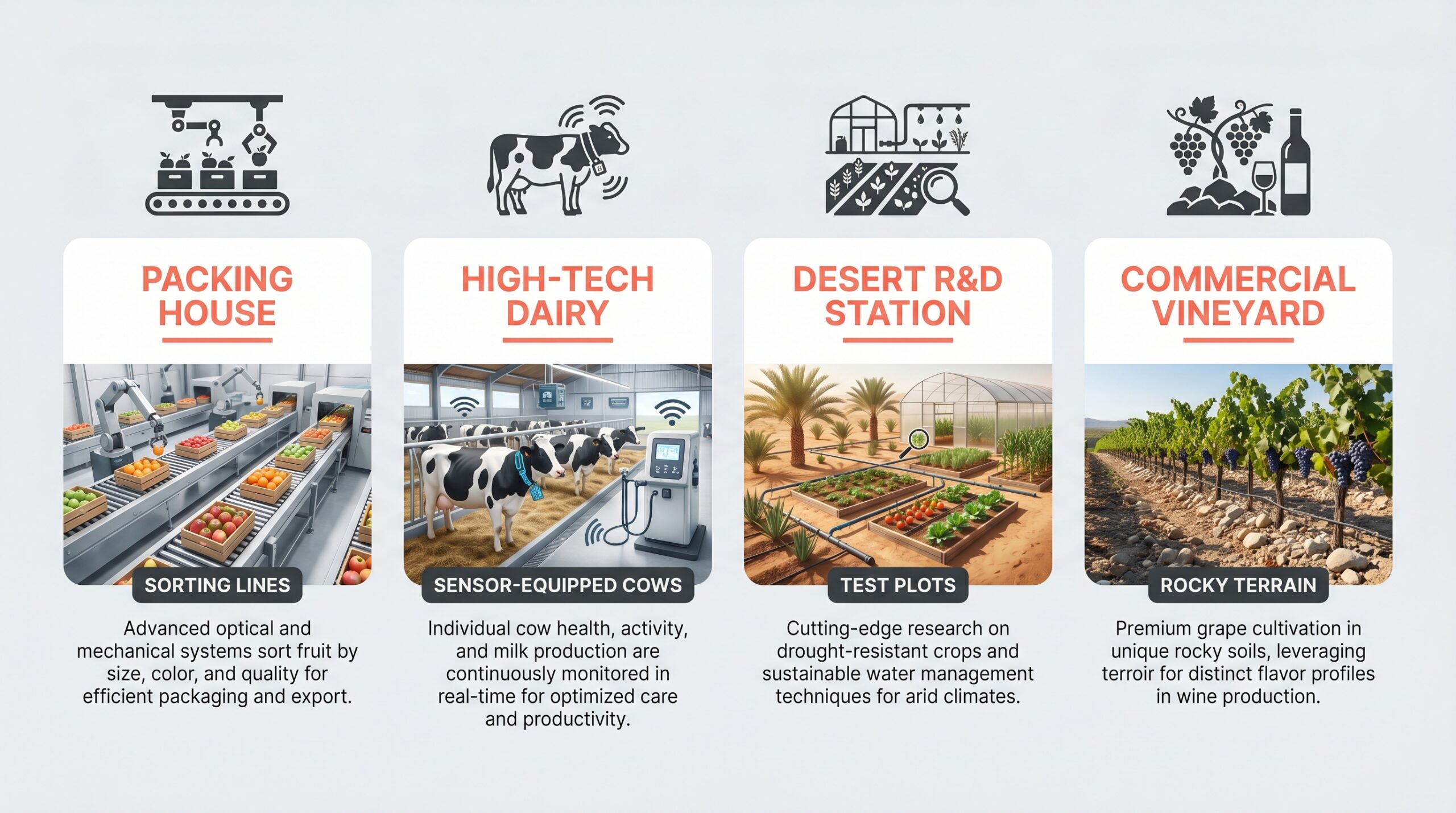
Working farm visits give professional delegations direct access to commercial operations and field-level expertise.
The working environments are the point. Packing houses with sorting and grading lines running at production speed. High-tech dairy setups where the cows wear sensor collars feeding live data into herd management systems. Vertical farming configurations stacked under controlled light spectrums. Commercial vineyards planted on terrain you would not expect to support them, producing fruit that reaches export markets.
On the research side, you see science in progress rather than finished products. Active test plots where breeders work on disease-resistant crop strains, and genetic conservation work that the Volcani Institute maintains as a living resource. A good guide gets the group to the plot while a researcher is still on site and willing to explain what is being measured and why it matters.
| Stop Type | What You Observe | Best For |
|---|---|---|
| Packing house | Grading, sorting, export logistics | Cooperatives, exporters |
| High-tech dairy | Automated milking, herd-data systems | Livestock professionals, families |
| Desert R&D station | Breeding trials, water use protocols | Agronomists, researchers |
| Commercial vineyard | Cultivation, tasting | General visitors, leisure groups |
Desert Agriculture and Greenhouse Projects in Israel
For most professional groups, this is the reason they came. Pulling premium export crops out of sand and brackish water is the headline of Israeli agriculture, and the south of the country is where you watch it happen at scale.
Dryland Farming Mechanics
In the Arava and Negev, growers work with brackish groundwater and precision nutrition systems to produce export-grade crops on terrain that looks agriculturally impossible at first sight. The Yair Station in the Arava runs the resilience research behind this work, in a climate defined by high solar radiation and sharp day-to-night temperature swings. The drip irrigation systems that made this form of agriculture viable are still evolving, and the conservation logic behind them is documented in research from Ben-Gurion University covering drip irrigation in arid zones.
Why Greenhouse Walkthroughs Matter
Greenhouse visits show the controlled side of the system. Thermal management, computerized insect control, and hydroponic configurations for leafy greens growing in conditions that would not sustain open-field crops. The Vidor Center in the Arava combines an orientation film, a seasonal walk through working display greenhouses, and an interactive space that connects the visitor experience directly back to the ongoing Yair research station work nearby.
Agritourism in Israel Versus an Agri-Tech Tour
Agritourism in Israel is the leisure side of farm travel. Rustic farm lodging, artisanal cheese, small organic wineries, and pick-your-own fields you walk into with a basket. The pace is deliberate and the purpose is enjoyment rather than data collection.
An agri-tech tour operates in a different register entirely. It centers on scientific advances, precision machinery, biological pest management, and the export and trade implications that follow from those developments. The Israeli government has formalized rural agritourism as a policy tool for rural development, framing it as a mechanism for revitalizing farming communities by turning working farmland into visitor activity, as detailed in the rural tourism support procedure. Knowing which category of trip your U.S. group actually needs saves everyone from booking a relaxed cheese-and-wine weekend when the delegation came to evaluate irrigation infrastructure.
Pick-Your-Own Fruit Visits on an Agriculture Tour
U-pick is one of the most popular interactive stops for recreational American groups, and it works well when the timing aligns with what is actually ready in the field.
Choosing the Right Farm and Season
The crop decides the calendar. Golan Heights cherries peak in early summer. Red raspberries, micro-vegetables, and greenhouse strawberries extend the picking season across other months. A farm that is full of ready fruit in May can be bare in August, so the field choice follows the harvest rather than the convenience of the travel date. This is a practical constraint that shapes itinerary planning for any American group building agriculture stops into a broader Israel program.
Pre-Arrival Checks That Matter
Before a bus goes an hour into the countryside, three things need to be confirmed directly with the farm: that the crop is actually ready that specific week, that the entry slot is reserved for the group, and that the field is accessible for children if families are traveling. We make those calls for the American groups we coordinate, because a closed gate at a remote field costs a half day that cannot be recovered.
Best Season for Agriculture Tours in Israel
Season is not a preference here. It controls what you can see and how manageable the field walks are. Treating it as a secondary planning consideration is one of the more consistent planning errors U.S. group leaders make when arranging their first agriculture trip.
Seasonality of Harvests
Autumn brings the olive pressings. Late winter is citrus picking. Late spring is when the grapevines flower and the northern orchards shift into activity. Build the itinerary around what is actually happening in the ground that month, and the trip teaches itself without needing additional programmatic padding.
Weather Realities in the Field
For outdoor field work, the window from October through April is the practical one for most American groups – pleasant temperatures, manageable sun intensity, and full access across all farm regions. The deep summer heat in the Negev and Arava is not something to schedule a long greenhouse walkthrough into. We have adjusted more than one delegation’s dates by a few weeks for exactly this reason, and the practical improvement in what the group could actually do in the field each day made the date change worth it.
Which Regions Are Best for an Israel Agriculture Tour
North and south are two different farming worlds, and most strong itineraries find a way to connect them, because the contrast between them is itself a significant part of what American professional groups come to understand.
In the north, across the Galilee and the Golan Heights, you find traditional olive farming, sustainable organic goat ranches, intensive fruit orchards, and a landscape that American church groups often recognize from scripture. A farm like The Rom Farm in the western Galilee shows the hands-in-the-soil, close-to-the-land side of Israeli agriculture that predates modern agri-tech by centuries.
The south tells the engineering story. In the Negev and Arava, groups see cutting-edge desert greenhouses, interactive research visitor centers like the Vidor Center, and brackish-water aquaculture projects that, by most agricultural intuition, should not be producing at the level they do.
| Region | Signature Agriculture | Visitor Draw |
|---|---|---|
| Galilee & Golan (north) | Olives, fruit orchards, organic goat ranches | Traditional, hands-on, family-friendly |
| Negev & Arava (south) | Desert greenhouses, brackish-water aquaculture | Agri-tech, research, professional delegations |
Customizing an Israel Agriculture Tour to Your Group’s Focus
This is where most of the planning work goes. A delegation focused on organic cultivation, one centered on dairy management systems, one on precision irrigation engineering, and one on commercial food security policy should not share an itinerary simply because they are all traveling to the same country. They share a destination, not a purpose or a route.
Specialized routing is what turns a study trip into a return on the travel budget. When the bus only stops where the group’s actual expertise lies, the conversations at each facility go deeper and the days feel more productive. American groups looking for a starting point can browse our pre-designed agriculture tours in Israel and indicate what they would change. That conversation is where the real program gets built.
What to Wear and Bring on a Farm Tour in Israel
Field days are working days, and dressing for them changes what the group can do and how long they can stay out in the environment comfortably.
The practical essentials are straightforward. High-traction closed shoes for uneven ground and packing-house floors. A moisture-wicking sun shirt for extended time outdoors. UV-protective eyewear and a wide-brim hat for the south particularly, where the sun angle and reflective terrain intensify exposure. A durable water flask you actually refill throughout the day, not just carry. The desert sun in the Arava is not negotiable, and a group that planned for it physically stays in the field longer, asks more questions, and absorbs more of what they came to learn.
Frequently Asked Questions
Israel agriculture tours work when the itinerary matches the group’s actual purpose – whether that is a family-oriented farm visit in the Galilee, a technical delegation touring desert greenhouse operations in the Arava, or a U.S. church group combining a biblical pilgrimage with a hands-on look at the land described in scripture. The season, the region, and the type of facility access all shape what is possible, and those decisions are worth working through carefully before travel dates are fixed. Getting those foundational choices right is what separates a productive trip from a well-traveled one.
If your U.S. group is beginning to map out an agricultural study trip or a professional delegation to Israel, we are glad to work through dates, harvest timing, facility access, and routing before you commit to anything. Reach Talya directly at [email protected] or through the contact page.
Build Your Israel Agriculture Tour Program
Whether your American group needs a leisure farm visit, a full professional delegation route, or something in between, we build the program around your specific objectives. Browse pre-designed agriculture tours or contact us to start from your group’s actual needs.
About the Author

Talya Felner
Owner and CEO, Talya Tours Services (TTS)
Talya Felner is the Owner and CEO of Talya Tours Services (TTS), a leading professional tour operator in Israel. With over 35 years of experience and more than 90,000 travelers served, Talya has built TTS into a trusted name for Christian pilgrimages, biblical tours, and professional programs for American groups visiting Israel and the Holy Land. Her team designs each itinerary around the specific Christian denomination of the visiting group – whether Protestant, Catholic, Evangelical, Baptist, Methodist, Pentecostal, Lutheran, Presbyterian, Anglican, Orthodox, or another tradition – ensuring that sites, worship arrangements, and guides reflect what matters most to that congregation. From visas and accommodations to guides, transportation, and on-site coordination, TTS handles every detail so American pastors and group leaders can focus on the spiritual experience of their travelers.