
A pastor in Charlotte calls us in February. His group is twenty-two people, three of them over seventy, two of them traveling with grandchildren, and one in a wheelchair. He wants Galilee, Jerusalem, and a baptism renewal at the Jordan. He also wants everyone back at the hotel by four o’clock most afternoons, because his older travelers fade after lunch. A standard group bus tour cannot do this. A private tour can. This article walks through how Israel private tours work, what they cost, what moves the price, and how to build one that actually fits your group’s size, denomination, and travel pace.
Reading time: 6 minutes
Key Points
- A private Israel tour means one licensed guide, one dedicated vehicle, and an itinerary built from scratch around your specific group – not a premium version of a bus package.
- Every itinerary Talya Tours builds is shaped by the denomination of the visiting group, whether Evangelical, Catholic, Baptist, Methodist, Pentecostal, Lutheran, Anglican, Orthodox, or another tradition.
- For groups of four to eight people, private tours often cost less per person than a comparable packaged group tour once you account for shared guide and vehicle costs.
- Before any deposit, confirm guide hours, entrance fees, parking, driver lodging, and weekend support in writing – these are the most common sources of late surprises.
What an Israel private tour really means, and who it is for
A private tour means one guide, one vehicle, and a schedule that belongs entirely to your group.
When American travelers search for Israel private tours, most picture a fancier version of a group bus. It is not that. A private tour means three things working together: a personal licensed guide assigned to your group alone, a dedicated vehicle that goes where you go, and an itinerary built from scratch around your exact group size, interests, faith tradition, and walking ability.
The travelers who benefit most are the ones a fixed group tour serves worst. Multi-generational American families with grandparents and small children. Pilgrimage groups from a single U.S. congregation who want their own pastor leading devotions at each site. Busy professionals who have eight days and no patience for waiting on a stranger who is late to the bus. Couples on their first visit. And travelers with accessibility or dietary requirements that a bus of forty cannot accommodate.
The practical payoff is straightforward. You stop managing logistics. Someone else handles parking, entrance timing, and the route, and you spend your attention on the place you came to see.
Why a guide beats a rental car in Israel, every time
Israel is small on a map and dense in reality. The layers of history, faith, and current geography sit on top of each other, and a self-drive trip strips most of that away. With private guided tours in Israel, you get a licensed local who can stand you at Caesarea (Acts 10:1-8) and explain why Peter’s vision there changed the early church – in a way no app or printed guidebook will.
A guide also buys back hours. Experienced operators know which sites open early, which fill by ten in the morning, and which back roads skip the worst traffic on the way down to the Dead Sea. Over 35 years of organizing tours for American groups, the consistent finding is that the difference between a good guide and no guide is often a full extra site visited per day.
And then there is flexibility. If the morning runs long at the Garden Tomb because your U.S. congregation wants to linger for prayer and reflection, the afternoon shifts. Weather turns, energy drops, someone falls in love with one quiet chapel. The schedule moves with you. A fixed bus cannot do that.
How to choose a private tour that fits your group exactly
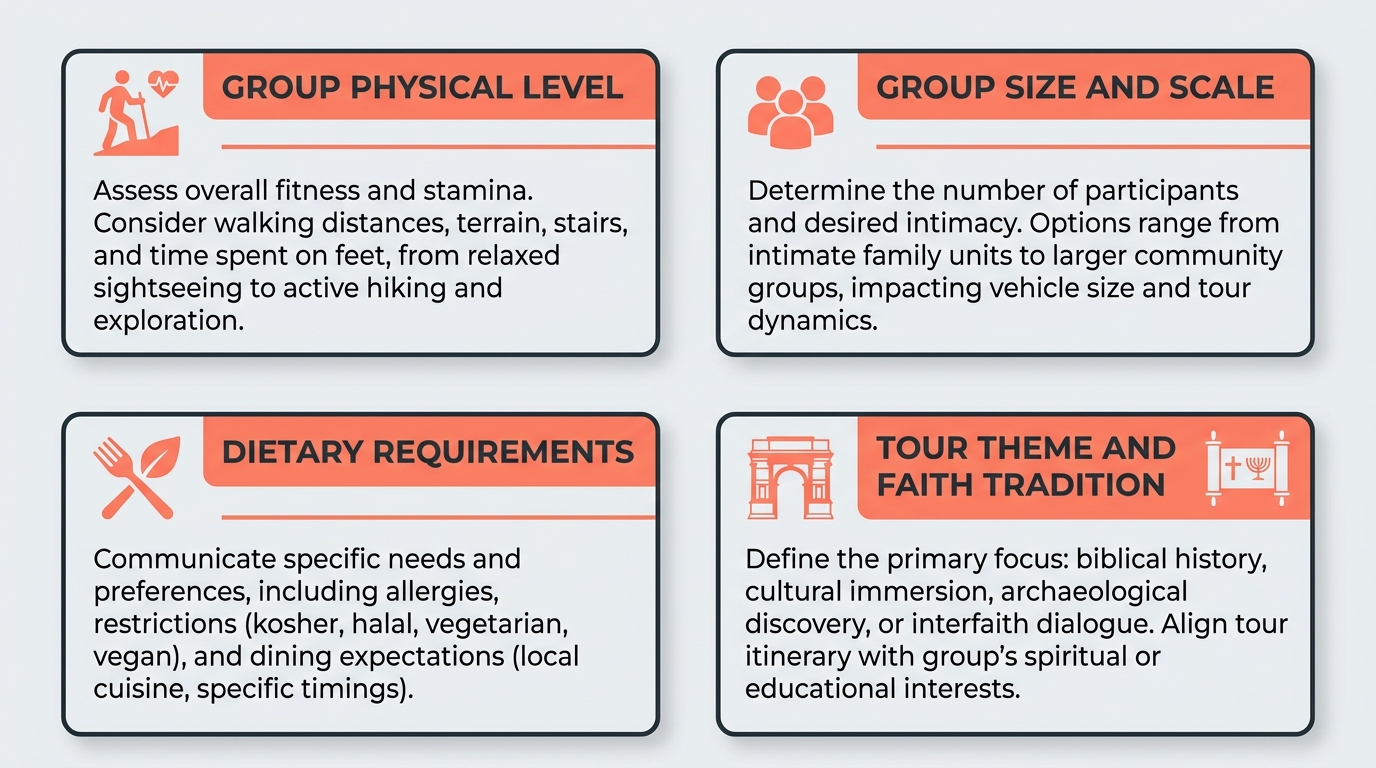
Before booking any Israel private tour, run through a short, honest checklist with your group. How much real historical curiosity is there, and how much will be lost on people who just want the famous sites? What is the physical limit of your slowest walker? Are there dietary needs – kosher-style meals, vegetarian options, known allergies? With children, how much spacing does the day need before the youngest runs out of patience?
Then decide on scale. A private tour can be a single-day excursion out of Tel Aviv or Jerusalem, or a comprehensive eight to twelve day program covering the whole country.
Last, align on theme and denomination. Some American groups care about biblical history above all else. Others want heritage, culinary arts, or agricultural study. For congregations planning a spiritual journey, Christian tours in Israel can be customized to cover key biblical sites in Galilee and Jerusalem at your own pace. This is also where denomination matters deeply. A Catholic parish, an Evangelical congregation, a Pentecostal ministry, and a Lutheran church do not want the same itinerary – and a serious tour operator does not give them one.
What to ask before you sign with any operator
A good planning call should feel like an interview, and you should be the one asking. First question: who is my actual guide, and what is their specialty? Some guides are stronger on Old Testament archaeology, others on New Testament sites, others on modern Israel’s political and social history. You want the right match for your group’s tradition, not just any badge.
Ask about flexibility and the cancellation policy if your inbound flight from the U.S. changes – because transatlantic flights do shift. Ask about vehicle size and comfort, and whether it has air conditioning and WiFi. Ask how the day adjusts if your group moves more slowly than planned.
At Talya Tours, the planning conversation starts with two questions of our own: what tradition does your group belong to, and what does your pastor want the congregation to walk away with? That conversation shapes every site selection, every worship arrangement, and every guide assignment that follows.
Planning a private pilgrimage or group tour for your American congregation? Talya Tours builds every itinerary around your denomination and your group’s specific goals – from site selection and worship arrangements to transportation, accommodations, and on-site support.
What Israel private tours cost, and what moves the price
Pricing for Israel private tours is driven by a handful of real factors. Guide rates per day. Vehicle type and fuel, since a sedan for two costs far less to run than a minibus for twelve. Driver hours, especially on long Dead Sea and Galilee days. Entry fees to national parks and holy sites. And seasonal surge pricing around Easter, Passover, and the autumn holidays.
Here is the part that surprises many American travelers. For a family or small group of four to eight people, custom private tours of Israel often come out cost-effective rather than expensive. When you split one guide and one vehicle across six people, the per-person figure drops sharply – and you skip the individual ticketing and shuttle markups that a large group package adds on top.
One firm piece of advice: insist on an itemized quote. You want each line visible, so there are no surprises mid-trip.
| Group size | Shared cost basis | Per-person trend |
|---|---|---|
| Couple (2) | 1 guide, 1 sedan | Highest per person |
| Family (4-6) | 1 guide, 1 van | Drops sharply |
| Small group (7-8) | 1 guide, 1 minibus | Most efficient per person |
Daily guiding fee or full package – which structure fits you
There are two common ways to book private tours of Israel, and they suit different types of American travelers. The first is a flat daily guiding fee. You pay the guide and driver per day, and you cover hotels, meals, and entrance tickets yourself as you go.
The second is an all-inclusive package – half-board or full-board – where accommodation, most meals, transport, and guiding are bundled into one figure.
The daily fee gives flexible travelers more control. The package removes daily decisions, which matters most for larger groups or complex multi-region itineraries where you do not want a pastor handling restaurant bills for forty people every evening. Most American church groups we work with prefer the package structure for exactly that reason.
What a private Israel tour package usually includes
A typical private Israel tour package quote covers a clear baseline: a security-licensed driver, a government-licensed guide, custom itinerary design, air-conditioned transport, hotel pickups, and the administrative support to hold it all together. For Christian groups, baptism and communion arrangements at the appropriate biblical sites, and Jerusalem Pilgrim certificates, are coordinated within the same service.
Check the exclusions carefully. Tips for guides and drivers, lunch, and personal travel insurance are commonly left out of the base figure, so confirm them before you compare two quotes side by side.
A structured option such as an Evangelical tour of 8 days will typically include all ground logistics, hotel accommodation arrangements, and daily guiding service. From that base, an Evangelical group might emphasize the Garden Tomb, Yardenit on the Jordan River, the Mount of Beatitudes (Matthew 5:1-16), and Capernaum (Mark 1:21-35). A Catholic parish on the same dates would weight the Church of the Holy Sepulchre, the Basilica of the Annunciation, and the Via Dolorosa – with arrangements made for Mass at the appropriate sites. A Methodist or Presbyterian group may place greater emphasis on the prophetic landscapes of the Judean wilderness and the scriptural geography of the Galilee region. Same country, meaningfully different trips.
A short checklist before you pay a deposit
Before any deposit on a private tour, get these confirmed in writing. Driver and guide hours per day, so you know when overtime begins. Highway tolls on Route 6. Parking fees at busy sites. Driver and guide lodging if you stay overnight away from their base – in Galilee, for instance. National park admissions, which add up meaningfully across a full week. And weekend and emergency support, because something always comes up, usually on a Saturday.
If a quote is silent on any of these, that silence is the surprise charge waiting to happen.
Do guides in Israel have to be licensed?
Yes, and this is not a small detail for anyone booking Israel private tours. Guiding in Israel is a regulated profession governed by the Ministry of Tourism. A guide does not simply read a few books and start working. They pass a rigorous, multi-year training course covering history, archaeology, geography, and emergency procedures, and they renew the license periodically.
The official rules and renewal requirements are published by the Ministry of Tourism, and you can read them on the tour guide licence page. Partnering with licensed operators is what guarantees American groups a professional, safe, and accountable itinerary rather than an enthusiastic amateur.
How to verify a guide’s license in two minutes
Every Ministry of Tourism guide carries a physical badge with their photo, license number, and the languages they are certified to work in. You are entitled to ask to see it, and any professional guide expects the question.
You can also confirm a guide independently before you travel. The Ministry maintains a public database of registered tour guides where you check a name or license number against the official record. For any private tour, this is a thirty-second step that removes all doubt before your group boards a flight from the U.S.
Private tour versus the big-bus group tour
The honest comparison between private tours of Israel and a large commercial group tour comes down to control. One bends to you. The other does not.
| Parameter | Private tour | Big-bus group tour |
|---|---|---|
| Schedule changes | Fully fluid, day by day | Rigid, fixed in advance |
| Start times | You decide | Early and sharp, no waiting |
| Crowds | Guide times sites to dodge peaks | You arrive when the bus arrives |
| Routing | Custom to your denomination and interests | Standard loop for everyone |
| Questions | Personal, unlimited | Shared across forty people |
For a faith group especially, the difference is felt most at the sites that matter most – where forty strangers and a tight clock can flatten the moment your congregation came for.
A sensible 7-day private route through Israel
Here is a balanced seven-day flow used often for private guided tours in Israel, adjusted constantly to the group in front of us. Day 1 covers the coastal plain, with Caesarea (Acts 10:1-8) and a gentle landing after the long flight from the U.S. Days 2 and 3 move to Galilee and the Golan, with the Sea of Galilee, Tabgha (John 6:1-15), Capernaum (Mark 1:21-35), and the Mount of Beatitudes (Matthew 5:1-16). Days 4 and 5 are Jerusalem, old city and new. Day 6 covers the Judean Desert and the Dead Sea. Day 7 brings the group to Jaffa and the airport.
The specific sites within each day shift by denomination. A Pentecostal group visiting Galilee will spend time differently at the Sea than a Presbyterian group will. A Baptist congregation arriving at the Jordan River is there for something personally and theologically specific. An Anglican group in Jerusalem will want time at sites their tradition has long held sacred, alongside the broader pilgrimage sites that all Christian visitors share. The seven-day frame is a container; the content inside it is always built around your group.
| Day | Region | Anchor sites |
|---|---|---|
| 1 | Coastal plain | Caesarea (Acts 10:1-8) |
| 2-3 | Galilee and Golan | Tabgha (John 6:1-15), Capernaum (Mark 1:21-35), Mount of Beatitudes (Matthew 5:1-16) |
| 4-5 | Jerusalem | Old and New City |
| 6 | Judean Desert and Dead Sea | Masada, Dead Sea |
| 7 | Coast | Jaffa, airport departure |
How many days to actually see Israel
The honest answer depends on how much your group wants to absorb, but the brackets are clear. Five days covers the highlights – Jerusalem, the Dead Sea, and a taste of Galilee. Eight to ten days is the classic detailed itinerary, adding the Golan Heights and the historic coastal towns. Twelve days and up lets you go deep into the Negev desert and down to Eilat.
Here is the part that surprises many American visitors. A well-run private trip sees in seven days what a big bus tour covers in ten to twelve, because you lose almost no time to logistics. No waiting on forty bags. No counting heads before every departure. Private tours compress the calendar by cutting the dead hours.
When to book a private Israel tour package
Israel runs on real seasons, and they drive both price and comfort. Spring and autumn around the major holidays are peak periods, with the best weather and the highest demand. Summers on the Mediterranean coast are hot, while the Galilee hills stay more manageable. Winters are mild but wetter, and the climate genuinely shifts by region – from coast to mountains to desert – as the Israel Meteorological Service maps in its climate zone data.
For peak windows like Easter, Passover, and the autumn holidays, book your leading guides four to six months out. The best licensed guides are allocated first, and American church groups planning around Easter in particular should treat the guide booking as the first fixed point in their planning calendar, not the last.
If your group has an interest in specialized visits tied to Israeli agriculture and land use – which is a growing area of interest for some American denominations exploring the biblical relationship between faith and farming – securing agriculture guided tours in Israel during early winter or spring is worth planning around, since the relevant harvest windows are narrow.
Are private tours right for families with children?
They are, and families are where private Israel tours outperform group buses by the widest margin. The challenge is keeping children genuinely engaged. That means swapping dry historical lectures for stories, interactive excavations, scavenger hunts at the national parks, and trails kids can actually run on rather than file along in silence.
The dedicated driver and vehicle is the quiet hero here. A child needs a snack, a bathroom break, a nap, or an unscheduled stop, and the day simply bends. No forty strangers waiting and sighing while you sort it out.
At Talya Tours, family routes and daily pacing are built deliberately to avoid over-tiring the youngest traveler, because a worn-out six-year-old at two in the afternoon ends the meaningful part of the day for the whole family.
How to build a family day that does not end in exhaustion
The pacing formula that holds up on family private tours is simple and worth following. Plan one major historical site in the morning, while everyone is fresh. Take a relaxed, sit-down lunch with real food and real rest, not a rushed snack on the move. Then give the afternoon to sensory activity – rafting on the Jordan, walking the water tunnels at a spring, or a hands-on workshop in one of the agricultural sites.
One serious site, one good meal, one active experience. That rhythm carries children through a full week without reaching breaking point by Wednesday.
Can Israel private tours be fully accessible?
They can, and accessibility planning is one of the strongest reasons to go private. Israel has made real step-free progress at major historic reserves and modern facilities, though old-world city centers like parts of the Old City of Jerusalem still require careful route mapping in advance.
A customized private itinerary makes it possible to coordinate wheelchair-accessible transport, ramps, and accessible trailheads ahead of time – rather than discovering an unexpected staircase on the day. Those details are confirmed in advance with the relevant park authorities. The Israel Nature and Parks Authority publishes detailed guidance on its accessibility page, which informs route planning for travelers with mobility needs.
For the Charlotte pastor mentioned at the start, this kind of pre-trip coordination was exactly what made the wheelchair traveler’s week in Israel fully possible – not a compromise, but a full experience.
Israel private tours give American groups and families the thing a bus tour cannot provide – a schedule that belongs to your group, a guide matched to your tradition, and an itinerary shaped from the start around what your congregation actually came to experience. The difference between a private tour and a fixed group package is not a matter of comfort or luxury; it is a matter of whether the trip reflects your group’s denomination, pace, and purpose, or someone else’s.
If your American congregation or family is in the early stages of planning, the most useful next step is a direct conversation about dates, group size, denomination, and what your pastor or group leader wants people to carry home from the trip. Talya Tours has been doing exactly this work for American groups for over 35 years, and that conversation costs nothing.
Ready to plan a private tour for your congregation or family? Contact Talya directly to discuss your denomination, travel dates, group size, and what you want the trip to accomplish. Every itinerary is built from scratch around your specific group.
Start Planning Your Private Tour
Or email Talya directly at [email protected]
About the Author

Talya Felner
Owner and CEO, Talya Tours Services (TTS)
Talya Felner is the Owner and CEO of Talya Tours Services (TTS), a leading professional tour operator in Israel. With over 35 years of experience and more than 90,000 travelers served, Talya has built TTS into a trusted name for Christian pilgrimages, biblical tours, and conferences for American groups visiting Israel and the Holy Land. Her team designs each itinerary around the specific Christian denomination of the visiting group – whether Protestant, Catholic, Evangelical, Baptist, Methodist, Pentecostal, Lutheran, Presbyterian, Anglican, Orthodox, or another tradition – ensuring that sites, worship arrangements, and guides reflect what matters most to that congregation. From visas and accommodations to guides, transportation, and on-site coordination, TTS handles every detail so American pastors and group leaders can focus on the spiritual experience of their travelers.