Planning a Catholic pilgrimage to the Holy Land requires a different kind of preparation than booking a sightseeing vacation. The logistics of moving a parish group between Galilee and Jerusalem are real and specific, and the spiritual dimension – Mass at the shrines, the Sacraments on the road, the sequence of sites that follows the liturgical calendar your group lives by – cannot be added on afterward. This article walks through what Catholic tours of the Holy Land actually involve, how itineraries are built around your parish’s needs rather than a generic program, and what American group leaders need to know before they begin planning.
Reading time: 9 minutes
Key Points
- A Catholic pilgrimage itinerary is built around the Sacraments, the shrines, and the liturgical rhythm of your specific parish – not a one-size-fits-all program used for every Christian group.
- Altar reservations at major shrines such as the Church of the Holy Sepulchre must be secured months in advance through the Franciscan Custody – this is not a detail that can wait until the trip is close.
- Ten days is the most practical length for most American Catholic parishes, providing enough time to cover Galilee, Bethlehem, and Jerusalem without sacrificing reflection.
- Four variables move the cost significantly – season, group size, hotel tier, and whether flights from the U.S. are included – and each is worth understanding before requesting a proposal.
Table of Contents
- What Catholic Tours of the Holy Land Actually Are
- How a Catholic Tour Differs from a Standard Sightseeing Trip
- Pilgrimage vs. Vacation: The Practical Difference
- How Long Your Pilgrimage Should Be
- A Realistic 10-Day Itinerary Framework
- The Holy Places at the Center of a Catholic Pilgrimage
- What Catholic Holy Land Tours Cost
- What Is Included and What Is Out of Pocket
- Best Season to Book
- Safety and Current Travel Conditions
- Traveling with a Priest or Spiritual Leader
- How Daily Mass and Shrine Liturgies Work in Practice
- What to Pack
- Spiritual Preparation Before You Depart
- Accommodating Senior Travelers and Limited Mobility
- How Custom Group Bookings Work for Parishes
- Supporting Local Christian Communities
- Passport and Visa Requirements for U.S. Travelers
- Why Travel Insurance Matters for a Parish Trip
- How to Begin Planning with Talya Tours
What Catholic Tours of the Holy Land Actually Are
A Catholic tour of the Holy Land is a faith-based travel program built specifically for Roman Catholics walking the land of the Gospels. It joins two things that rarely meet in ordinary travel – the logistics of getting 40 people fed, housed, and moved between sites, and the spiritual life of a parish on the road.
The structure side is real work. Accommodation, half-board dining, licensed buses, site admissions, and timing between the Galilee and Jerusalem all have to fit together. The spiritual side is the point of it. These trips follow the life, teachings, and Resurrection of Jesus Christ as the New Testament records them, at the physical places where the events happened. As a local operator based in Ramat Gan, the job at Talya Tours is to make those biblical stories land in front of your group at the right hour, in the right sequence, with a priest free to celebrate Mass when you reach the shrine.
This is also where the distinction between a Catholic itinerary and a generic Christian tour becomes important. The program built for a Catholic parish group is structured around the Sacraments, the Marian shrines, the Stations of the Cross, and the liturgical priorities of your congregation. It is not the same itinerary used for a Baptist congregation or a Pentecostal ministry visiting the same country. Different traditions have different theological anchors, different worship needs, and different sites that carry the most meaning. Every program Talya Tours builds reflects the denomination of the group traveling.
How a Catholic Tour Differs from a Standard Sightseeing Trip
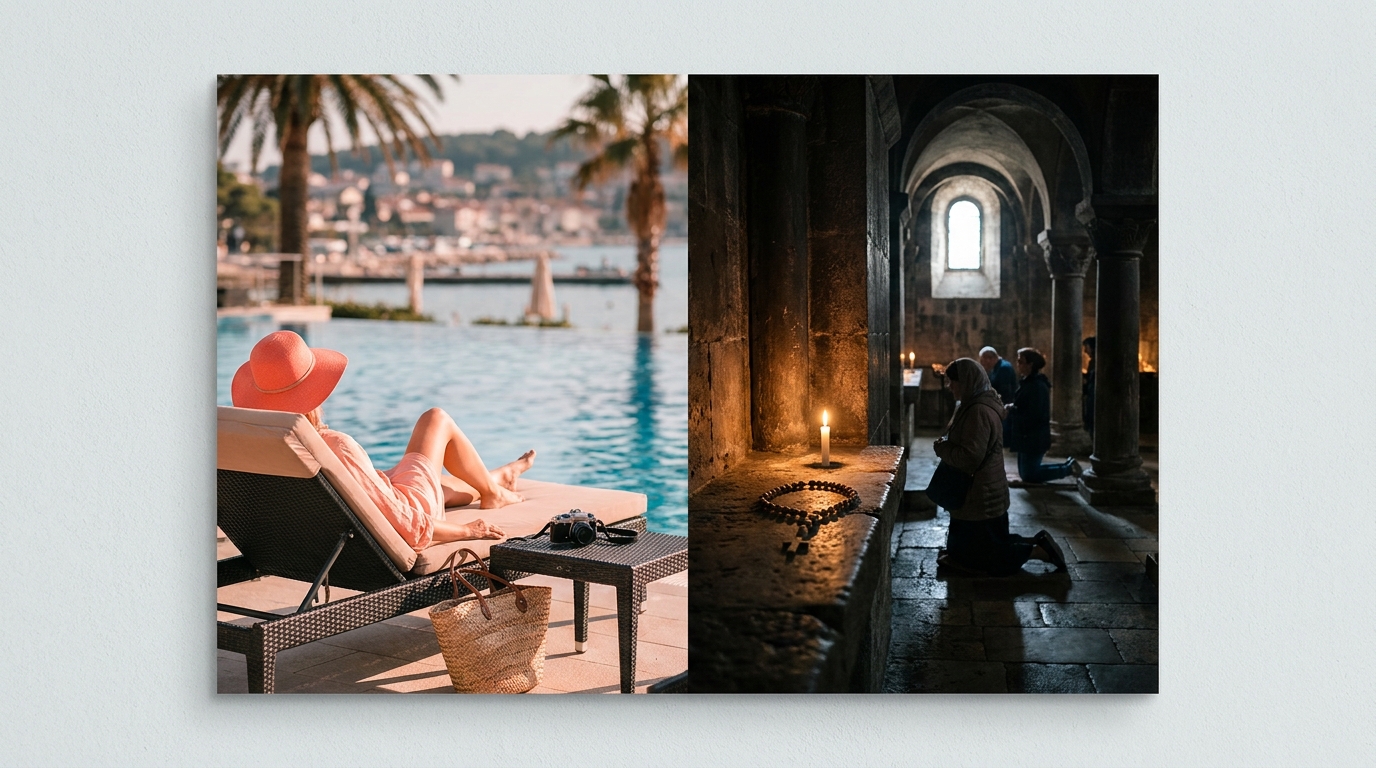
A Catholic pilgrimage follows the life of Jesus at the places where it happened – not as historical tourism, but as an act of faith.
A standard sightseeing trip treats Capernaum (Mark 1:21-35) as an archaeological site with old basalt walls and a fifth-century octagon. A Catholic tour treats it as the town where Jesus made His home, and reads the Gospel there before the group moves on.
The general tour gives you history and a little regional context. The Catholic itinerary weaves in daily prayer, Scripture read at the very spot it describes, and dedicated spiritual guidance from your accompanying clergy. There is also something quieter that travelers report afterward. Moving through these places alongside fellow believers, people from your own parish, builds a sense of community that a mixed coach of strangers never produces. You pray together at Tabgha and you come home knowing each other differently.
The practical difference shows up in how a day is scheduled. A sightseeing group arrives at the Church of the Annunciation in Nazareth, follows a guide for twenty minutes, and boards the bus. A Catholic parish group arrives, celebrates Mass at the altar if the reservation was secured in advance, pauses for reflection in the garden, and then moves on. That sequence takes more time. It requires coordination with the Franciscan Custody weeks beforehand. It is the reason building a Catholic itinerary is different work than building a general tour program.
Pilgrimage vs. Vacation: The Practical Difference
A vacation is for rest. A pilgrimage is an act of devotion, penance, and the deliberate pursuit of closeness to God in the places He chose to enter human history.
The contrast is easy to feel on the ground. A vacation has an unhurried afternoon and a pool deck. A pilgrimage has reflective silence on the bus down the Jordan Valley, the Sacrament of Reconciliation arranged before you reach the Holy Sepulchre, and devotions at the shrines that most tourists pass in fifteen minutes. People still laugh, still eat well, still enjoy the Dead Sea float on an afternoon when the schedule allows it. But the spine of the trip is spiritual, and that changes how each day is built from the first morning to the last.
Parish leaders planning a pilgrimage for their congregation often describe a shift in their group by day four or five. The travel fatigue has passed, the setting has become familiar, and something more personal begins to happen for individual members of the group. That shift is what the trip is designed for. Getting the logistics right – transfers, timing, accommodation – is the foundation that makes the spiritual experience possible.
How Long Your Pilgrimage Should Be
The honest answer depends on your schedule, your budget, and the stamina of your group. Most American Catholic parishes land on 8, 10, or 12 days. Each length buys a different experience.
| Length | Best for | Pace | Trade-off |
|---|---|---|---|
| 8 days | Working professionals, tighter budgets | Fast | Little margin for slow reflection |
| 10 days | Most parishes | Balanced | The sweet spot – few regrets |
| 12 days | Groups wanting depth and desert sites | Unhurried | Higher cost, more vacation days required |
The 8-Day Option
Eight days suits busy professionals and groups watching the budget. The pace is fast, and we say that plainly to every parish coordinator who asks. You still cover the essential ground – Nazareth, the Sea of Galilee, Bethlehem, and Jerusalem – but the quiet hour is often the first thing that disappears. If you want to compare how the same length is structured for a different Christian tradition, the 8-Day Evangelical Tour shows how a Protestant group’s priorities reshape the exact same timeline.
Why Ten Days Works for Most Parishes
Ten days is what we recommend to most American Catholic parishes. The Galilee and Jerusalem are roughly a three-hour drive apart, and moving between the northern sites and southern Judea at a realistic pace requires time. Ten days leaves room for dedicated reflection at the shrines, maintains a schedule that older group members can sustain, and allows a proper two-day stay in Jerusalem without feeling rushed through the Old City.
The 12-Day Journey for Greater Depth
Twelve days opens the Judean desert sanctuaries that a shorter trip cannot reach, adds an unhurried ascent of Mount Tabor (Matthew 17:1-9) for the Transfiguration, and builds in breathing room between heavy spiritual days. Groups who have traveled before often choose this length on their second trip, knowing what they wished they had more time for.
A Realistic 10-Day Itinerary Framework
Here is the kind of framework we build into a specialized Catholic Pilgrimage to the Holy Land package. The specific Mass locations and site sequence shift with your group’s parish needs and the shrine reservation calendar, but the overall shape is consistent.
Phase 1 – The Galilean Ministry (Days 1 to 4)
Arrival at Tel Aviv, a recovery night after the flight, then north to the Galilee. Nazareth and the Basilica of the Annunciation (Luke 1:26-38). Cana (John 2:1-11), where married couples often renew their vows in a moment that catches people off guard with its weight. The Mount of Beatitudes (Matthew 5:1-16) and a boat ride on the Sea of Galilee, usually mid-morning before the wind picks up. Capernaum (Mark 1:21-35) – the synagogue ruins beside Peter’s house where the Gospels become concrete in a way no homily quite manages.
Phase 2 – Judea and Bethlehem (Days 5 to 7)
South down the Jordan Valley to the baptismal site (Matthew 3:13-17), then the climb to Bethlehem and the Shepherds’ Fields (Luke 2:8-20). The Church of the Nativity sits only about 9 kilometers from the Mount of Olives, closer than most groups assume from the map. The Silver Star beneath the altar draws a quiet line of pilgrims, and the queue itself becomes part of the devotion. The universal significance of this site is reflected in its UNESCO heritage listing.
Phase 3 – Jerusalem and the Paschal Mystery (Days 8 to 10)
The Mount of Olives, Gethsemane (Matthew 26:36-46), the Via Dolorosa with the Stations of the Cross, and the Church of the Holy Sepulchre. Two full days in Jerusalem is the standard recommendation. The Empty Tomb is the destination toward which the whole trip leans, and arriving there hurried does not serve your group well. When planning the surrounding Old City days, the Jerusalem Walls National Park opening hours are worth confirming in advance, as the surrounding sites often close earlier than groups expect.
The Holy Places at the Center of a Catholic Pilgrimage
Three regions carry a Catholic pilgrimage. Groups wanting a wider route or variations across other Christian traditions can explore our broader Christian Tours Israel options, but these are the anchors for a Catholic program.
The Galilee Region
Beyond Capernaum, the Church of the Primacy of Peter at Tabgha marks the restoration of Peter’s mission (John 21:15-19) in a setting that is intimate and quietly powerful. The Church of the Multiplication nearby (John 6:1-15) holds one of the most recognized mosaic floors in Christendom. These are not additions to a Catholic program – they are central to it.
Jerusalem
Mount Zion carries the Upper Room, the Cenacle (Mark 14:12-26), and the Dormition Abbey within a short walk of each other. The route from the Cenacle to Gethsemane to Calvary traces the final hours of the Passion, and walking it on foot with your parish group is a different experience than reading it. The Church of the Holy Sepulchre, for a Catholic group, is not a final stop on the list. It is the destination the entire itinerary has been building toward.
Bethlehem
The Church of the Nativity (Luke 2:1-7) marks the birthplace of Jesus Christ over a grotto venerated since the second century. For Catholic groups, this is not simply a historical visit. Mass in the Grotto of the Nativity, when secured in advance, is among the most profound liturgical experiences the pilgrimage offers.
Planning a Parish Pilgrimage to the Holy Land?
Talya Tours builds every Catholic itinerary around your specific parish – your dates, your denomination, and the shrines that matter most to your congregation. Contact us to begin a planning conversation with no obligation.
What Catholic Holy Land Tours Cost
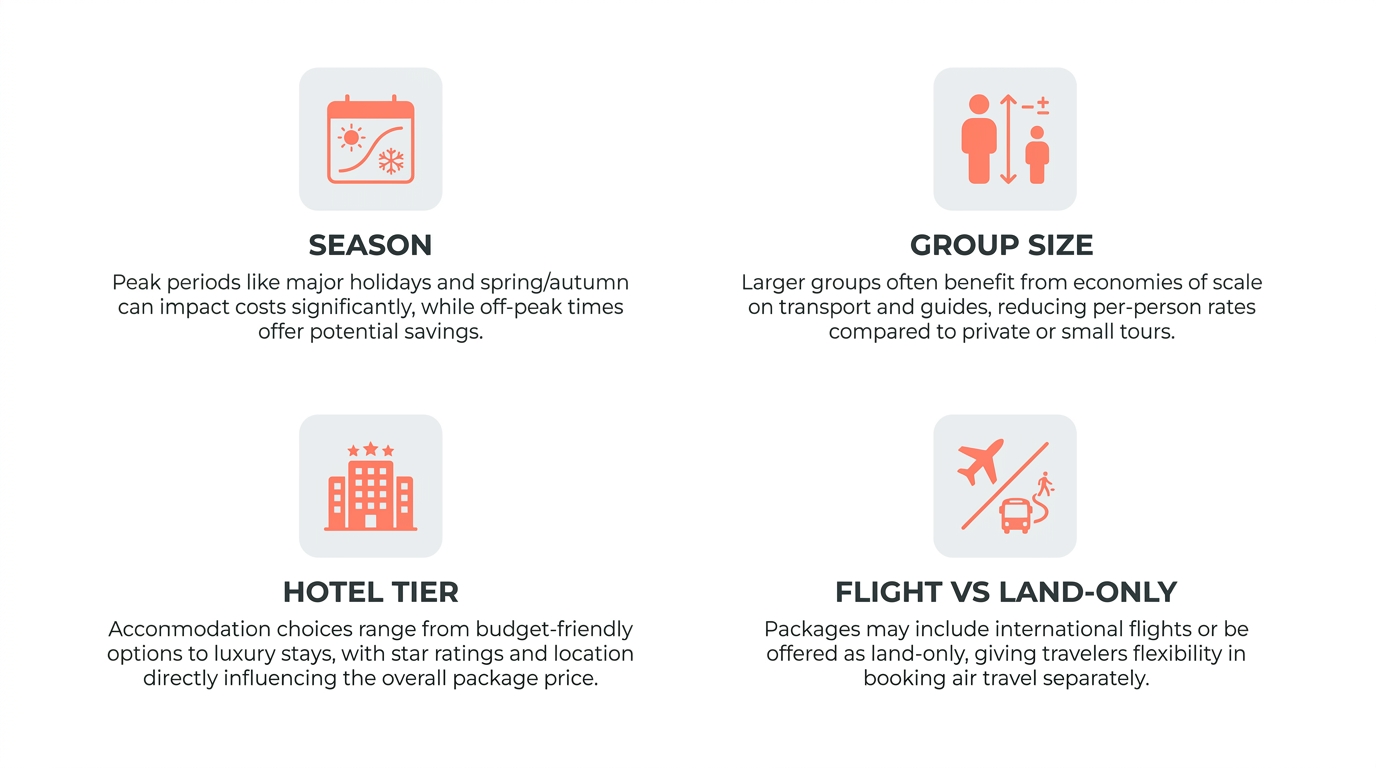
Four variables drive most of the price difference between proposals – understanding them helps parishes compare options honestly.
There is no single number, and any operator who gives you one before asking questions is guessing. Four variables move the price more than anything else.
Season comes first. Spring and autumn cost more than winter. Group size matters next, since a coach of 40 spreads fixed costs further than a group of 15. Hotel tier is the third lever – the gap between standard tourist 3-star properties and deluxe 5-star hotels is significant across nine or ten nights. The fourth variable is whether the package is land-only or includes international flights from the U.S. Most American parishes book land-only and arrange their own group flights, which keeps the pricing transparent and easier to compare across proposals.
The right question to ask any operator is not “what is the total?” but “what is in it and what is not?” That comparison tells you more than a headline figure.
What Is Included and What Is Out of Pocket
The fastest way to compare two proposals honestly is to look at what each one leaves out.
| Typically included | Usually out of pocket |
|---|---|
| Deluxe air-conditioned tour bus with WiFi | Daily lunch |
| Government-licensed English-speaking local guide | Gratuities for driver and guide |
| Hotels on half-board (breakfast and dinner) | Personal travel insurance |
| Site admission tickets | International flight taxes and fees |
At Talya Tours, the out-of-pocket line goes in front of you before you commit. A surprise on day three damages trust we have spent decades building, so we would rather lose the sale on price than win it on a hidden cost.
Best Season to Book
Spring and Autumn
March to May and September to November are the most requested months by American Catholic parishes. Temperatures are mild, the walking is pleasant, and the long days at Capernaum or on the Mount of Olives do not exhaust older travelers. These are also the busiest months at the major shrines – which is precisely why altar reservations for October and April must be secured well ahead of the trip dates.
Winter Travel
December to February brings thinner crowds and lower hotel rates, with a real chance of rain, especially in Jerusalem and the Galilee. The Israel Meteorological Service rainfall data sets the official rainy season clearly for groups doing their research. Seniors who want cool weather and quiet shrines often prefer winter and accept the umbrella as the cost of fewer crowds.
Safety and Current Travel Conditions
This is the first question many American group leaders raise, and it deserves a direct answer.
We adjust itineraries in real time, stay in close contact with the relevant authorities, and route land travel through corridors we know and trust from decades of operation. A site that is accessible one month may be replaced the next, and we make that call before your group ever lands. For your own due diligence, read the official Israeli National Security Council travel directives as you plan, and bring any questions those raise directly to us.
The U.S. State Department Israel travel advisory is also worth reviewing as part of your planning process. We encourage group leaders to read it rather than avoid it, and to call us with the specific points they want addressed.
Traveling with a Priest or Spiritual Leader
If your group can bring an ordained priest, it changes the trip from a meaningful journey into an active, sacramental pilgrimage in the fullest sense of the term.
A priest offers spiritual direction along the way, hears Confessions where the schedule allows quiet, and celebrates Holy Mass at the shrines. This is where the denomination of your group shapes the entire program. A Catholic parish needs altars, Mass reservations, and sacramental time built into the schedule. A non-denominational Evangelical group wants extended Scripture reading at the Garden Tomb and Yardenit. A Pentecostal ministry may ask for long worship time at Gethsemane. A Presbyterian fellowship may want a session led by their own elder at key sites.
We start every conversation by asking which tradition your group belongs to and what your priest or pastor wants your people to experience. The answer to that question rewrites the whole program. There is no version of this work that begins with a template.
How Daily Mass and Shrine Liturgies Work in Practice
Mass at the great shrines is not a walk-in arrangement. Altars at the Basilica of the Annunciation and the Church of the Holy Sepulchre are reserved months in advance, often through the Franciscan Custody of the Holy Land, which holds custodianship over many of these sites.
Securing a private group liturgy means coordinating your travel dates against the shrine’s own reservation calendar, sometimes shifting a day in the itinerary to match an available slot. This coordination is the kind of logistics that only runs smoothly after you have done it many hundreds of times. We build the Mass schedule first and the sightseeing around it, not the reverse.
This is also the reason the planning conversation for a Catholic pilgrimage needs to begin well in advance of your travel dates. The closer you get to the most requested months, the fewer altar slots remain available.
What to Pack

Practical packing choices have a direct effect on how comfortably your group moves through the holy sites each day.
Pack light, but do not skimp on a few specific items. Broken-in walking shoes matter more than anything else on the list, because the ancient cobblestones of Jerusalem’s Old City punish new soles badly and the Via Dolorosa is uneven underfoot. Beyond footwear, the practical list includes a travel-sized Bible, your rosary, a journal, modest layers for cool mornings and warm afternoons, sun protection for outdoor sites in the Galilee, and a plug adapter for Israeli power sockets.
Dress Code at Sacred Sites
Christian, Jewish, and Muslim holy sites all enforce modesty without exception – shoulders and knees must be covered, and no revealing tops. A lightweight scarf folds into any bag and covers shoulders the moment you reach a church door. Zip-off trousers address the heat-versus-modesty problem on a single hot day without carrying an extra garment. We include a site-by-site dress code note in the pre-departure materials sent to every traveler.
Spiritual Preparation Before You Depart
The pilgrims who gain the most from these ten days are the ones who started weeks earlier, at home.
Study the Gospels through the regions you will visit, so that Galilee and Jerusalem already live in your imagination before the bus pulls in for the first time. Set a personal prayer intention – something you are carrying specifically to the Holy Sepulchre or to Gethsemane. And receive the Sacrament of Reconciliation before you fly. Arriving prepared turns the first morning in Nazareth from a tourist’s curiosity into a pilgrim’s arrival.
Parish leaders can support this preparation by running a brief series of evening talks or Sunday-morning reflections on the sites the group will visit. Groups that arrive with some shared context tend to move through the holy places with more attention and less distraction.
Accommodating Senior Travelers and Limited Mobility
The Holy Land is physically demanding in places, and we say that clearly to every parish coordinator who asks. The Via Dolorosa is uneven, and several shrines involve stairs with no accessible alternative.
That said, much can be solved with planning. We arrange accessible routes where they exist, slow the daily pace for older groups, and keep the modern air-conditioned coach close so no one walks further than is necessary for a given site. Of the more than 90,000 travelers we have hosted across all denominations, a great many were well into their seventies and completed their pilgrimage fully on their feet. The difference was preparation – we told the parish the truth about each day in advance, so seniors could choose where to rest without embarrassment and without feeling they had failed the group.
If specific mobility concerns exist in your group, raise them before the itinerary is finalized. Site selection and day sequencing can often be adjusted to make the journey manageable for members who might otherwise feel excluded.
How Custom Group Bookings Work for Parishes
The process starts with a planning conversation – usually with a priest, a parish coordinator, or occasionally a Knights of Columbus council organizing a diocesan trip. We ask about your congregation’s tradition, your approximate dates, the size of the group you expect, and the sites and sacramental moments that are most important to your parish.
From there we design the itinerary around your parish’s specific needs, then provide the practical tools to help fill it. That includes customized flyers your coordinator can distribute after Mass, a dedicated payment arrangement so families can pay in stages over several months, and promotional materials suitable for the bulletin and the parish website.
The host’s job is to gather the people. Ours is everything else – from the visa checklist to the altar reservation, the ground transportation, and the guide briefed on your denomination’s priorities.
Supporting Local Christian Communities
The “living stones” of the Holy Land are the local Arab Christian families of Bethlehem, Jerusalem, and the Galilee, whose communities trace back nearly two thousand years and whose numbers have thinned under sustained economic hardship.
A pilgrimage can help sustain them, directly and concretely. Booking local guides who come from these communities, choosing Christian-owned hotels where they exist, and purchasing olivewood carvings from the family workshops in Bethlehem rather than airport stalls keeps money inside these families and neighborhoods. The Palestinian Christians of Bethlehem have been carving olivewood rosaries and nativity figures for generations. Buying from them is a different act than buying the same item from an airport retailer.
A pilgrimage that strengthens the church that still prays at these sites is a fuller act of faith than one that only photographs them.
Passport and Visa Requirements for U.S. Travelers
The requirement that most often catches American travelers off guard is passport validity. Your passport must be valid for at least six months beyond your date of departure from Israel – not your date of arrival. A renewal that has slipped to the bottom of someone’s to-do list can ground a pilgrim a week before the flight, and it has happened.
For U.S. citizens, tourist entry to Israel is granted on arrival for a standard pilgrimage stay and requires no advance visa application. We send every American group a clear pre-departure checklist that covers passport validity, what to expect at Ben Gurion Airport, and the straightforward entry process so no one discovers a problem at the terminal.
The checklist also covers the entry process into Bethlehem, which sits within the Palestinian Authority and involves a brief checkpoint crossing. This is routine for our groups and is handled smoothly, but first-time travelers benefit from knowing what to expect before they arrive.
Why Travel Insurance Matters for a Parish Trip
Insurance is the line groups most want to skip and most regret skipping. The issue is not pessimism – it is that the cost of not having it is far higher than the cost of buying it.
Comprehensive travel insurance covers three things that matter on a trip of this kind. Trip interruption if a family emergency at home calls someone back before the pilgrimage is complete. Medical evacuation if a serious situation arises far from a major hospital, which can cost tens of thousands of dollars without coverage. And ordinary emergency health care for the twisted ankle on the cobblestones or the chest cold that arrives after the Jerusalem nights.
Insurance protects both the traveler’s health and the money the parish has invested over a year of saving and promotion. We treat it as standard planning, not an optional add-on.
How to Begin Planning with Talya Tours
Every Talya Tours pilgrimage begins with a planning conversation, not a checkout page.
Booking with us begins with a planning call, not an online checkout. We talk through your dates, your parish’s Catholic tradition and specific liturgical priorities, and the shrines that matter most to your congregation. From there we draft an itinerary, revise it until it fits, and provide the preparation materials your travelers will need before departure.
Talya Felner, our owner, is personally involved with every group we take to Israel. That is not a policy we added recently – it is how Talya Tours has run pilgrimages for American parishes across more than three decades.
If your parish is beginning to think about a pilgrimage to the Holy Land, we are glad to walk through dates, Mass arrangements, and logistics before you commit to anything. Reach Talya directly at [email protected] or through the Talya Tours contact page.
Frequently Asked Questions
Can Talya Tours design an itinerary specifically for our Catholic parish, or do you use a standard program for all groups?
Every itinerary we build is specific to the denomination and congregation of the group traveling. A Catholic parish program is structured around the Sacraments, the Marian shrines, and the Mass reservation schedule – none of which applies to the program we would build for a Baptist, Methodist, or Pentecostal group visiting the same country. The starting point for any conversation with us is the tradition of your congregation.
How far in advance should we start planning a Catholic pilgrimage from the U.S.?
For spring and autumn travel – the most requested seasons – we recommend starting the conversation at least 9 to 12 months before your intended departure. Altar reservations at the major shrines fill up quickly, and the closer you are to the travel date, the fewer slot options remain. Groups traveling in winter have a little more flexibility, but the planning lead time is still important for getting the complete itinerary in place.
What is the minimum group size for a parish pilgrimage?
There is no hard minimum, but the economics shift significantly below roughly 15 travelers. The fixed costs of a bus, a licensed guide, and hotel blocks spread more favorably across larger groups. Most American Catholic parishes we work with travel with 20 to 50 people. Smaller groups can still travel well, but the per-person cost will reflect the smaller size, and the proposal will show that clearly.
Does our priest need to arrange the shrine Mass reservations personally, or does Talya Tours handle that?
We handle the coordination with the Franciscan Custody and the individual shrine administrations on your behalf. Your priest does not need to navigate those institutional channels independently. We need the priest’s name and ordination details for the reservation submission, and we need the Mass dates confirmed in advance – but the liaison work is ours. That coordination is part of what we mean when we say the host’s job is to gather the people.
Are flights from the U.S. included in the tour package?
Most American parishes book land-only with us and arrange their international flights separately through a travel agent or directly with an airline. This keeps the two costs transparent and comparable. We can advise on routing and typical flight times from major U.S. hubs to Tel Aviv, but the flight booking itself is usually handled by your group independently.
What happens if the security situation in Israel changes close to our travel dates?
We monitor conditions on the ground continuously and adjust itineraries in real time when needed. If specific sites or routes become inadvisable, we substitute with alternatives and notify your group leader immediately. In cases where the situation makes travel genuinely inadvisable, we discuss the options plainly with your parish coordinator – including rescheduling. We do not send American groups into situations we would not send our own families into.
Can we include members of our parish who use wheelchairs or have limited mobility?
Some sites in the Holy Land present genuine physical challenges with no accessible alternative – the Via Dolorosa and certain sections inside the Old City among them. Many other sites are fully manageable with planning. When mobility limitations exist in your group, tell us early in the planning process. We design around the specific situation – adjusting day sequence, identifying rest points, and noting in advance which sites a particular traveler may choose to observe from a distance rather than enter. The goal is for no one to feel excluded from the pilgrimage.
A Catholic pilgrimage to the Holy Land is a specific undertaking, not a variation on a standard tour. The itinerary follows the Sacramental life of your parish, the Mass schedule is built around shrine reservations secured months in advance, and the sites are sequenced around the theological priorities of your Catholic congregation rather than a generic Christian program. For American parishes considering this journey, the most practical step is a planning conversation well before your intended travel dates – when the altar slots are still available, the hotels have availability, and there is time to prepare your group properly.
Talya Tours has organized these pilgrimages for American Catholic parishes, alongside groups from other Christian denominations, for over 35 years. If your parish is at the early stages of planning, reach Talya directly at [email protected] to begin the conversation.
Ready to Plan Your Catholic Parish Pilgrimage?
We begin every pilgrimage with a planning conversation – your dates, your denomination, your parish’s priorities. No templates, no generic programs. Contact us to speak with Talya directly about your group’s pilgrimage to the Holy Land.
About the Author
Talya Felner
Owner and CEO, Talya Tours Services (TTS)
Talya Felner is the Owner and CEO of Talya Tours Services (TTS), a leading professional tour operator in Israel. With over 35 years of experience and more than 90,000 travelers served, Talya has built TTS into a trusted name for Christian pilgrimages, biblical tours, and conferences for American groups visiting Israel and the Holy Land. Her team designs each itinerary around the specific Christian denomination of the visiting group – whether Protestant, Catholic, Evangelical, Baptist, Methodist, Pentecostal, Lutheran, Presbyterian, Anglican, Orthodox, or another tradition – ensuring that sites, worship arrangements, and guides reflect what matters most to that congregation. From visas and accommodations to guides, transportation, and on-site coordination, TTS handles every detail so American pastors and group leaders can focus on the spiritual experience of their travelers.