
A Holy Land pilgrimage is a guided journey through biblical Israel built around Scripture and worship rather than a standard sightseeing route. American congregations planning this trip face real decisions on cost, timing, trip length, and travel documents, and the itinerary itself should be shaped by the specific Christian tradition of the group. This article walks through what a pilgrimage tour actually includes, what it costs, when to travel, and how a Catholic parish, a Baptist congregation, or a Pentecostal fellowship end up with noticeably different programs even when visiting the same country.
Reading time: 7 minutes
Key points in this article
- Organized group pilgrimages from the U.S. typically run $3,500 to $7,500 or more per person for land services, with international airfare booked separately.
- Itineraries are built around the specific denomination of the traveling group, from Catholic Mass arrangements to Baptist baptism renewals at the Jordan River.
- U.S. travelers now need pre-travel electronic authorization through the ETA-IL system before booking flights, not the night before departure.
- Most first-time American groups benefit from a 10 to 12 day itinerary rather than a rushed 7-day schedule that skips Galilee overnights.
Table of contents
- What Holy Land pilgrimage tours are and how they differ from a regular vacation
- Who a pilgrimage is designed for
- What a Holy Land pilgrimage costs
- Cost drivers most groups underestimate
- Best time of year to travel
- How many days you actually need
- Safety considerations for today’s traveler
- Visa and travel document requirements
- Key holy sites on a classic pilgrimage
- How denomination shapes the whole itinerary
- Choosing the right tour partner
- Frequently asked questions
What Holy Land pilgrimage tours are, and how they differ from a regular vacation
A regular vacation moves a traveler from one attraction to the next and asks nothing of them. A Holy Land pilgrimage asks something. It is an intentional journey built around Scripture, not around a checklist of monuments.
On these tours, days are structured around prayer, reflection, and communal worship. A group reads Matthew on the Mount of Beatitudes (Matthew 5:1-16), stands at Capernaum (Mark 1:21-35), and the text stops being abstract. Progress is measured in what happens inside the group, not in how many stops were photographed.
Traveling as a congregation changes the experience further. The same forty travelers share meals, quiet moments, and a boat ride on the Sea of Galilee, and by the end of the trip it has become a shared milestone rather than a vacation. To see how to select a spiritual itinerary that matches a group’s faith tradition, see our guide to choosing a Holy Land tour.
Who a pilgrimage to the Holy Land is designed for
Almost any American traveler seeking a real spiritual connection belongs on this kind of trip. Some groups simply get more structured value from it than others.
Church and parish groups are the core of what we host. A congregation travels with its pastor or priest, observes its own rites on site, and studies Scripture where the events took place. Multi-generational families come to pass faith down, with a grandmother and a teenager standing at the Jordan River together. Individual travelers join organized U.S. groups to walk the biblical sites without carrying every logistical decision alone.
A pilgrimage works for all three because the framework is built to hold structure and personal reflection at the same time, adjusted to the denomination of the group traveling.
What a Holy Land pilgrimage costs
For an organized group tour departing the United States, realistic pricing runs from about $3,500 to $7,500 or more per person for land and services in Israel, with international airfare usually booked separately. Where a group lands in that range depends on season, hotel standard, and how many travelers are in the party.
The value of an organized package is predictability. A solo traveler pays retail for everything and absorbs every surprise. In a group, the cost is fixed in advance, and the church knows what it owes before departure.
What is typically included in the package price
A well-built package normally covers accommodation from standard to luxury, ground transport in air-conditioned coaches with WiFi, a government-licensed guide, half-board meals, and entry fees to national parks, historical sites, and holy shrines. To avoid surprise out-of-pocket costs, most congregations prefer pre-planned Christian tour packages to Israel that bundle transport, accommodation, and guided excursions under one arrangement.
Extra out-of-pocket expenses to budget for
Plan separately for personal travel insurance, single-room supplements, lunches, souvenir shopping, and daily gratuities for the driver, guide, and hotel staff. These are standard exclusions across the industry, and knowing them ahead of time keeps a congregation’s budget honest.
Cost drivers most groups underestimate
Four variables move the price more than anything else. Seasonality is the biggest factor. Easter and Christmas weeks, along with spring and fall, sit at the top of the range, while late summer and winter run cheaper. Group size matters next, since a larger congregation unlocks better rates on coach charters and blocked hotel rooms. Accommodation standard is a choice the church controls, ranging from modest kibbutz hotels and religious guesthouses to higher-end properties in Jerusalem and Tiberias. Itinerary duration closes the gap, since a standard 8-day program costs noticeably less than a 10-to-14-day version reaching further regions.
This arithmetic only becomes clear after arranging these trips repeatedly. A group that shifts its dates by two weeks sometimes saves enough per person to add a full extra day to the itinerary.
Planning a trip for your congregation
Talya Tours builds custom pilgrimage itineraries for U.S. church groups, denomination by denomination, from Catholic Mass scheduling to Evangelical baptism renewals. Email [email protected] or use the contact form to start a conversation about your group’s dates, size, and tradition.
Best time of year to travel
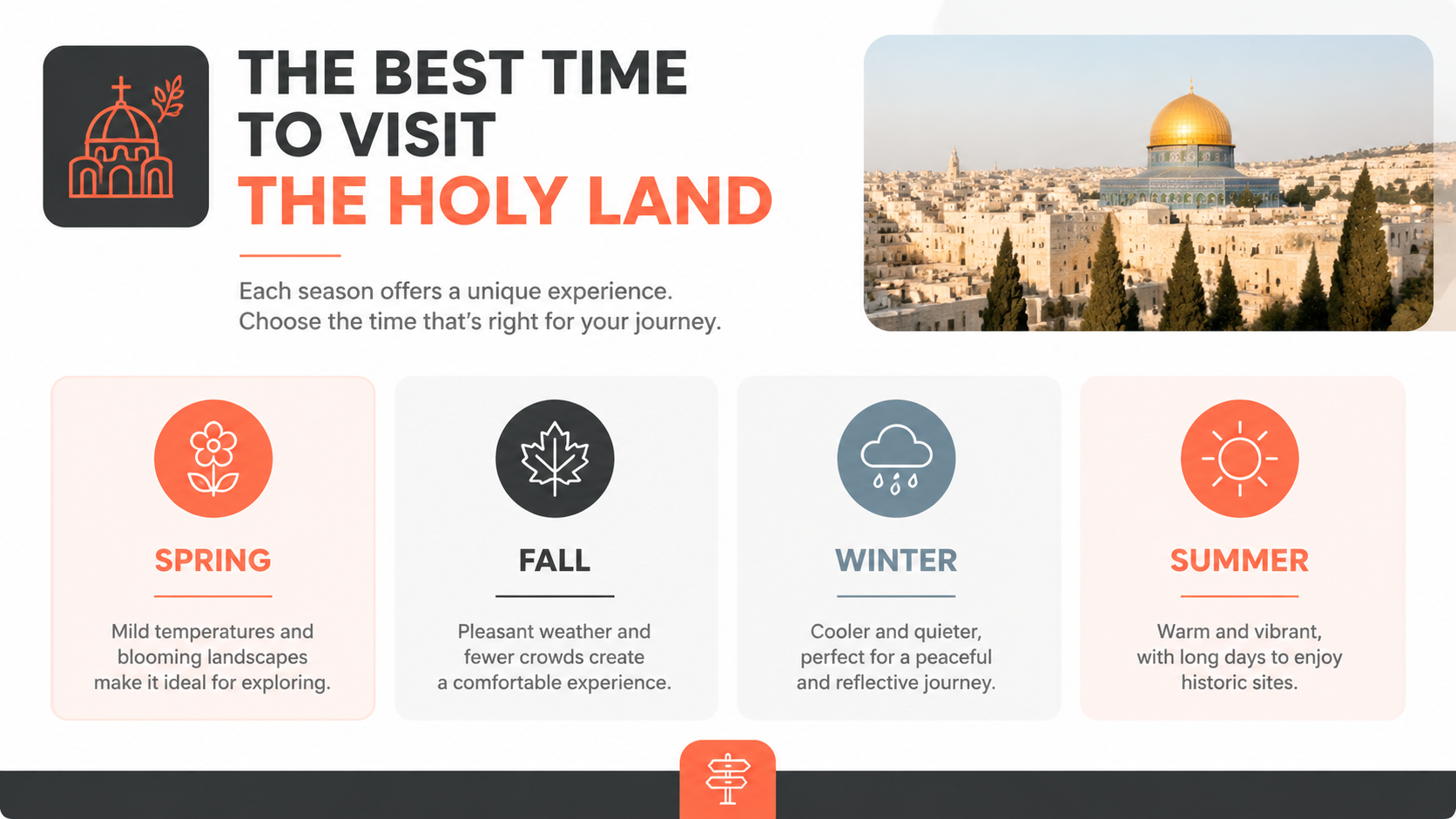
Seasonal comparison for planning a Holy Land pilgrimage
Israel offers four honest options, and none of them is wrong for a pilgrimage. The right choice depends on what the group values most.
| Season | Weather | Crowds and cost | Best for |
|---|---|---|---|
| Spring (Mar-May) | Comfortable, blooming landscapes | Busy, higher cost, Easter peak | Groups wanting Easter and mild days |
| Fall (Sep-Nov) | Pleasant, dry, good for walking | Moderate to busy | Outdoor prayer and trail walking |
| Winter (Dec-Feb) | Cool, occasional rain | Fewer crowds, lower prices | Christmas atmosphere, budget-minded groups |
| Summer (Jun-Aug) | Hot, needs careful pacing | Variable | Water sites, archaeological digs |
Regional microclimates matter more than most people expect. Jerusalem can be cool while the Dead Sea is warm on the same afternoon. The official Visit Israel weather portal is a reliable place to confirm seasonal patterns before locking in dates.
How many days you actually need
Most first-time American groups ask for 7 days and then wish they had booked more. Among the tens of thousands of travelers we have guided, the ones who felt rushed almost always chose the shortest option.
A 7 to 8 day trip is a focused introduction covering Jerusalem, Bethlehem, and the Sea of Galilee at a fast pace. A 10 to 12 day trip is what we recommend for most groups, since it adds the Jordan Valley, Nazareth, biblical ruins, and the Dead Sea without the feeling of watching the Holy Land through a bus window. A 14-day or longer trip opens desert monasteries, longer hiking paths, and destinations beyond the standard route.
We generally recommend two nights in Galilee rather than one. A single Galilee night forces the whole northern ministry section into a scramble, and Galilee is exactly where a pilgrimage tends to become real for people.
Safety considerations for today’s traveler
The concern is natural, and we address it plainly with the families who ask. Professional operators coordinate closely with local authorities and monitor conditions continuously, adjusting routing when needed.
Tourist corridors, religious sites, and standard pilgrim routes are closely watched, and a group rarely moves through anything that has not been checked in advance. Travelers can follow official advisories through the National Security Council travel warnings portal, and the Ministry of Tourism runs a virtual tourist office for real-time questions.
Visa and travel document requirements
The rules changed recently, and this is where late-planning groups get caught. Travelers from visa-exempt countries, including the United States, now must obtain pre-travel clearance through the online ETA-IL system before boarding their flight.
Register several days before booking flights, not the night before departure. The process is documented through the Israel Embassy ETA-IL announcement and the tourist visa requirements page, with group entries covered under a separate group entry guide. For an entire congregation, we handle this coordination so no one arrives at the airport with a problem.
Key holy sites on a classic pilgrimage
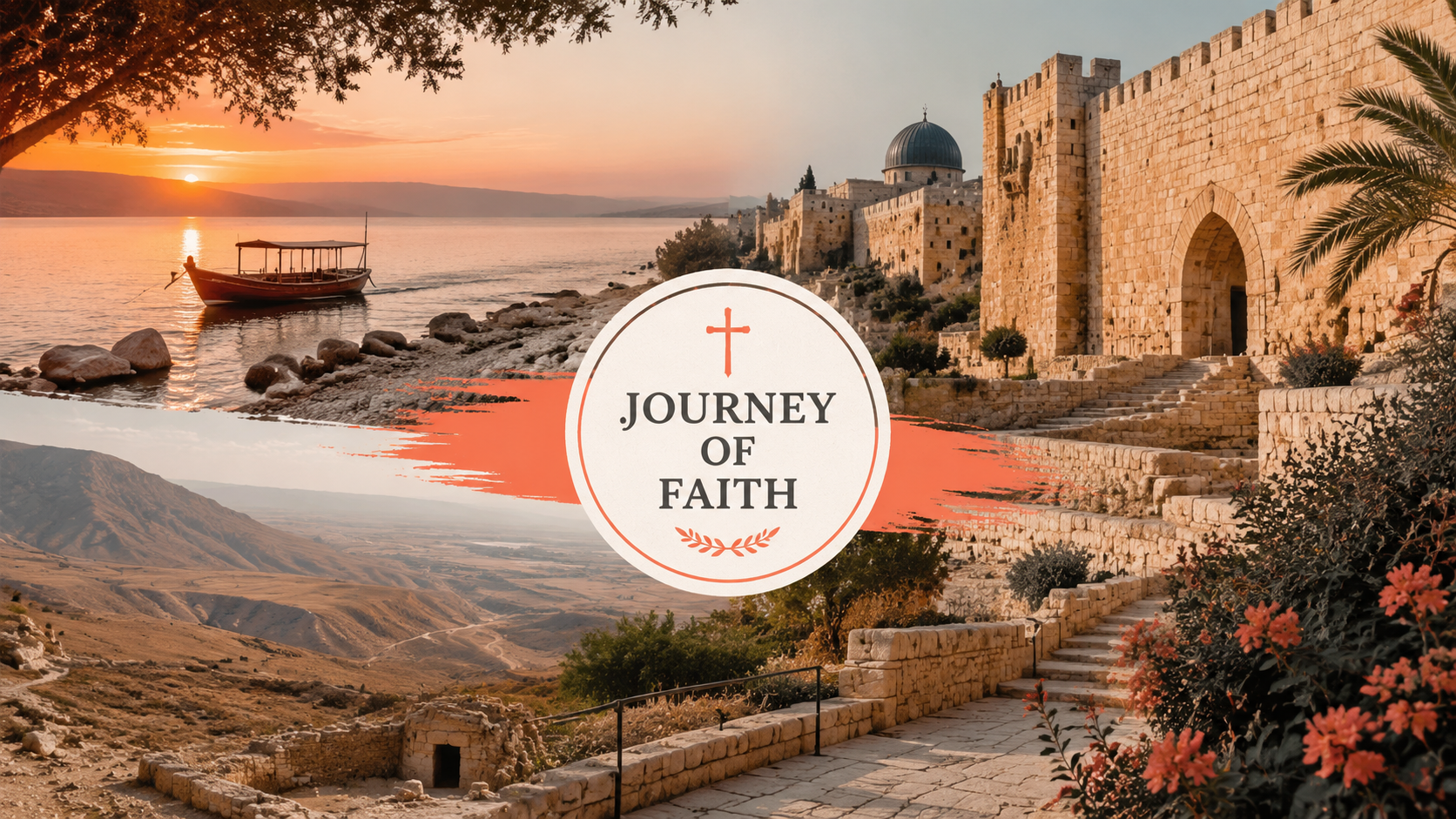
Key sites across Galilee, Jerusalem, and the Judean desert
A traditional route runs north to south, from the green hills of Galilee down to Jerusalem and the desert. This is where the denominational question surfaces most sharply, because the same map produces very different journeys.
The Galilee and northern holy sites
The north is where the public ministry of Christ unfolds. Groups visit Capernaum (Mark 1:21-35), the Mount of Beatitudes (Matthew 5:1-16), Tabgha (John 6:1-15) where the loaves and fish were multiplied, Cana (John 2:1-11), and Nazareth (Luke 1:26-38). Groups that want to walk part of the terrain often take a stretch of the Galilee trail system linking these sites, described in the Gospel Trail project.
Jerusalem and Bethlehem
This is where the passion narrative takes physical form, at the Mount of Olives (Luke 19:37-44), the Garden of Gethsemane (Matthew 26:36-46), Mount Zion, the Via Dolorosa, and the Church of the Holy Sepulchre. Groups also reach Bethlehem and the Church of the Nativity (Luke 2:1-20), and the Western Wall in Jerusalem.
Here the customization is unmistakable. A Catholic parish spends meaningful time inside the Church of the Holy Sepulchre and walks the Via Dolorosa station by station, often with Mass arranged. An Evangelical or Baptist group frequently prefers the Garden Tomb for its quiet communion setting and a baptism renewal at the Jordan River. Access details, such as the round-the-clock prayer plaza at the Western Wall, matter to the timing of both.
Judean desert and Jericho
The road drops toward the lowest place on earth, taking in the Jordan River baptismal site at Qasr al-Yahud (Matthew 3:13-17), Jericho (Joshua 6:1-20) as one of the oldest continuously inhabited cities, and desert oases such as the Ein Gedi Nature Reserve. Designing a route that links Galilee, Jerusalem, and this desert region without wasted hours takes careful logistics. Our Holy Land tours guide shows how the segments fit together.
How denomination shapes the whole itinerary
This is the part off-the-shelf operators skip. Many hand every group the same 8-day program regardless of tradition. We build the sequence, pacing, and on-site ceremonies around the denomination of the traveling congregation.
| Tradition | Emphasized sites | On-site focus |
|---|---|---|
| Catholic | Holy Sepulchre, Basilica of the Annunciation, Church of the Nativity, Via Dolorosa | Daily Mass, station devotions |
| Evangelical / Baptist | Garden Tomb, Yardenit / Jordan River, Mount of Beatitudes, Capernaum | Extended Scripture reading, baptism renewal |
| Pentecostal | Mount of Olives, Garden of Gethsemane | Extended prayer and worship time |
| Methodist / Presbyterian / Lutheran | Biblical sites with historical context | Theological teaching, quiet contemplation |
| Anglican / Episcopalian / Orthodox | Liturgical sites, historic monasteries | Formal liturgy, clergy-led services |
Every planning conversation with a new group starts with the same two questions, what tradition the congregation belongs to, and what the pastor or priest wants the group to experience. Those answers decide the sequence of sites, the daily pacing, and which ceremonies get arranged on location.
Choosing the right tour partner
Talya Tours is a local company based in Ramat Gan, building faith-centered journeys for American groups since the late 1980s. Tourism is our only line of business.
Our guides are government-licensed and able to open the biblical text on the ground where it happened. Itineraries are private and built from scratch, so whether a group wants a specialized Catholic pilgrimage with daily Mass reservations, or a Protestant Scripture-centered route, the details are tailored rather than templated. Pricing is transparent, which keeps the overall cost honest while running modern coaches, comfortable hotels, and full coordination on the ground. Because we are based in Israel around the clock, a routing change made early in the morning is typically resolved before the group finishes breakfast.
How far in advance should our congregation book a pilgrimage
Nine to twelve months ahead is comfortable for most congregations, particularly for Easter or Christmas travel when hotel space and flights fill early. Six months can still work for off-peak dates, but leaves less flexibility if the group wants specific room configurations or a particular guide.
Can Talya Tours arrange a Mass, communion, or worship service on site
Yes. Catholic groups can have daily Mass coordinated at churches along the route, including inside the Church of the Holy Sepulchre where scheduling allows. Baptist, Evangelical, and Pentecostal groups often arrange communion at the Garden Tomb or a baptism renewal at the Jordan River. These arrangements are set during itinerary planning based on the group’s denomination and preferences.
What happens if part of our group cancels after booking
Group contracts typically include cancellation terms tied to how close to departure the change happens, since hotel blocks and coach charters are booked in advance. We review these terms with the group leader before signing, so there are no surprises if travelers drop out closer to the date.
Do we need travel insurance
Travel insurance is not included in standard group packages and is worth arranging separately. It covers trip interruption, medical needs abroad, and baggage issues, none of which are covered by the tour package itself.
How does the itinerary differ for a Pentecostal group versus a Presbyterian group
A Pentecostal group typically wants longer, less structured time for prayer and worship at sites like the Mount of Olives and Garden of Gethsemane. A Presbyterian group more often prioritizes historical and theological teaching at each stop, with guided discussion and quieter contemplation built into the schedule. Both visit similar regions, but the pacing, on-site programming, and time allocation are set differently.
Who leads the tour, a local guide or our own pastor
Both. A government-licensed local guide handles logistics, historical and archaeological context, and site access, while the group’s own pastor or priest leads worship, communion, or Mass at the relevant stops. This split lets each person focus on what they know best.
A Holy Land pilgrimage works best when the itinerary reflects the specific tradition of the traveling congregation rather than a generic route. Cost, season, trip length, and travel documents are all manageable with enough lead time, and the sites themselves, from Galilee to Jerusalem to the Judean desert, hold meaning that shifts depending on whether the group is Catholic, Baptist, Pentecostal, Presbyterian, or from another Christian stream.
Ready to talk through your congregation’s trip
Reach out with your group size, preferred dates, and denomination, and we will put together a first draft itinerary and cost estimate built around your congregation, not a generic template.

About the Author
Talya Felner is the Owner and CEO of Talya Tours Services (TTS), a leading professional tour operator in Israel. With over 35 years of experience and more than 90,000 travelers served, Talya has built TTS into a trusted name for Christian pilgrimages, biblical tours, and conferences for groups visiting Israel and the Holy Land. Her team designs each itinerary around the specific Christian denomination of the visiting group, whether Protestant, Catholic, Evangelical, Baptist, Methodist, Pentecostal, Lutheran, Presbyterian, Anglican, Orthodox, or another tradition, ensuring that sites, worship arrangements, and guides reflect what matters most to that congregation. From visas and accommodations to guides, transportation, and on-site coordination, TTS handles every detail so American pastors and group leaders can focus on the spiritual experience of their travelers.