A pastor in Nashville calls in late January. His congregation of 38 wants to stand at the Garden Tomb on Resurrection Sunday, and he has not yet decided whether the trip is seven days or ten. That single phone call contains almost every question this article answers. Christian tours to Israel are guided pilgrimages that follow the biblical text across the actual ground where it happened. They are not sightseeing holidays with a religious label attached. After bringing more than 90,000 American travelers to Israel, Talya Tours can tell you the difference is structural, not decorative.
Reading time: 9 minutes
Key Points in This Article
- Christian tours to Israel are theological journeys built around the biblical text, and every itinerary Talya Tours creates is shaped by the specific Christian denomination of the visiting American group.
- Catholic, Evangelical, Baptist, Pentecostal, and other denominational groups follow different site sequences, worship arrangements, and guide assignments – no two programs are the same.
- Seven to ten days is the practical range for a comprehensive pilgrimage, with spring and autumn offering the best walking conditions across Galilee and Jerusalem.
- U.S. travelers from visa-exempt countries now require an ETA-IL digital travel authorization before flying, and Talya Tours handles this process for all groups.
Table of Contents
- What Are Christian Tours to Israel
- Why Choose a Christian-Focused Guide and Agency
- Is It Safe for Christian Travel to Israel
- How Many Days Are Ideal for Israel Tours
- Biblical Sites in Jerusalem’s Old City
- New Testament Sites in Nazareth and Galilee
- What Is Included in Christian Holy Land Packages
- How Much Do Christian Tours of Israel Cost
- Private Tour vs. Group Tour
- Catholic vs. Evangelical Holy Land Pilgrimages
- Best Season to Book Christian Travel to Israel
- Visa and ETA-IL Requirements
- Visiting Bethlehem on a Pilgrimage
- What to Pack for a Holy Land Tour
- Questions to Ask Before Choosing a Tour Company
- Sample 8-Day Evangelical Pilgrimage Itinerary
- Sample 10-Day Catholic Holy Land Itinerary
- How to Start Planning Your Custom Christian Tour
What Are Christian Tours to Israel
A Christian tour of Israel is a theological journey before it is anything else. The itinerary follows Scripture rather than a generic checklist of attractions. Where a standard holiday moves by convenience, Christian tours in Israel move chronologically through the life of Jesus, often opening with Old Testament narratives in the north and closing with the Passion and Resurrection in Jerusalem.
That sequencing matters. A group reads the Sermon on the Mount while standing on the Mount of Beatitudes (Matthew 5:1-16), then later walks the Via Dolorosa toward the place of the cross. The terrain reinforces the text. Reading more About Talya Tours can help American pilgrims see how specialized operators build services around denominational delegations rather than handing every group the same program.
The most common Christian trips fall into a few clear types. Galilee-and-Jerusalem classic pilgrimages cover the Sea of Galilee, Nazareth, Bethlehem, and the Old City. Baptism-renewal journeys are built around the Jordan River. Liturgical pilgrimages include daily Mass for Catholic parishes. Bible-study tours feature extended Scripture reading for Evangelical and Baptist congregations. Each of these Christian tours of Israel is shaped by the tradition of the group requesting it – never assembled from a single master template applied to everyone.
Why Choose a Christian-Focused Guide and Agency in the Holy Land
A licensed guide who understands the difference between the Garden Tomb and the Church of the Holy Sepulchre – and why one carries more weight for your particular congregation – changes the entire trip. Generic history is not enough in the Holy Land. A Pentecostal group standing at the Garden of Gethsemane (Matthew 26:36-46) wants room for prayer; a Catholic group at the same site wants the liturgical context. The guide must read both.
In Israel, every working guide is required to hold a license from the Ministry of Tourism. This is not a formality. Licensing and supervision standards are documented by the State Comptroller, and active credentials can be checked through the official tour guide database. Talya Tours assigns only credentialed guides who are matched to the theology of the group, not just to the route.
Is It Safe for Christian Travel to Israel, and How Should Travelers Prepare
This is the first question almost every American group leader asks, often before dates or budget. The honest answer is that organized pilgrimage groups travel very differently from independent tourists, and that difference accounts for most of the safety story.
A reputable operator monitors regional conditions daily and adjusts routes in real time. A site that is accessible on a Tuesday may be rerouted by Thursday, and your group should never feel the adjustment. That only works when the operator runs its own licensed transport rather than leaving people on public buses.
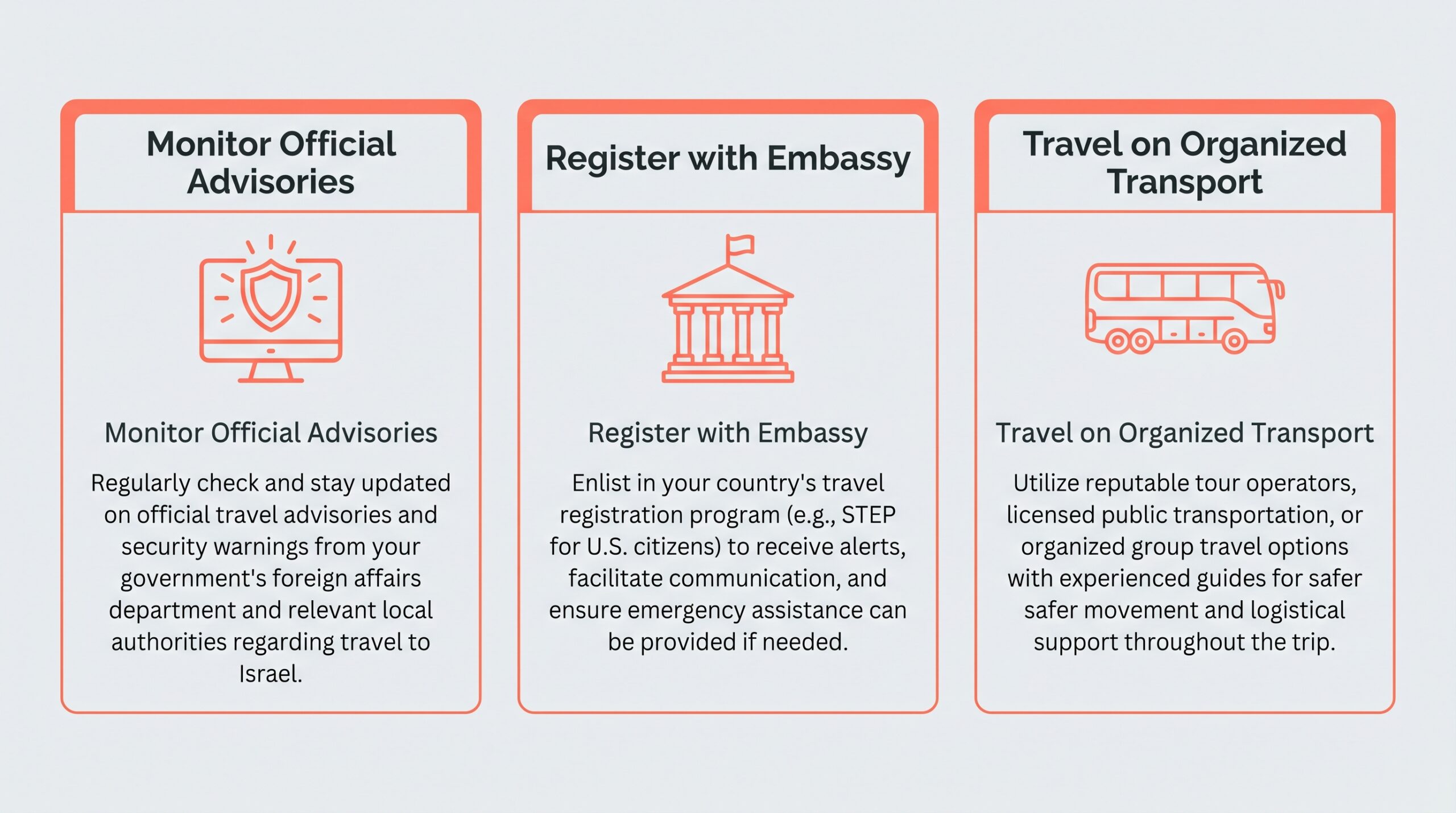
For responsible Christian travel to Israel, three practical steps matter. First, monitor official travel classifications through the National Security Council dashboard and the Ministry of Foreign Affairs advisories so your information comes from the source rather than from social media. Second, register your group with your embassy in Israel before departure. Third, travel on organized coach transport with your guide rather than independent transit.
In 35 years, the groups that felt secure were the ones whose logistics were handled under one roof. Coordinating buses, guides, and contingency routes from a hotel lobby in Tiberias is not something your pastor should be doing mid-trip. That is the operator’s responsibility.
How Many Days Are Ideal for Comprehensive Israel Tours for Christians
Seven to ten days is the standard, and there is a reason it has held for decades. Israel is small in geographic terms, but the distance between Galilee in the north and Judea in the south carries real biblical weight. Rushing it costs you the meaning. Most Israel tours for Christians fall into two shapes.
8-Day Classic Itineraries
The eight-day program typically splits into 3 nights in the Galilee and 4 nights in Jerusalem. The Galilee base covers the Sea of Galilee, Capernaum, and Nazareth. The Jerusalem base covers the Mount of Olives, the Old City, and Bethlehem. It is balanced and does not exhaust a group of forty.
10-to-12-Day Extended Itineraries
Adding two to four days allows room for the Dead Sea, additional Jordan River sites for baptism, Masada, and the wilderness segments where much of Scripture takes place (Matthew 4:1-11). Extended trips suit American congregations that want contemplative time at each site rather than a tight schedule driven by the clock.
The Must-See Biblical Sites in Jerusalem’s Old City
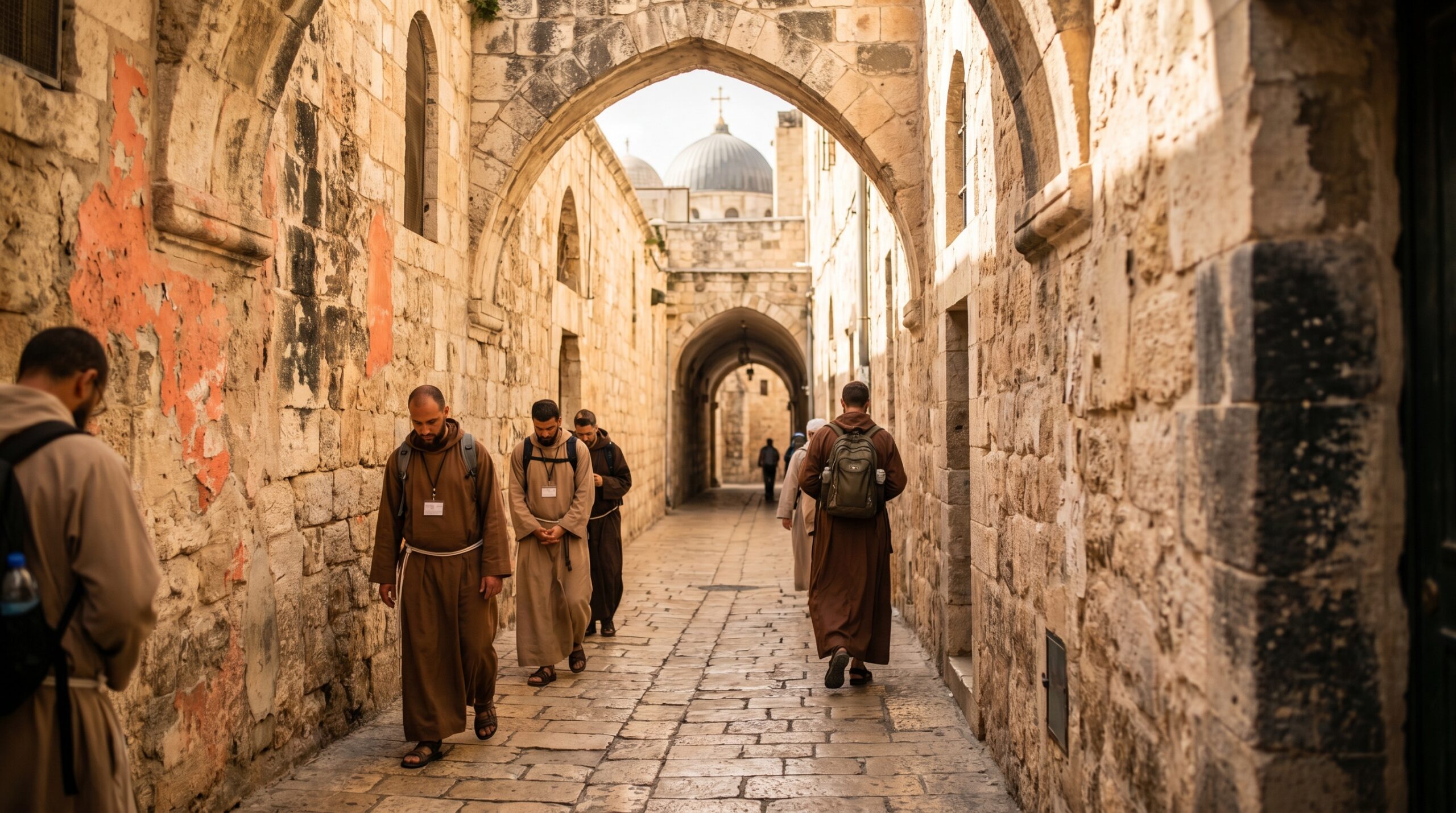
Everything in the Old City bends toward the events of the final week. For most American pilgrims, Jerusalem is the emotional center of the Holy Land, and the two anchor sites are the Via Dolorosa and the place of the Resurrection.
Way of the Cross – Via Dolorosa
The Via Dolorosa traces the route Jesus walked toward Crucifixion (Luke 23:26-32), marked by fourteen stations through the Old City. Groups usually walk it in the early morning, before the lanes fill. Catholic groups often pray each station with full liturgical form; Evangelical groups frequently read the passion narrative aloud as they walk. The guide’s role at each station is shaped by which tradition is present.
Church of the Holy Sepulchre
The Church of the Holy Sepulchre encloses both Calvary and the Tomb under one roof (John 19:17-42), and its history is documented by the official Visit Israel resource alongside an overview of Jerusalem’s Old City. For Catholic and Orthodox pilgrims this is the structural heart of the visit. Many Evangelical and Baptist American groups instead give that weight to the Garden Tomb. Talya Tours plans the day around whichever site your tradition holds central, not whichever is more convenient logistically.
Plan Your Denomination-Specific Pilgrimage to Israel
Whether your congregation is Catholic, Evangelical, Baptist, Methodist, Pentecostal, Lutheran, Presbyterian, Anglican, Orthodox, or another tradition, Talya Tours builds your itinerary from your denomination outward. Contact us to begin the conversation – no commitment required.
New Testament Sites in Nazareth and Galilee
Roughly 80 percent of the recorded ministry of Jesus took place in the Galilee, which is why a serious itinerary spends real time in the north. This is where the gospels stop being abstract for most American pilgrims. The Galilee is where the text and the ground finally meet in a way that no classroom or church service can replicate.
Capernaum – The Ministry Base
Capernaum (Mark 1:21-35) was the operating base of Jesus during the Galilean ministry. The excavated remains include the reconstructed house traditionally identified with Peter and the ruins of an ancient synagogue. Practical details from the official national park guidelines matter for timing, because the site closes in the afternoon. A Methodist or Presbyterian group will find as much teaching material here as an Evangelical one – the site speaks to all Protestant traditions.
Nazareth and the Basilica of the Annunciation
Nazareth (Luke 1:26-38) is where the early life of Jesus, Mary, and Joseph unfolded. The Basilica of the Annunciation marks the traditional site of the Annunciation, and the official Nazareth guidance covers visiting hours and the workshop tradition tied to Joseph. For Catholic American groups, this site carries Marian significance that shapes how time is allocated here compared to a Baptist or Pentecostal visit.
Tabgha and the Yardenit Baptismal Site
Tabgha (John 6:1-15) commemorates the Feeding of the Five Thousand and the Primacy of Peter, documented through the official Tabgha resource. Nearby, the Yardenit site on the Jordan River is where many American groups hold baptism renewals (Matthew 3:13-17). Baptist, Pentecostal, and Adventist congregations often treat this moment as one of the most significant of the entire trip. Groups wanting the best of Galilee and Judea in one week can explore a comprehensive Highlights Tour that maps these stops in a logical sequence.
What Is Included in Christian Holy Land Packages
Knowing what sits inside the package price tells you the real out-of-pocket cost for your congregation. A clear inclusion list prevents the budget surprises that catch first-time U.S. group leaders off guard after they have already committed.
Standard logistics typically cover half-board hotel accommodation with breakfast and dinner daily, modern air-conditioned private coaches, a dedicated Christian guide matched to your denomination, and sightseeing entry fees to sites such as Capernaum, Masada, and the national parks. Under one roof, Talya Tours also arranges ETA-IL processing, travel insurance, baptism and communion logistics at appropriate sites, airport assistance, and Jerusalem Pilgrim certificates for group members.
Common upgrades include single-room supplements for travelers who want privacy, a boat ride across the Sea of Galilee, and reserved St. Peter’s Fish lunches in Tiberias. None of these are required. They are choices, and Talya Tours presents them clearly before you decide – no pressure to add anything that does not fit your group’s priorities.
How Much Do Christian Tours of Israel Typically Cost
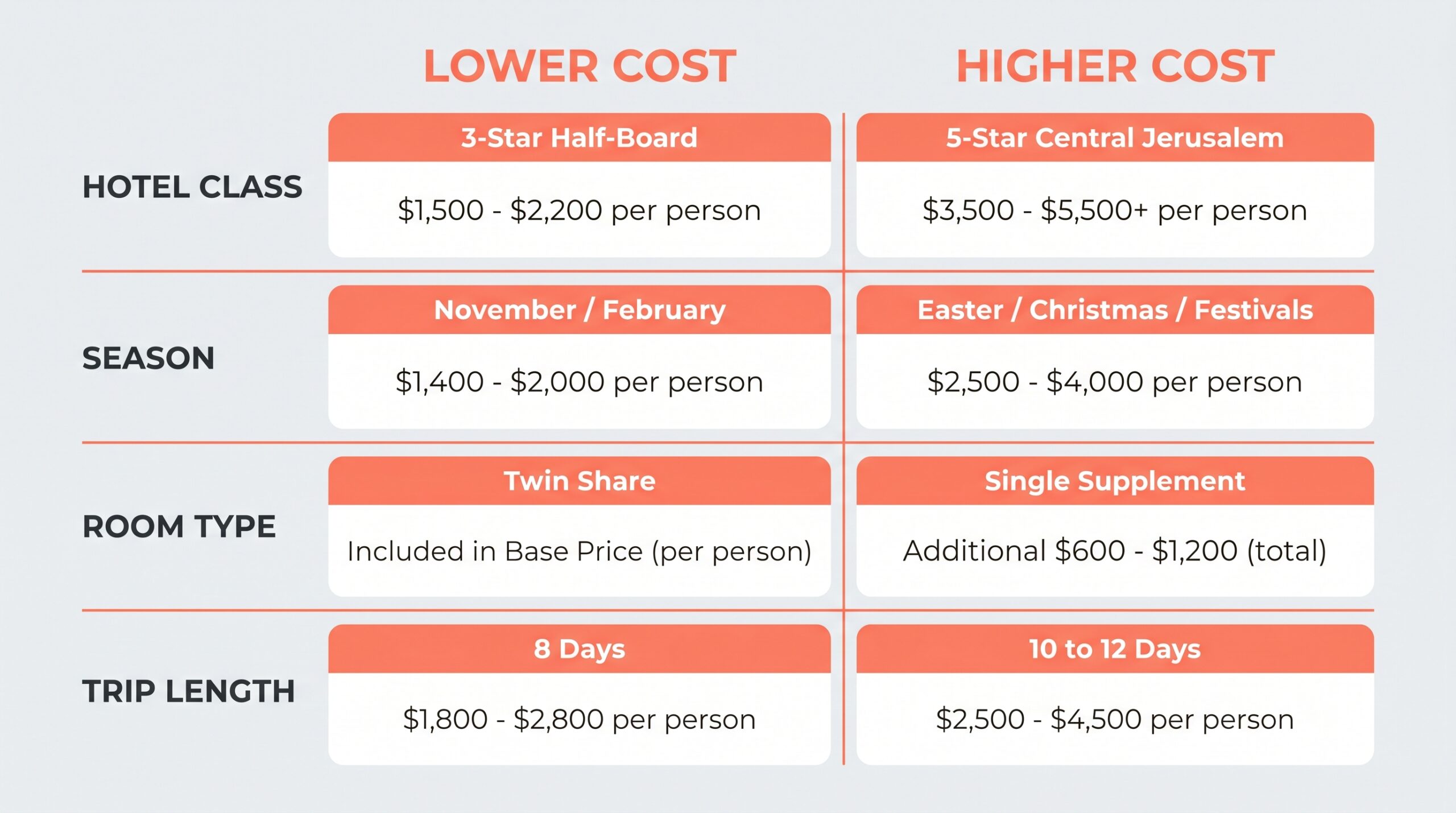
Price moves on a small number of drivers, and once you understand them the range stops feeling mysterious. The biggest single lever on Christian tours of Israel is hotel class.
Standard Class vs. Luxury Class Pricing
A 3-star, half-board program sits at the lower end of the per-person range, while a 5-star program with centrally located Jerusalem hotels can run substantially higher for the same itinerary. The biblical sites are identical regardless of hotel class. What changes is where the group sleeps and eats – and for a 10-day pilgrimage, that matters to some congregations more than others.
High Season Surcharges
Easter, Christmas, and the Hebrew festivals push hotel rates up sharply because demand spikes across the country at once. An American group of 40 booking for Resurrection Sunday should expect to pay meaningfully more than the same group traveling in early November, and should begin the booking process considerably earlier to secure the accommodation they need.
| Variable | Lower Cost | Higher Cost |
|---|---|---|
| Hotel class | 3-star, half-board | 5-star central Jerusalem |
| Season | November, February | Easter, Christmas, festivals |
| Room type | Twin share | Single supplement |
| Trip length | 8 days | 10 to 12 days |
Should You Book a Private Christian Tour or Join a Group Tour
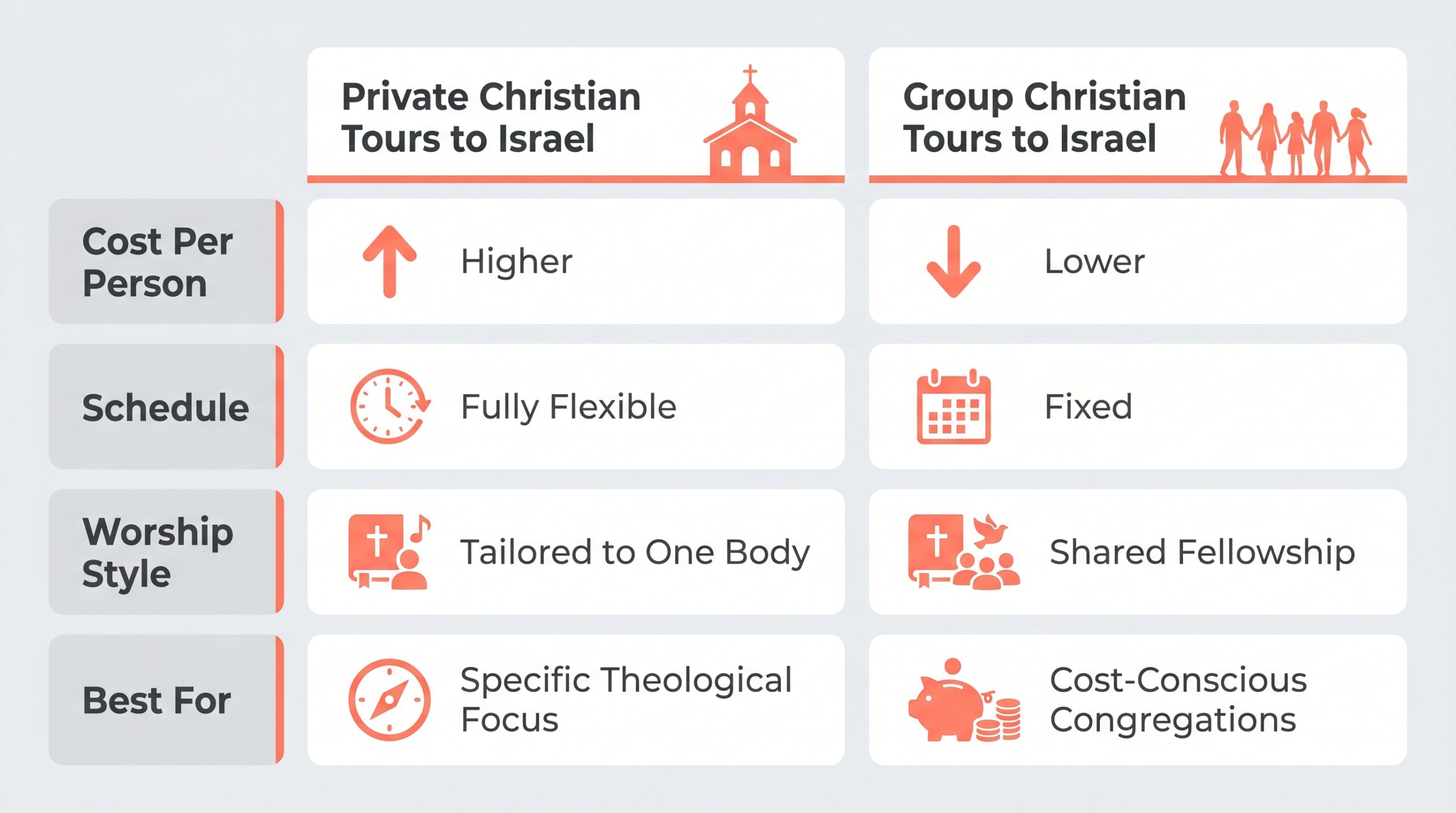
This decision shapes the whole feel of the pilgrimage, and there is no universally correct answer. It depends on what your congregation values and what your pastor wants the group to carry home from the experience.
A private tour gives custom routing, flexible timing, and room for theological deep-dives tailored to a single church. A group tour lowers the per-person cost and creates shared liturgy and corporate worship across the biblical sites. Many American congregations of 30 to 50 members land in the middle – traveling as one church group with a fully private guide and coach, which gives them the pacing benefits of a private arrangement at a cost closer to a shared program.
| Dimension | Private | Group |
|---|---|---|
| Cost per person | Higher | Lower |
| Schedule | Fully flexible | Fixed |
| Worship style | Tailored to one congregation | Shared fellowship |
| Best for | Specific theological focus | Cost-conscious congregations |
For Christian travel to Israel, Talya Tours often recommends a private guide even for a single church group, because it lets the pacing follow your pastor rather than strangers whose theological background and priorities may differ from your congregation’s.
Catholic vs. Evangelical Holy Land Pilgrimages – What Are the Differences
This is where the idea of one generic Christian tour falls apart. The site list, the sequence, and the ceremonies all shift with the tradition, and this is the core of how Talya Tours builds every Christian tour in Israel. The same is true across the broader spectrum – Methodist, Lutheran, Presbyterian, Anglican, Orthodox, Pentecostal, and Adventist groups each bring a different set of theological priorities to the same land.
Catholic Pilgrimage Routes
A Catholic itinerary centers on Eucharistic sites, the sacraments, and Marian devotion, with daily Mass arranged at appropriate chapels. Time is allocated to the Basilica of the Annunciation in Nazareth, the Visitation Church at Ein Karem (Luke 1:39-56), the Church of the Nativity in Bethlehem, and the Church of the Holy Sepulchre. American Catholic parishes following a liturgical calendar can register for a structured Catholic Pilgrimage to the Holy Land with daily Mass built into the program at each relevant site.
Evangelical Bible-Study Journeys
An Evangelical or Baptist program leans toward biblical exposition, interactive study, and outdoor teaching. The Mount of Beatitudes (Matthew 5:1-16), Capernaum, the Garden Tomb, and Jordan River baptisms carry the weight, with extended Scripture reading at each stop. To maximize teaching time at these landscapes, a focused evangelical tour emphasizes exposition over liturgy. Every conversation with Talya Tours begins the same way – which tradition is your group, and what does your pastor want them to carry home from Israel.
When Is the Best Season to Book Christian Travel to Israel
Season determines comfort more than almost any other factor, and walking sites in the wrong month can quietly undermine a strong itinerary. American groups planning their first pilgrimage are often surprised by how much the timing decision matters.
Spring and Autumn Windows
March through May and September through November give mild temperatures and low rainfall, which is ideal for the long walking days at Caesarea, the Old City, and the Galilee hillsides. These are the windows Talya Tours recommends for most Christian travel to Israel, particularly for larger American church groups traveling with members across a range of ages and physical conditions.
Summer Heat Conditions
July and August bring intense heat, especially around the Dead Sea and the Judean wilderness, where afternoon temperatures climb sharply. U.S. groups traveling in summer should plan early starts, keep water on the coach throughout the day, and check the official Israel Meteorological Service warnings before heat-exposed walking days.
Do Christian Tourists Need a Visa or ETA-IL to Enter Israel
The entry rules changed recently, and every group leader planning Christian tours of Israel needs the current version. What applied on your last trip may not apply now.
The ETA-IL Requirement
Travelers from visa-exempt countries, including the United States, must now obtain an ETA-IL – a digital travel authorization – before flying. The official explanation appears in the embassy notice and the group entry service page. The ETA-IL permits a tourist stay of up to 90 days. It is not a long-term visa, and as the help center makes clear, it does not by itself guarantee entry.
Official Entry Visa B/2 and eVisa Portals
American group members should confirm passport validity well ahead of travel and apply early. The official PIBA portals cover the process at the eVisa application page and the visa options page. Exemption status can be confirmed against the Ministry of Foreign Affairs exemption list. Talya Tours handles these applications for its groups so no American traveler arrives at the gate unsure of their authorization status.
Can You Visit Bethlehem on a Classic Christian Pilgrimage
Yes, and nearly every American group does. Bethlehem (Luke 2:1-7) sits inside the West Bank, in Area A, only a short drive south of the Mount of Olives – closer than most U.S. travelers expect when they look at a map for the first time.
Visiting the Church of the Nativity means crossing a checkpoint, and there is a protocol for it. Israeli-licensed guides hand the group to a licensed local Christian guide inside Bethlehem, who leads the visit to the Nativity and Shepherd’s Field. The crossing is routine for organized groups and typically takes only minutes. The seamlessness comes entirely from coordination – and that coordination is exactly the kind of operational detail Talya Tours has managed thousands of times across the Holy Land for American congregations of every denomination.
What Should You Pack for a Holy Land Tour in Israel
Two practical decisions determine comfort and site access more than anything else in your suitcase.
Modest Dress at Religious Sites
Many churches and holy sites require shoulders and knees to be covered for entry. A light scarf or shawl kept in the day bag solves this quickly, and the requirement applies to both men and women at sites such as the Church of the Nativity and the Basilica of the Annunciation. This applies regardless of denomination – the site regulations are the same for every visiting congregation.
Footwear and Sun Protection
Bring sturdy shoes with solid grip. Your group will be ascending Mount Tabor (Matthew 17:1-9) and crossing uneven ancient stone at Caesarea Maritima, and smooth-soled shoes are a problem on both surfaces. Add a wide-brimmed hat, sunscreen, and a refillable water bottle for the long open-air days. These are not optional comforts – they are functional requirements for a pilgrimage that involves several hours of walking each day.
What Questions Should You Ask Before Choosing a Tour Company in Israel
A few direct questions asked early will save a U.S. group leader real money and real stress later. Treat this as a short verification checklist before committing to any operator.
Ask whether the operator is registered with the Ministry of Tourism and whether its guides hold current, valid licenses, which can be confirmed against the official licensing standards. Ask whether they can accommodate your specific liturgical needs – daily Mass for a Catholic parish, a Jordan River baptism renewal for a Baptist congregation, or open worship time at Gethsemane for a Pentecostal group. Ask how many American groups from your specific denomination they have actually hosted, and what those programs looked like. Operators with real denominational experience, such as Talya Tours, will be able to answer that question with specifics rather than generalities.
Sample Itinerary – 8-Day Evangelical Pilgrimage
This is a working outline of a typical Evangelical program, built chronologically and weighted toward teaching sites. It serves as a model for Israel tours for Christians from Baptist, Evangelical, and similar Protestant traditions – not a fixed script, but a starting framework that Talya Tours builds upon after understanding your congregation’s specific focus.
| Day | Focus |
|---|---|
| 1 | Arrival at Ben Gurion Airport, drive to the coast |
| 2 | Caesarea Maritima, Mount Carmel (1 Kings 18:16-40), Megiddo, Tiberias |
| 3 | Boat ride on the Sea of Galilee, Capernaum (Mark 1:21-35), Mount of Beatitudes (Matthew 5:1-16) |
| 4 | Nazareth (Luke 1:26-38), Mount Arbel, Jordan River baptism renewal (Matthew 3:13-17) |
| 5 | Jericho, Judean Desert, entry into Jerusalem |
| 6 | Mount of Olives, Garden of Gethsemane (Matthew 26:36-46), Mount Zion |
| 7 | Garden Tomb, Western Wall, Southern Steps |
| 8 | Emmaus (Luke 24:13-35), Jaffa, departure |
Sample Itinerary – 10-Day Catholic Holy Land Journey
A Catholic program runs longer to make room for daily Mass and the sacramental sites. The contrast with the Evangelical outline above is the clearest illustration of why Talya Tours never reuses one program for two different traditions in the Holy Land.
| Day | Focus |
|---|---|
| 1 | Arrive Tel Aviv, transfer to Galilee |
| 2 | Mount Tabor, Church of the Transfiguration (Matthew 17:1-9), Cana wedding church Mass (John 2:1-11) |
| 3 | Basilica of the Annunciation, Tabgha Mass (John 6:1-15), Mount of Beatitudes |
| 4 | Peter’s Primacy, Capernaum, boat ride on the Sea of Galilee |
| 5 | Qumran, Dead Sea, Bethany |
| 6 | Bethlehem, Church of the Nativity (Luke 2:1-7), Shepherd’s Field Mass |
| 7 | Palm Sunday road, Mount of Olives, Dominus Flevit, Gethsemane Mass |
| 8 | Church of the Holy Sepulchre, Calvary Mass (John 19:17-42), Via Dolorosa |
| 9 | Ein Karem, Visitation Church (Luke 1:39-56), Yad Vashem |
| 10 | Departure from Tel Aviv |
Background on the Mount Tabor sites appears in the official Mount Tabor nature reserve page and its trail guide.
How to Start Planning Your Custom Christian Tours in Israel with Talya Tours
Planning a pilgrimage is simpler than most American faith leaders initially expect, and it begins with two numbers and one question.
Defining Group Size and Budget
Tell us the approximate headcount and the hotel class your congregation has in mind. Group leaders organizing a delegation can sometimes receive a complimentary place depending on the final number traveling, which is worth raising early in the conversation. A congregation of 40 from Atlanta and a fellowship of 18 from Phoenix are quoted very differently, and knowing the basics upfront makes the planning process faster and more accurate.
Customized Liturgy and Schedule
Then comes the question Talya Tours always asks first. What tradition is your group, and what does your pastor want them to experience. From that answer, we build a route that maps directly onto your ministry – daily Mass for a Catholic parish, baptism renewals for a Baptist church, worship space at Gethsemane for a Pentecostal congregation, or extended teaching time at the Mount of Beatitudes for a Methodist or Presbyterian group. We do not start from a template. We start from your church. Owner Talya Felner is personally involved with each group, and pilgrimage to Israel is the only business we do.
Frequently Asked Questions
How far in advance should an American church group book a pilgrimage to Israel?
Six to twelve months ahead is the practical window for most U.S. groups. If your congregation is planning to travel at Easter, Christmas, or during the Jewish high holidays, twelve months is the minimum to secure the accommodation and guide availability you need. Groups traveling in shoulder season have more flexibility, but earlier is always better when traveling with 30 or more people whose schedules and passports need to align.
Can Talya Tours accommodate both Catholic and Protestant travelers in the same group?
Yes, but the itinerary needs to reflect that mixed composition honestly. When a group includes both Catholic and Evangelical travelers, we build a schedule that gives meaningful time to sites that matter to both traditions – the Church of the Holy Sepulchre and the Garden Tomb can both be visited, for instance, with the guide framing each one appropriately. The key is that we know the composition of the group before we plan, not after. A blended group handled as if it were a single tradition serves no one well.
What is the minimum group size for a private tour with Talya Tours?
There is no fixed minimum, though smaller groups under 10 will find private-tour pricing higher on a per-person basis. Most American church groups traveling with Talya Tours fall between 20 and 50 participants, which is the range where a private coach and dedicated guide make the most financial sense. Smaller delegations – a pastor and spouse, a family, or a study group of six – can still travel privately; the per-person cost simply reflects the smaller base over which fixed expenses are spread.
Can a Baptist or Pentecostal group arrange a Jordan River baptism renewal on their itinerary?
Yes, and it is one of the most frequently requested elements for Baptist, Pentecostal, and Charismatic groups from the United States. The Yardenit site on the Jordan River is set up specifically for this, with changing facilities, white baptism garments available for rental, and a setting that many American travelers describe as one of the most significant moments of their trip. Talya Tours coordinates the timing, garments, and logistics in advance so the moment itself is entirely focused on the experience.
Are flights included in Christian Holy Land tour packages from Talya Tours?
Standard packages from Talya Tours are land-only, meaning flights from the United States to Israel are arranged separately. This is the norm for Israel-based tour operators. Many American group leaders find it more practical to handle flights through a U.S. travel agent who can block-book seats, manage frequent flyer accounts, and deal with U.S. carriers directly. Talya Tours takes over from the moment your group lands at Ben Gurion Airport and handles all logistics from that point forward.
How does Talya Tours handle itinerary changes if security conditions shift during the trip?
Talya Tours monitors the National Security Council and Ministry of Foreign Affairs advisories daily throughout your trip. If a site or area requires rerouting, the team adjusts the day’s plan and substitutes an equivalent site so the group experiences minimal disruption. The coach and guide remain with the group throughout, which is what makes real-time rerouting possible. Groups that have attempted to mix private transport with public transit have far less flexibility in this respect – a situation Talya Tours deliberately avoids by keeping all logistics under one operational roof.
Christian tours to Israel are pilgrimages built around the biblical text, and they work best when every element – the sites visited, the worship arrangements, the guide’s framing at each stop, and the pace of the day – is shaped by the specific tradition of the American group making the journey. There is no single program that serves a Catholic parish, a Baptist congregation, and a Pentecostal fellowship equally well, because their theological priorities are genuinely different. Talya Tours builds each itinerary from the denomination outward, which is why the planning conversation always starts with one question – who is your group, and what does your pastor want them to carry home.
If your American congregation is beginning to think about a Holy Land pilgrimage, Talya Tours is glad to talk through the details before you commit to anything. You can reach Talya directly at [email protected] or submit an inquiry through the contact page.
Start Your Group’s Pilgrimage Planning Today
Tell us your denomination, your approximate group size, and the time of year you have in mind. Talya Tours will build an itinerary around your congregation’s specific tradition and priorities – not a recycled template. No commitment required to begin the conversation.
About the Author

Talya Felner
Owner and CEO, Talya Tours Services (TTS)
Talya Felner is the Owner and CEO of Talya Tours Services (TTS), a professional tour operator in Israel with over 35 years of experience and more than 90,000 travelers served. Talya has built TTS into a trusted name for Christian pilgrimages, biblical tours, and conferences for American groups visiting Israel and the Holy Land. Her team designs each itinerary around the specific Christian denomination of the visiting group – whether Protestant, Catholic, Evangelical, Baptist, Methodist, Pentecostal, Lutheran, Presbyterian, Anglican, Orthodox, or another tradition – ensuring that sites, worship arrangements, and guides reflect what matters most to that congregation. From ETA-IL processing and accommodations to guides, transportation, and on-site coordination, TTS handles every detail so American pastors and group leaders can focus on the spiritual experience of their travelers.