
Planning a Holy Land tour for an American congregation usually starts with one practical question, what will the trip actually cost per traveler. This article lays out the real numbers behind a Holy Land pilgrimage for U.S. groups, from land packages and airfare to the expenses that surface after the invoice is signed. It also explains why the itinerary, and often the price, shifts depending on the denomination of the traveling group, whether Protestant, Catholic, Evangelical, Baptist, Methodist, Pentecostal, Lutheran, Presbyterian, Anglican, Orthodox, or another Christian tradition.
Reading time: 5 minutes
Key Points
- A 9 to 10 day Holy Land land package for American groups typically runs $1,750 to $2,500 per person in a 4-star hotel, before airfare.
- Trip length changes the daily cost significantly, since coach, guide, and hotel fees apply per night regardless of group size.
- Expenses beyond the invoice, meals, tips, insurance, and a possible single room supplement, generally add $600 to $1,000 per person.
- Every itinerary is built around the denomination of the traveling group, since site visits, worship arrangements, and pacing differ between Protestant, Catholic, Evangelical, and other Christian traditions.
Table of Contents
- What Determines the Cost of a Holy Land Tour
- The Costs That Appear After the Invoice Is Paid
- Trip Length and the Arithmetic of Each Additional Day
- What the Package Price Actually Covers
- Airfare and What Land-Only Really Means
- Hotels and Seasons, the Two Dials That Move the Total
- Why Larger Groups Pay Less Per Person
- Frequently Asked Questions
What Determines the Cost of a Holy Land Tour
The first distinction worth fixing in your head is the difference between the land package and the total trip cost. The land package is what the ground operator provides in Israel, hotels, guiding, transport, entrance fees, and most meals, from arrival at Ben Gurion Airport to departure. Airfare from the United States sits on top of that figure, and personal spending sits on top again.
Three tiers cover most American groups. The variable that surprises pastors most is not hotel star rating, it is trip length, because every additional night carries a hotel bill, a guide fee, a coach fee, and a dinner, whether the group is eight people or forty.
| Tier | Hotels | 9 to 10 day land package, per person | Estimated total with airfare |
|---|---|---|---|
| Budget | 3-star, often outside city centers | $1,250 to $1,750 | $2,300 to $3,200 |
| Standard | 4-star, central Jerusalem and Galilee | $1,750 to $2,500 | $2,900 to $4,200 |
| Premium | 5-star or boutique, prime locations | $2,900 to $4,300 | $4,300 to $6,000 and above |
A well-built quotation includes entrance fees, guiding, coach, and dinners inside the per-person rate, with the few items left outside it written down in the same document rather than discovered on arrival. Longer itineraries and richer inclusions are what separate a genuinely planned Holy Land tour from one that looks appealing on a flyer but falls short on the ground.
The Costs That Appear After the Invoice Is Paid
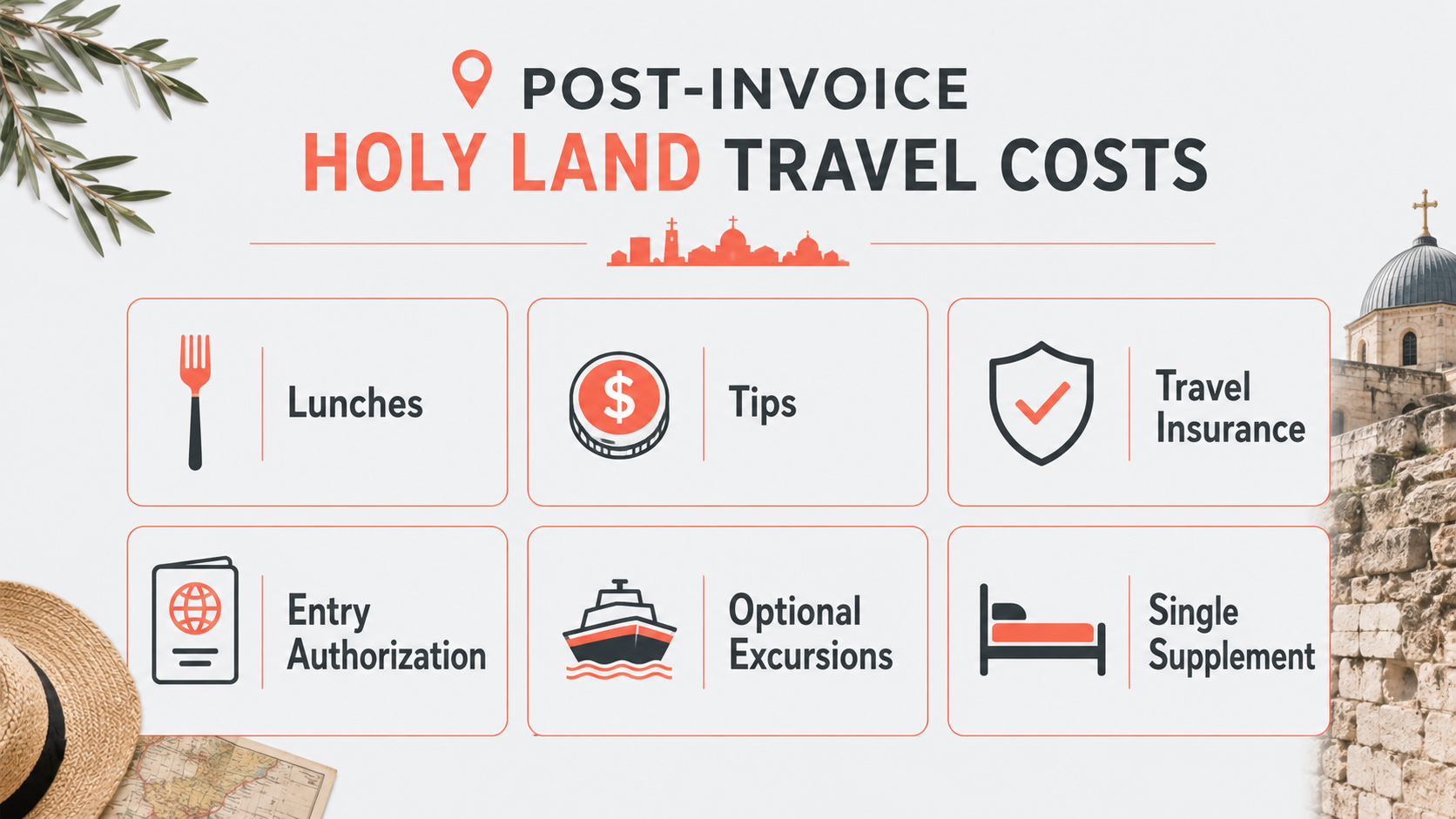
Typical out-of-pocket expenses on a 10-day Holy Land trip.
None of these items are large individually, but together they run $600 to $1,000 per person on a 10-day trip. Lunches are almost never included by design, since groups eat at different speeds and prices, and a fixed lunch for forty people costs more than it saves. Budget $12 to $20 a day. Beverages at dinner, including bottled water, are billed separately in Israeli hotels, which surprises American travelers more than anything else on this list.
Travel insurance is not included and should not be skipped. Most American travelers also need an electronic travel authorization before boarding, a small government fee explained in the official ETA-IL notice. It costs under ten dollars, and missing it is the one paperwork failure that stops a traveler at the departure gate in the United States.
Pilgrimage pricing assumes two people sharing a room. A solo traveler taking a room alone pays the hotel’s difference, typically $55 to $110 per night, or $500 to $1,000 across a 10-day trip. We try to match willing roommates within a group when the pastor allows it.
| Item, 10-day trip | Typical range per person |
|---|---|
| Lunches | $120 to $200 |
| Tips for guide, driver, hotel staff | $120 to $170 |
| Travel and cancellation insurance | $120 to $300 |
| Entry authorization | Under $10 |
| Single room supplement, if applicable | $500 to $1,000 |
Daily Spending and Tipping
A workable daily formula is $15 for lunch, $20 set aside for gifts and religious articles, and $10 held in reserve, which totals $45 a day. Most American travelers spend between $30 and $60 daily. Purchases above the government minimum at participating shops qualify for a VAT refund processed before departure, described on the airport authority’s Ben Gurion VAT refund page. Keep invoices in carry-on luggage, not in a checked bag.
Tipping follows a settled custom for tour groups, roughly $8 to $10 per traveler per day for the guide, $4 to $6 per traveler per day for the driver, and about $2 a day for hotel staff. We state this separately rather than bundling it into the invoice, so a group leader knows the exact figure before departure and never has to raise the subject again with the congregation.
Trip Length and the Arithmetic of Each Additional Day
A 7-day trip does not cost seven tenths of a 10-day trip. Airfare is a fixed block, typically $900 to $1,600 depending on gateway and booking date, and it does not shrink with fewer nights. Spread over five touring days it feels heavy. Spread over eleven it looks reasonable.
| Length | Land package, 4-star, per person | With airfare | What it covers |
|---|---|---|---|
| 7 days | $1,300 to $1,850 | $2,400 to $3,400 | Jerusalem, Bethlehem, one Galilee day, Dead Sea or Masada |
| 10 days | $1,750 to $2,500 | $2,900 to $4,200 | Full Galilee and Jerusalem circuit, Caesarea, Dead Sea, Masada |
| 14 days | $2,600 to $3,700 | $3,700 to $5,400 | All of the above plus Negev, extended northern sites, unhurried pacing |
Length is also where denomination begins to change the invoice. A Southern Baptist congregation and a Catholic parish do not spend fourteen days the same way. A Baptist group typically wants extended time at the Garden Tomb, a baptism renewal at the Jordan River, and unhurried Scripture reading at the Mount of Beatitudes and Capernaum. A Catholic parish needs Mass arranged in advance at specific chapels, time on the Via Dolorosa, and visits to the Church of the Holy Sepulchre and the Basilica of the Annunciation, which is the shape of the Catholic tours of the Holy Land we coordinate. Different sites, different permissions, different pacing, and occasionally a slightly different cost.
Sample 10-Day Budget, Mid-Range, Per Person
For a group of thirty in 4-star hotels, double occupancy, traveling in November, figures land approximately as follows. Land package $2,150, covering nine hotel nights, breakfast and dinner daily, a licensed guide, a coach, and all site entrances. Round-trip airfare $1,150 from a mid-size gateway with one connection. Tips $130 across the trip. Lunches and personal spending $400 at $40 a day. Travel insurance $160. Entry authorization and incidentals $60. Total in the region of $4,050, with an optional side excursion adding $450 to $650 if the pastor wants it.
What the Package Price Actually Covers
A proper land price should include accommodation on the stated basis, breakfast and dinner every day, an air-conditioned licensed coach with a professional driver, a government-licensed guide for the full program, all entrance fees, porterage at hotels, and airport assistance on arrival and departure.
Entrance fees are the line most often underestimated. Masada with the cable car, Caesarea, Qumran, Beit Shean, Tel Dan, and Banias are national park sites with published rates set by the Israel Nature and Parks Authority, verifiable on its official entrance fee schedule. Across a 10-day itinerary these add up to $70 to $110 per person. If a quotation is silent about them, they are not included.
The Checklist to Send With a Quote Request
Ask each operator to confirm in writing the hotel names and star rating for every night, not a category description. The meal basis, stated plainly. Whether one licensed guide accompanies the group throughout or changes daily. Coach size and whether it stays with the group. Entrance fees to every site on the itinerary. Airport transfers on both ends. Ceremonies, meaning baptism arrangements, communion, Mass, or a group worship slot, listed by site and matched to the group’s denomination. The single room supplement. Payment schedule and cancellation terms. An operator who cannot produce these answers within a day is not ready to carry a congregation.
If you are pricing a Holy Land trip for a U.S. congregation, we can provide a written cost breakdown built around your dates, group size, and denomination, whether Protestant, Catholic, Evangelical, Baptist, Pentecostal, Methodist, or another tradition. There is no obligation attached to asking.
Airfare and What Land-Only Really Means
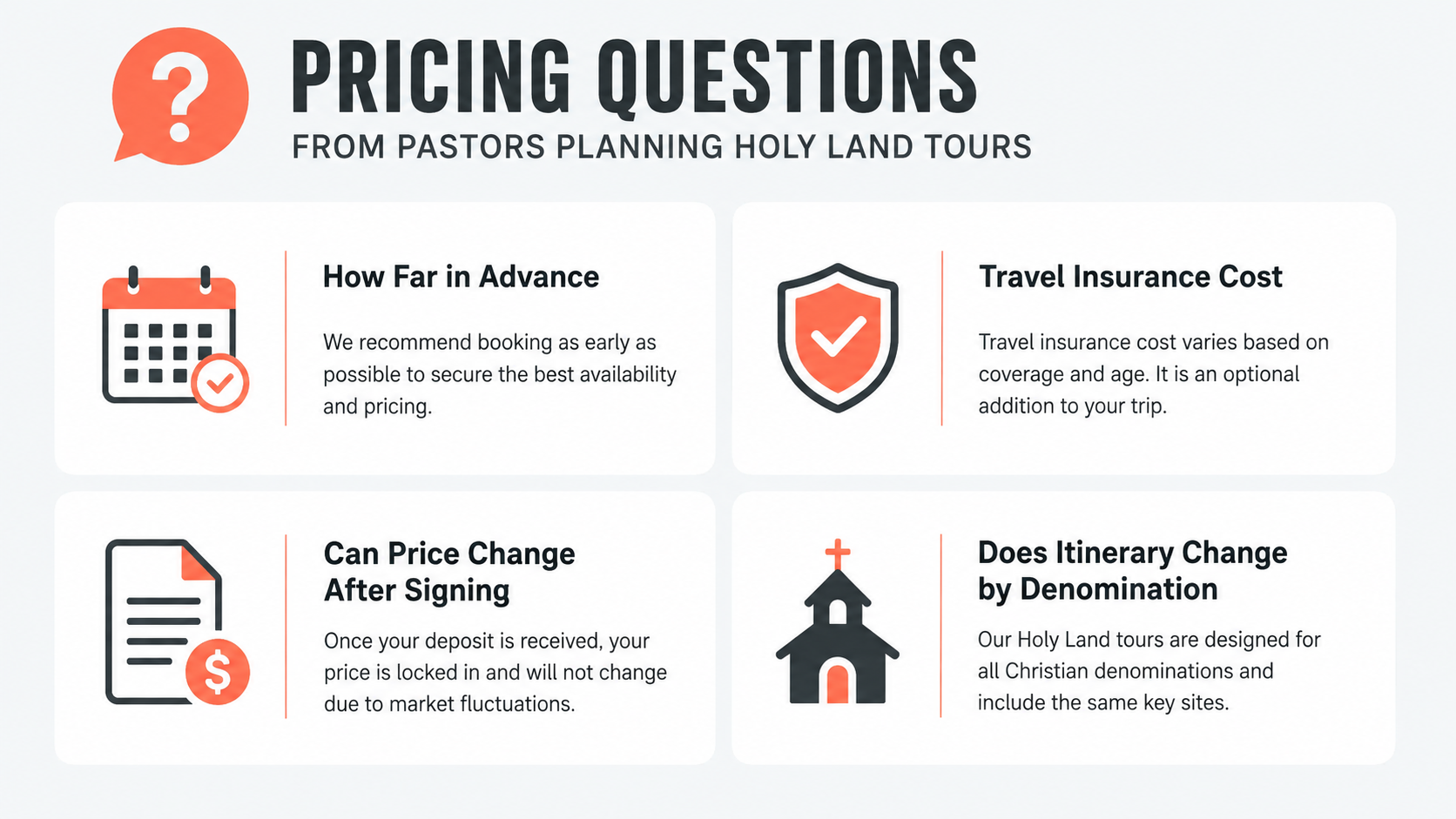
Airfare and land-only pricing questions American pastors ask most often.
Airfare is the least predictable component of a Holy Land trip. From New York or Newark, non-stop tickets to Tel Aviv have run $850 to $1,400 in normal seasons. From Atlanta, Dallas, Chicago, or Houston, expect $1,000 to $1,600 with a connection. Around Easter, Passover, and late December, the same seat can cost $1,800 or more, and it sells out early.
Group contracts change this picture. Airlines issue block space for ten or more passengers traveling together, usually with a deposit, a name deadline around forty-five days before departure, and a fixed fare that does not move when the public price climbs. For a congregation of thirty booking eight months out, that contract is often worth $150 to $300 per seat compared with individuals booking separately close to departure.
A land-only price covers everything from arrival at Ben Gurion to the departure drop-off, and nothing in the air. It suits pastors using airline miles, travelers extending their trip on either end, and families arriving on different flights. The pricing is identical to a full package minus the ticket.
Land-Only Pitfalls to Watch For
Land-only pricing breaks in two places. The first is arrival timing, since a group split across different arrival times means two transfers instead of one, and the second is billed. The second is the pre-tour night, since a traveler arriving the evening before the program starts needs a hotel room not included in the package, at $130 to $220 depending on the city, plus a transfer. We would rather itemize that cost at the planning stage than have a tired traveler negotiating at a Tel Aviv front desk at midnight.
Hotels and Seasons, the Two Dials That Move the Total
Hotel choice is the single largest controllable line in the total. Per person in a shared room, a 3-star property runs $70 to $95 a night, a 4-star $110 to $170, and a 5-star $210 to $330. Multiplied across nine nights, the tier decision alone shifts the total by well over $1,000.
Location carries its own premium. A hotel inside Jerusalem’s center, walking distance from the Old City walls, costs meaningfully more than one on the western approaches. Sometimes the premium is worth it, since groups that can walk to the Mount of Olives area before the coaches arrive get something no schedule can replicate. Sometimes it is not, since a group of forty is on the bus by 7:30 regardless.
Season moves hotels and flights together. Easter week, Passover, Christmas, and the October feast period are peak, with rates rising 20 to 40 percent. January, February, and mid-summer are lower. Late October, November, and early March are value windows, when Jerusalem daytime temperatures sit comfortably in the sixties and low seventies according to multi-year averages published by the Israel Meteorological Service, and hotels are still discounting.
Why Larger Groups Pay Less Per Person
A licensed coach with a driver costs the same per day whether four people or forty-four are on it. So does a licensed guide. Those two items run roughly $1,100 to $1,600 per touring day combined. Divide that by eight travelers and it is $140 to $200 per person per day before a single hotel night is counted. Divide it by thirty-two and it is $35 to $50.
That arithmetic explains most of the price difference between a private family tour and an organized group trip, and it is why a church group of thirty often pays 30 to 40 percent less per person than a private itinerary of the same standard. Most operators, including ours, grant one complimentary place above a certain group size, which pastors typically apply to the trip leader. Private touring still makes sense for delegations of six to eight with specific requirements, but it will not deliver group economics.
Frequently Asked Questions
How far in advance should our church book?
Six to twelve months. That window secures the group airfare contract, the hotel block, and the guide. For Easter or Christmas travel, twelve months is standard, not early.
How much should we budget for travel insurance?
Expect 5 to 10 percent of the total package cost, more for travelers over seventy. Cancellation coverage matters as much as medical coverage for group leaders, since congregations typically lose a few participants to family circumstances before departure.
Can the price change after we sign?
A confirmed land price is held. What can move is airfare before ticketing, and any element the group itself changes, such as adding an excursion or upgrading hotels after the block is confirmed. A well-written quotation separates the guaranteed portion from the variable portion clearly.
Does the itinerary really change based on our denomination?
Every time. The first questions we ask a new group concern the congregation’s tradition, what the pastor wants his people to experience, and which ceremonies need arranging on site. A Pentecostal ministry asking for extended worship time in the Garden of Gethsemane needs a different schedule from a Methodist group focused on quiet teaching at Tabgha, and an Assemblies of God group planning baptisms at the Jordan River needs something different again. Site selection, worship arrangements, and guide assignment all follow the group’s denomination.
What is the practical difference between land-only and a full package?
Land-only covers hotels, guiding, transport, and entrance fees from arrival to departure in Israel, with airfare arranged separately by the traveler or church. A full package adds group airfare on top, usually secured through an airline block contract that locks in a fare months before departure.
A Holy Land tour for an American congregation typically lands between $2,500 and $5,500 per person once airfare, hotels, and incidental costs are counted, and the gap between those figures comes down to trip length, hotel tier, season, and group size, all of which a pastor can plan around. Just as important, the specific plan, sites, worship time, and pacing, should reflect the denomination making the journey rather than a generic template. If you would like a written breakdown built around your congregation’s dates, size, and tradition, reach out to Talya directly at [email protected] or through the contact page.
Send your travel dates, approximate group size, and denomination, and we will prepare a itemized cost breakdown for your congregation’s Holy Land trip. There is no obligation attached to asking.

About the Author
Talya Felner is the Owner and CEO of Talya Tours Services (TTS), a leading professional tour operator in Israel. With over 35 years of experience and more than 90,000 travelers served, Talya has built TTS into a trusted name for Christian pilgrimages, biblical tours, and conferences for groups visiting Israel and the Holy Land. Her team designs each itinerary around the specific Christian denomination of the visiting group, whether Protestant, Catholic, Evangelical, Baptist, Methodist, Pentecostal, Lutheran, Presbyterian, Anglican, Orthodox, or another tradition, ensuring that sites, worship arrangements, and guides reflect what matters most to that congregation. From visas and accommodations to guides, transportation, and on-site coordination, TTS handles every detail so American pastors and group leaders can focus on the spiritual experience of their travelers.