
A United Methodist congregation from Columbus, Ohio recently sent us a roster of 34 travelers with an average age of 71. Four walked with a cane, one used a rollator, two had knee replacements within the last three years, and one 84-year-old gentleman wanted to stand once more in Capernaum (Mark 1:21-35) before he stopped flying long haul. That roster became the itinerary. Over more than 35 years and above 90,000 travelers served, we have found that a senior group does not need a shorter trip. It needs a differently ordered one, and this article explains how pacing, site access, and denomination-specific planning work together for American church groups planning a trip to Israel.
Reading time: 9 minutes
Key Points
- Senior itineraries typically run 10 to 12 days across three or fewer hotels, which reduces the packing and repacking that adds up to real fatigue.
- Coach routes are planned around elevation, dropping groups at the higher point of a site and collecting them at the lower point rather than retracing an uphill climb.
- Spring (mid-March to mid-May) and autumn (mid-September to mid-November) offer the most comfortable temperatures for older travelers.
- Every itinerary is built around the visiting group’s specific denomination, whether Catholic, Baptist, Pentecostal, Presbyterian, or another Christian tradition, rather than a single generic template.
Table of Contents
- What Are Holy Land Tours for Seniors
- Cobblestones Do Not Care How Fit You Were at Fifty
- How Much Walking Is Actually Involved
- Pace Matters More Than the Number of Sites
- Which Months We Recommend, and Which We Quietly Discourage
- The Operational Checklist That Defines a Senior-Friendly Trip
- A Catholic Parish and a Baptist Congregation Do Not Receive the Same Itinerary
- Site by Site, What Is Genuinely Accessible and What Is Not
- Seven Days, Ten Days or Twelve, What Stamina Actually Dictates
- Paperwork, Packing and the Safety Question
- Departure Dates You Can Plan a Year Around
What Are Holy Land Tours for Seniors
The term describes a full pilgrimage or vacation itinerary, usually 7 to 12 days, engineered around walking distance, rest intervals, and vehicle access rather than around how many sites can be squeezed into a day. A standard group tour will place four major stops into a single morning. A senior program places two, with the coach parked closer, seating arranged in advance, and a genuine pause built between stops.
Three things change in practice. Walking segments stay short and mostly downhill where the terrain allows. Coaches drop off and pick up at different points, so nobody retraces a climb. Hotels are chosen for elevator access and central location, not price alone.
This is planning work, not marketing language. You can read more about Talya Tours and how we handle comfort-led, faith-focused travel management. On arrival, groups also have access to the official tourist information office at Ben Gurion Airport, though our own staff meet every group at the terminal exit.
Cobblestones Do Not Care How Fit You Were at Fifty
The Old City of Jerusalem is built on limestone polished by roughly two thousand years of foot traffic. It is uneven, occasionally slick, and stepped in places where a ramp is physically impossible. The descent from the Mount of Olives toward Gethsemane (Matthew 26:36-46) is steep. The Via Dolorosa (Luke 23:26-33) narrows in places where a group has to move single file past market carts.
None of that rules out a pilgrimage. It rules out improvising.
Well-built senior itineraries use adaptive routes, the upper entrance instead of the lower one, a visitor center elevator instead of the stairs, a shorter loop at a national park where the Israel Nature and Parks Authority maintains a published list of accessible routes. Before booking, be honest about one number. How many minutes can you stand still, without a seat, before your back or knees signal that it is time to sit down. Twenty minutes is a normal answer for many travelers in their seventies. Tell your organizer that number. It changes how we schedule the Church of the Holy Sepulchre (John 19:41-42), where queues form and seating is limited.
What “Moderate Physical Activity” Actually Means in an Itinerary
In tour brochures, “moderate” usually means one to three miles of walking spread across a full day, with 15 to 40 minutes of standing at each major site. Standing is the part that catches people off guard. A basilica visit is not a hike, but 35 minutes upright on stone with no bench is harder on the body than a flat mile.
Sensible senior travel planning translates the vague word into questions you should ask your coordinator directly. How many steps lead to the entrance of this church. Is there seating inside, and how much. What is the longest single stretch without a restroom. How far is the coach parked from the gate. If a coordinator cannot answer those four questions for each site, they have not walked the route recently.
How Much Walking Is Actually Involved
On a well-planned itinerary for older travelers, expect 1 to 2.5 miles per day, almost never in one continuous stretch. A typical Jerusalem day breaks into segments of 300 to 700 yards each, separated by a stop, a talk, and a chance to sit.
Flat paved ground is not the issue. Nazareth’s Basilica of the Annunciation (Luke 1:26-38) has good modern surfaces around it. Capernaum (Mark 1:21-35) is largely level and boardwalked. The strain comes from stone steps and from the Old City’s gradients, which climb and drop repeatedly inside a very small area.
Coach positioning is what saves legs. Dropping a group at the top of the Mount of Olives (Acts 1:9-12) and collecting it at the bottom of the Kidron Valley removes an uphill return of roughly 500 feet of elevation. That single scheduling decision affects a senior group’s energy more than any other line in the program.
A Sample Easy-Paced Jerusalem Day
| Time | What Happens | Walking | Why We Set It This Way |
|---|---|---|---|
| 08:45 | Coach departs hotel | None | No early wake-ups; breakfast is unhurried |
| 09:20 | Mount of Olives overlook (Acts 1:9-12) | About 200 yards, flat | Orientation talk with seating at the lookout wall |
| 10:00 | Descent to Gethsemane (Matthew 26:36-46) | 600 yards, downhill | Coach waits below; nobody walks back up |
| 11:15 | Coach transfer, Scripture reading on board | None | Air-conditioned rest built into the schedule |
| 12:30 | Seated lunch, 75 minutes | Short | Restrooms, medication, and shade |
| 14:15 | Garden Tomb (John 20:1-18) or Holy Sepulchre (John 19:41-42), by tradition | 400 yards | Site selected according to the group’s denomination |
| 16:00 | Return to hotel, evening free | None | Rest before dinner is not optional at this age |
Pace Matters More Than the Number of Sites
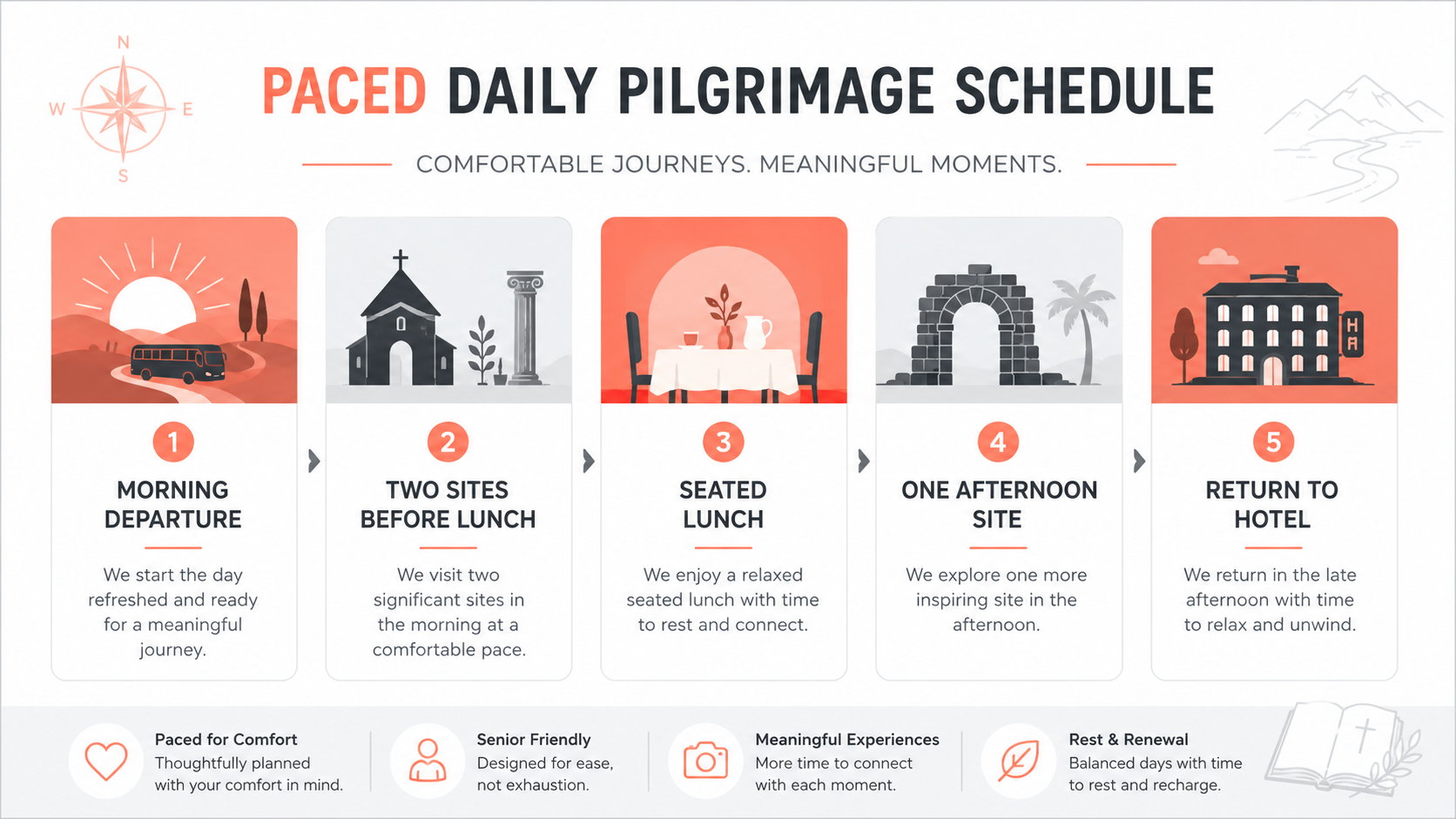
A paced itinerary spreads fewer sites across a full day rather than crowding the schedule.
Groups that try to see eleven sites in a day remember the bus. Groups that see six remember Tabgha (John 6:1-15) in the late morning when the church is quiet and the mosaic of the loaves and fishes is not surrounded by three other coaches.
Our senior itineraries run on a simple structure. Departure between 08:30 and 09:00. Two substantial sites before lunch. Lunch seated and long. One site in the afternoon, occasionally two if both are level. Return to the hotel by late afternoon, with the evening free for the group’s own worship, prayer, or simply an early night.
Pastors sometimes push back on this at the planning stage, because the day looks light on paper. By day four they stop pushing back. Fatigue in a group of 30 travelers over 70 does not accumulate gradually. It arrives all at once, usually on the fourth morning, and takes two days to recover from.
Which Months We Recommend, and Which We Quietly Discourage
Spring, roughly mid-March through mid-May, and autumn, mid-September through mid-November, are the two windows we recommend for almost every senior group. Daytime temperatures sit in a comfortable range, the light is good, and the Galilee is green in spring.
Summer is the problem. July and August bring sustained heat, and along the coast humidity pushes the heat load higher than the thermometer suggests, as the Israel Meteorological Service documents in detail. The Dead Sea and the Judean Desert run considerably hotter than Jerusalem on the same day. Israel’s Ministry of Health publishes specific heat protection guidance for older adults, and it matters here. Sensible planning treats August at Masada the way you would treat a Phoenix afternoon in July.
| Season | Conditions | Crowds | Our View |
|---|---|---|---|
| March to May | Mild days, green Galilee, occasional rain in March | High around Easter and Passover | Best overall; book 10 to 12 months ahead for Holy Week |
| June to August | Hot, humid on the coast, very hot in the desert | Moderate | Only with heavily shortened outdoor time |
| September to November | Warm early, comfortable by October, stable | Peaks around autumn Jewish holidays | Our first choice for slower-walking groups |
| December to February | Cool, wet spells, Jerusalem can be cold at night | Low except Christmas | Workable, fewer people at the sites, pack layers |
The Operational Checklist That Defines a Senior-Friendly Trip
Some features are non-negotiable and worth verifying in writing before deposits are paid. Modern air-conditioned coaches with a low first step, working handrails, and a functioning restroom on longer transfers. Centrally located hotels with elevators, so nobody is on the third floor of a building with stairs only. Luggage handled door to door, from the airport belt to the hotel room and back again. Portable seating or guaranteed benches at the longer standing sites. Guides licensed by the Ministry of Tourism who have worked with mature groups and know to count heads twice and speak slowly.
Guide selection matters more than most people assume. A guide who is excellent with a college group can be exactly wrong for a congregation of 68-year-olds. Patience, volume, pacing, and the instinct to notice when someone at the back has gone quiet are the qualities we look for. That is a small pool of professionals, which is one reason senior itineraries need to be booked further ahead than standard tours.
Checkpoints Before You Sign With Any Operator
Ask for the maximum group size in writing, not the average. Ask what happens medically at 2 a.m. in Tiberias, and who makes the call. Ask whether the operator has a working relationship with hospitals in Jerusalem, Tiberias, and Tel Aviv. Ask how diabetic, low-sodium, gluten-free, and soft-food diets are handled at hotel buffets and restaurant lunches, and whether that was arranged in advance or is left to the traveler each day.
Talya Tours handles mobility and medical particulars traveler by traveler, before departure, on a named list, not as a category, as individuals.
Why 12 to 25 Passengers Changes the Whole Trip
A 50-seat coach takes roughly 12 minutes to board and unload at every stop. Multiply that by seven stops a day and you have lost more than an hour of standing and waiting, most of it in the sun. A group of 18 boards in four minutes.
Small groups also fit inside the sites. The Church of the Nativity (Luke 2:1-7) entrance, the grotto below, and the narrow chapels of the Holy Sepulchre (John 19:41-42) were not designed for 50 people at once. With 20, a guide can speak at conversational volume and everyone hears. With 50, half the group stands outside. For safety and simple comfort, we cap most senior programs at 25.
If your congregation is planning a trip with older travelers in mind, we can walk through pacing, hotel access, and group size before anything is booked. Every plan is built around your group’s specific denomination.
A Catholic Parish and a Baptist Congregation Do Not Receive the Same Itinerary
This is the part that generic operators get wrong. They print one “Christian tour” and send it to every group. Our conversation with a new group starts with one question, what tradition is your congregation, and what does your pastor or priest want the group to carry home.
A Catholic parish from a diocese in Pennsylvania receives daily Mass arranged at the appropriate sanctuaries, Mass at the Holy Sepulchre (John 19:41-42) where scheduling allows, the Basilica of the Annunciation (Luke 1:26-38) in Nazareth, the Church of the Nativity (Luke 2:1-7) in Bethlehem, and the Stations along the Via Dolorosa (Luke 23:26-33) with a spiritual director accompanying the group. For seniors, we reserve chapels with seating and step-free entry, and we shorten the Stations by starting at the point where the coach can wait. Nobody misses the sacraments because of a staircase. For a program built around these traditions, see our Catholic Pilgrimage to the Holy Land.
A Southern Baptist congregation from Nashville gets a different map. The Garden Tomb (John 20:1-18) rather than the Sepulchre as the primary Resurrection site, extended open-air Scripture reading at the Mount of Beatitudes (Matthew 5:1-16), a baptism renewal service at the Jordan River (Matthew 3:13-17), and long unhurried time at Capernaum (Mark 1:21-35). A Pentecostal ministry from Tulsa will want extended worship and prayer on the Mount of Olives (Acts 1:9-12) and in the Garden of Gethsemane (Matthew 26:36-46), which means booking a private garden slot rather than sharing the space. A Presbyterian fellowship usually asks for more archaeological and theological context and quieter contemplative periods. An Assemblies of God group and a non-denominational congregation from suburban Atlanta will each want something different again.
General Christian Itinerary or a Tailored Pilgrimage?
A general itinerary leans historical and archaeological. Caesarea Maritima (Acts 10:1-48), Megiddo, Masada, the Israel Museum model of Second Temple Jerusalem. Excellent content, and for some groups it is exactly right.
A pilgrimage is devotional. The sequence follows the biblical narrative rather than the road map, worship happens on site, and time is left for silence. Most senior groups we host want the second, with two or three historical days folded in for variety. To compare programs across traditions, review our Christian Tours Israel catalog. Choosing the right focus at the planning stage, rather than discovering the mismatch on day three, is the single largest factor in how satisfied a group feels at the end of the trip.
Site by Site, What Is Genuinely Accessible and What Is Not
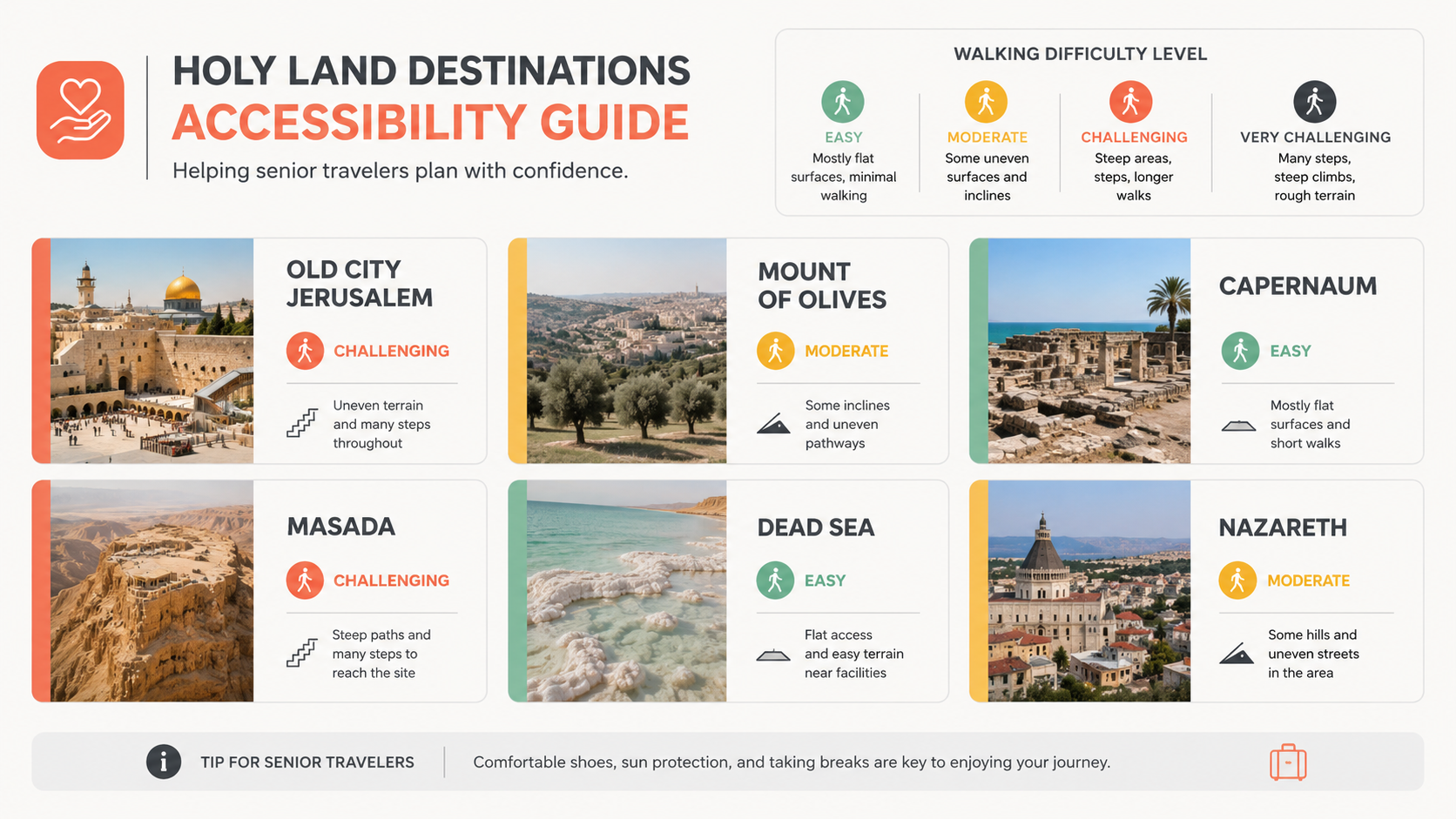
Accessibility varies significantly by site, from level boardwalks to steep stone paths.
Honest answers matter more than optimistic ones. Israel’s national parks publish their own accessibility information covering parking, paths, restrooms, and visitor centers, and the standard varies considerably from site to site.
| Site | Realistic Difficulty | What We Do About It |
|---|---|---|
| Old City, Jerusalem | Hard. Steps, gradients, polished stone | Enter via Jaffa or Dung Gate, shortened routes, seating stops |
| Mount of Olives (Acts 1:9-12) | Moderate downhill, difficult uphill | Drop at the top, collect at the bottom |
| Capernaum (Mark 1:21-35) | Easy. Level, boardwalked | Longer stop, good for a slow morning |
| Mount of Beatitudes (Matthew 5:1-16) | Easy to moderate. Gentle garden paths | Coach parks close, shaded seating available |
| Masada | Easy with the cable car, difficult on foot for most | Cable car both directions, timed to avoid midday heat |
| Dead Sea | Moderate. Slippery entry, uneven shore | Hotel beach with steps, handrails, and attendants |
| Nazareth (Luke 1:26-38) | Moderate. Modern surfaces, some hills | Short walking loop, elevator access at the basilica |
Wheelchairs, Walkers, and Mobility Aids on Tour
Collapsible wheelchairs and folding walkers travel in the coach hold at no charge and are unloaded by the driver at each stop. Powered scooters are more complicated, because of weight and hold clearance, and need to be declared at booking rather than mentioned at the airport.
Renting locally is often the better answer. Manual wheelchairs, rollators, and shower stools can be hired in Israel for the length of the trip and delivered to the first hotel, which spares you the risk of airline damage. For a long-haul flight from the U.S., request wheelchair assistance from your departure airport through to the aircraft door, and again at Ben Gurion, where distances between the gate and passport control are long. Confirm both legs with the airline 72 hours before departure.
Seven Days, Ten Days or Twelve, What Stamina Actually Dictates
A 7-day itinerary works, but it moves. Galilee and Jerusalem in one week means two hotel changes and full days with limited slack. We run them for groups traveling under a strict church calendar, and we run them carefully.
Ten to twelve days is where senior groups do best. The reasoning is simple. Two nights in Tiberias becomes three, one long transfer day becomes a half day with an easy stop at Caesarea (Acts 10:1-48), and Jerusalem gets five nights in a single hotel. Multi-night stays remove the packing and repacking cycle, which is quietly one of the most exhausting parts of any tour when you are 75 and managing medication, a suitcase, and a room key at the same time.
If your group is deciding, our recommendation for a senior-focused itinerary is 10 days with a maximum of three hotels, or twelve if the budget allows a rest day in the middle, which we usually schedule in Tiberias, on the shore of the Sea of Galilee.
Paperwork, Packing, and the Safety Question
Entry first. Passports must be valid for at least six months beyond your travel dates, and visa-exempt American travelers now need an Electronic Travel Authorization before boarding. The official Ministry of Tourism entry guidance sets out the requirement and the process. We handle the group paperwork and check every ETA approval against the rooming list, because one missing authorization in a group of 30 delays everybody at check-in.
What to Pack, and What People Forget
Broken-in supportive walking shoes with real tread, not new shoes bought for the trip, and not sandals. The single most common problem we see on a senior itinerary is footwear purchased three days before departure.
Modest clothing for holy places, meaning covered shoulders and knees for both men and women, which is enforced at the Church of the Nativity (Luke 2:1-7) and elsewhere. Breathable layers, because a Jerusalem evening in October is considerably cooler than the afternoon. A wide-brimmed hat, sunglasses, and a refillable water bottle. Prescription medication in original labeled containers, in your carry-on, in quantities that cover the trip plus four extra days. Copies of prescriptions. A written list of medications and dosages, in English, in your wallet.
Is It Safe, and Who Is Watching
Israel has a dense modern medical system. Emergency response is fast, hospitals in Jerusalem, Tiberias, Haifa, and Tel Aviv operate to high standards, and pharmacies are widespread. Every traveler on our senior itineraries is required to carry travel medical insurance including emergency evacuation coverage, and we ask for proof of it before departure. Not as a formality. We have used it.
On the security side, our office monitors official advisories continuously, including the National Security Council’s travel warnings portal, and we adjust routes when needed. Sometimes that means visiting a site in the morning instead of the afternoon. Sometimes it means substituting one site for another. Groups are told what changed and why.
Departure Dates You Can Plan a Year Around
Older travelers book earlier, and they book with more at stake. A guaranteed departure means the date does not evaporate because the group did not reach a minimum number, which matters when you have already bought flights from Charlotte or Kansas City and told your doctor when you will be away. Our scheduled Guaranteed Tours in Israel run on fixed dates, and we hold them.
Flexibility is the other half. Health changes. A traveler has surgery scheduled sooner than expected, or a spouse cannot fly. Talya Tours works with group leaders on name substitutions and deposit terms so a single cancellation does not damage the whole booking, and the same applies to private departures organized around a parish calendar or a jubilee year.
Frequently Asked Questions
How far in advance should we book a senior group tour to Israel?
Ten to twelve months ahead is typical, especially for travel around Easter, Christmas, or the autumn Jewish holidays when hotel space and accessible-route guides book up early. Booking early also gives us time to review each traveler’s mobility notes individually rather than as a general category.
Will the itinerary look different for our specific denomination?
Yes. A Catholic parish, a Southern Baptist congregation, a Pentecostal ministry, and a Presbyterian fellowship each receive a different sequence of sites, worship arrangements, and guide briefings built around their tradition’s priorities. We start every planning conversation by asking about your denomination and what your pastor or priest wants the group to experience.
What if someone in our group needs a wheelchair for part of the trip?
Collapsible wheelchairs travel in the coach hold at no charge, and manual wheelchairs, rollators, and shower stools can be rented locally and delivered to your first hotel. This needs to be declared at booking so the coach and hotel arrangements account for it in advance.
How many travelers are typically in a senior tour group?
We cap most senior programs at 25 travelers. Smaller groups board coaches faster, fit inside narrow historical spaces like the chapels of the Holy Sepulchre, and allow guides to speak at a volume everyone can hear.
What happens if a traveler has a medical issue during the trip?
Every traveler is required to carry travel medical insurance with emergency evacuation coverage, verified before departure. Israel’s hospitals in Jerusalem, Tiberias, Haifa, and Tel Aviv are modern and emergency response is fast. Our office coordinates directly with local medical facilities when needed.
Planning a senior itinerary for Israel comes down to a small number of decisions that matter more than any brochure line. Choose the right season, keep the group small, build in rest between sites, position the coach to avoid uphill walks, and shape every site and worship arrangement around your congregation’s specific denomination rather than a generic template. These decisions, made early, are what separate a trip travelers remember with fondness from one they remember mainly for its fatigue.
If you are beginning to plan a pilgrimage for a U.S. group with mobility considerations, we are glad to go through pacing, hotels, site access, and your congregation’s tradition before anything is committed. Tell us the ages, the walking abilities, and the denomination, and we will build the days from there.

About the Author
Talya Felner is the Owner and CEO of Talya Tours Services (TTS), a leading professional tour operator in Israel. With over 35 years of experience and more than 90,000 travelers served, Talya has built TTS into a trusted name for Christian pilgrimages, biblical tours, and conferences for groups visiting Israel and the Holy Land. Her team designs each itinerary around the specific Christian denomination of the visiting group, whether Protestant, Catholic, Evangelical, Baptist, Methodist, Pentecostal, Lutheran, Presbyterian, Anglican, Orthodox, or another tradition, ensuring that sites, worship arrangements, and guides reflect what matters most to that congregation. From visas and accommodations to guides, transportation, and on-site coordination, TTS handles every detail so American pastors and group leaders can focus on the spiritual experience of their travelers.