
A pastor from Charlotte, North Carolina called Talya Tours in February with a question we hear often from American church leaders planning a first trip to Israel. Forty-one members of his congregation were ready to travel, most had exactly one week of paid leave available, and he wanted to know whether a group could genuinely experience Galilee, Jerusalem, and Bethlehem in seven days. The answer is yes, provided the days are sequenced correctly rather than rushed. This article walks through how a well-built seven-day Holy Land itinerary actually works, day by day, and how Talya Tours shapes that itinerary around the specific Christian denomination of the traveling group.
Reading time: 5 minutes
Key Points
- A seven-day Holy Land tour is built around three geographic clusters, the Sea of Galilee basin, the Judean Desert and Dead Sea valley, and the Jerusalem and Bethlehem corridor, connected by only two hotel bases for the week.
- Three to four significant sites per day is the practical limit for a group to absorb Scripture at each stop rather than rushing to the next one.
- Itineraries differ by denomination. A Baptist congregation, a Catholic parish, and a Pentecostal church visiting the same country in the same week will typically use noticeably different schedules.
- Day 3, covering the Jordan Valley, Qumran, Masada, and the Dead Sea, is the single transition day that allows the two-hotel structure to work without long daily drives.
Table of Contents
- The Group That Has One Week, Not Two
- Is Seven Days in the Holy Land Enough
- Day by Day, A Week Starting in Galilee
- Two Different Itineraries Depending on Your Tradition
- Two Hotels, Seven Nights
- Masada, the Dead Sea, and the Month You Travel
- Seven Days or Ten, Private Vehicle or Coach
- Questions American Group Leaders Ask
- What the Week Leaves You With
The Group That Has One Week, Not Two
A seven day Holy Land tour is a compressed pilgrimage built around three geographic blocks, the Sea of Galilee basin, the Judean Desert and Dead Sea valley, and the Jerusalem corridor including Bethlehem. Nothing else fits without damage to the pace of the trip.
It suits first-time pilgrims, American church groups whose members cannot take unpaid leave, families traveling with teenagers, and pastors who want to test a smaller delegation before bringing a larger group the following year. We also see American couples in their sixties who prefer a shorter tour with two hotels rather than a twelve-day program with five.
What Talya Tours does with that week is unglamorous, and it is the whole job. We fix the sequence, the driving windows, the entry times, and the worship arrangements, so the group spends its energy on the sites rather than on logistics.
Is Seven Days in the Holy Land Enough
Yes, if the map does the work for you. Seven days in the Holy Land is enough time for the foundational biblical geography, because the core sites sit in tight clusters. Around the lake, the Mount of Beatitudes (Matthew 5:1-16), Tabgha (John 6:1-15), and Capernaum (Mark 1:21-35) are within a few kilometers of one another. In Jerusalem, most of what a pilgrim group came to see is inside one walled square kilometer.
The Israel Ministry of Tourism publishes a baseline structure for a week of this kind in its first-timers seven day itinerary, and the underlying logic matches what we use in practice, group the sites by location, then move the whole group once.
Three to four significant sites per day is the practical ceiling. Beyond that, people stop absorbing Scripture at the site and start watching the clock for the bus.
Day by Day, A Week Starting in Galilee
The chronological rhythm of a well-built week in the Holy Land runs north to south, following both the gospel narrative and the road network, arrival on the coast, two nights on the lake, a descent through the Jordan Valley to the desert, then four nights in Jerusalem.
| Day | Region | Priority sites | Overnight |
|---|---|---|---|
| 1 | Coastal plain | Ben Gurion arrival, Caesarea Maritima (Acts 10:1-48) | Tiberias |
| 2 | Sea of Galilee and Nazareth | Mount of Beatitudes (Matthew 5:1-16), Tabgha (John 6:1-15), Capernaum (Mark 1:21-35), boat crossing (Mark 4:35-41), Basilica of the Annunciation (Luke 1:26-38) | Tiberias |
| 3 | Jordan Valley and Dead Sea | Yardenit (Matthew 3:13-17), Qumran, Masada, Dead Sea float | Jerusalem |
| 4 | Mount of Olives and Bethlehem | Ascension (Acts 1:9-12), Dominus Flevit (Luke 19:41-44), Gethsemane (Matthew 26:36-46), Upper Room (Acts 2:1-4), Church of the Nativity (Luke 2:1-7), Shepherds’ Fields (Luke 2:8-20) | Jerusalem |
| 5 | Old City of Jerusalem | Pools of Bethesda (John 5:1-15), Via Dolorosa (John 19:16-17), Church of the Holy Sepulchre (John 19:41-42), Western Wall | Jerusalem |
| 6 | Jerusalem and the hills | Garden Tomb (John 20:1-18), Yad Vashem or Ein Karem (Luke 1:39-56) | Jerusalem |
| 7 | Old City and departure | Christian Quarter market, free morning, transfer to TLV | Flight home |
Days 1 to 3, Coast, Lake, and the Descent to the Dead Sea
Day 1. A Talya Tours representative meets the group inside the terminal at Ben Gurion, the coach is loaded, and the drive heads north along the Mediterranean. Groups landing before noon usually stop at the Roman harbor and aqueduct at Caesarea National Park, where Peter was sent to the household of Cornelius (Acts 10:1-48). Tiberias is roughly two hours from the airport. Check in, a short orientation with the guide, and an early night follow. Jet lag is real, and Day 2 starts at eight.
Day 2. This is the day that makes the whole seven day plan work, because everything is close. Beatitudes first, while the hillside is quiet. Tabgha and the Primacy of Peter (John 21:15-19) by mid-morning. Capernaum before the coaches arrive. Then the wooden boat crossing, which most groups use for singing and a short reading, followed by lunch and an afternoon in Nazareth at the Basilica of the Annunciation (Luke 1:26-38) and Mount Precipice (Luke 4:28-30).
Day 3. Bags out at seven. Renewal of baptismal vows at Yardenit on the Jordan River (Matthew 3:13-17) for groups whose tradition includes it, then the long descent through the rift valley to 430 meters below sea level. Qumran, Masada, an hour in the water, and up to Jerusalem for the evening.
Days 4 to 7, Jerusalem, Bethlehem, and the Last Morning
Day 4 starts on the Mount of Olives with the panorama, walks down through Dominus Flevit (Luke 19:41-44) to Gethsemane and the Church of All Nations (Matthew 26:36-46), then crosses to Mount Zion for the Upper Room (Acts 2:1-4) and the Tomb of King David. Bethlehem follows in the afternoon, when the queue at the Grotto is shorter.
Day 5 is the Old City on foot. The group enters through the Lion’s Gate, visits the Pools of Bethesda and the Crusader church of St Anne, where groups often sing because the acoustics are remarkable, and walks the Via Dolorosa to the Church of the Holy Sepulchre. The Western Wall follows in the late afternoon.
Day 6 opens with communion at the Garden Tomb (John 20:1-18), which many Protestant groups describe afterward as the quietest hour of the week. Yad Vashem or Ein Karem in the afternoon, a farewell dinner in the evening, and Jerusalem Pilgrim certificates handed out at the table.
Day 7. A free morning for olive wood shopping in the Christian Quarter or a second visit to whichever site made the strongest impression. Departure transfers are timed three hours before the flight. A well-planned short tour ends with people rested, not staggering.
Two Different Itineraries Depending on Your Tradition
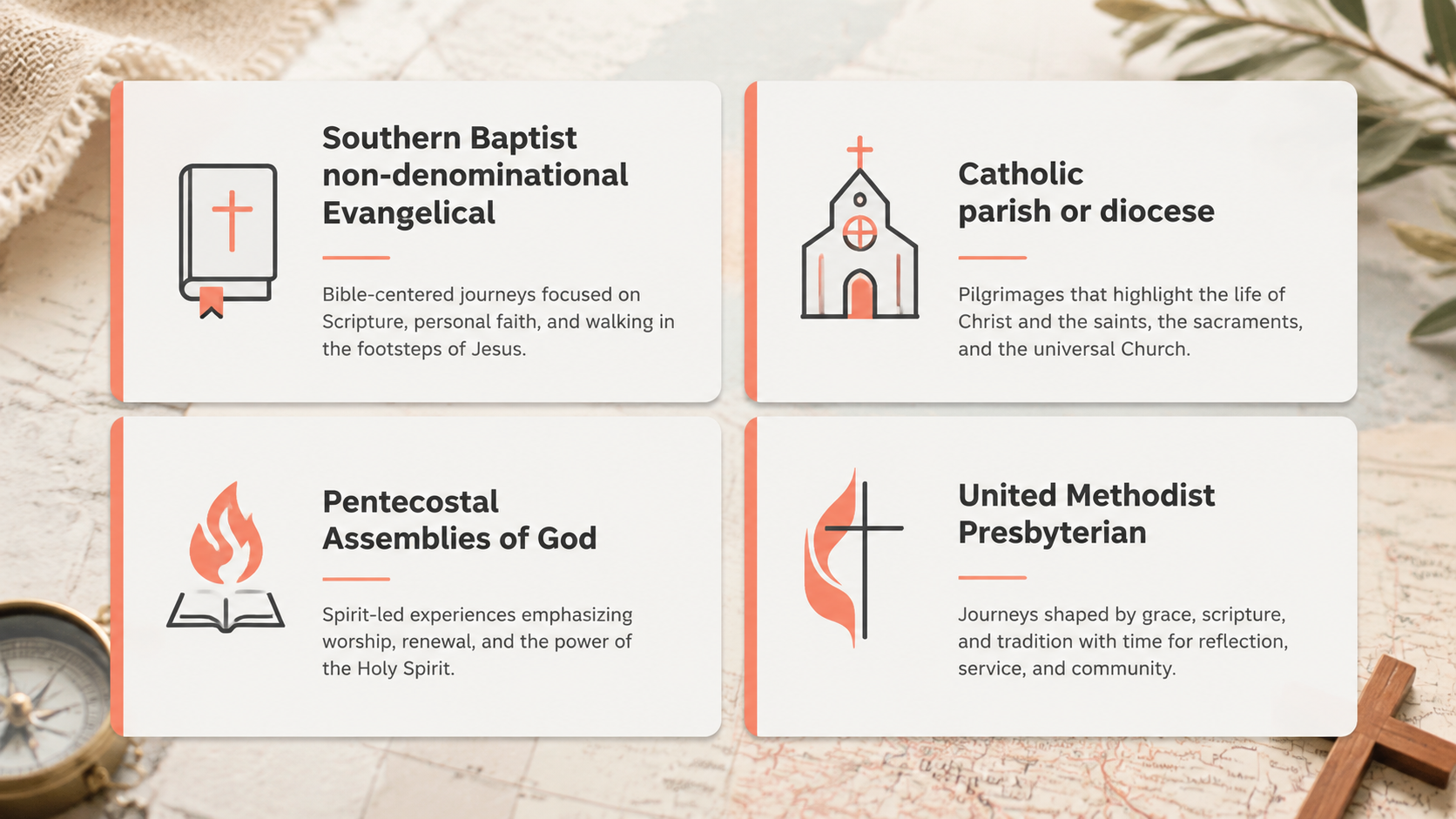
Itinerary priorities differ by denomination even within the same seven days.
Every planning conversation with Talya Tours begins with the same two questions, and neither is about dates. What is your congregation’s denomination, and what does your pastor want people to carry home from the trip.
A Southern Baptist church from Nashville and a Catholic parish from Cincinnati can travel the same seven days and use barely half the same itinerary. The Baptist group prioritizes Yardenit, the Garden Tomb, Capernaum, and extended open-Bible time at each stop. The Catholic parish requests Mass arranged at the Basilica of the Annunciation, unhurried time inside the Holy Sepulchre, and a full, properly walked Via Dolorosa. When a schedule is compressed to seven days, knowing which sites matter most to your own tradition is what keeps the week centered on your congregation’s priorities rather than a generic itinerary.
| Tradition | Gets more time | Usually gets less | Arranged on site |
|---|---|---|---|
| Southern Baptist / non-denominational Evangelical | Garden Tomb, Yardenit, Beatitudes, Capernaum | Marian churches, Franciscan chapels | Baptism renewal, outdoor communion |
| Catholic parish or diocese | Holy Sepulchre, Nativity Grotto, Annunciation, full Via Dolorosa | Garden Tomb, secondary Galilee overlooks | Daily Mass, priest coordination with the Custody |
| Pentecostal / Assemblies of God | Mount of Olives, Gethsemane, lake shore worship | Museums and archaeology-heavy stops | Extended worship and prayer blocks |
| United Methodist / Presbyterian | Capernaum, Bethesda, Yad Vashem, teaching stops | Devotional repetition at multiple chapels | Quiet contemplative time, guide-led teaching |
Two Hotels, Seven Nights
Groups commonly arrive with one of two flawed plans, either a single hotel for the entire week, which means three hours of driving daily, or a different hotel every night, which means repeated packing before breakfast with dozens of suitcases.
Two bases work better. Nights one and two on the Sea of Galilee in Tiberias put the group on the northern shore before day-trip coaches arrive from the coast. Nights three through six in Jerusalem sit roughly fifty minutes from Yad Vashem, twenty minutes from Bethlehem, and within walking distance of most central sites when the hotel is chosen correctly.
Bethlehem sits about ten kilometers from the Mount of Olives. Talya Tours coordinates access and local guiding in advance, so the crossing becomes a short administrative pause rather than a lost afternoon. Luggage moves once, on Day 3, while the group is at Masada.
Planning a Seven Day Trip for Your Congregation
Talya Tours builds each itinerary around the denomination of the visiting group, whether Baptist, Catholic, Evangelical, Pentecostal, Methodist, Lutheran, Presbyterian, Anglican, Orthodox, or another Christian tradition. Send us your congregation’s denomination, group size, and preferred travel window, and we will draft a day-by-day plan for your review.
Masada, the Dead Sea, and the Month You Travel
Masada and the Dead Sea combine into one transition day without strain, which is exactly what Day 3 is for. Taking the cable car up, rather than the Snake Path, brings the ascent down to three minutes instead of an hour of climbing, and during periods of extreme heat the path itself is restricted, a detail published on the Masada National Park page along with seasonal opening hours. After the summit, one hour of floating at Ein Bokek or Kalia, with shower facilities available, precedes the climb back up to Jerusalem.
Seasonal averages by region are available from the Israel Meteorological Service climate atlas, and they matter more here than anywhere else in the country, because the desert runs ten to fifteen degrees hotter than the Jerusalem hills on the same afternoon.
| Season | Jerusalem and Galilee | Desert and Dead Sea | Best suited to |
|---|---|---|---|
| March to May | Mild, green hillsides, ideal walking | Warm but workable, early start advised | Most American church groups, Easter demand is heavy |
| September to November | Clear, comfortable, fewer crowds after Sukkot | Still hot in September, pleasant by late October | Groups wanting quieter sites |
| December to February | Cool, rain possible, Bethlehem at Christmas | Warmest place in the country, very comfortable | Budget-sensitive groups, Christmas pilgrimages |
| June to August | Hot and dry, long daylight | Extreme by midday, desert stops before 10am | Families tied to school holidays |
Seven Days or Ten, Private Vehicle or Full Coach
A seven day program carries the gospel narrative from the Annunciation to the Resurrection. What it leaves out is the north and the south, the Golan Heights, Caesarea Philippi (Matthew 16:13-20), Tel Dan, the Negev, and any extension into Jordan. Groups with ten to twelve days and a slower pace are often better served by a comprehensive ten-day Holy Land itinerary, which spreads the same Jerusalem days across a gentler rhythm.
On the private vehicle versus full coach question, the answer depends on group size. A family of six in a private vehicle moves through the Old City faster and can pause for a service whenever they choose. A congregation of forty pays considerably less per person and can sing in four-part harmony at St Anne’s, something a family of six is unlikely to attempt.
Either way, the variable that shapes the week most is the guide. Working with licensed Christian tour guides in Israel means having someone who knows that the Garden Tomb closes earlier than most American visitors expect, and who reads the relevant passage at the site itself rather than reciting dates from memory.
Questions American Group Leaders Ask
Questions raised most often by American pastors and group organizers during planning calls.
Is a seven day Holy Land tour physically demanding?
Moderately. Expect eight to twelve thousand steps daily, much of it on uneven limestone and stairs, with Day 5 in the Old City being the most demanding. Sturdy shoes with grip are recommended over sandals. Talya Tours builds seated options into the day for anyone in the group who needs them, and we ask about mobility during planning rather than discovering a need at the Lion’s Gate.
Can we customize the itinerary with Talya Tours?
That is the normal case, not the exception. American church groups, families, and couples receive a private program built around their denomination, their pastor’s teaching plan, and the physical range of the group. Baptism at the Jordan, communion at the Garden Tomb, or Mass at a specific basilica are all arranged in advance with the relevant church authorities.
Which airport should we fly into?
Ben Gurion International, TLV, near Tel Aviv. It is the entry point for every route described here, and Talya Tours staff meet groups inside the terminal on arrival.
What should we wear at the holy sites?
Shoulders and knees covered inside churches, at the Western Wall, and in mosques. A light scarf in the day bag solves most situations for women, and long trousers solve the rest for men. Shorts will keep a man out of the Grotto in Bethlehem.
What does a week cost, roughly?
The main variables are hotel category, group size, and season, in that order. Shekels are the local currency, cards are accepted almost everywhere, and dollars are taken at many tourist sites at a poor exchange rate. Customary tipping for the guide and driver is usually handled as a group collection. Talya Tours’ page on Holy Land pilgrimage costs and budgeting gives real figures before you book flights or commit to a hotel tier.
Is it safe to move between Jerusalem, Galilee, and Bethlehem?
The pilgrimage corridors have operated routinely through most of Talya Tours’ thirty-five years in business. Groups travel with a licensed guide and a licensed vehicle, conditions are monitored daily, and itineraries are adjusted quietly when something local requires it. Out of more than 90,000 travelers served, the large majority never notice that any change was made.
What the Week Leaves You With
A week in the Holy Land does one thing that no book can. It puts distances into your body. You feel how short the walk is from Gethsemane to Caiaphas’s house, how small Capernaum is, and how far Bethlehem is not. That is why a properly paced seven day Holy Land tour changes how American travelers read Scripture for years afterward, without requiring anyone to take a month off work.
Talk Through Your Dates With Talya Tours
Tourism has been Talya Tours’ only business since the late 1980s. If your church is beginning to look at dates, we are glad to talk through seasons, hotel bases, and worship arrangements before anything is committed. Tell us your congregation’s denomination and group size, and we will build the week around both.
A seven day Holy Land tour works when the itinerary respects both the geography of Israel and the specific tradition of the group walking through it. Two hotel bases, a clustered daily schedule, and a plan shaped around your congregation’s denomination make the difference between a rushed trip and a week that stays with people. Talya Tours has spent thirty-five years refining exactly that balance for American church groups.

About the Author
Talya Felner is the Owner and CEO of Talya Tours Services (TTS), a professional tour operator in Israel. With over 35 years of experience and more than 90,000 travelers served, Talya has built TTS into a trusted name for Christian pilgrimages, biblical tours, and conferences for groups visiting Israel and the Holy Land. Her team designs each itinerary around the specific Christian denomination of the visiting group, whether Protestant, Catholic, Evangelical, Baptist, Methodist, Pentecostal, Lutheran, Presbyterian, Anglican, Orthodox, or another tradition, ensuring that sites, worship arrangements, and guides reflect what matters most to that congregation. From visas and accommodations to guides, transportation, and on-site coordination, TTS handles every detail so American pastors and group leaders can focus on the spiritual experience of their travelers.