A pastor in Nashville called us on a Tuesday. His non-denominational congregation of 38 wanted to be at the Garden Tomb during Holy Week, he had already collected deposits from his members, and he had just discovered that the operator he found online was a reseller who did not own a single bus in Israel. He is now our client. This is not a rare story. Out of the more than 90,000 American travelers we have hosted over 35 years, a large share came to us after a first attempt went sideways. This article explains how American church groups and pastors can evaluate a Holy Land tour operator before booking, what actually drives pricing, and why itineraries built around a group’s specific Christian denomination matter more than a glossy brochure.
Reading time: 5 minutes
Key Points
- A direct local ground operator who owns contracts with guides, drivers, and hotels solves problems faster than a U.S.-based reseller layering your booking onto someone else’s operation.
- The clarity of an operator’s written answers on cancellation policy, guide contact, and contingency planning before you pay is a strong predictor of how organized the trip will be.
- Pricing gaps between quotes for the same route usually come from hotel location, guide experience, and vehicle quality, not from the itinerary itself.
- Every itinerary should be built around your congregation’s specific denomination, whether Catholic, Baptist, Pentecostal, Methodist, Presbyterian, Anglican, or non-denominational, rather than a one-size-fits-all Christian tour template.
Table of Contents
- What Defines the Best Holy Land Tour Companies Beyond Generic Marketing
- How Do You Evaluate Holy Land Tour Operators Before Booking
- Why the Word “Company” Hides Two Completely Different Businesses
- Should You Choose a Group Tour or a Private Customized Itinerary
- What Actually Drives Holy Land Tour Pricing
- How to Verify Your Guide Is Actually Licensed
- How to Spot an Overcrowded Itinerary Before You’re Trapped in It
- Which Sites Belong in a Premium Package, and Why Order Matters
- Where Talya Tours Fits
- Frequently Asked Questions
What Defines the Best Holy Land Tour Companies Beyond Generic Marketing
Most search results for the best Holy Land tour companies read the same way. A glossy catalog, a fixed eight-day price, and a form. That model works until something moves. And in Israel, something always moves.
The operators worth a deposit share four traits. They hold direct local contracts for guides, drivers, and hotels rather than reselling someone else’s block. They quote a written price with the inclusions spelled out. They will change the sequence of a day without treating it as an emergency. And they can demonstrate genuine ground knowledge, not a brochure purchased from a wholesaler.
Israel is a logistically dense destination. Incoming visitor volume runs into the millions in a normal year, which means peak-season crowding at fixed sites is a scheduling problem, not a surprise. Handling that is the whole job. Talya Tours was built as a ground operation first, which is why we frame the best Holy Land tours around how a day is actually run, not how it photographs. Any tour company can list Jerusalem on a page. Few can move 40 American travelers through the Church of the Holy Sepulchre before the mid-morning crowd arrives.
How Do You Evaluate Holy Land Tour Operators Before Booking
A pastor is not choosing a vacation. He is choosing an organization that will hold his congregation for eight to eleven days in a foreign country. It helps to evaluate the operator with that in mind.
Essential Checklist Before the Initial Consultation
Before a call with any Holy Land tour operator, know what to measure. Ask whether the itinerary is genuinely customizable or a fixed catalog. Ask the group size cap on a single guide and a single bus. Ask the accommodation category by name, not by star count. Ask exactly which meals are included, since half-board and full-board are very different budgets over ten days. Ask the transport specification, including whether the coach is air-conditioned, has onboard WiFi, and whether the driver holds a tourist transport license.
Critical Questions to Ask Prior to Paying a Deposit
Before money moves, get four answers in writing. What is the cancellation and refund schedule by date. Who is the ground contact if the guide is unreachable at 9 p.m. What is the contingency plan if a site closes for a security or holiday reason. And are site and hotel reservations guaranteed, or provisional until final payment. Official pre-trip resources are also available through the Ministry of Tourism’s Virtual Tourism Bureau, which is a useful cross-check beyond a single sales conversation.
A pattern holds after 35 years of doing this work. The clarity of an operator’s written answers before payment is a strong predictor of how organized they will be once the group lands. Vague email tends to mean a vague trip.
Why the Word “Company” Hides Two Completely Different Businesses
Many Holy Land tour companies that American groups find online are marketing resellers. They own a website and a phone number in the United States. They do not own a bus, employ a guide, or hold a hotel contract in Israel. They sell the group to a local operator and take a margin along the way.
A direct local ground tour company is a different business. We contract our own licensed drivers and vehicles, assign guides we have worked with for years, and hold our own hotel allocations. When a road closes near the Dead Sea or a checkpoint causes a delay, the person solving it works for us and answers directly to Talya.
The practical effect for a pastor booking from the U.S. is threefold, faster problem-solving during the trip, no hidden intermediate markup stacked on the real cost, and a clear chain of responsibility. When a group books through layered resellers, a problem at 7 a.m. in Galilee has to travel through a U.S. office that is asleep. When a group books with a direct operator, it is handled before breakfast.
Should You Choose a Group Tour or a Private Customized Itinerary
There is no single right answer here. There is a right answer for a specific congregation, and it usually comes down to who is traveling and how much control the church leadership wants over the daily schedule.
Large Group Tours: Budget and Cohesion
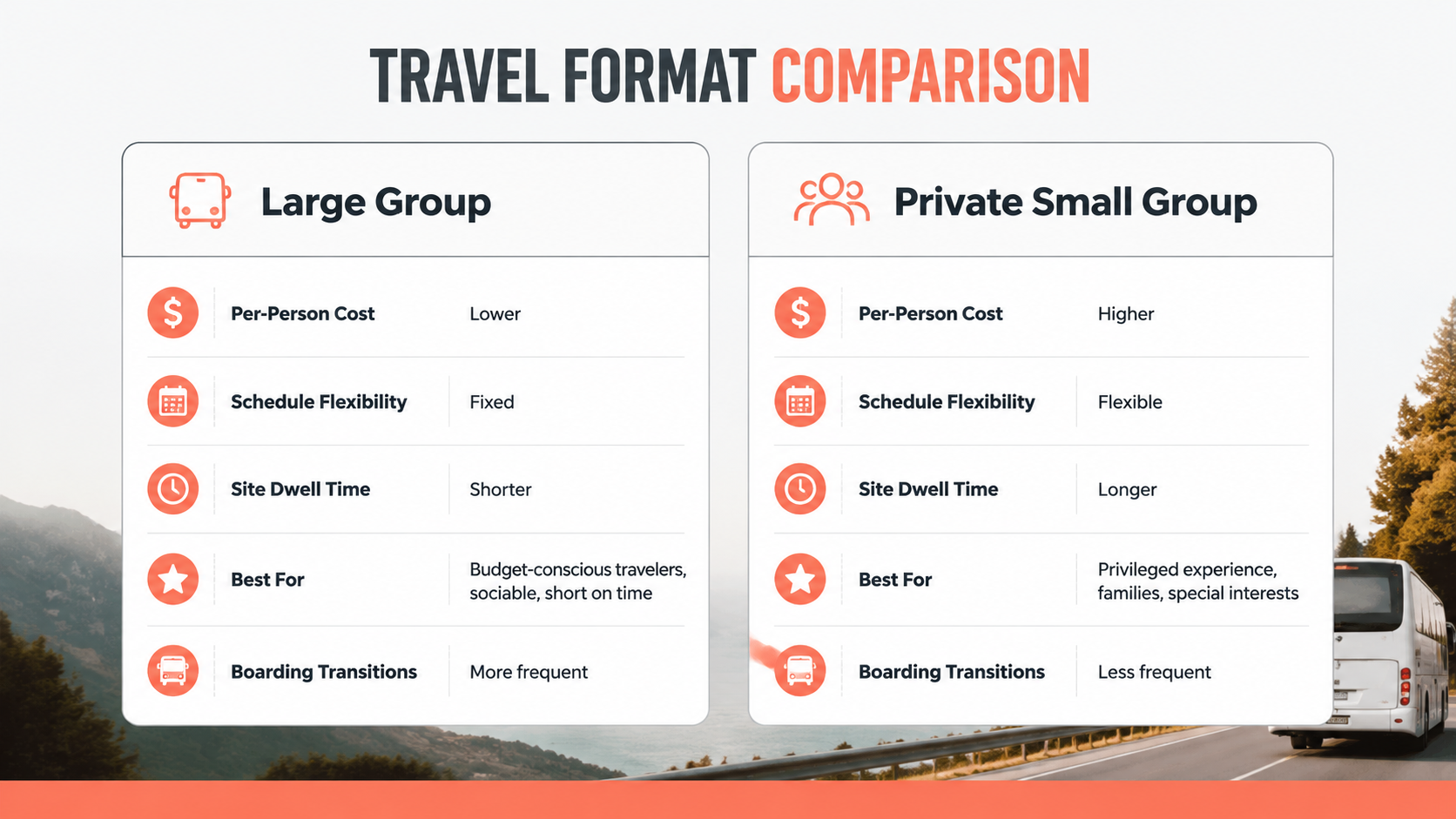
A large group tour, 40 to 50 travelers on a full motorcoach, is the most affordable way to run the best Holy Land tours. The trade-off is fixed. Everyone moves on the same schedule, dwell time at each site is set in advance, and boarding 48 people takes real minutes at every stop. It works well for a cohesive American congregation that wants to travel and worship together.
Private Customized Tours: Who Benefits Most
Private itineraries suit families, church leadership teams, and multi-generational groups where a grandmother and a teenager need different pacing. Group leaders set the wake-up times, decide how long to linger at the Mount of Beatitudes, and can build in a slower afternoon when the group is tired. Among Holy Land tour operators, the ones who run both formats can advise honestly on which fits, rather than steering toward whichever pays more.
| Dimension | Large Group (40-50) | Private / Small Group (up to ~20) |
|---|---|---|
| Per-person cost | Lowest | Higher |
| Schedule flexibility | Fixed | High |
| Site dwell time | Preset | Adjustable on the day |
| Best for | Whole-congregation trips | Families, leadership groups, mixed ages |
| Boarding / transitions | Slower | Fast |
What Actually Drives Holy Land Tour Pricing
Two quotes for the same eight days can differ by hundreds of dollars per person, and the route is identical. The gap is almost never mileage.
All-Inclusive vs. Base Packages
A true all-inclusive price covers national park and site entrance fees, the licensed guide’s daily fee, full-board or half-board meals as specified, a modern touring vehicle, and driver and guide gratuities. A base package quotes a low headline number and adds most of those charges later. It matters to know which one is being compared before any price comparison is made at all.
Hidden Costs to Request in Writing
The surprises in cheap offers are predictable. Site entry surcharges billed on arrival. Weekend hotel supplements in Jerusalem. Whisper radio headset rentals so a group can hear the guide inside a crowded church. Airport and port transfers treated as extras. It is worth asking for every one of these in writing before signing anything.
The real price variation among Holy Land tour companies usually comes from hotel location first. A hotel inside central Jerusalem costs more than one in a peripheral suburb 25 minutes out, and that 25 minutes each way is an hour of the day lost to a bus. Guide experience and vehicle comfort follow closely behind. A cheaper quote on the best Holy Land tours often means a suburban hotel and a junior guide, a detail groups only discover on day two.
How to Verify Your Guide Is Actually Licensed
In Israel, tour guiding is a regulated profession. Licensed guides complete a multi-year course and periodic retraining, and the license can be checked directly. This is not a formality. The quality gap between a Ministry-certified guide and an unlicensed one is the difference between understanding the layered history at Capernaum and simply standing next to a pile of stones.
Any guide’s status can be verified directly in the Ministry’s official database of licensed tour guides, and the professional standards themselves sit under the Ministry’s professional training division. Serious Holy Land tour operators assign only licensed guides and will provide the license number on request.
Seven Questions to Ask the Assigned Guide
Before accepting a guide, ask seven things. What is the license number. What is the area of specialization, biblical, archaeological, or general. What languages are guided in fluently. Has this guide worked with groups from our specific denomination before. How is a member handled if they fall ill mid-day. What is the plan when a site is unexpectedly crowded. And, for a tour company serving American faith groups, does the guide understand the specific theological emphases of our tradition. That last question separates a good guide from the right guide for a particular congregation.
How to Spot an Overcrowded Itinerary Before You’re Trapped in It
The most common complaint about other operators is not cost. It is exhaustion. An itinerary that crams eight to ten major sites into one day looks impressive on paper and feels like a forced march by 3 p.m. Groups spend the day on the bus and arrive at the most sacred stops with no energy left to pray.
Masada is the clearest example. Between the cable car, the summit, and the descent, the official visitor guidance from the Israel Nature and Parks Authority’s Masada visitor information shows why this stop alone deserves a real morning slot, not a rushed 40 minutes wedged between two other stops. A well-built day around the Dead Sea leaves time for Ein Gedi and time in the water, with buffer built in.
That buffer is not padding. Reserves close and reopen with the seasons and after flash floods, as the Parks Authority notes in updates such as the Ein Gedi partial-reopening notice. The best Holy Land tours plan a spare hour into each day precisely so a security delay or a holiday crowd does not collapse the schedule. Rigid itineraries break. Ours are built to bend.
Which Sites Belong in a Premium Package, and Why Order Matters
Every good route covers three zones, the Old City of Jerusalem, the Sea of Galilee region with Nazareth, and the Dead Sea region with Masada. What separates a professional itinerary is routing. Driving from Galilee to the Dead Sea and back to Jerusalem in a poorly planned week wastes hours. A better structure clusters the north together, moves south once, then finishes in Jerusalem.
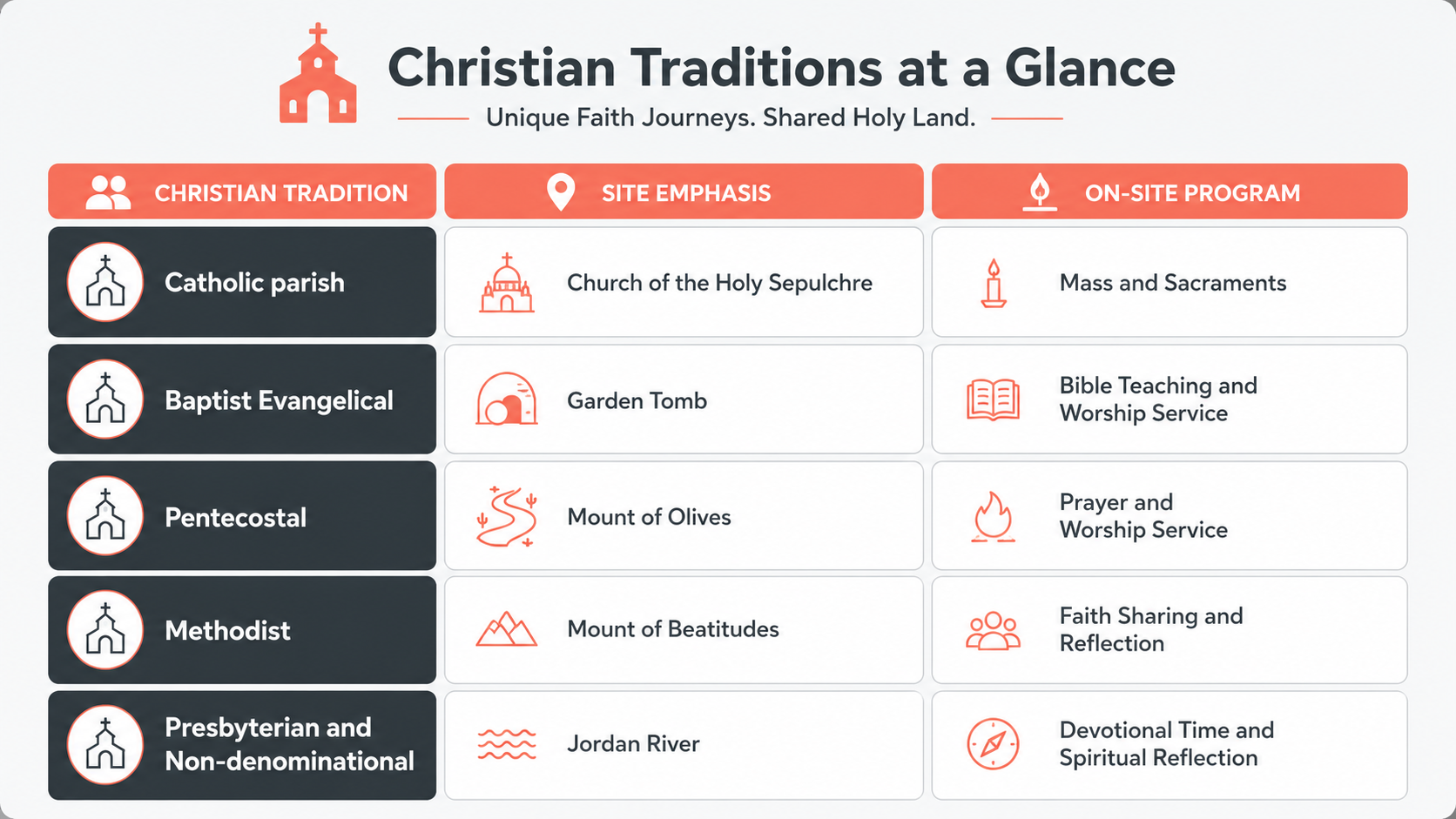
This is where denomination changes everything, and where a generic package quietly fails. We do not run one Christian tour. Each itinerary is built around the specific tradition of the visiting American group.
| Tradition | Site Emphasis | On-Site Program |
|---|---|---|
| Catholic parish | Church of the Holy Sepulchre, Basilica of the Annunciation, Church of the Nativity, Via Dolorosa | Mass arranged at appropriate locations |
| Baptist / Evangelical | Garden Tomb, Yardenit on the Jordan, Mount of Beatitudes, Capernaum | Extended Scripture reading, baptism renewals |
| Pentecostal | Mount of Olives, Garden of Gethsemane | Extended prayer and worship time |
| Methodist / Presbyterian | Biblical sites with theological context | Quieter, contemplative pacing |
| Non-denominational | Broad coverage across all zones | Flexibility for in-group worship moments |
A Southern Baptist group from Houston and a Catholic parish from Columbus visiting in the same week receive genuinely different weeks. For congregations mapping out this level of detail, our Christian tours to Israel guide lays out how Scripture-focused itineraries are built by tradition. Access to some sacred sites is also coordinated through official channels, including the government religious affairs unit, which is one more reason a local operator matters.
Plan a Denomination-Specific Itinerary
If your congregation is beginning to plan a pilgrimage, tell us your denomination and the dates you are considering. We will put together an itinerary built around your tradition, with a written all-inclusive price, before you commit to anything.
Where Talya Tours Fits
The conversation with us begins the same way every time. What tradition is the group, what does the pastor want them to walk away with, and what ceremonies need arranging on site. From there we build. Over 35 years and more than 90,000 American travelers, that starting question is what has kept churches from Atlanta to Phoenix coming back.
What a group gets is a direct local ground operation with no middleman margin, licensed multilingual guides that can be verified, private and full-group itineraries built to the group’s tradition, an all-inclusive price written out in full, and staff reachable on the ground throughout the stay. Among Holy Land tour operators, being an owner-led tour company means Talya herself is involved with every group. Tourism is our only business, and it is the reason American congregations continue to count us among the operators worth the difference.
How far in advance should a church group book a Holy Land pilgrimage?
Most American congregations begin planning nine to twelve months ahead, especially for Holy Week or peak spring and fall dates when hotel availability in Jerusalem tightens. Booking earlier also gives more room to build the itinerary around the group’s specific denomination rather than settling for whatever slots remain.
Can Talya Tours arrange Mass for a Catholic parish group?
Yes. Mass arrangements at appropriate churches, such as the Church of the Holy Sepulchre or the Church of the Nativity, are coordinated in advance as part of a Catholic itinerary, alongside a route built around those specific sites.
Does an itinerary really change based on our denomination, or is that just marketing language?
It changes in practice, not just in wording. A Baptist or Evangelical group typically spends more time at the Garden Tomb and Yardenit for baptism renewals, a Pentecostal group is given extended prayer time at Gethsemane, and a Catholic parish has Mass built into the schedule at designated churches. The guide assigned, the pacing, and the daily sequence all shift based on those priorities.
What happens if a site is closed or crowded on the day our group arrives?
Well-built itineraries include a spare hour in the daily schedule so the guide can reorder stops without disrupting the rest of the day. This is one reason it is worth asking any operator directly how they handle unexpected closures before booking.
Is it better to book a large group tour or a private itinerary for our congregation?
It depends on the group. A large group tour of 40 to 50 travelers keeps the per-person cost lowest and works well for a cohesive congregation traveling together. A private or small-group itinerary costs more per person but allows the schedule to be adjusted day to day, which suits families or mixed-age groups traveling with church leadership.
Evaluating a Holy Land tour operator comes down to a small set of concrete checks, whether the company owns its own ground contracts, how clearly it answers questions in writing before a deposit is paid, whether guides are verifiably licensed, and whether the itinerary is genuinely built around a congregation’s specific Christian tradition rather than a generic template. Getting these right before booking is what separates a meaningful pilgrimage from a frustrating one.
Talk Through Your Group’s Dates and Denomination
Reach Talya directly to discuss dates, denomination-specific sites, and logistics before committing to anything.

About the Author
Talya Felner is the Owner and CEO of Talya Tours Services (TTS), a leading professional tour operator in Israel. With over 35 years of experience and more than 90,000 travelers served, Talya has built TTS into a trusted name for Christian pilgrimages, biblical tours, and conferences for groups visiting Israel and the Holy Land. Her team designs each itinerary around the specific Christian denomination of the visiting group, whether Protestant, Catholic, Evangelical, Baptist, Methodist, Pentecostal, Lutheran, Presbyterian, Anglican, Orthodox, or another tradition, ensuring that sites, worship arrangements, and guides reflect what matters most to that congregation. From visas and accommodations to guides, transportation, and on-site coordination, TTS handles every detail so American pastors and group leaders can focus on the spiritual experience of their travelers.