
A pastor in Nashville calls us in late February. His congregation of 38 wants to be in Jerusalem for Holy Week. He has a rough date, a rough budget, and no hotels booked. That call happens more often than you would think, and how it ends depends almost entirely on one thing, whether the group booked a structured package or tried to build the trip piece by piece.
Israel is a small country holding an enormous amount of history in a very tight geography. That is exactly why planning it independently overwhelms so many first-time American travelers. This article walks through what a Holy Land vacation package actually includes, what drives the cost, how long a trip should run, and how a serious operator builds each itinerary around your congregation’s specific Christian denomination rather than a one-size-fits-all route.
Reading time: 8 minutes
Key Points
- Ten-day packages are the most requested length, balancing Galilee time, Jerusalem time, and the Dead Sea without exhausting a group.
- Season, hotel category, and meal plan drive pricing far more than most travelers expect, with Easter, Passover, and Christmas weeks commanding premium rates booked months in advance.
- Itineraries at Talya Tours are built around each group’s specific Christian denomination, so Catholic, Baptist, Pentecostal, Methodist, Presbyterian, and other congregations follow different site sequences and worship stops.
- U.S. travelers must obtain digital travel authorization before departure, and this should be handled early, well before the flight is booked.
Table of Contents
- What a Holy Land Travel Package Includes
- How Much Packages Cost and What Drives the Price
- Sample Packages Compared, 7 to 15 Days
- What a Premium Package Includes, and the Fine Print
- Tailored Package or Independent Planning
- How Many Days You Actually Need
- What a Classic Route Looks Like
- Can You Customize Your Package
- When to Visit and When to Book
- Entry Requirements and Safety
- Pilgrimage or Historical Tour
- Seniors, Families, and Mobility Needs
- Frequently Asked Questions
What Is a Holy Land Travel Package and What Does It Actually Include?
A Holy Land travel package is a single organized structure that carries the whole trip, ground transport, licensed guiding, accommodation, site entrances, and the sequence that ties them together. You are not buying a hotel and a bus. You are buying the decisions.
The value shows up in the parts you cannot see from home. Coordinating daily transport across the Galilee, securing a government-licensed guide during Passover week, and holding hotel rooms in Jerusalem’s Old City area when a dozen other groups want them are three separate battles. A good package fights them for you. A weak one hands you a document and wishes you luck.
Land Only vs. Air-Inclusive Packages
Land Only packages cover everything from the moment you land at Ben Gurion. No flights included. American groups often prefer this because it lets them use frequent flyer miles or depart from their own hubs in Atlanta, Dallas, or Charlotte without being locked into a group flight schedule. Air-inclusive packages fold the transatlantic flights in, which simplifies budgeting for a first-time coordinator who does not want to manage two vendors.
Group Tours vs. Private Departures
A group departure means sharing the itinerary and the coach with fellow travelers. It is social, cost-efficient, and for many U.S. church groups it becomes part of the experience. A private departure builds the entire program around one family or one congregation, with its own pacing and its own worship moments, and it is scheduled around that group’s denomination from the first day of planning.
How Much Do Holy Land Vacation Packages Cost, and What Drives the Price?
Numbers first, because everyone wants them. For a multi-day land package, standard three-star programs generally land in the lower range, premium four-star programs sit in the middle, and luxury five-star programs run considerably higher per person. Flights, when included, add on top.
What moves the price is rarely what people assume. Season is the biggest driver. Easter, Passover, and Christmas weeks push hotel rates up sharply, and rooms tighten months out. After that come hotel star rating, whether you upgrade to a private vehicle, and the meal plan. Half-board with breakfast and dinner costs more than bed-and-breakfast, but it removes daily out-of-pocket friction.
The quiet advantage of a structured package is protection from surprise. Groups that assemble travel arrangements piece by piece routinely hit local transport surcharges and dynamic hotel pricing spikes. A locked package price does not do that to you.
Sample Packages Side by Side, 7, 10, 12, and 15 Days
Duration decides how much of the country you can honestly cover. Here is how our four most-requested lengths compare, with the highlights each one realistically fits.
7-Day Package, Standard / Value
Best for groups with limited vacation days wanting core sites
Highlights Sea of Galilee, Mount of Beatitudes (Matthew 5:1-16), Capernaum (Mark 1:21-35), Jerusalem Old City, Western Wall, Church of the Holy Sepulchre or Garden Tomb
10-Day Package, Premium (most popular)
Best for first-time congregations and multi-generational families
Highlights Everything above plus Nazareth, Jordan River baptism at Yardenit, Bethlehem (Matthew 2:1-12), Mount of Olives, Dead Sea, Masada
12-Day Package, Premium / Deluxe
Best for groups wanting depth without exhaustion
Highlights Adds Caesarea (Acts 10), Mount Carmel (1 Kings 18:16-40), Tabgha (John 6:1-15), Ein Gedi, extended Jerusalem time, rest afternoons
15-Day Package, Deluxe / Luxury
Best for deep pilgrimage plus cultural immersion
Highlights Full northern circuit, Golan Heights, Machane Yehuda market, archaeological time, optional Eilat or extended Dead Sea stay
Notice the seven-day program leaves out Masada and Bethlehem to stay honest about time. We would rather tell a group that upfront than watch them sprint through the Old City.
What a Premium Package Includes, and What Sits in the Fine Print
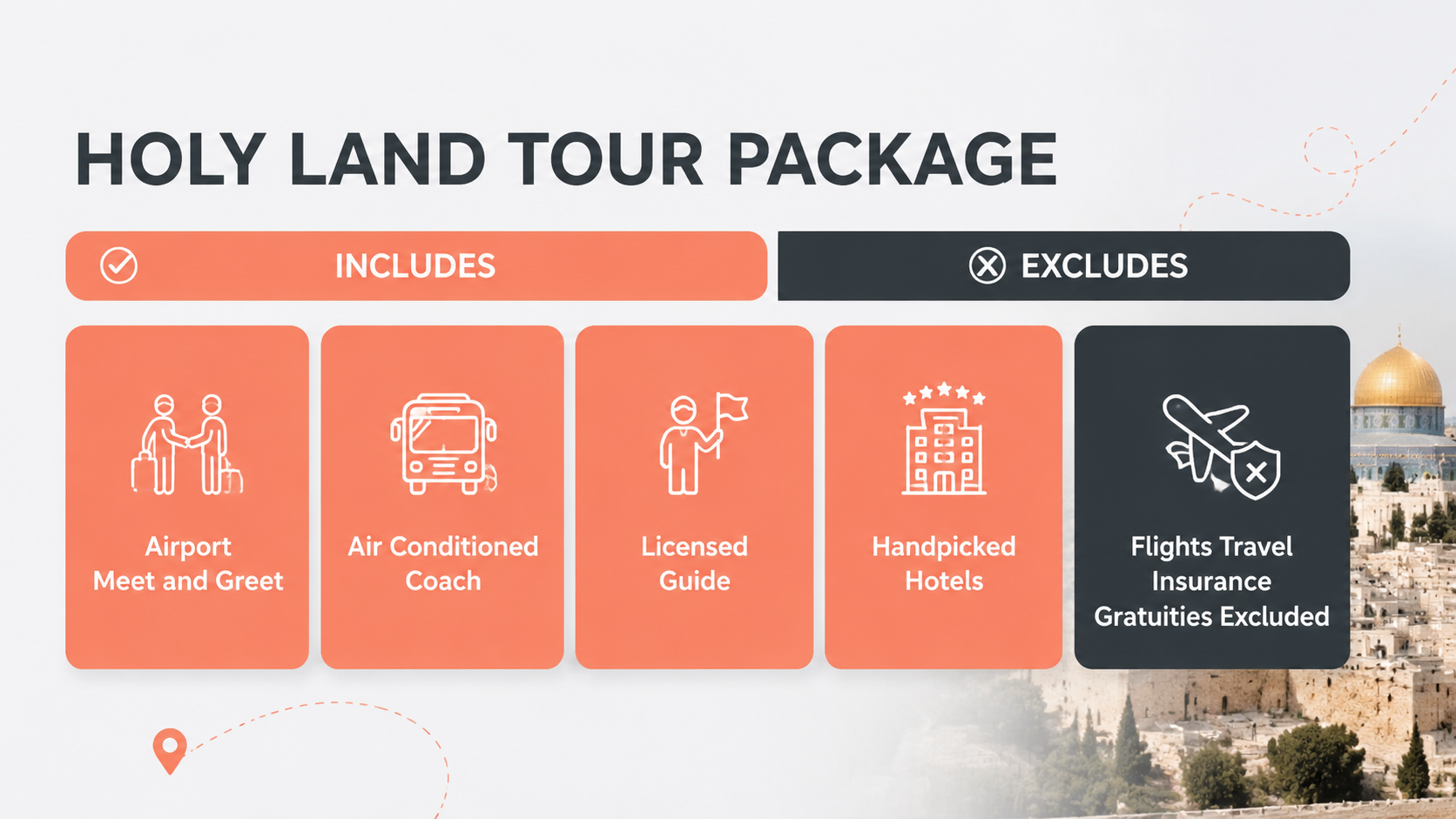
Overview of standard package inclusions and common fine-print exclusions.
A premium package should include airport meet-and-greet, a modern air-conditioned coach, an expert guide licensed by the Ministry of Tourism, handpicked hotels, and pre-arranged entrance tickets to the archaeological and holy sites on the route. Every group we host is touched personally by Talya, so nothing on that list is an afterthought.
The exclusions matter just as much. International flights, if booked Land Only, travel insurance, gratuities for your driver and guide, and lunches on the road are usually on you. Knowing this before you pay is the difference between a smooth trip and a running argument about who owes what.
The Booking Checklist
Ask three things and you will learn everything. First, are all listed sites guaranteed, or are some marked optional and quietly billed later? Second, what is the exact hotel name, and how far is it from the Old City or the Galilee shore? Third, is the guide licensed, and does the coach have WiFi? A serious operator answers all three without hesitating.
All-Inclusive, What It Really Means Here
In Israel, high-tier all-inclusive means daily breakfast and dinner, portage at the hotels, and pre-paid site fees so you are not counting change every morning. It rarely means lunches or personal shopping. Clarity beats a fancy label.
Should You Take a Tailored Package or Plan Independently?
Planning a trip to Israel independently means navigating geopolitical boundaries, a language you do not read, layered historical narratives, and driving conditions that stress most first-time visitors. Each of those is manageable alone. Together, they eat your vacation.
A curated package removes the friction in one move. You get secure, dedicated transport and a professional guide who makes Caesarea and Capernaum come alive instead of reading like museum placards. For first-time visitors, multi-generational families, and faith-based groups, a structured package is simply the calmer road.
How Many Days Do You Actually Need?
The country runs from the southern desert and the Dead Sea up through the coastal plain, Jerusalem, and the northern Galilee. Sounds compact, and it is. But the driving days between regions are real, and cramming them is where groups burn out.
Why 10 Days Is the Standard Recommendation
Ten days divides beautifully. Three to four days in the Galilee and north, four to five days in Jerusalem and Bethlehem, and dedicated time for Tel Aviv and the Dead Sea. That balance is why the 10-day package is the one we recommend most. You see the essentials and you are not wrecked by day five.
Avoiding Itinerary Fatigue
We build in soft afternoons on purpose. A leisurely stop in a local market, an unstructured evening, or a floating session in the Dead Sea resets a group better than a fourth church in one day. Rest is not wasted time on a pilgrimage. It is what lets the next morning land well.
What a Classic Route Looks Like, Day to Day
A first-time program usually flows geographically to avoid backtracking. Groups arrive at Ben Gurion, spend early time near Tel Aviv and the Mediterranean coast, then head up to the Sea of Galilee, Nazareth, and Capernaum (Mark 1:21-35). From the Mount of Beatitudes (Matthew 5:1-16) the route moves down the Jordan Valley, pausing at the Jordan River, before ascending to Jerusalem and Bethlehem (Matthew 2:1-12).
In Jerusalem the days fill fast, the Mount of Olives, the Western Wall, and then the site that divides itineraries by tradition. A Catholic parish will spend meaningful time at the Church of the Holy Sepulchre and along the Via Dolorosa. A Southern Baptist or non-denominational Evangelical congregation more often gathers at the Garden Tomb for Scripture reading and a communion moment. This is where denomination shapes the route, and it is decided before a single hotel is booked, not adjusted afterward.
Can You Customize Your Package?
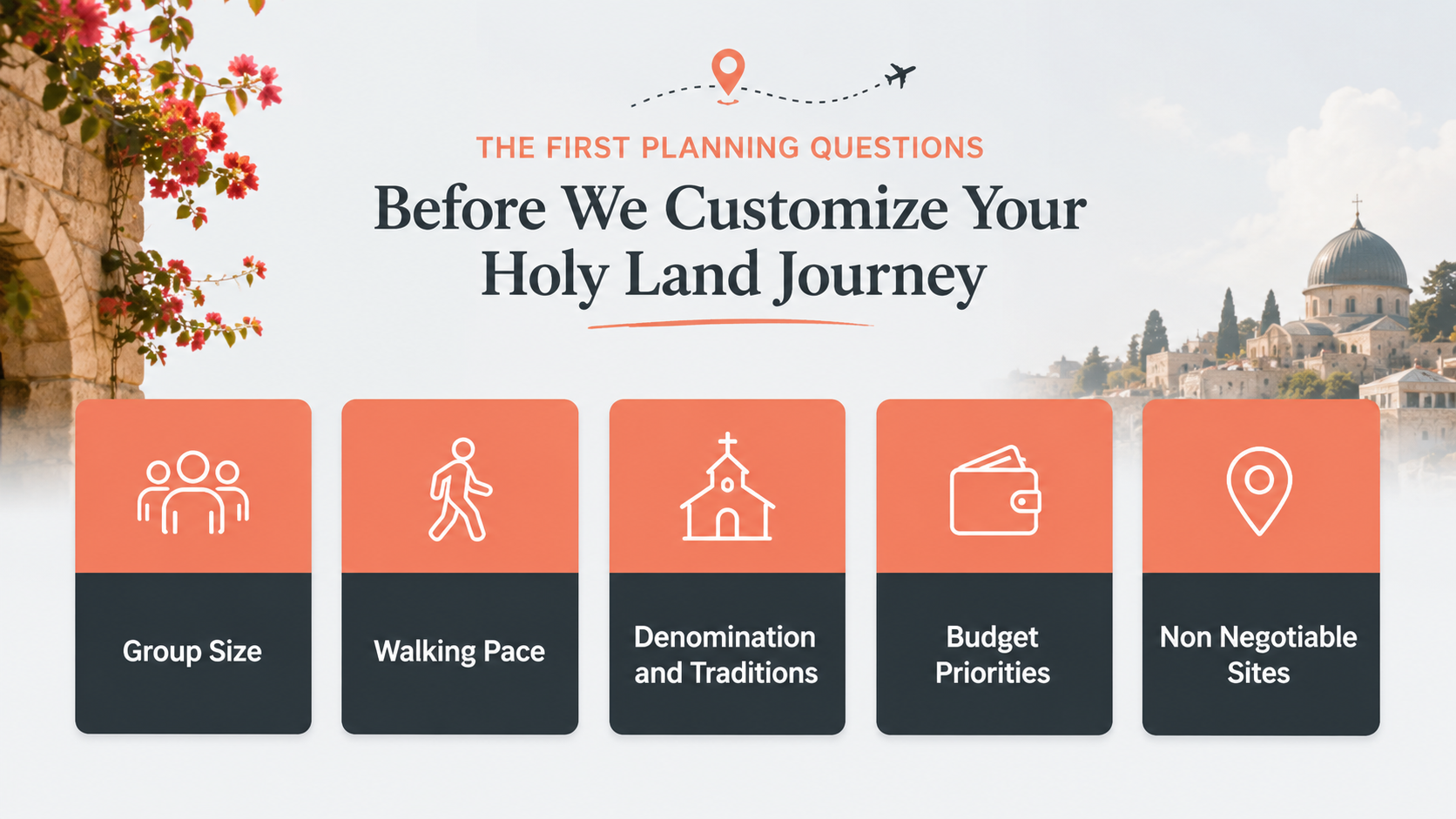
Itinerary decisions shift depending on a group’s denomination and worship preferences.
Yes, and for most groups we do. A custom plan adjusts for physical pace, theological focus, and the specific rites a group wants performed on site. A Pentecostal ministry may ask for extended worship time at the Garden of Gethsemane. A United Methodist conference may want quieter contemplative stops with theological context. A Presbyterian fellowship often values the same. We build around what your pastor wants the group to carry home, whether that group is Lutheran, Anglican, Orthodox, Adventist, or another tradition entirely.
What We Ask You First
The conversation opens with a few plain questions, your group size, your walking pace, your denomination and its traditions, your budget priorities, and your non-negotiable sites. From there the itinerary gets built, not pulled off a shelf.
Add-Ons Worth the Money
Two upgrades earn their cost almost every time. A traditional Shabbat dinner with a local family gives American travelers a window into everyday Israeli life. And a sunrise cable car up Masada, before the heat and the crowds, is one of the few early wake-ups nobody complains about later.
Planning a Trip for Your Congregation?
Talya Tours builds each itinerary around the denomination of the U.S. group traveling, whether Protestant, Catholic, Evangelical, Baptist, Pentecostal, Methodist, Lutheran, Presbyterian, Anglican, or Orthodox. Tell us your group size, dates, and tradition, and we will outline a route that fits.
When to Visit, and When to Book
Spring, roughly March to May, and autumn, September to November, give the best weather and the biggest crowds. Summer brings real heat and intense sun, well documented in the Israel Meteorological Service seasonal forecasts, so we pace summer groups for early mornings and shaded afternoons. Winter runs cooler with occasional rain, lower prices, and thinner crowds at major sites. For climate context by region, the IMS Climate Reports and the plain-language overview at Visit Israel are both worth reviewing before deciding on dates.
On timing, book six to nine months ahead. Around Easter, Passover, and Christmas, treat that window as a floor, not a suggestion. That Nashville pastor who called in February for Holy Week? We made it work, but rooms were tight and choices were fewer than they should have been.
Entry Requirements and Security Before You Book
Two practical items decide whether your gate experience is smooth. Handle both early.
Israel’s ETA-IL Entry System
Under a recent entry regulation, travelers from visa-exempt countries, including the United States, must obtain digital travel authorization before boarding. The official Ministry of Tourism group entry and ETA-IL guidelines lay out the requirement, and the ETA-IL application can be completed well ahead of departure. We remind every group, but processing it early is always the group leader’s job to confirm.
Safety and Staying Informed
We monitor local conditions in real time for every group on the ground. For your own peace of mind before you commit, read the U.S. Department of State travel advisory. Building any itinerary starts with knowing the current picture, and we would rather a group leader check the official source than take our word for it.
Pilgrimage or Historical Tour, Aligning the Package to Your Goal
A faith-focused pilgrimage prioritizes private Scripture reading at biblical locations, corporate worship, set prayer times, and specific sanctuaries tied to a denomination’s tradition. A historical or cultural tour leans into archaeological digs, geopolitical context, national museums, and Israel’s culinary range. The best packages hold both, so the afternoons of rest sit beside the mornings of discovery. A well-built package does not force a group to choose one over the other.
Planning for Seniors, Families, and Mobility Needs
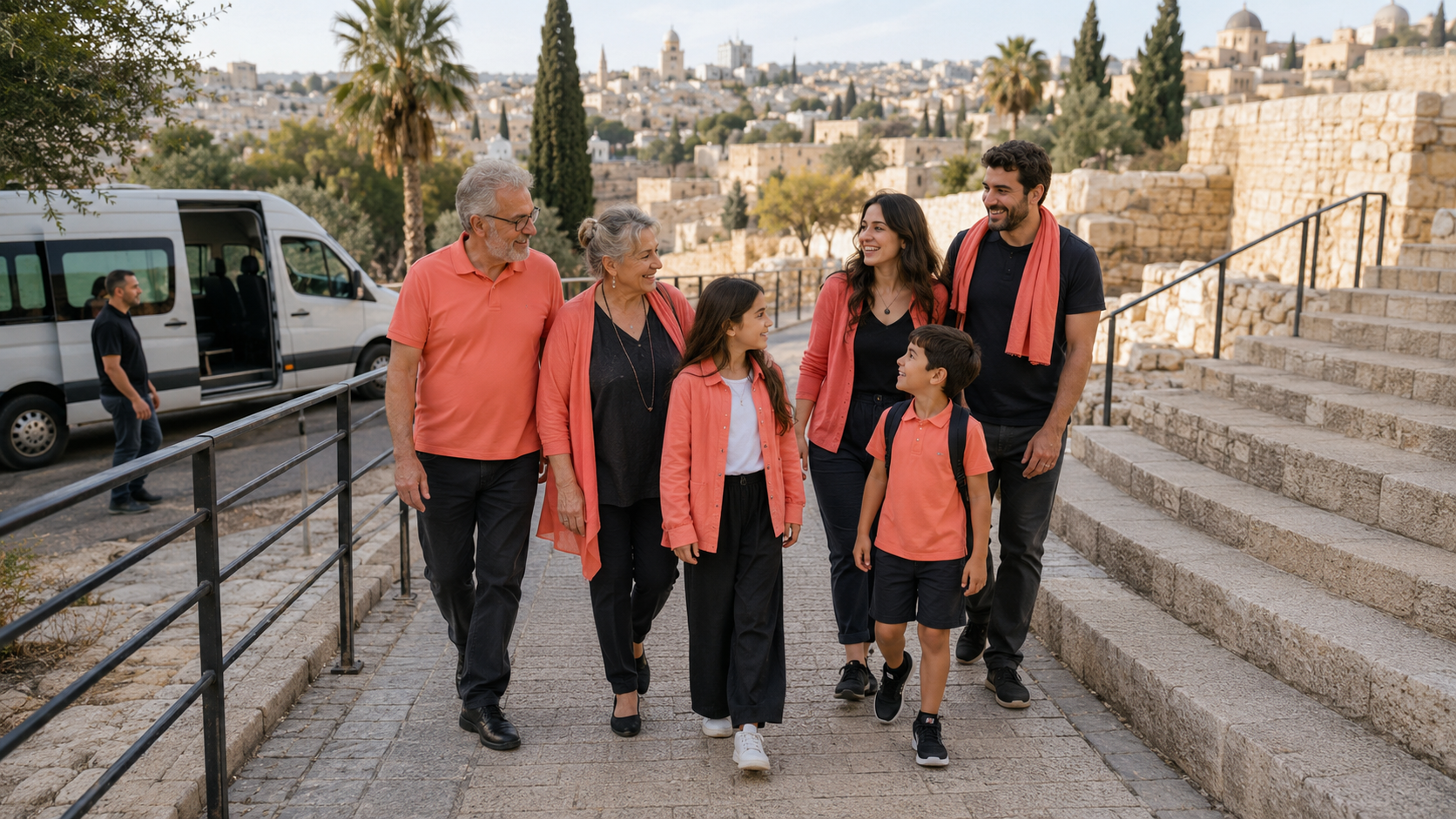
Accessible transport and paced schedules matter for multi-generational groups.
Ancient sites are not flat. Uneven cobblestones, steep steps, and long walking stretches are the norm in the Old City and at hilltop ruins. A thoughtfully built package answers this with accessible transport, wheelchair-friendly routes where they exist, hotels with elevators, and a paced schedule that does not punish anyone.
Navigating Israel with Limited Mobility
For travelers who need it, routes are planned around the hardest terrain, specialized vans are used, and gentler alternatives are offered at places like Jerusalem’s Old City. Ben Gurion’s own support helps too, and the Israel Airports Authority accessibility services handle arrival and departure so the trip starts easy.
Multi-Generational Family Travel
Keep grandparents and grandchildren in the same trip by alternating learning with hands-on time. Floating in the Dead Sea and walking Hezekiah’s water tunnel do more for a restless ten-year-old than another guided lecture. Balance is the whole trick.
Frequently Asked Questions
How far in advance should our congregation book a trip?
Six to nine months is a safe general window. For Easter, Passover, or Christmas travel, book nine to twelve months out, since hotel rooms in Jerusalem tighten quickly around those dates.
Can the itinerary reflect our specific denomination’s worship needs?
Yes. Every itinerary is built around the visiting group’s denomination, whether Catholic, Baptist, Pentecostal, Methodist, Lutheran, Presbyterian, Anglican, Orthodox, Adventist, or another tradition. Site sequencing, worship stops, and guide assignments are chosen accordingly, not applied generically.
What happens if someone in our group has mobility limitations?
Tell us before the trip is finalized. We route around the hardest terrain, arrange specialized vans where needed, and select hotels with elevators. Some hilltop sites have limited step-free access, and we explain those tradeoffs upfront.
Do U.S. travelers need a visa or special authorization to enter Israel?
U.S. citizens do not need a traditional visa for short visits, but digital travel authorization through the ETA-IL system is now required before boarding. We recommend applying as soon as travel dates are confirmed.
What is typically not included in the package price?
International flights on Land Only packages, travel insurance, gratuities for the driver and guide, and lunches on the road are usually separate. We list these clearly before booking so there are no surprises on the ground.
A Holy Land trip is usually a long-held goal for a congregation, not an ordinary vacation, and it deserves careful planning. The right package handles the logistics, transport, guiding, and lodging, while the itinerary itself is shaped around your group’s denomination, from site sequencing to worship arrangements. If your group is starting to think about dates, sites, and how to build a route around your congregation’s tradition, we are glad to talk it through before anything is booked.
Ready to Talk Through Your Group’s Trip?
Reach Talya directly by email or through our contact page. We will ask about your group size, dates, budget, and denomination, then outline a route built specifically for your congregation.
Or email directly at [email protected]

About the Author
Talya Felner is the Owner and CEO of Talya Tours Services (TTS), a leading professional tour operator in Israel. With over 35 years of experience and more than 90,000 travelers served, Talya has built TTS into a trusted name for Christian pilgrimages, biblical tours, and conferences for groups visiting Israel and the Holy Land. Her team designs each itinerary around the specific Christian denomination of the visiting group, whether Protestant, Catholic, Evangelical, Baptist, Methodist, Pentecostal, Lutheran, Presbyterian, Anglican, Orthodox, or another tradition, ensuring that sites, worship arrangements, and guides reflect what matters most to that congregation. From visas and accommodations to guides, transportation, and on-site coordination, TTS handles every detail so American pastors and group leaders can focus on the spiritual experience of their travelers.