
A pastor in Charlotte called us in late February. Forty-six people from his congregation had already paid deposits, and they wanted to be in Jerusalem for Palm Sunday. Jerusalem hotel rooms for Holy Week had been committed since the previous autumn.
We found him beds. Not the beds he wanted, in a hotel further from the Old City than he had pictured, at a rate he had not budgeted for. The trip was good. It could have been better for the same money if he had called us nine months earlier.
That is the real lesson of planning a Holy Land trip. The order in which you make decisions matters more than the decisions themselves. What follows is the sequence we use with American groups, in the order we use it.
Reading time: 9 minutes
Key points in this article
- Itineraries are built around the group’s specific Christian denomination first, then fitted to dates and length of stay.
- Spring and autumn offer the most reliable walking conditions for groups with older travelers, though winter and summer both have practical trade-offs.
- Passport expiry dates, not the visa process itself, cause most last-minute delays for American groups.
- A seven to ten day trip using two hotel bases, Jerusalem and the Galilee, covers the sites most U.S. congregations want to see without unnecessary hotel changes.
Table of contents
- Step one: decide what kind of trip this is
- Step two: pick your month and check the weather
- Step three: passports, visas, and paperwork
- Step four: how many days the trip really needs
- Step five: guiding and transport
- Step six: safety planning
- Step seven: what to wear and what to pack
- The mistakes that cost American groups a full day
- Frequently asked questions
Step one: decide what kind of trip this is, before you look at a calendar
To visit the Holy Land means travelling through a fairly compact set of places, including Jerusalem and the Old City, the Mount of Olives (Acts 1:9-12), Bethlehem (Luke 2:1-7), the Galilee basin around Nazareth (Luke 1:26-38) and Capernaum (Mark 1:21-35), and the desert edge at Masada and the Dead Sea. Most American groups who write to us about how to visit the Holy Land already know the site names. What they have not yet settled is the purpose.
A pilgrimage, a heritage and archaeology tour, and an interfaith study trip cover much of the same map and produce three different weeks. The pilgrimage sits longer at fewer sites. The heritage tour wants excavation layers, Herodian stonework, and Roman roads. The study trip wants people to meet, not only stones to see.
For Christian groups there is a second question, and we ask it in the first phone call, which tradition is the group coming from, and what does the pastor want them to experience at each site. We do not run one generic Christian program. Site order, ceremonies, and pacing are built around the specific denomination, which is why a Southern Baptist congregation from Houston and a Catholic parish from Cleveland traveling the same seven days will not follow the same days.
| Tradition | Sites given the most time | Ceremonies we normally arrange | Typical pacing |
|---|---|---|---|
| Catholic parish or diocese | Church of the Holy Sepulchre (John 19:17-20), Basilica of the Annunciation (Luke 1:26-38), Church of the Nativity (Luke 2:1-7), Via Dolorosa stations (Luke 23:26-32) | Daily Mass at approved sanctuaries, Stations of the Cross, priest-led devotions | Steady, liturgy sets the clock |
| Southern Baptist or non-denominational Evangelical | Garden Tomb, Yardenit on the Jordan (Matthew 3:13-17), Mount of Beatitudes (Matthew 5:1-16), Capernaum (Mark 1:21-35) | Baptism renewal, communion service, extended Scripture reading at each stop | Longer teaching blocks, fewer sites per day |
| Pentecostal or Assemblies of God | Garden of Gethsemane (Matthew 26:36-46), Mount of Olives, Upper Room on Mount Zion (Acts 2:1-4) | Open worship and prayer time, often at first light or late afternoon | Flexible, sessions run long by design |
| United Methodist or Presbyterian | Sea of Galilee (Mark 4:35-41), Caesarea Maritima (Acts 10:1-8), Tabgha (John 6:1-15) | Quiet contemplative readings, small-group reflection, one or two formal services | Moderate, with real rest built in |
Groups planning a faith-based week usually find it easier to start from our Christian tours in Israel pages and tell us what to change, rather than describing a whole itinerary from a blank page.
If your congregation’s tradition should shape the itinerary rather than fit into a generic Christian tour, tell us the denomination and rough travel dates and we will build the plan around them.
Step two: pick your month, then check the weather you will actually be walking in
Spring from March to May and autumn from September to November are the two windows we recommend for almost every group. Daytime temperatures in the Jerusalem hills sit in a range that lets a group of sixty walk the Old City for four hours without anyone going down, and the Judean Desert is still manageable at midday. The Israel Meteorological Service publishes the regional climate profile for the Jerusalem hills, and it is worth a look before you commit, because Jerusalem sits around 800 meters above sea level and is cooler than most Americans expect in March and November.
Something that surprises first-time organizers is that the Dead Sea is roughly 430 meters below sea level, about 1,400 feet. On the same April afternoon, Jerusalem can be pleasant and the Dead Sea shore can be fifteen degrees Fahrenheit hotter.
When to go if you want fewer crowds
January and February bring lower hotel rates, thinner lines at the Church of the Holy Sepulchre, and rain in the north. We have run excellent winter pilgrimages, with coats. July and August are the opposite trade, offering light evenings and low airfare from some U.S. hubs, paired with desert heat that forces Masada and Ein Gedi (1 Samuel 24:1-7) into the 8:00 to 10:30 window and nothing later.
If your group includes travelers over seventy, and most church groups do, shoulder season is not a preference. Treat it as a requirement.
Step three: passports, visas, and the paperwork that quietly delays groups
For a U.S. passport holder, the visa question is usually simple. Tourist entry is handled under the B/2 category, and eligible visitors complete the electronic travel authorization online before flying rather than applying at a consulate. The official service description for the B/2 visitor visa is the reference point, and the practical rule we give every group is passport validity of at least six months beyond travel dates.
What actually delays American groups is not the visa. It is passports.
Out of a group of forty, we routinely find three people whose passports expire within five months of departure and one who cannot locate the document at all. Renewals take weeks. When we begin planning a trip to the Holy Land with a church, we ask the coordinator to collect passport photocopies with expiry dates at the deposit stage, not sixty days out. Names on the passport must match the names on the air ticket exactly, which matters for married women traveling under a maiden name on one document and a married name on the other.
Travel planning also means insurance, and insurance means reading the medical evacuation clause rather than the brochure. We arrange cover for groups as part of the package. Individual travelers who arrange their own should check whether the policy covers pre-existing conditions and cancellation for medical reasons.
Step four: how many days the trip really needs
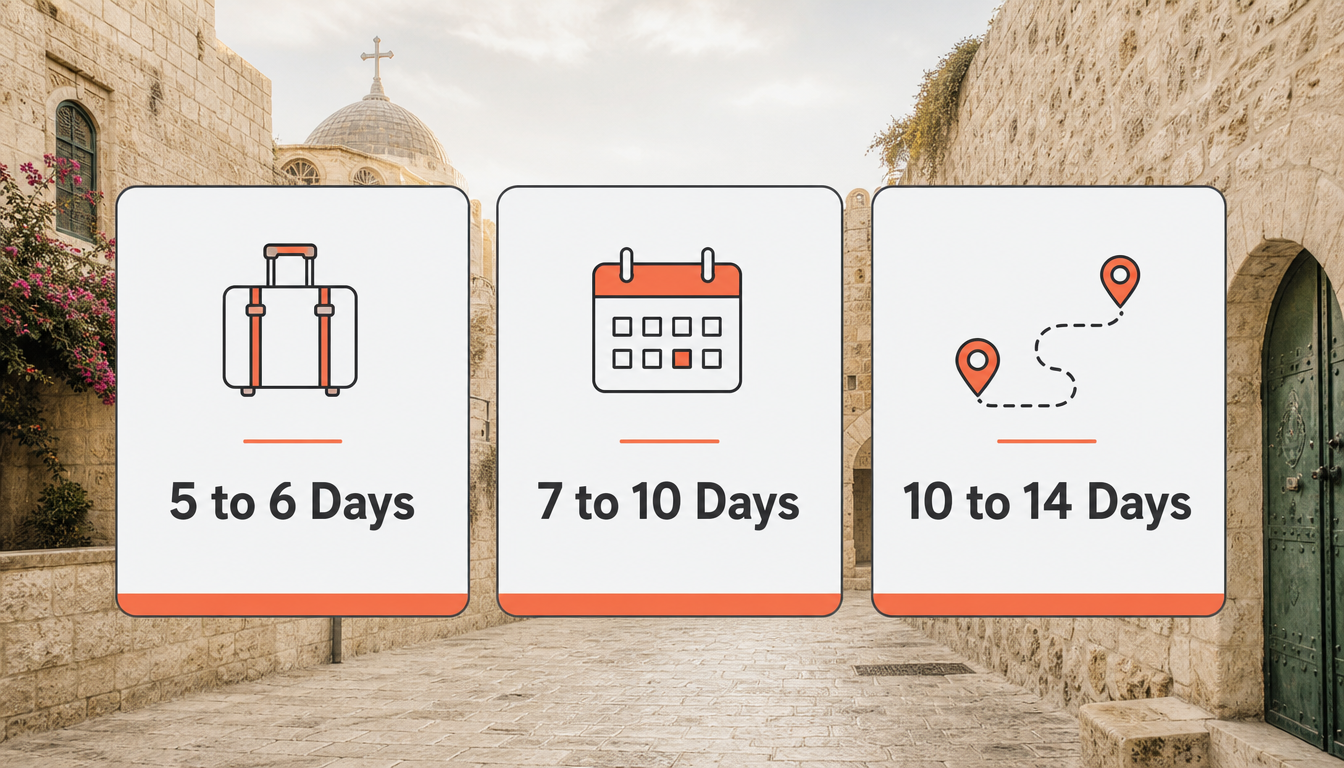
Trip length options for Holy Land itineraries and what each covers.
Seven to ten days is the honest answer. Three to four days for Jerusalem and its surroundings, two to three for the Galilee, one to two for the Dead Sea and the desert. Anything shorter is a choice to skip something, which is fine as long as the group knows what it is skipping before they board.
| Trip length | What fits comfortably | What gets cut | Who it suits |
|---|---|---|---|
| 5 to 6 days | Jerusalem, Bethlehem, one full Galilee day, a short Dead Sea stop | Lower Galilee, Caesarea, Masada, any rest day | Pastors with tight congregational calendars, repeat visitors |
| 7 to 10 days | Jerusalem in depth, Bethlehem, two nights in the Galilee, Masada and the Dead Sea, one flexible day | Very little of substance | Most first-time American groups |
| 10 to 14 days | All of the above with Mount Carmel (1 Kings 18:16-40), the Golan, Beit She’an, free days, archaeological add-ons | Nothing, though budget and stamina both rise | Seminary groups, in-depth pilgrimages, delegations combining study and touring |
The seven-day framework we build from
Two hotel bases only. Jerusalem for the first four nights, the Galilee for the last three. Every hotel change costs a group roughly two hours of packing, loading, and re-rooming, so we keep changes to one. This is the skeleton we adjust when a group asks us to help them plan a trip to the Holy Land in a single week.
| Day | Base | Main content |
|---|---|---|
| 1 | Jerusalem | Arrival at Ben Gurion, transfer, Mount of Olives panorama (Acts 1:9-12) |
| 2 | Jerusalem | Old City, Via Dolorosa (Luke 23:26-32), Church of the Holy Sepulchre or the Garden Tomb, Western Wall |
| 3 | Jerusalem | Bethlehem and the Church of the Nativity (Luke 2:1-7), Mount Zion and the Upper Room (Acts 2:1-4) |
| 4 | Jerusalem | Judean Desert, Masada, float in the Dead Sea |
| 5 | Galilee | Jordan Valley transfer, Nazareth (Luke 1:26-38), Cana (John 2:1-11) |
| 6 | Galilee | Boat on the Sea of Galilee (Mark 4:35-41), Capernaum (Mark 1:21-35), Mount of Beatitudes (Matthew 5:1-16), Tabgha (John 6:1-15) |
| 7 | Departure | Caesarea Maritima (Acts 10:1-8), transfer to the airport |
Step five: guiding and transport, which is where the week is won or lost
Self-guided travel in Israel is possible. Roads are good, English is widely spoken, and a family of four can manage. A group of forty cannot, and the reason is not language.
Tourist guiding in Israel is a licensed profession. A licensed guide has passed a two-year course and examinations, holds the credential that permits entry with groups at controlled sites, and knows which coach lane at the Church of the Nativity is usable at 10:00 on a Tuesday. Bethlehem is only about eight kilometers from the Old City, roughly a twenty-minute drive, though we plan thirty to forty-five minutes because checkpoint traffic varies. Israeli-plated coaches require the correct arrangements for that crossing, and every traveler carries an original passport, not a photocopy.
When evaluating options, reading a detailed guide to choosing the best Holy Land tour helps clarify whether a fixed-departure group or a custom itinerary suits your congregation’s pace and budget. Working with an experienced tour operator in Israel means daily transport, licensed guiding, and site access are handled in advance rather than negotiated at the gate.
Talya Tours has organized these weeks for more than thirty-five years and hosted over 90,000 travelers. Tourism is our only business. The value of that shows up in small things, such as knowing that the Garden Tomb is closed on Sundays and shuts in the late afternoon, or that a Catholic group needs its Mass slot confirmed months ahead. A Catholic pilgrimage to the Holy Land builds daily Mass into the sanctuaries along the Via Dolorosa and around the Sea of Galilee, while a Baptist group the same week is at Yardenit for baptism renewals (Matthew 3:13-17) and skips the Holy Sepulchre in favor of a longer morning at the Garden Tomb.
Step six: safety planning is a process, not a yes or no answer
Groups travel to the Holy Land under organized protocols, and the practical question is not whether it is safe but how the trip is built so that it stays safe and still happens. Check current official guidance through the National Security Council’s travel warnings database, and register with your own government’s traveler program before departure.
Beyond that, the answer is structural. We hold refundable or date-flexible terms wherever suppliers allow it. We build itineraries with alternates already identified, so that if one region is inadvisable in a given week the day is replaced rather than lost. We monitor local conditions daily during a group’s stay, and our staff are reachable throughout.
The pre-departure checks we ask every coordinator to complete
Confirm the insurance policy’s medical evacuation limit and its cancellation terms in writing. Circulate a one-page emergency sheet with the guide’s mobile number, the local office number, the hotel addresses in English, and each traveler’s next of kin. Verify flight status the evening before departure and again four hours out. Give every traveler a printed copy of the itinerary, because phones fail and a paper page in a pocket has settled more confusion than any app.
Step seven: what to wear and what to pack
Modest, breathable, layered clothing covers most of it. Sacred sites across all traditions expect shoulders and knees covered, for men as well as women, and enforcement at the Church of the Nativity, the Church of the Holy Sepulchre, and the Western Wall plaza is real. Long trousers or a skirt below the knee, a light scarf that lives in the day bag, and a hat are the basics. Jerusalem in the evening in March is cold enough for a fleece.
Footwear is the single item people get wrong. The Old City is worn limestone polished by centuries of feet, and it is slippery when damp. The Masada paths and the desert reserves are dust and loose rock, and the Israel Nature and Parks Authority requires closed, supportive shoes on walking trails at reserves such as Ein Gedi. Sandals are not shoes. Nor are shoes bought the week before the flight.
Break them in for a month. We have seen more trips diminished by blisters on day two than by anything else.
The day bag carries a refillable water bottle, sunblock, a power bank, a head covering, and the printed itinerary. The health kit carries blister plasters, electrolyte sachets, and all prescription medication in original labelled containers with a copy of the prescription. Israel runs on 230 volts with Type H and Type C sockets, so bring an adapter that handles both. For older travelers, and for anyone managing a chronic condition, the Ministry of Health’s guidance on preparing medically before travel is worth reading with your own physician well before you fly.
The mistakes that cost American groups a full day
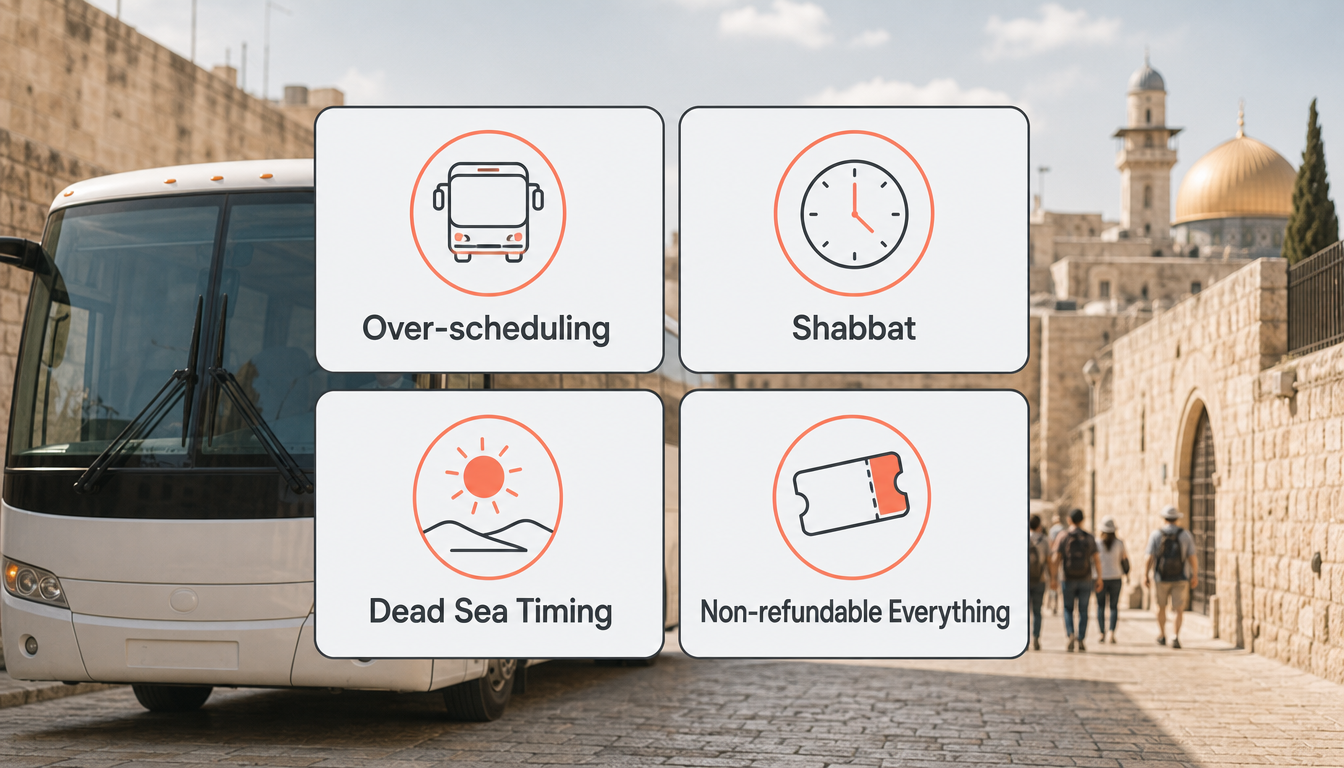
Scheduling issues that most often cost a group a full day of touring.
Over-scheduling is first. A day with seven sites produces a coach full of exhausted people who remember none of them. Five is plenty. Four is often better.
Second is Shabbat. Public transport in most cities pauses from Friday afternoon until Saturday evening, many shops and some sites close, and hotel service changes. This is not a problem for a group with its own licensed coach, and it is a serious problem for independent travelers who assumed a bus would be running. Religious holidays compress or close sites further, and Christian, Jewish, and Muslim calendars all affect access in Jerusalem and Bethlehem.
Third is booking the Dead Sea for a late afternoon in summer, when the shore is at its hottest and the light is gone by the time the group has showered. We put desert days early.
Fourth is non-refundable everything. Book the flexible fare category for at least the internal elements. On currency, the Israeli New Shekel is the local currency, cards are accepted almost everywhere, and a small amount of cash is still useful for tips and market stalls in the Old City and Nazareth.
How far in advance should our congregation start planning?
For Holy Week, Christmas week, or any trip involving forty or more people, nine to twelve months ahead gives you real choice of hotels near the Old City. Outside those peak periods, six months is usually workable, though passport renewals and airline schedules still deserve early attention.
Will the itinerary actually change based on our denomination, or is that just a phrase?
It changes in concrete ways. Site selection, the amount of time spent at each stop, whether Mass or a baptism renewal or an open worship session is scheduled, and even which guide is assigned all depend on the tradition of the group. A Presbyterian group and a Pentecostal group visiting in the same month follow different days, not the same route with different prayers read aloud.
Do older travelers in our group need any special accommodation?
Traveling in spring or autumn matters more for older members than any other single decision. Beyond timing, we build in rest breaks, avoid stacking uneven terrain on consecutive days, and can arrange shorter walking routes at sites like Masada for anyone who needs them. Tell us ages and mobility levels when planning so the daily pace fits the group.
What happens if part of our group cannot get their passport renewed in time?
We flag expiry dates at the deposit stage precisely to avoid this. If a renewal is genuinely delayed, expedited passport service through the U.S. Department of State is usually the only remaining option, and it needs to start the moment the issue is known, not the week before departure.
Can we combine a pilgrimage with a business conference or leadership meeting in Israel?
Yes. We regularly build combined itineraries for U.S. groups that include conference days alongside pilgrimage days, coordinating meeting venues, transport, and accommodations so both parts of the trip run on the same clock without conflicting.
Planning a Holy Land trip comes down to a fixed sequence, deciding the purpose and denomination first, then the season, then the paperwork, then the length of stay, then who guides and drives the group each day. Skip a step or do it out of order, and it usually costs money, comfort, or both, as it did for the pastor from Charlotte.
If your congregation or group is ready to work through these steps, we are glad to talk through dates, denomination-specific arrangements, and costings before you commit to anything. Tell us your group’s tradition and roughly when you want to travel.

About the Author
Talya Felner is the Owner and CEO of Talya Tours Services (TTS), a leading professional tour operator in Israel. With over 35 years of experience and more than 90,000 travelers served, Talya has built TTS into a trusted name for Christian pilgrimages, biblical tours, and conferences for groups visiting Israel and the Holy Land. Her team designs each itinerary around the specific Christian denomination of the visiting group, whether Protestant, Catholic, Evangelical, Baptist, Methodist, Pentecostal, Lutheran, Presbyterian, Anglican, Orthodox, or another tradition, ensuring that sites, worship arrangements, and guides reflect what matters most to that congregation. From visas and accommodations to guides, transportation, and on-site coordination, TTS handles every detail so American pastors and group leaders can focus on the spiritual experience of their travelers.