
Planning a biblical tour of Israel for an American church group involves more decisions than most pastors expect when they first start looking into it – and the most consequential decision is not which sites to visit, but how the itinerary is built around the specific Christian tradition of the group. A Southern Baptist congregation, a Catholic parish, and a Pentecostal fellowship may all want to walk where Jesus walked, yet what they need to experience at each site, which ceremonies they want arranged, and how the guide presents the text are meaningfully different. This article works through the practical questions that American pastors and U.S. group leaders ask when planning a biblical tour of Israel – from how long the trip should be and what the sites actually look like on the ground, to what a good operator includes and how to tell whether they will genuinely tailor the program to your tradition.
Reading time: 9 minutes
Key Points
- A biblical tour of Israel is a Scripture-driven journey through real geography, and its value depends heavily on how well the itinerary matches the denomination of the visiting group.
- Eight to twelve days is the realistic minimum to give both the Galilee and Jerusalem their due without cutting sites or rushing the pace that meaningful reflection requires.
- The best itineraries organize travel geographically, using two fixed base hotels to minimize daily packing and maximize time at sites.
- Before booking with any operator, ask specifically whether they build denomination-specific itineraries, hold government-licensed guides, and can arrange on-site ceremonies suited to your tradition.
What is a biblical tour of Israel
A biblical tour of Israel is a journey that follows Scripture across real geography, placing your feet on the same hills, lakeshores, and city stones described in the Old and New Testaments. It is not a sightseeing loop with a few churches added in. It is a deliberate movement through the events, prophecies, and teachings of the text, with the passages read aloud where they happened.
The difference shows up in how each day is built. A standard leisure tour treats Capernaum as a stop on a map. A scriptural journey treats it as the town where Jesus made His home, and the guide reads Mark 1:21-35 before the group walks in. Historical context, geography, and theology are layered together, which is why a congregation standing at the Mount of Beatitudes understands the Sermon on the Mount (Matthew 5:1-16) differently than they ever did from a pew back home.
What makes this work in practice is the alignment between the guide’s interpretive approach and the theological tradition of the visiting group. A Catholic parish and a Baptist congregation can stand at the same site and need very different conversations. At the Church of the Holy Sepulchre, a Catholic group may want time for liturgical prayer in the Edicule. A Baptist group might spend the same hour at the Garden Tomb, which many Evangelical and Protestant traditions associate more naturally with the resurrection narrative. The site matters, but so does what your tradition brings to it.
For American church groups, the formal entry side matters too. Israel’s Ministry of Tourism publishes the official requirements for religious and study group entry, and a reliable operator handles that paperwork as part of arranging the trip. You can review the framework through the Ministry of Tourism group entry requirements. When you are ready to translate Scripture into a route, the Talya Tours team builds the customized plan around your congregation and its specific tradition.
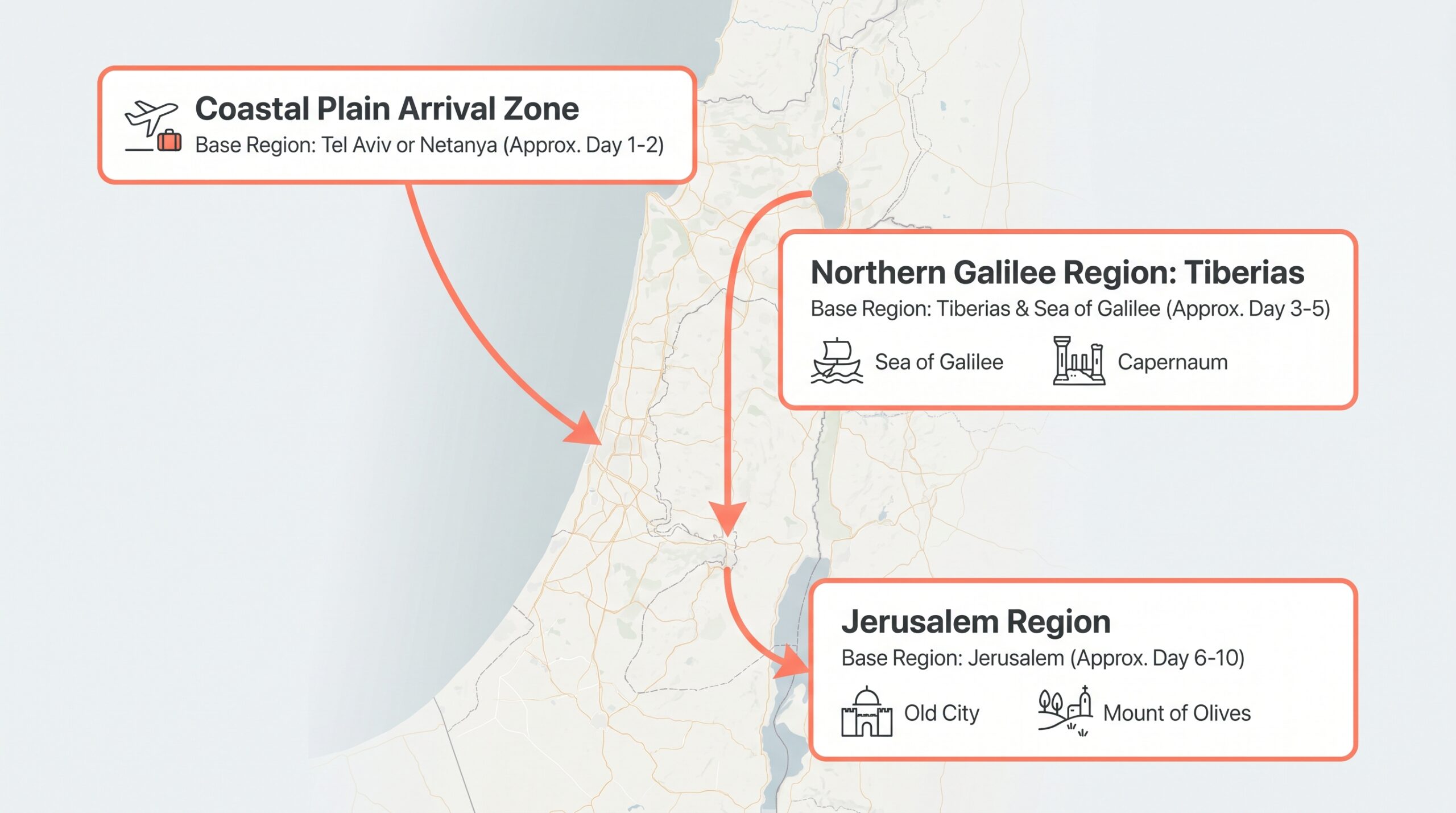
A well-planned biblical tour itinerary organizes Israel’s three main regions into a logical, geography-driven route.
What are the must-see biblical sites in Israel
Israel is a small country, but the biblical sites are spread across three very different landscapes, and that is exactly where groups lose time if no one plans the geography carefully. A practical approach clusters everything into three zones: Jerusalem and its surroundings, the Galilee in the north, and the southern desert by the Dead Sea. Trying to bounce between all three without a logical route is the fastest way to lose a full day on the bus. The Christian tours programs at Talya Tours are arranged precisely along these clusters.
What gives these places their weight is continuity. The ruins and excavations are not reconstructions for tourists. You are looking at actual stones, actual synagogue foundations, actual fortress walls. The physical reality of that is something no classroom or film conveys.
Jerusalem highlights
The Mount of Olives (Zechariah 14:4, Acts 1:9-12) is where most groups begin, looking west across the Kidron Valley toward the Old City. From there the descent leads to the Garden of Gethsemane (Matthew 26:36-46), then into the Old City toward the Via Dolorosa and the Church of the Holy Sepulchre.
How a group moves through the Old City depends significantly on their tradition. Catholic and Anglican groups typically follow the Stations of the Cross along the Via Dolorosa as a structured act of devotion. Evangelical and nondenominational groups often spend that time at the Western Wall plaza and the Davidson Archaeological Park before making their way to the Garden Tomb. Orthodox Christian groups carry their own liturgical priorities, including specific chapels inside the Church of the Holy Sepulchre that hold particular significance for their tradition. No single route through Jerusalem serves all of them equally, which is why we map each group’s Old City day around their denominational focus before departure.
The Old City is listed by UNESCO World Heritage for its walls and sacred sites. The surrounding Old City Basin, documented by the Jerusalem Development Authority, forms the historical and religious core that every American group visiting Israel will want to give serious time.
Galilee and Sea of Galilee highlights
The north is where the Gospels come alive most visibly in the landscape. Capernaum (Matthew 4:13) was the town Jesus made His base of ministry, and the synagogue foundations are still there. The Mount of Beatitudes (Matthew 5:1-16) overlooks the lake in a way that makes the Sermon on the Mount immediately more understandable. Tabgha (John 6:1-15) marks the site of the feeding of the five thousand, and the mosaic floor in the small church there is one of the oldest surviving Christian artworks in the region.
The Jordan River, where John baptized (Matthew 3:13-17), is one of the most requested ceremony sites among American groups. For Baptist, Evangelical, and Pentecostal congregations, a baptism renewal or first-time baptism at the Yardenit baptismal site on the Jordan is often the single moment that defines the entire trip. This takes advance arrangement with the site and with the group’s pastor. We coordinate both.
Judean Desert, Dead Sea, and Qumran
Qumran is where Bedouin shepherds found jars of ancient scrolls in 1947, and those texts reshaped how scholars read the Hebrew Bible. The Israel Museum’s Shrine of the Book houses the best-preserved scrolls, and the Dead Sea Scrolls overview provides accessible context for groups who want to understand what was recovered and why it matters for biblical study.
Nearby, the fortress of Masada (recognized by UNESCO World Heritage) rises above the desert floor. It is not a biblical site in the New Testament sense, but it sits at the intersection of Jewish history, Roman history, and the world the early church moved through. For groups with a strong Old Testament or historical study focus, it is worth the morning. The Israel Nature and Parks Authority publishes a practical Masada visitor brochure with current access details.
How many days do you need for a biblical tour of Israel
You can see Jerusalem in five days. You cannot see Israel in five days. A tour that genuinely does justice to both the northern Galilee and the southern desert, with Jerusalem in the middle, needs a minimum of 8 to 12 days on the ground.
A 7-day tour usually forces a hard choice. Most groups spend it on Jerusalem and Galilee and skip Masada and the Dead Sea entirely, or they rush the desert into a single crowded afternoon. That can work for some groups with a narrow focus. A 10-day tour gives each major zone its due, allows time to read Scripture at each site without watching the clock, and still leaves a full day at Masada and Qumran.
This is where biblical tours differ from a coach holiday in a practical way. The reading, the reflection, the time to stand still at the Jordan River and actually absorb where you are – all of that needs minutes built deliberately into the plan. A well-structured biblical itinerary is not trying to maximize the number of sites visited. It is trying to maximize the depth of engagement at the sites that matter most to your specific congregation. We pace our programs so that the bus is never the destination.
Planning a biblical tour for your American congregation?
Talya Tours builds each itinerary from the ground up around the specific Christian denomination of your group – whether you are a Catholic parish, a Baptist church, a Pentecostal fellowship, or another tradition. Tell us your group size, your denomination, and your preferred travel window, and we will map out a program suited to what your congregation actually needs on the ground.
What is the best 7 to 10 day biblical tour itinerary in Israel
The geography largely solves the itinerary if you let it. The route that works moves in one direction – land on the Coastal Plain, drive north to the Galilee, descend the Jordan Valley, then ascend to Jerusalem. You almost never double back. This matters more than groups expect because a poorly mapped trip can lose two hours a day to backtracking, which over ten days represents a full site sacrificed to a bad routing decision.
We draw multi-day religious itineraries to avoid exactly that kind of waste. You can see how we approach regional sequencing across a multi-country example in the Israel, Jordan and Egypt programme overview (PDF).
Sample structure by regions
We recommend one night on the Coastal Plain on arrival, three nights in Tiberias for the full Galilee cluster, and four to five nights in Jerusalem for the south and the city itself. The reason is simple and physical – a group of 40 packing and unpacking every night loses an hour each morning to logistics and arrives at every site slightly behind and already tired. Two fixed base hotels solve that, and the day-trip structure from each base keeps the bus time proportionate to the site time.
Within this structure, the specific sites selected for each day differ by denomination. A Lutheran group from Minnesota and a Charismatic Catholic group from Texas both spend three nights in Tiberias, but they do not spend those days at identical sites or with the same pacing. The Lutheran group may want extended time at the synagogue in Capernaum connecting to the Reformation tradition’s focus on Scripture and teaching. The Charismatic Catholic group may want a longer morning at Tabgha and Magdala, with time for spontaneous prayer at each stop. Both are valid programs. Neither is the other’s program.
Is it better to do a guided biblical tour or travel independently
Independent travel gives you flexibility. You set your own pace, change plans freely, and linger where you like. What it cannot give you is context. Standing at Megiddo (Revelation 16:16) without someone who can explain the twenty-six layers of civilization beneath your feet is just a hill. The archaeology, the military history, the prophetic significance, and the way the site connects to the passages your group has studied – that requires a guide who has spent years learning the ground.
A government-licensed local guide reads the archaeological layers, handles complicated entries at sites with timed access or advance booking requirements, and connects the text to the physical location in ways that deepen rather than distract from the experience. The Garden Tomb in Jerusalem keeps hours that surprise most first-time groups. The Church of the Holy Sepulchre fills with tour crowds at predictable windows. A guide who has navigated these sites for years routes around both without the group ever noticing there was a problem to avoid.
For U.S. group leaders researching the trip, the National Security Council travel advisory page provides current guidance. We monitor the same sources daily and adjust itineraries when conditions warrant it.
What is included in a biblical tour package
A standard package from us covers the things that make or break a group trip: professional government-licensed guiding, regional transport in modern air-conditioned buses, airport transfers, hotel accommodation at your chosen category, and daily meals on a half-board basis (breakfast and dinner). Site entrance fees for the main program sites are included. On-site ceremony coordination – such as advance arrangement for baptism renewal at Yardenit, or communion at the Garden Tomb – is handled by our team and is part of how we build denomination-specific programs.
What is generally not included in land-only packages: international flights from the U.S. to Israel, travel health insurance, lunches, personal souvenirs, and gratuities for the driver and guide. Knowing this upfront prevents the awkward surprises that groups occasionally discover mid-trip when comparing quotes from different operators. When you review an all-inclusive faith-based package, look closely at exactly what sits inside the price. You can see what our programs cover across the Christian tours listings at Talya Tours.
The table below illustrates how site emphasis, ceremony preferences, and pacing differ meaningfully across four common denominational groups that American congregations represent:
How much does a biblical tour of Israel cost
Price moves with four levers – the season you travel, the hotel category you choose, the type of transport required, and how large your group is. A U.S. congregation of 40 splits fixed costs significantly better than a group of 12, which is why per-person pricing drops as group size grows.
Traveling in shoulder months reduces accommodation rates meaningfully. This pattern is reflected in broader tourism data, including the Israel hotel investment white paper published by the government. As a rough guide for a 10-day land-only program per person, three-star hotel options with a larger group sit in the lower price range; four-star options with mid-size groups fall in the middle; five-star properties with smaller groups carry the highest per-person cost. International flights from the U.S. are separate from all of these figures.
The most reliable way to get an accurate number for your group is to share your group size, denomination, and general itinerary interests with us directly. We price every tour individually because the program is custom-built – there is no off-the-shelf package with a fixed price that applies to every American congregation regardless of their tradition or travel needs.
What is the difference between a Bible Tour and a Holy Land tour
The terms are used interchangeably in marketing, but they describe meaningfully different kinds of trips. A dedicated Bible Tour keeps continuous focus on Scripture, prophecy, biblical history, and study time at each location. The text drives the route. Each site is selected because it connects to a specific passage, and the guide’s role is to make that connection concrete.
A broader Holy Land tour widens the lens. It folds in general regional history, modern Israeli history, geopolitics, and contemporary culture alongside the sacred sites. Both are valid, and both serve real needs. A nondenominational megachurch group from Phoenix often wants the broader version with room built in for in-group worship and discussion. A Bible college group from Indiana focused on Old Testament archaeology wants the tighter scriptural version where every site ties to a text. Knowing which type your group actually needs is the first conversation we have before anything else is planned.
Some American groups discover mid-planning that they want something in between – a framework of biblical sites with enough modern context to understand why Israel looks and functions the way it does today. That hybrid approach works too, and we build it deliberately rather than defaulting to a generic template.
What is the best season for a biblical tour of Israel
Spring (March to May) and autumn (September to November) are the most practical travel windows for American groups. Temperatures sit in a range that accommodates the long walking days that biblical sites demand, especially when half the itinerary covers open archaeological ground with limited shade. The light in these months is also noticeably better for the landscape photographs that most groups want from the Sea of Galilee and the Judean Desert.
Summer in the Judean Desert and at Masada is genuinely hot. A group walking the Masada ruins at midday in July is spending stamina that would be better used at the site itself. Heat management for older congregation members is a real logistical concern, not a minor detail. Groups that insist on summer travel typically need earlier start times at every site and shorter walking windows in the afternoon.
Winter brings rain, which is largely manageable with appropriate clothing, but it carries one genuine planning risk worth knowing in advance. Flash floods can fill desert canyons very quickly during seasonal transitions, particularly in the area around the Dead Sea and the Judean wilderness. The Israel Meteorological Service publishes guidance on checking flash flood conditions before visiting desert trails. A responsible operator monitors forecasts and reroutes desert days when the conditions make it necessary. We do this as standard practice.
What to look for when choosing a biblical tour company
Three things separate a genuine operator from a travel reseller. Local licensing in Israel, meaning the company is physically based here with government-licensed guides and established site relationships. Real knowledge of the denominational differences between Christian traditions, not just an ability to add “customizable” to a brochure. And the capacity to arrange on-site ceremonies – baptism at the Jordan, Mass at a site with a functioning altar, communion at the Garden Tomb, extended prayer time at Gethsemane – which require advance coordination that a reseller operating from a desk in another country simply cannot do.
Talya Tours is owner-led, and Talya Felner is involved in every group that travels. Tourism is our only business, and every itinerary is built from the beginning around your denomination, your pastor’s goals, and the specific ceremonies and site priorities your congregation needs. When you are ready to discuss dates and a program, the Talya Tours contact page is the place to start.
Questions to ask before you book
Before committing to any operator, five questions are worth asking directly. First, does the tour adapt specifically to your denomination, not just in name but in site selection, guide briefing, and ceremony arrangement? A Catholic parish and an Assemblies of God congregation should not receive the same program. Second, are the guides certified by Israel’s Ministry of Tourism? Third, what ceremonies can be arranged on site – such as baptism at the Jordan or communion at the Garden Tomb – and who coordinates those with the site authorities? Fourth, what is the operator’s policy when the itinerary needs to change due to weather, site access issues, or security conditions? And fifth, who is your single point of contact from initial planning through the last day of the trip?
If your church group is beginning to map out a pilgrimage to Israel, we are glad to talk through dates, sites, and the kind of program that genuinely fits your tradition before you commit to anything. Reach Talya directly at [email protected] or through the Talya Tours contact page.
Frequently asked questions
A biblical tour of Israel is one of the most significant journeys an American congregation can take together, and the quality of the experience depends directly on how well the itinerary is built around the specific Christian tradition of your group. The sites are irreplaceable. What determines whether your group comes home transformed or simply well-traveled is the depth of the program – the guide’s understanding of your denomination’s theology, the ceremonies arranged at the sites that matter to your tradition, and the pacing that allows Scripture to connect to the ground beneath your feet. With over 35 years of experience and more than 90,000 American travelers served, Talya Tours designs every program from the ground up around the group in front of us, not a catalog of standard itineraries. If your church is ready to begin planning, reach out through the Talya Tours contact page or directly at [email protected] to talk through what your congregation needs.
Ready to plan your congregation’s biblical tour of Israel?
Tell us your denomination, group size, and the kind of experience your congregation is looking for. We will put together a program built specifically around your tradition – not a package designed for everyone and suited to no one in particular.

About the Author
Talya Felner – Owner and CEO, Talya Tours Services (TTS)
Talya Felner is the Owner and CEO of Talya Tours Services (TTS), a leading professional tour operator in Israel. With over 35 years of experience and more than 90,000 travelers served, Talya has built TTS into a trusted name for Christian pilgrimages, biblical tours, and conferences for American groups visiting Israel and the Holy Land. Her team designs each itinerary around the specific Christian denomination of the visiting group – whether Protestant, Catholic, Evangelical, Baptist, Methodist, Pentecostal, Lutheran, Presbyterian, Anglican, Orthodox, or another tradition – ensuring that sites, worship arrangements, and guides reflect what matters most to that congregation. From visas and accommodations to guides, transportation, and on-site coordination, TTS handles every detail so American pastors and group leaders can focus on the spiritual experience of their travelers.