
Planning a group trip to Israel from the United States involves more moving parts than most American church leaders and group organizers expect – hotel blocks, licensed guides, pre-booked site entries, Shabbat logistics, border fees, and an itinerary built around the specific priorities of your congregation’s Christian tradition. This article walks through every practical dimension of Israel group tours so that American pastors, church administrators, and group leaders can approach the planning process with a clear picture of what is actually involved, what it costs, and what questions to ask before committing to anything.
Reading time: 9 minutes
Key Points
- Group tour cost varies by group size, hotel category, and season – no single number applies until you share those details with your operator.
- A well-structured package always includes a licensed guide, licensed driver and vehicle, and pre-paid site entrances – anything missing from that core is an incomplete package.
- Itineraries built for American church groups should be shaped by denomination – Catholic, Baptist, Pentecostal, Lutheran, Methodist, Orthodox, and other traditions each have different site priorities and worship needs that a serious operator accounts for from the start.
- Guaranteed departures, small-group formats, and clear cancellation terms in writing are the most reliable signals that you are dealing with a serious, accountable operator.
Table of Contents
What are Israel group tours and who are they best for
A licensed guide leads an American church group through a biblical site in Israel.
An Israel group tour is a professionally organized, scheduled itinerary where travelers share one vehicle, one licensed guide, and one set of pre-arranged logistics. Entrance tickets are booked in advance. The daily route is planned. Departure dates are confirmed. Nobody in your group is standing at a ticket window in the midday heat trying to negotiate entry for 40 people.
The format serves several types of American travelers well. First-time visitors who do not want to figure out Shabbat closures or Old City gate schedules on their own. Seniors who prefer having their luggage handled at every property without lifting a bag. Church communities traveling as a congregation. And solo American travelers who want the security of moving with a group rather than navigating Jerusalem alone in the evenings.
Working with a licensed, locally based experienced tour operator in Israel means the logistical burden stays on our side of the table. American groups arrive, walk the sites their faith tradition holds most meaningful, and return home with the experience they came for. The planning, permitting, and coordination happen before they land.
How much do group trips to Israel cost
There is no single answer, and any operator who quotes a number without asking questions is guessing. The cost of group trips to Israel moves primarily with three variables – group size, hotel category, and travel season.
Group size is the strongest lever. A bus carrying 25 people spreads the fixed costs of guide, driver, and vehicle across more travelers than a bus of 12. A larger group almost always produces a lower per-person land rate, which is why a church of 40 traveling together pays meaningfully less per head than a family of four on the same route.
Hotel category is the second lever. A three-star tourist-class property in Tiberias and a five-star property overlooking the Sea of Galilee are not in the same price range. Most American church groups settle on four-star properties as a practical midpoint – comfortable, clean, and well-located without the premium of the top tier.
Season is the third. The same itinerary in February costs noticeably less than the same itinerary at Easter, Christmas, or during the fall festival weeks in October. Those peak periods carry real demand surcharges across hotels, buses, and some sites. A few costs nearly always sit outside the land package – land border-crossing fees, certain airport taxes, and specific departure transfer charges are often handled separately. For current, official fee schedules, the Israel Airports Authority publishes them directly.
What is included in Israel group tour packages
Reading the inclusions and exclusions of a quote carefully is where most American groups either save money or lose it. A complete package bundles the essentials clearly and names the exclusions just as clearly.
Three elements should always be inside the package without exception. A safe, air-conditioned vehicle with a government-licensed driver. A government-licensed guide for all touring days. And pre-paid entrance fees for the sites on your confirmed itinerary. If any one of those three is missing, you are looking at an incomplete package.
Beyond the core, most serious Israel group tour packages also include daily hotel breakfasts, a selection of group dinners, and luggage porterage at each property. Some include more. Ask before you assume.
The classic exclusions that catch American groups off guard include international airfare (almost never inside the land package), personal travel and health insurance, lunches on the road, and guide and driver gratuities. Tipping the guide and driver is customary in Israel and is not built into the headline price. Before signing anything, confirm every cancellation term in writing. The Israel Consumer Council sets clear standards on written disclosure and cancellation rules for vacation packages, and a serious operator will meet those standards without being prompted.
Planning a group trip from the United States and not sure where to begin?
Talya Tours builds each itinerary around the specific Christian denomination of your group – whether you are traveling as a Baptist congregation, a Catholic parish, a Pentecostal ministry, a Methodist church, or another tradition. Share your group size, travel window, and denomination, and we will outline a realistic, denomination-specific plan with transparent pricing.
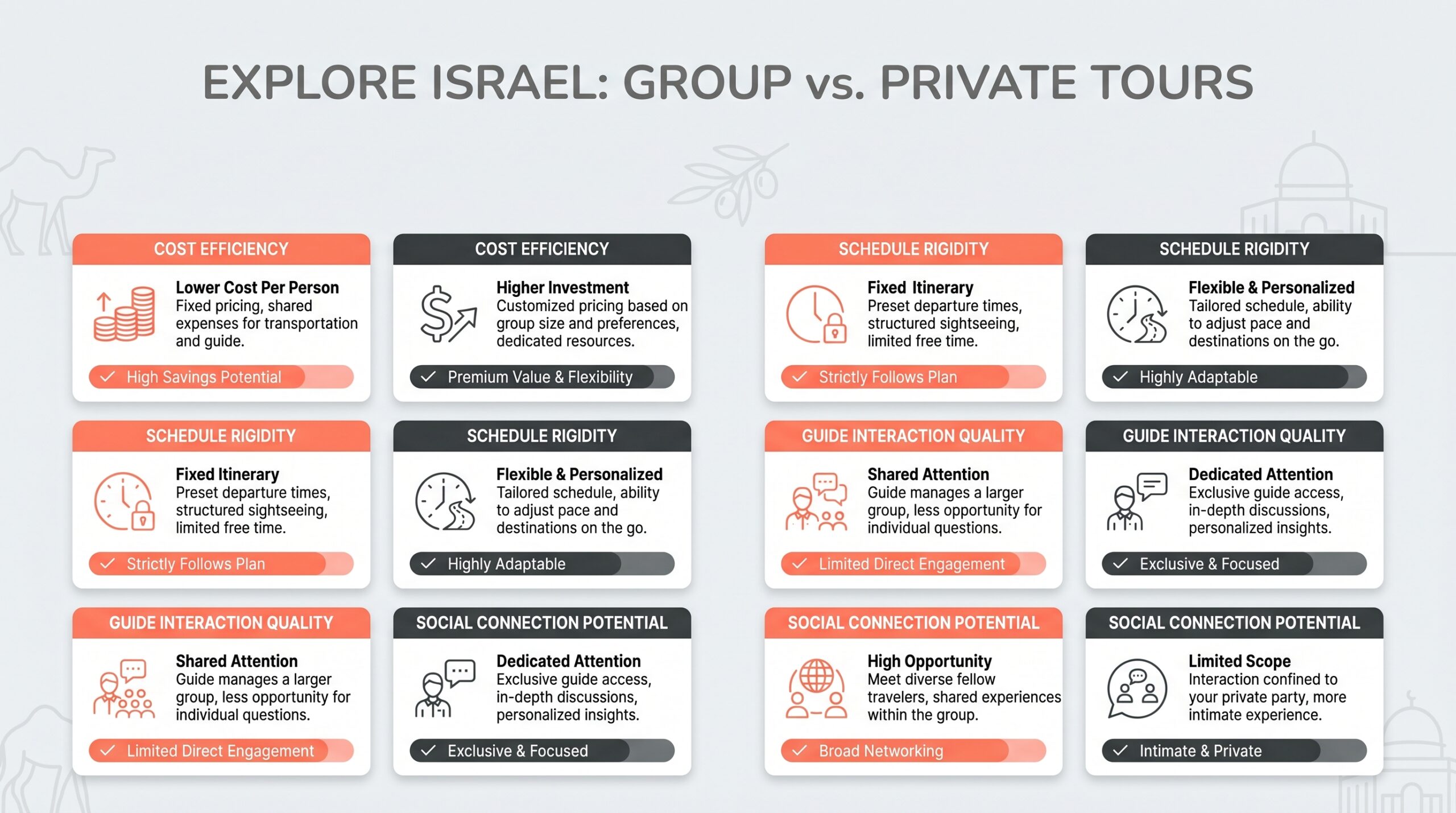
Is a group tour better than a private tour in Israel
Neither format is better in the abstract. They solve different problems. A group format wins on cost, because hotels and attractions extend volume-discounted rates that a couple or small family traveling alone will never access. It also wins on shared meaning, which matters more than people expect on a pilgrimage. Forty people praying together at the Mount of Beatitudes (Matthew 5:1-16) is a different experience than two people doing the same thing quietly.
A private itinerary wins on flexibility. A family that wants to linger at one site and skip another, or a specialized group focused on a narrow set of biblical locations specific to their tradition, moves on their own terms. A Baptist group that wants three hours at Yardenit on the Jordan River for baptism renewal does not need to coordinate that with 35 other passengers.
Group Tour vs. Private Tour – A Practical Comparison
| Dimension | Group Tour | Private Tour |
|---|---|---|
| Cost efficiency | High – shared fixed costs and volume hotel rates | Lower – all costs carried by one small party |
| Schedule rigidity | Fixed daily program | Fully adjustable day to day |
| Guide interaction | Shared across the group | One-on-one attention throughout |
| Denominational customization | Built into the group’s itinerary from the start | Fully customizable with maximum flexibility |
| Shared spiritual experience | Strong – congregation travels and worships together | Limited to your own traveling party |
For a congregation traveling together as a group, the shared format usually wins on both budget and collective meaning. The fact that the itinerary is shaped around that congregation’s specific tradition – whether they are Methodist, Presbyterian, Anglican, or another stream – makes the group format feel personal rather than generic.
What is a small group tour
A small group tour is an operational definition, not a marketing phrase. Instead of a 50-seat coach, the group travels in a smaller vehicle, typically limited to somewhere between 8 and 18 guests.
That size changes the day in real ways. Morning departures are faster – boarding 14 people takes minutes rather than the thirty a full coach demands. The guide can actually speak with each traveler rather than broadcasting through a microphone the entire day. And the access changes materially.
A small group vehicle can reach narrow lanes in the Old City of Jerusalem, park near smaller restaurants and family-run sites in Nazareth, and stop at locations where a full-size 50-seat bus simply cannot maneuver. For American church groups that want a more intimate Israel experience, the smaller format is worth the slightly higher per-person cost. The feedback from those trips is consistent over years of operation – smaller is calmer, more connected, and easier on the itinerary’s pace.
What is a guaranteed departure group tour
A guaranteed departure means the trip runs on its confirmed date regardless of how many people ultimately enroll. This is one of the most practically important things an operator can offer, and one of the least discussed.
American travelers routinely book their international flights months in advance to secure reasonable fares. If the tour is later cancelled because enrollment fell short of a minimum, those flights and any non-refundable hotel nights become a personal problem. A guaranteed departure removes that risk entirely.
Even if the bus is half full, the operator runs the program as confirmed. The guide arrives. The hotels honor the booking. The entrance tickets are used. Every traveler who enrolled early absorbed no scheduling risk for doing so. When you are comparing operators, look specifically for one offering guaranteed departures on a regular basis. It allows your congregation to lock in flights at good fares months ahead, which is exactly the point where fares are most favorable.
When is the best time to join an Israel group tour
Two windows work best for group travel to Israel from the United States. Spring, roughly March through May, and fall, roughly September through November. Temperatures in both periods are comfortable for walking the Old City, climbing at elevated biblical sites, and standing outdoors near the Sea of Galilee without exhaustion setting in by midmorning.
Summer is genuinely hot, and the heat is not uniform across the country. Jerusalem, sitting high in the Judean Hills, stays manageable in the evenings. The Dead Sea and Tiberias, both far below sea level, become punishing in July and August, regularly exceeding 100 degrees Fahrenheit by midday. American groups booking summer should plan early starts, early afternoon breaks, and finishes before the hottest hours.
Winter, December through February, brings meaningfully lower prices and thinner crowds at most sites, with the trade-off of cooler days and a real possibility of rain, particularly in the Galilee region and the north. Some American groups accept that exchange willingly. Before finalizing packing lists, review the official multi-year climate records in the Israel Meteorological Service Climate Atlas so that clothing choices match the region and season your group is actually traveling in.
How many days do you need for group travel to Israel
Seven days is the realistic minimum, though not a comfortable one. In a week you can cover Jerusalem and its Old City, Bethlehem and the Church of the Nativity (Luke 2:1-20), and a day at the Dead Sea. It is workable, but it moves quickly, and Galilee either gets rushed or dropped.
Most American church groups plan better with 10 to 12 days. That range allows your group to reach Safed, the Golan Heights, the Sea of Galilee, Nazareth, and Tel Aviv without anyone wearing out mid-trip. It gives Galilee two proper nights rather than a compressed afternoon, and it leaves room for the unhurried worship time at significant sites that most denominational groups specifically want – time that a tight seven-day pace simply cannot protect.
The most common regret from American travelers on a seven-day Israel group tour is not a missed site. It is the feeling that there was never time to stop, absorb, and breathe. The extra days are not luxury – they are what allows the trip to become what most congregations intended it to be.
What a typical Israel itinerary looks like
Itineraries follow a logical geography – generally moving from the coastal plain northward through Galilee, then south into Jerusalem – to minimize backtracking and long transit days. For American church groups, the site selection within that geography is where denominational tradition does real work. A denomination-specific Christian tour of Israel differs from a generic sightseeing package precisely because the priority sites, worship arrangements, and time allocations are chosen to reflect what matters most to that congregation’s tradition.
The 7-Day Classic Highlights Framework
A seven-day flow typically runs from arrival near Tel Aviv, up to Haifa and Mount Carmel (1 Kings 18:16-40), across to the Sea of Galilee with Capernaum (Mark 1:21-35) and Tabgha (John 6:1-15), into Nazareth, then south to Jerusalem and the Old City, across to Bethlehem, and through to Masada and the Dead Sea before departure. That route covers the structural geography, but the specific sites, worship stops, and Scripture readings within it change substantially depending on whether the group is Lutheran, Evangelical, Anglican, Orthodox, or another tradition. Two groups on the same seven-day bus route can have meaningfully different experiences based entirely on how the itinerary is weighted for their denomination.
The 10-Day Deep Exploration Framework
The longer version keeps the same structural spine and adds meaningful depth. A full day for Tel Aviv and the ancient ruins at Caesarea. A day in the Golan Heights and upper Galilee. An overnight near the Dead Sea rather than a rushed afternoon transit. For the Masada leg, the Masada National Park official portal lists current visiting regulations and cable car details, which matter when you are timing a sunrise climb with a full group and need to confirm access windows in advance.
Are Israel group tours safe
Safety is the first question most American group leaders raise, and it deserves a direct answer rather than a reassuring generality. Licensed, locally based operators maintain active awareness of ground conditions at all times. Routing decisions are made in real time based on official guidance, not pre-set maps that ignore current conditions.
In practice this means buses are routed around congested or sensitive areas as conditions warrant. Drivers are government-licensed and know the geography in detail – which roads to use, which to avoid, and when to adjust. Every group arrangement carries standard emergency contacts and built-in safety protocols that a serious operator follows as a matter of routine.
For an organized Israel group, the security thinking is invisible on most days and reassuring on the rare day it becomes relevant. It is part of the planning structure, not an afterthought.
One pre-departure step that applies to all U.S. travelers now regardless of itinerary type – American citizens from visa-exempt countries are required to register an electronic travel authorization before arriving in Israel. Complete that process through the official ETA-IL registration system well before your departure date so your arrival is both lawful and smooth.
Can I join a group tour as a solo traveler
Yes, and many American travelers do exactly that. An organized Israel group tour is one of the safest and most cost-effective ways for a solo traveler from the United States to experience the country without managing a single day of logistics independently.
You travel with the group, eat with the group, and have a guide who knows your name within the first day. The social dimension often turns out to be the most valued part of the experience for people who arrived expecting to keep mostly to themselves.
On cost, there are two standard paths. Some operators offer roommate-matching, pairing solo travelers of the same gender to share a double room and split the cost. If you prefer a private room, you pay a Single Supplement, which is a fixed additional charge disclosed upfront. Either way, solo participation on Israel group tours is common, expected, and straightforward to arrange from the U.S. before your departure.
Are Israel group tours good for families and multi-generational groups
They are, for one specific reason above all others – synchronization. When a grandfather, his adult daughter, and her children are all traveling together, the hard part is keeping everyone on the same schedule, in the same hotel block, at the same meals. A group format handles that automatically, which removes a layer of daily coordination stress that would otherwise fall on whoever in the family volunteered to plan the trip.
The advice for American families planning group travel to Israel is to watch the pacing of the itinerary carefully before booking. Look for programs with late-morning hotel departures rather than pre-dawn starts, and with limited daily mileage swings. A day that ends with three hours on a bus exhausts a six-year-old and an eighty-year-old in equal measure, and neither will recover quickly enough for an early start the next morning.
A multi-generational Israel trip planned with the right pacing works well. The fix is in choosing the route and the schedule before you commit, not in hoping the group will adapt once you arrive.
What to look for when choosing an Israel group tour company
Start with licensing. A serious operator holds valid Israeli operating permits, and the guides they employ hold current government licenses. This is not a formality – guiding in Israel is regulated by law, and licensed guides have passed real examinations in Israeli history, biblical geography, and professional conduct to earn the credential. Using an unlicensed guide, whether knowingly or because the operator cut costs, puts your group in an educationally and legally weaker position.
Beyond paperwork, judge a company by how it responds to you before any money changes hands. Slow, vague, or evasive answers at the inquiry stage reliably predict slow, vague, and evasive service after you have paid. Ask specifically about the guides they assign – their background, their language fluency, their experience with your denomination’s specific tradition and site priorities.
Choose a company registered and audited under the official standards maintained by the Israel Ministry of Tourism. An online reseller aggregating packages from multiple providers rarely carries that level of accountability, and when something goes wrong on the ground, the distance between you and the person actually responsible becomes a real problem.
Warning Signs to Watch Before Booking
A headline price that seems unusually low almost always conceals expensive local service charges added after the deposit is paid. Itineraries that name no specific hotels – only vague category descriptions like “four-star equivalent” – give the operator flexibility to downgrade accommodations without technically breaching the contract. And any operator who declines to put cancellation and refund terms in clear, written language before you commit is telling you something important about how they handle disputes after the fact.
Questions to ask before booking any Israel group tour
A good initial conversation with a tour operator is also a screening process. Work through the following list with any operator you are seriously considering before paying a deposit.
- What is the average number of travelers on the bus for this itinerary?
- Are all entrance fees for the listed sites pre-paid within the package price?
- Is this a guaranteed departure, and what is the written confirmation of that guarantee?
- What languages is the assigned guide fluent in, and what is their experience with our denomination’s tradition?
- Which specific hotels, named by property, will the group stay in?
- How are Shabbat closures in Jerusalem managed within the confirmed schedule?
- Which meals are included each day, and which are on the traveler’s own expense?
- What is the full cancellation and refund policy, in writing, before any payment is made?
- Is travel and health insurance included in the package, or is that the traveler’s own responsibility?
- What is the Single Supplement charge for a traveler who wants a private room?
- Can the itinerary site selection and worship arrangements be adjusted to reflect our denomination’s specific priorities?
- Who is the on-the-ground contact if something goes wrong during the trip?
If an operator answers all twelve of those questions clearly and without hesitation, you are likely speaking with a real professional. Vague or deferred answers on group trips to Israel are the most reliable early warning sign available before any money moves.
Why choose Talya Tours for your group journey to Israel
Over 35 years, Talya Tours Services has organized pilgrimages, biblical tours, and professional conferences for more than 90,000 American travelers. Tourism to Israel is the only business we operate, and Talya Felner runs it personally. Every group arrangement is touched by her directly, not handed off through layers of staff.
The central distinction in our work is denomination-specific planning. We do not offer one generic Christian itinerary and adjust a few site names. We start by asking what tradition your congregation belongs to and what your pastor wants the group to experience – and the itinerary is built from that answer outward.
A Catholic parish group typically spends extended time at the Church of the Holy Sepulchre, the Basilica of the Annunciation in Nazareth, and the Stations of the Via Dolorosa, with Mass arranged at the appropriate sites along the route. A Southern Baptist congregation often emphasizes the Garden Tomb, baptism renewal at Yardenit on the Jordan River, and unhurried Scripture reading time at Capernaum (Mark 1:21-35). A Pentecostal ministry may want long, open worship sessions at the Mount of Olives without a tight schedule pressing them toward the next site. A Lutheran group traveling with a focus on Reformation-era biblical scholarship will have different priorities than a group from an Episcopal parish. Each of those itineraries is built differently because each tradition prioritizes differently – and a competent guide assignment reflects that from day one.
The practical logistics sit under one roof. Government-licensed multilingual guides, licensed vehicles with WiFi, carefully selected hotels at appropriate categories, visa assistance, travel insurance coordination, baptism and communion arrangements at the biblical sites relevant to your tradition, and airport coordination from arrival to departure. Guaranteed departures, small-group format options, transparent inclusions, and written cancellation policies are how we operate by default – not features we add on request.
Ready to plan your group’s Israel trip around your denomination’s specific tradition?
Share your congregation’s tradition, group size, and preferred travel window. Talya will outline a realistic, denomination-specific itinerary with clear pricing – no pressure, no vague estimates. You can also reach Talya directly at [email protected].
Frequently asked questions
How far in advance should our U.S. church group book an Israel tour?
Can our itinerary include baptism in the Jordan River?
How does Shabbat in Jerusalem affect a group tour schedule?
Does Talya Tours arrange Mass or denominational worship services at sites in Israel?
What is the ETA-IL requirement for American travelers to Israel?
Can a smaller church with 15 people still book a group tour?
Planning a group trip to Israel from the United States takes time, and the quality of that planning – who handles the logistics, how well the itinerary is matched to your congregation’s tradition, and how clearly the inclusions and cancellation terms are written – determines most of what the group will actually experience on the ground. The structure of a well-run group tour removes the logistical burden from the pastor and group leader, which is the entire point. If your congregation is beginning to think about dates, sites, and what a denomination-specific itinerary would look like for your group, Talya Tours is glad to walk through the specifics with you before any decisions are made. Reach out through the Talya Tours contact page or write directly to [email protected] to start the conversation.

About the Author
Talya Felner – Owner and CEO, Talya Tours Services (TTS)
Talya Felner is the Owner and CEO of Talya Tours Services (TTS), a licensed professional tour operator based in Israel. With over 35 years of experience and more than 90,000 travelers served, Talya has built TTS into a trusted name for Christian pilgrimages, biblical tours, and conferences for American groups visiting Israel and the Holy Land. Her team designs each itinerary around the specific Christian denomination of the visiting group – whether Protestant, Catholic, Evangelical, Baptist, Methodist, Pentecostal, Lutheran, Presbyterian, Anglican, Orthodox, or another tradition – ensuring that sites, worship arrangements, and guide assignments reflect what matters most to that congregation. From visas and accommodations to guides, transportation, and on-site coordination, TTS handles every detail so American pastors and group leaders can focus on the spiritual experience of their travelers.