
A pastor in Dallas calls our office in March. His congregation of 38 wants to walk the stones of Jerusalem in November, and he has already secured flights and rooms near Jaffa Gate. What he has not reserved is a single underground entry pass. This oversight costs American groups valuable time every season, because subterranean sites in Jerusalem operate under strict municipal security limits and fixed group capacities. When an unbooked group reaches the ticket barrier during peak season, the turnstile does not turn.
The ground beneath modern Jerusalem holds some of the most remarkable engineering of the ancient world. Street level in the Old City sits dozens of feet above the stone pavements of the Second Temple period, so a walk on the surface shows you Byzantine arches and Ottoman walls along with modern markets while stepping below places your feet on massive Herodian masonry and raw Iron Age bedrock. This guide covers what American group leaders need to know before taking their travelers underground, from the physical differences between dry corridors and wet water conduits to reservation rules and clothing requirements as well as how to sequence the sites into a single coherent day.
Reading time: 5 minutes
Key Points
- The Western Wall Tunnels and Hezekiah’s Tunnel are entirely different experiences because one is dry and paved and lit while the other is wet and dark and cut through raw bedrock.
- Underground sites cap groups at roughly twenty to thirty visitors per guide, and peak-season entries sell out two to three months in advance.
- Hezekiah’s Tunnel involves wading through a flowing stream up to thigh depth, so water shoes and quick-dry clothing are essential along with a headlamp.
- Underground itineraries can be shaped around a group’s specific denomination, from scripture reading stops to prayer time and guide selection.
Table of Contents
- What Lies Beneath the Old City Streets
- What to Expect on a Western Wall Tunnels Tour
- Why Underground Entries Must Be Reserved Well in Advance
- Western Wall Tunnels Compared With Hezekiah’s Tunnel
- Who Should Walk the Jerusalem Water Tunnels
- Accessibility for Wheelchairs and Strollers
- What to Wear and Pack for Dry and Wet Routes
- The Historical Eras Hidden Beneath Jerusalem
- How Your Denomination Shapes the Underground Itinerary
- The Best Time of Day and Season to Go Underground
- Combining Underground Sites Into a Single Day
- Frequently Asked Questions
What Lies Beneath the Old City Streets
Jerusalem’s underground passages divide into three distinct categories, and knowing the difference shapes every planning decision. The first includes the monumental dry corridors of the Second Temple period, high-ceilinged vaults that supported streets and plazas beside the Temple Mount. The second consists of paved archaeological shafts and drainage channels that carried storm water from the upper city down toward the Kidron Valley. The third comprises raw bedrock water conduits cut during the Iron Age, including the channel carved under King Hezekiah. Some pilgrims prefer quiet walkthroughs along paved, electrically lit stones. Others want the tactile experience of wading through flowing spring water in narrow bedrock fissures. Talya Tours has coordinated both for American church groups for more than 35 years.
What to Expect on a Western Wall Tunnels Tour
The Western Wall Tunnels follow the western flank of the Temple Mount platform built by King Herod. The open-air prayer plaza exposes only about 200 feet of the retaining wall, while the underground route reveals roughly 1,600 additional feet of original masonry. The defining highlight is the Western Stone, a single limestone block nearly 45 feet long and weighing an estimated 570 metric tons, one of the heaviest objects moved by human hands in the ancient world. Farther along, Warren’s Gate sits opposite the former site of the Holy of Holies and remains a place where many visitors pause for quiet prayer. The full walk takes about 75 minutes at a guided pace, and security screening requires arriving at least 25 minutes early. We recommend scheduling this site as an 8:30 AM opening stop, which leaves the rest of the morning free for surface visits such as the Southern Steps (Luke 2:41-52).
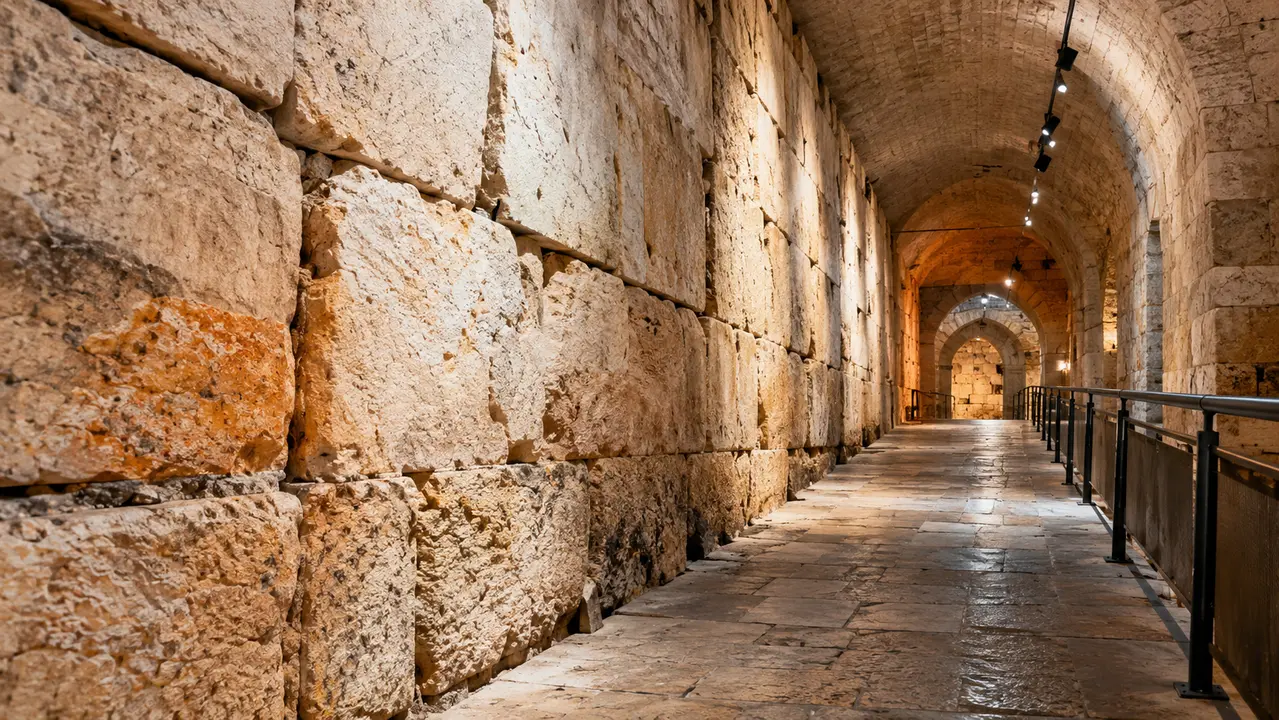
Timed entry and pacing for the Western Wall Tunnels route.
Why Underground Entries Must Be Reserved Well in Advance
Subterranean spaces cannot expand to absorb crowds. Civil safety codes cap underground groups at roughly twenty to thirty visitors per licensed guide, and once hourly slots fill for a given date, booking systems close completely. Entries sell out two to three months in advance during spring pilgrimage months and summer family travel as well as the autumn holidays. Pastors who delay often find their entire delegation locked out of preferred dates. Talya Tours monitors reservation calendars continuously and locks in verified entry times months before a group departs the United States, then manages check-in directly with site staff so travelers walk straight into their assigned slots with their dedicated guide.
Western Wall Tunnels Compared With Hezekiah’s Tunnel
Group leaders frequently confuse these two sites, yet their physical realities are entirely different. Because the paved and fully lit Western Wall complex is dry, visitors cross its wooden platforms and glass floors as well as its ancient flagstones without specialized gear. Hezekiah’s Tunnel is a water-filled channel cut through mountain bedrock around 701 BC, walked in darkness with flashlights while spring water flows around your legs. Understanding the difference prevents unhappy surprises for travelers who experience claustrophobia or limited balance.
| Feature | Western Wall Tunnels | Hezekiah’s Tunnel |
|---|---|---|
| Location | Western edge of the Temple Mount | City of David, Kidron Valley |
| Historical era | Second Temple, Herodian period | First Temple, Iron Age, around 701 BC |
| Walking conditions | Dry, paved, well lit | Running spring water, raw bedrock, dark |
| Physical exertion | Low, with moderate stairs | Moderate to high, narrow passages, some crouching |
| Footwear needed | Standard walking shoes | Secure water shoes or strapped sandals |
Who Should Walk the Jerusalem Water Tunnels
Jerusalem water tunnel tours center on the 533-meter conduit King Hezekiah carved when facing invasion by the Assyrian king Sennacherib. As recorded in 2 Kings 20:20, he blocked the springs outside the city and redirected the waters of the Gihon Spring into the fortified lower city. Two teams of miners cut from opposite ends through solid limestone, meeting in the middle using acoustic sound cues. Water still flows through the channel today, emptying into the Pool of Siloam (John 9:1-7). Most of the transit is calf-deep, levels fluctuate with rainfall, and the water holds near 64 degrees Fahrenheit year-round. This route suits adventurous travelers and youth groups as well as energetic adult Sunday school classes, and pastors leading American youth ministries often name it the most memorable morning of the trip. The site recommends a minimum age of five for the wet channel, and there are no intermediate exits once inside. Travelers who prefer to stay dry take the parallel Canaanite Dry Tunnel instead.
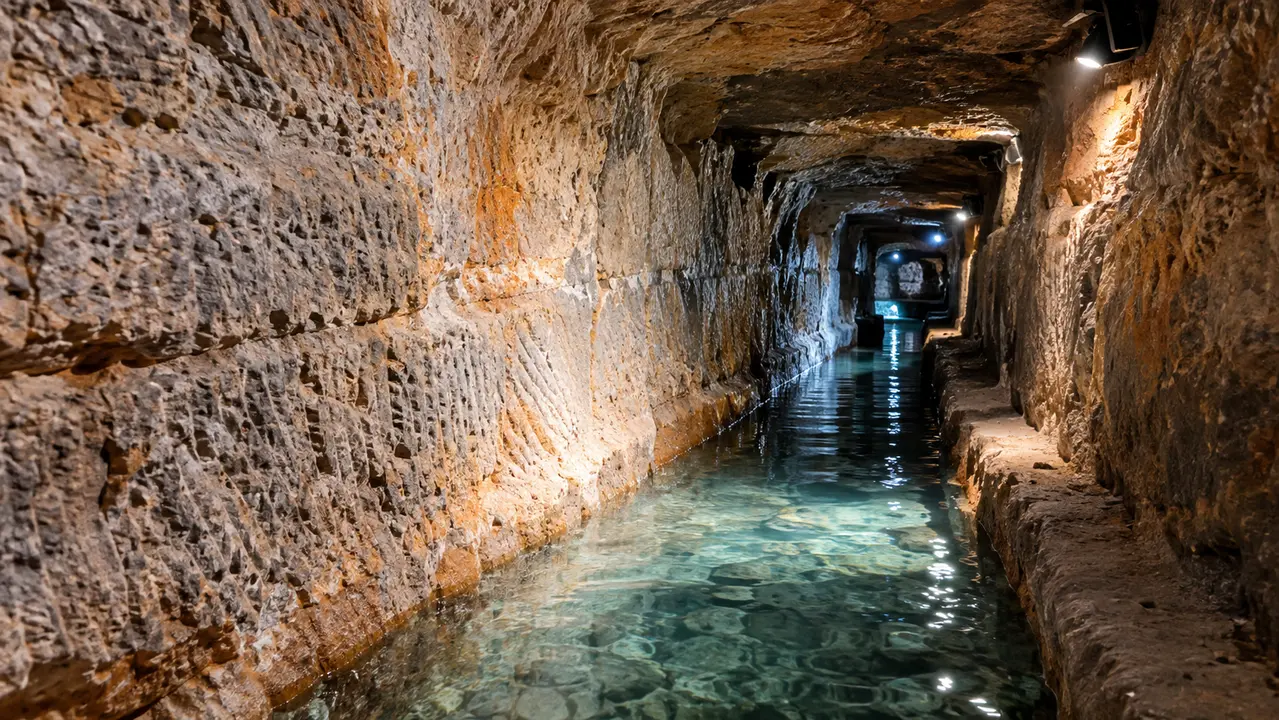
Matching travelers to the right underground route.
Accessibility for Wheelchairs and Strollers
Ancient passages, defense shafts, and stairways cannot accommodate modern ramps without destroying original archaeology. The Western Wall Tunnels offer partial accessibility through an elevator and a designated pathway reaching the Great Stone viewing platform, though wheelchairs must meet strict width limits to pass preserved stone arches, and full transit is not possible because of historic staircases at the exits. Water conduits and raw bedrock shafts cannot accommodate wheeled devices under any circumstances. Families visiting with infants should leave strollers on the tour bus and carry children in secure forward-facing carriers, which keeps hands free to maintain balance on wet stone.
What to Wear and Pack for Dry and Wet Routes
Dry sites around the Temple Mount require modest dress, with shoulders and knees covered for men and women, plus supportive walking shoes with non-slip soles because historic pavements can be slick. The wet channel demands more preparation. Closed-toe water shoes or rugged strapped sandals are mandatory, and flip-flops and bare feet are forbidden by site managers because of sharp bedrock edges underwater. Lightweight shorts or rollable pants work best, while cotton denim should be avoided since wet jeans stay heavy and cold for hours. Bring a small waterproof bag for passports and phones, a hands-free headlamp or a flashlight with a wrist strap rather than a phone light, and a compact towel with spare dry socks for the walk back to the bus after exiting near the Pool of Siloam.
The Historical Eras Hidden Beneath Jerusalem
Subterranean Jerusalem presents a vertical cross-section of ancient civilizations, where each ruler built directly on the ruins of the last. The deepest layers date to the Middle Bronze Age, with massive Canaanite defense towers around the Gihon Spring. Above them sit First Temple water systems carved under the Judean monarchy, then the monumental Herodian stones of the Second Temple era and finally vaults from the Roman and Byzantine periods and from the Crusader and Mamluk eras. For American pilgrims studying biblical narratives, these stone layers turn abstract reading into verifiable physical history.
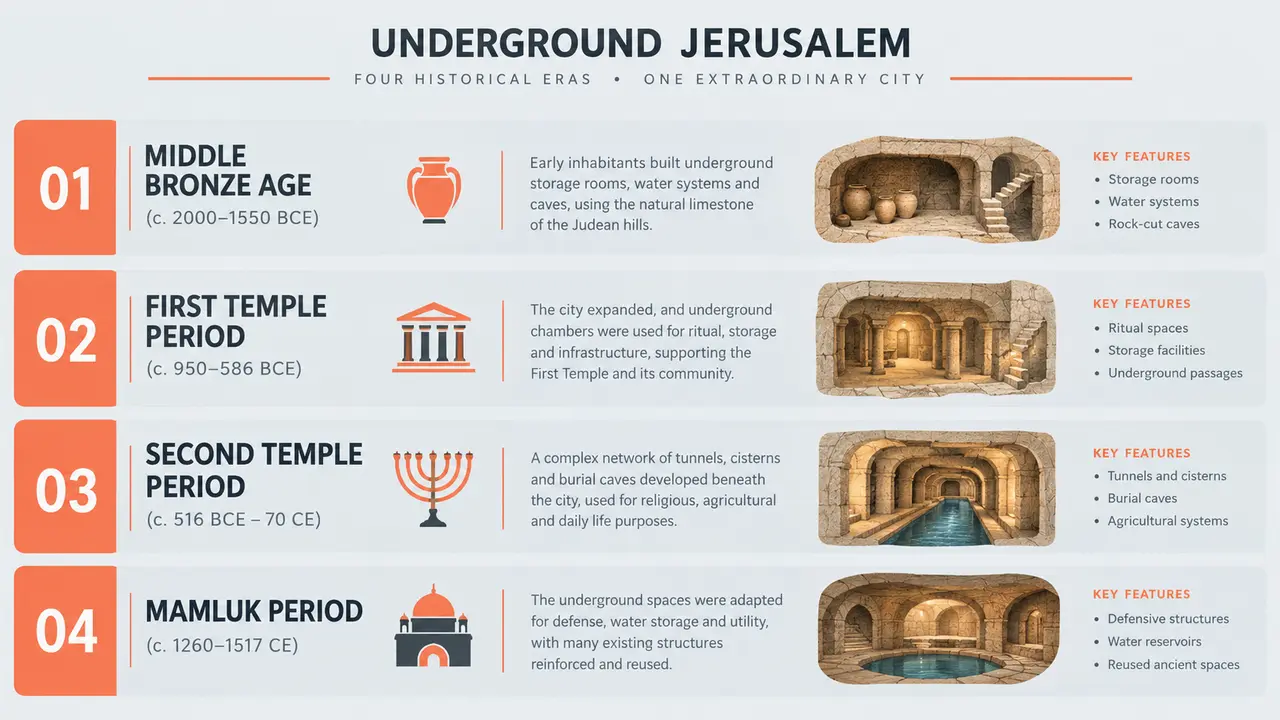
Three thousand years of building layers beneath the Old City.
| Historical Era | Approximate Date | Key Structures | Biblical Anchor |
|---|---|---|---|
| Middle Bronze Age | around 1800 BC | Canaanite Spring Tower, fortified pool | Melchizedek, King of Salem (Genesis 14:18) |
| First Temple Period | around 701 BC | Hezekiah’s Tunnel, Gihon Spring diversion | Hezekiah defends Jerusalem (2 Kings 20:20) |
| Second Temple Period | 20 BC to 70 AD | Herodian retaining wall, Western Stone | Jesus teaches at the Temple (Luke 21:1-6) |
| Mamluk Period | 1250 to 1517 AD | Vaulted arches, cisterns, support structures | Medieval expansion over ancient valleys |
How Your Denomination Shapes the Underground Itinerary
A generic underground itinerary serves no one well, because different Christian traditions read the same stones differently. An Evangelical or Southern Baptist group from Texas often prioritizes biblical prophecy and the physical verification of scripture, so we allocate extended time where excavated stones confirm recorded events. A Catholic parish from Ohio may ask for quiet contemplation near ancient underground prayer spaces and historic pilgrim markings, with a priest in the group able to lead devotions. When any group reaches the Pool of Siloam, we set aside time to read John 9 together. The same principle applies to Methodist, Lutheran, Presbyterian, Anglican, Pentecostal, and Orthodox groups, each with its own liturgical rhythms and sites of special significance. Talya Tours assigns guides and shapes each underground day around the specific tradition of the visiting congregation, never a one-size-fits-all route.
If your congregation is planning a pilgrimage to Israel, Talya Tours can build an underground Jerusalem day around your denomination and your travelers’ physical needs as well as your preferred pace. Our team will work out dates, security entries, and itinerary pacing with you before you make any financial commitment.
The Best Time of Day and Season to Go Underground
Underground chambers hold steady temperatures near 68 degrees Fahrenheit throughout the year, which makes them a smart scheduling tool. In summer they offer relief from midday heat, and in winter they shelter travelers from wind and rain. Early morning slots between 8:00 and 9:30 AM are calmest, while late afternoon visits after 4:00 PM also thin out as tour crowds return to their hotels. Sites near the Western Wall close early on Friday afternoons ahead of the Sabbath, and City of David water tours run shortened schedules before sunset on holiday eves. Scheduling between Monday and Thursday gives groups the most relaxed pacing.
Combining Underground Sites Into a Single Day
The most efficient underground day follows Jerusalem’s natural topography, beginning high at the Temple Mount and descending toward the Kidron Valley so travelers avoid uphill climbing late in the day. A proven sequence looks like this.
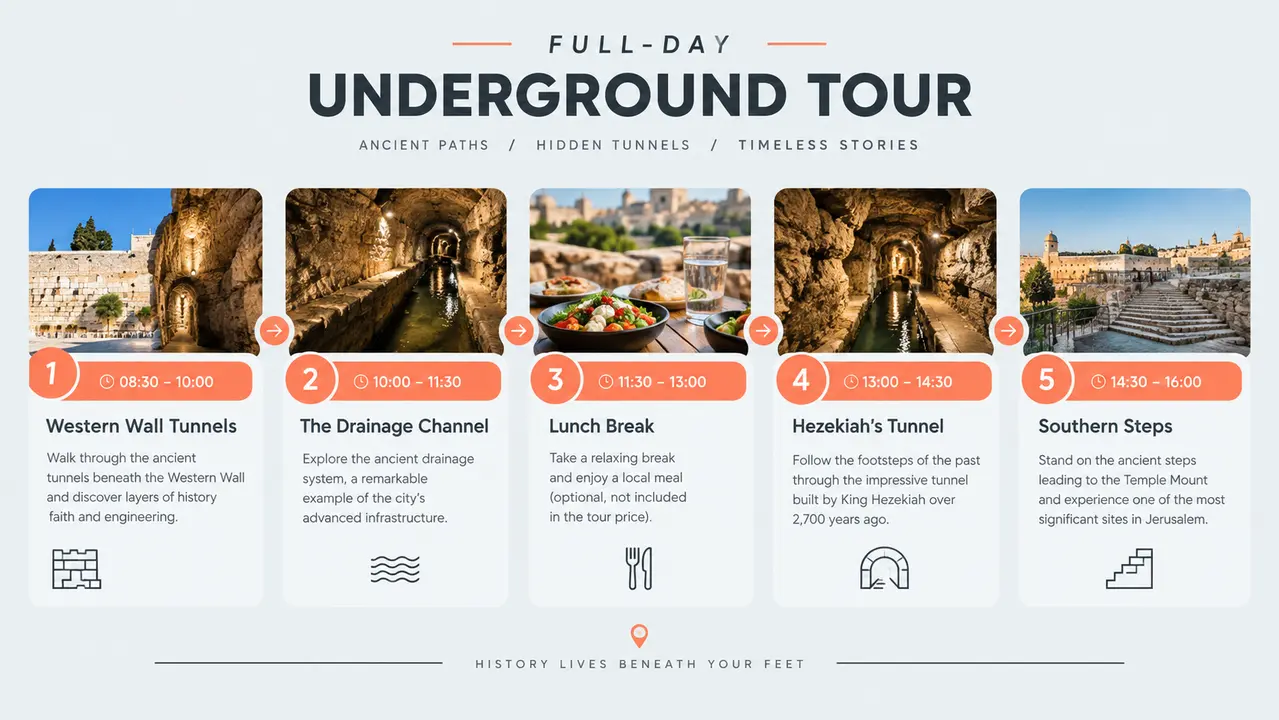
A full underground day sequenced from the Temple Mount down to the Kidron Valley.
| Time Window | Location and Activity | Key Focus |
|---|---|---|
| 8:30 AM to 10:15 AM | Western Wall Tunnels tour | Second Temple stones, Western Stone, Warren’s Gate |
| 10:30 AM to 11:30 AM | Herodian drainage channel walk | Subterranean transit to the City of David |
| 11:45 AM to 1:00 PM | Lunch near the City of David visitor center | Rest and hydration before the water walk |
| 1:15 PM to 3:00 PM | Hezekiah’s Tunnel and Pool of Siloam | First Temple water conduit (2 Kings 20:20, John 9:1-7) |
| 3:30 PM to 5:00 PM | Southern Steps of the Temple | Original entrance stairs to the Temple Mount (Luke 2:46) |
Finishing on the Southern Steps, where pilgrims climbed to the Temple in the time of Jesus, ties the whole day together. Every stone connects, and the biblical narrative gains a physical geography your travelers will remember long after they return home to their congregations.
Frequently Asked Questions
Will we get wet in the Jerusalem tunnels?
Only in Hezekiah’s Tunnel, where you will be wet from the waist down. The Western Wall Tunnels are completely dry, and the Canaanite Dry Tunnel at the City of David lets travelers reach the same exits without entering the water at all.
How far in advance should our church group reserve?
Plan on two to three months ahead for peak spring, summer, and autumn dates. Talya Tours locks in confirmed entry times as soon as calendars open and manages group check-in directly with site staff on the day of the visit.
Is Hezekiah’s Tunnel safe for older members?
It requires moderate fitness and balance, since several sections are under two feet wide and some spots demand crouching over uneven, submerged bedrock. Our coordinators help assign travelers with back, hip, or balance challenges to the Western Wall Tunnels or the dry Canaanite route because those routes serve them better.
Can our itinerary reflect our denomination?
Yes. Whether your group is Protestant, Catholic, Evangelical, Baptist, Pentecostal, Methodist, Lutheran, Presbyterian, Anglican, Orthodox, or from another tradition, Talya Tours selects sites, scripture stops, worship arrangements, and guides around what matters most to your congregation.
Are the tunnels suitable for children?
The wet channel carries a minimum age recommendation of five, and children must be tall enough to wade water that can reach their upper thighs. Families with younger children should choose the Western Wall Tunnels or the dry Canaanite channel because both offer higher ceilings, electric lighting, and easy exits.
Underground Jerusalem rewards careful planning. Reserve timed entries months ahead and match each traveler to the right route based on physical ability, then pack for wet or dry conditions accordingly and sequence the day downhill from the Temple Mount to the Kidron Valley. Above all, let the itinerary reflect the tradition of your congregation, because the same stones speak differently to a Baptist youth group than to an Orthodox parish. With those pieces in place, the engineering and the scripture come together in a single, unforgettable day beneath the Old City.
Ready to plan an underground Jerusalem day for your American church group? Contact Talya Tours and we will begin building a denomination-tailored itinerary complete with reserved entries, licensed guides, and full on-site coordination. Reach Talya directly at [email protected] or through our contact page.

About the Author
Talya Felner is the Owner and CEO of Talya Tours Services (TTS), a leading professional tour operator in Israel. With over 35 years of experience and more than 90,000 travelers served, Talya has built TTS into a trusted name for Christian pilgrimages, biblical tours, and conferences for groups visiting Israel and the Holy Land. Her team designs each itinerary around the specific Christian denomination of the visiting group, whether Protestant, Catholic, Evangelical, Baptist, Methodist, Pentecostal, Lutheran, Presbyterian, Anglican, Orthodox, or another tradition, ensuring that sites, worship arrangements, and guides reflect what matters most to that congregation. From visas and accommodations to guides, transportation, and on-site coordination, TTS handles every detail so American pastors and group leaders can focus on the spiritual experience of their travelers.