
Planning a trip to Israel for the first time raises the same practical questions for almost every American pastor and group leader who contacts us. What is a realistic number of days? Which month avoids the worst heat? What does the budget actually look like? This article walks through twelve planning steps in the order they matter, from setting priorities and choosing dates to visas, ground transport, and denomination-specific site arrangements. The goal is a clear framework you can work from whether you are organizing a church group of twenty or a solo trip built around the biblical sites that matter most to your tradition.
Reading time: 7 minutes
Key points from this article
- Seven days is the practical minimum for Israel; ten days allows both Galilee and Jerusalem without a rushed pace.
- Spring (April-May) and autumn (September-October) are the most comfortable windows for groups doing extended walking at outdoor sites.
- American travelers from visa-exempt countries now need electronic travel authorization (ETA-IL) before boarding – apply well ahead of your departure date.
- Site selection, worship arrangements, and itinerary structure vary significantly by Christian denomination, and every Talya Tours itinerary is built around the specific tradition of the visiting group.
Table of Contents
Start with priorities, not dates
Israel packs the Mediterranean coast, the hills of Jerusalem, the Galilee in the north, and the desert basins of the Negev and the Dead Sea into a country you can drive across in a long afternoon. The distances feel manageable on a map and larger on the ground, because the terrain shifts constantly and the sites do not run on tourist hours.
The first real planning decision is what your trip is fundamentally about. A pilgrimage built around the life and ministry of Jesus follows a very different route than a cultural and culinary visit. A Catholic parish from Houston and a non-denominational Evangelical congregation from Phoenix asking for the same travel dates will not receive the same itinerary from us, because their priorities at the holy sites are not the same. Catholics will want meaningful time at the Church of the Holy Sepulchre, the Basilica of the Annunciation, and the Church of the Nativity, often with arrangements for Mass at appropriate locations. Evangelical and Baptist groups typically center their Galilee days on Capernaum, the Mount of Beatitudes, and Yardenit on the Jordan River for baptism renewal. Pentecostal groups often ask for extended worship and prayer time at the Mount of Olives and the Garden of Gethsemane.
Once the purpose of the trip is clear, you can sequence the schedule so that biblical sites, city exploration, and natural landscapes do not compete for the same hours. Galilee in the morning light. Jerusalem’s Old City when its quarters are open. The Dead Sea in the afternoon heat, when floating in the salt water makes practical sense. Getting this sequence right from the start is what keeps a well-planned trip from feeling like a forced march.
This sequencing is also where working with an established operator like Talya Tours removes a significant planning burden from the pastor or group leader, since the denomination-specific itinerary, licensed vehicles, government-licensed guides, hotels, and on-site ceremony arrangements are handled under one roof rather than assembled from a laptop in the States.
How many days you actually need
Seven days is the practical floor. Below that, you are choosing one region and accepting that you will miss the others. To cover both Galilee and Jerusalem without feeling rushed, ten days is the honest answer for most American groups.
The most common planning error is counting travel and transfer days as full sightseeing days. They are not. A drive from the Galilee down to Jerusalem takes roughly two and a half hours before any stops, and once you add a meaningful detour through Beit She’an or along the Jordan Valley, that morning is accounted for. Build your working schedule with active days and transfer days listed separately, and the trip stops feeling impossibly packed before it starts.
Seven-day itinerary framework
A classic seven-day route enters through Tel Aviv, runs up the coast to Caesarea and Haifa, crosses into the Galilee for the sites around the Sea of Galilee, then descends to Jerusalem with one day covering the Dead Sea and Masada. The single most effective way to cut wasted time is to limit hotel check-ins. Two base locations – one in the Galilee and one in Jerusalem – will save a group several hours of luggage handling over the course of a week.
For a faith group, the Galilee days carry particular weight. Capernaum (Mark 1:21-35), Tabgha (John 6:1-15), and the Mount of Beatitudes (Matthew 5:1-16) sit close to one another, which is exactly why the region rewards two nights rather than a single rushed pass.
Ten-day itinerary framework
Ten days allows you to add the Golan Heights and the upper Galilee without cutting time from Jerusalem. You gain the archaeological depth of Tel Dan and Banias, and the northern landscapes that consistently surprise American visitors expecting only desert. Plan the mid-trip transfer south as a sightseeing day in its own right, stopping at Beit She’an – one of the best-preserved Roman cities in the country – on the way down, so the drive contributes to the experience rather than consuming it.
Fourteen-day itinerary framework
Two weeks is the full itinerary. North, center, and the deep south all fit comfortably. You can give Jerusalem three or four unhurried days, spend real time in the Galilee, and then travel through the Negev down to Eilat and the Red Sea. Build in rest on purpose. A two-week trip without a single slower afternoon, a beach hour, or an unscheduled walk through Jerusalem’s Mahane Yehuda market wears people down by day ten. The quiet days are part of the design, not wasted time.
Choosing the right month to visit
Spring, roughly April through May, and autumn, September into October, are the two windows we recommend most consistently for American groups that will be doing a lot of walking. The Galilean hills are comfortable, the desert is bearable, and the long site days do not exhaust people by midafternoon. The Mediterranean coast is warm and the Dead Sea floats are pleasant rather than punishing.
Summer is genuinely hot – particularly on Jerusalem’s stone streets at midday and very much so along the Dead Sea. Winter is mild on the coast but cold and wet in Jerusalem, and desert temperatures drop quickly after sunset. These seasonal patterns hold up against published climate data from the Israel Meteorological Service, which is worth reviewing when you are weighing dates for an itinerary with significant outdoor time.
How Jewish and national holidays affect planning
This is the planning factor American visitors underestimate most consistently. The Sabbath runs from Friday afternoon to Saturday evening. During those hours, most public transport stops, many shops close, and the rhythm of the country shifts noticeably. During the major festivals – Passover in spring and the autumn cluster of Rosh Hashanah and Sukkot – hotel rates increase sharply and rooms become scarce across Jerusalem and the Galilee.
None of this should discourage you from those windows. It simply means that when your dates fall inside these periods, accommodation and site reservations need to be made far earlier than you would otherwise plan. Holy Week and the Jewish spring festivals frequently overlap on the calendar, which is why a group wanting to be at the Garden Tomb or the Church of the Holy Sepulchre during that period needs to begin the reservation process months in advance, not weeks.
Planning a pilgrimage or church group trip to Israel?
Talya Tours builds every itinerary around the specific denomination of your group – whether your congregation is Catholic, Evangelical, Baptist, Pentecostal, Methodist, Lutheran, Presbyterian, Anglican, Orthodox, or another tradition. Share your dates and group details and we will put together a plan that reflects what matters most to your travelers.
Planning your budget and daily expenses
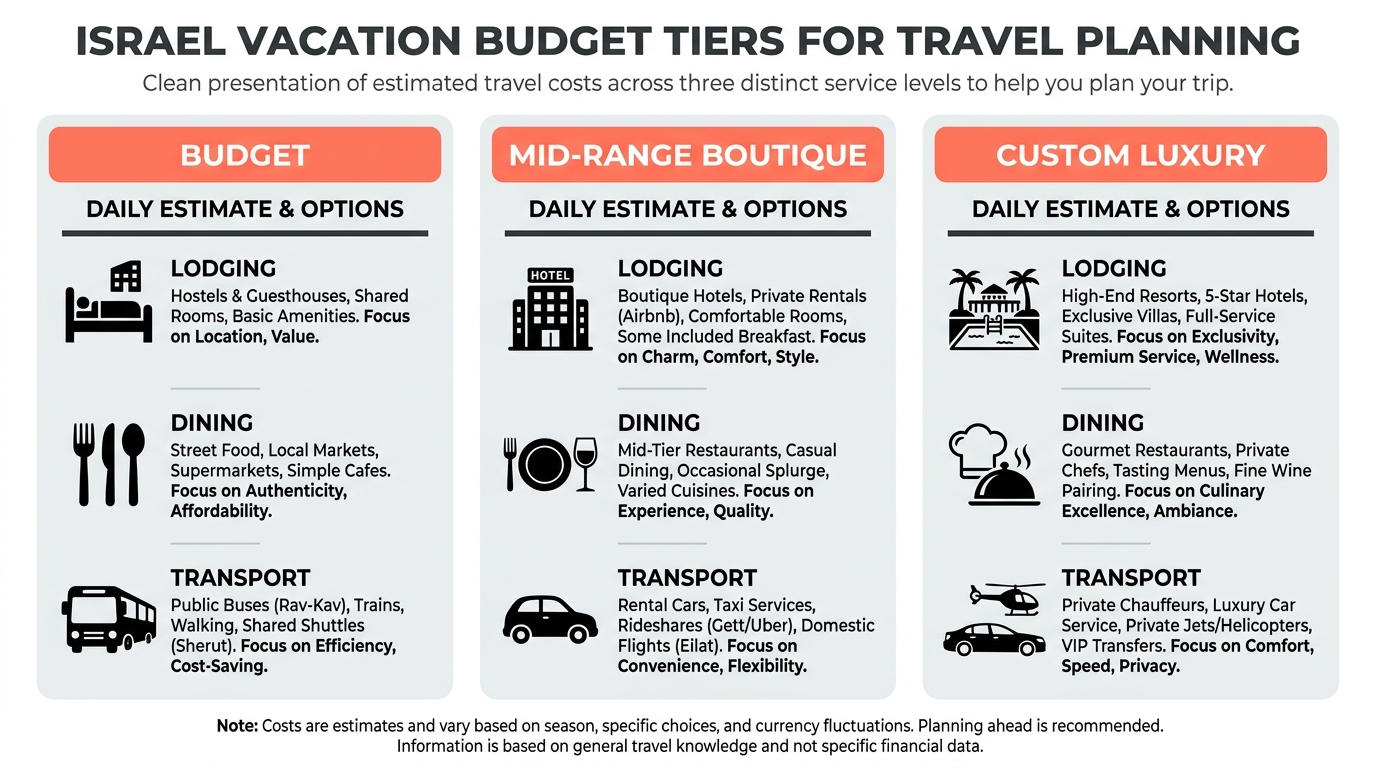
A realistic budget plan is one of the most important steps in organizing a group trip to Israel.
Israel is a premium travel destination, and planning a budget with that understanding up front avoids an unpleasant surprise on arrival. Accommodation and restaurant costs run closer to Western European levels than most first-time American visitors expect, and price data from Israel’s Central Bureau of Statistics reflects this consistently.
Build your working budget across five categories: accommodation, ground transportation, licensed guiding, dining, and site admissions. Of these, lodging and guiding are typically the two largest line items, and they are also where the quality of the trip is largely determined. A poorly briefed or unlicensed guide at a holy site is not a saving for your group – it is a loss your travelers feel at every stop along the route. Decide the quality tier first, then let the daily numbers follow from there.
Daily expense ranges by travel style
The figures below give approximate per-person daily ranges, excluding international flights, to frame the planning conversation. Actual costs shift with season, group size, and specific site admissions.
| Travel style | Lodging (per night) | Dining (per day) | Typical daily total |
|---|---|---|---|
| Budget | $80-130 | $25-40, street food and bakeries | $140-220 |
| Mid-range boutique | $180-300 | $60-90, casual and sit-down | $320-480 |
| Custom private | $400+ | $120+, fine dining | $650+ |
Street food in Israel is genuinely good and a proper meal of hummus, fresh-filled pita, or a falafel wrap costs a fraction of a restaurant dinner. Where groups tend to overspend is in private drivers booked piecemeal, day by day, rather than arranged as a packaged itinerary with a single operator up front. The per-day rate for a licensed vehicle drops meaningfully when the full program is committed at once.
Visas and travel authorization for American visitors
Most American travelers do not need a traditional visa to enter Israel, but visitors from visa-exempt countries, including the United States, now need to obtain electronic travel authorization before boarding their flight. This is the ETA-IL system. Details on who it covers, how the application process works, and what to expect are published on the official Population and Immigration Authority page. The authorization is not an automatic guarantee of entry, and approval timelines can vary, so applying well before your boarding date – rather than in the days immediately before departure – is the straightforward approach.
For groups, the Ministry of Tourism outlines specific requirements and timelines on its official group entry page. When a pastor is coordinating a delegation of 35 or 40 American travelers, ensuring every individual has submitted their authorization before the departure date becomes a real administrative task. It is one of the routine logistics we handle as part of group planning, so the group leader is not chasing individual confirmations in the days before the flight.
Passport validity also matters. Israel requires at least six months of validity beyond the date of entry. For a church group of any size, confirming every traveler’s passport expiration date early in the planning process is worth doing before anything else is booked.
Where to base your group: Tel Aviv, Jerusalem, or both
Tel Aviv and Jerusalem are roughly an hour apart by road and feel like entirely different places. Tel Aviv is the Mediterranean coast, the food markets, the modern city energy, the beaches, and the cultural scene. Jerusalem is ancient and layered, with the spiritual weight that the Old City carries across four distinct quarters – Jewish, Christian, Muslim, and Armenian – and the holy sites that draw most American pilgrim groups in the first place.
For a faith-centered trip, the overnight balance tilts clearly toward Jerusalem, with the Galilee as the essential second base. For a culture and food-focused visit with biblical sites included, the balance can shift. Many American groups split the difference, spending three or four nights in Jerusalem and basing their Galilee days out of Tiberias or a lakeside property, with one or two nights in Tel Aviv to open or close the trip.
The choice of accommodation tier matters more in Jerusalem than in most cities because proximity to the Old City and the specific character of a property changes the experience of the mornings and evenings considerably. A hotel within walking distance of Jaffa Gate handles the rhythm of Old City visits very differently than one requiring a shuttle. For neighborhood-level detail and specific property considerations, the Talya Tours blog covers this at greater depth than this overview allows.
Getting around Israel
The trains and intercity buses are efficient and reach most major destinations. The high-speed rail line between Tel Aviv and Jerusalem covers the distance in around half an hour. Public transport runs on the Rav-Kav, a contactless card loaded with credit and used across buses, trains, and the light rail networks in Jerusalem and Tel Aviv. It is also accessible through a mobile app.
For an individual traveler with a flexible schedule, this network is practical and reliable. For a group of 35 or 40 travelers with luggage, a structured itinerary, and worship ceremonies to coordinate across multiple sites, public transport stops being an effective solution. The Sabbath gap – when most bus and rail service shuts down from Friday afternoon through Saturday evening – can isolate a group that has not planned around it. A licensed coach with a dedicated driver changes the math entirely.
Airport transfers from Ben Gurion
From Terminal 3, direct rail service runs into central Tel Aviv in under 30 minutes with onward connections to Jerusalem, plus bus options and taxi ranks outside the arrivals hall. The Israel Airports Authority directions page details the exact stands and platforms for every option. For arriving American groups, having a Talya Tours representative meet the delegation at the terminal means no one is navigating unfamiliar transport infrastructure jet-lagged at six in the morning after a transatlantic flight.
Working with a professional tour operator
For an independent couple on a flexible two-week trip, doing the research and booking independently is entirely workable. For a church group, a family delegation that includes older travelers and children, or a ministry conference on a fixed schedule, the calculation is different. A government-licensed guide brings depth at every site that a self-guided visit cannot replicate. A licensed vehicle removes the coordination burden entirely. And the denomination-specific customization – the factor that most separates a meaningful pilgrimage from a standard sightseeing tour – requires someone who knows both the holy sites and the theological priorities of the visiting tradition.
This is where the denominational specificity of the planning matters most. A Southern Baptist group from Georgia planning their first visit to Israel will hear a different proposal from us than a United Methodist conference from the Midwest, a Pentecostal ministry from the South, or a Lutheran congregation from the Pacific Northwest. The sites overlap, but the emphasis, the time allocated, the worship arrangements, and the guide briefings do not.
| Tradition | Site emphasis | On-site arrangements | Approach |
|---|---|---|---|
| Catholic | Holy Sepulchre, Church of the Nativity, Basilica of the Annunciation, Via Dolorosa | Mass arrangements at appropriate locations | Liturgical, structured |
| Evangelical / Baptist | Garden Tomb, Yardenit, Mount of Beatitudes, Capernaum | Baptism renewal, extended Scripture reading | Teaching-focused |
| Pentecostal | Mount of Olives, Garden of Gethsemane, Galilee shoreline | Extended prayer and worship time | Devotional, flexible |
| Methodist / Presbyterian | Biblical sites with full theological context | Quiet contemplative stops | Reflective, unhurried |
| Orthodox / Anglican / Lutheran | Sites tied to church tradition, early Christian history | Arrangements aligned with liturgical calendar | Tradition-centered |
Reading the About Talya Tours page gives a clearer picture of this approach than a price quote ever could – the level of curation involved, the licensed VIP guides we use, and the owner-led model that comes from Talya Felner working with each group personally across more than 35 years. Tourism to Israel is our only business, and that focus is precisely what allows us to build a trip around your congregation’s tradition rather than hand you a pre-assembled template.
If your group is beginning to plan a pilgrimage, a ministry conference, or a biblical study tour to Israel, we are glad to walk through dates, denomination-specific site arrangements, visa logistics, and accommodation options before you commit to anything. You can reach Talya directly at [email protected] or through the Talya Tours contact page.
Frequently asked questions
Is Israel safe to visit for American travelers?
The practical answer for most American visitors planning a pilgrimage or group trip is that the popular tourist and pilgrim routes – Jerusalem’s Old City, the Galilee, Bethlehem, the Dead Sea, and the northern sites – operate normally the vast majority of the time. We monitor the security situation continuously and adjust itineraries when conditions require it. The U.S. State Department’s Israel travel advisory page is the current and official reference for American travelers, and we recommend reviewing it in the months before your departure.
How far in advance should we book a group trip to Israel?
For a standard autumn or spring group trip, six to nine months of lead time gives you a solid selection of accommodation and space at the popular sites. For Holy Week, the Jewish spring holidays, or Sukkot, you need to be planning a full year in advance, sometimes longer for specific hotels in Jerusalem. The earlier the conversation starts, the more options remain open. Groups that contact us with less than three months of lead time for a peak-season trip typically face constrained choices in lodging and, occasionally, site access.
Can we arrange a baptism ceremony in the Jordan River?
Yes. The primary baptism site for Evangelical, Baptist, and Pentecostal groups is Yardenit, located on the southern outflow of the Sea of Galilee, where the Jordan River exits the lake. The site is designed specifically for group ceremonies and provides robing facilities and space for large delegations. For some traditions, the site near Qasr el Yahud in the lower Jordan Valley – the area associated with Jesus’ baptism – is the preferred location, and access is possible with appropriate advance arrangements. We handle the booking and coordination as part of the itinerary planning.
What is the difference between the Garden Tomb and the Church of the Holy Sepulchre?
These are two different sites, each with distinct historical and denominational significance. The Church of the Holy Sepulchre, within the Old City’s Christian Quarter, is the site recognized by Catholic, Orthodox, and many mainline Protestant traditions as the location of the crucifixion and resurrection. It is managed jointly by several Christian communities under a centuries-old arrangement. The Garden Tomb, outside the Old City walls near Damascus Gate, is an alternative proposed site that most Evangelical and Protestant groups find more devotionally accessible – it is open, quiet, and managed in a way that allows extended Scripture reading and group worship. Most of the American faith groups we work with visit both, with the emphasis determined by their denominational tradition.
What currency should we bring and how does tipping work?
The local currency is the Israeli Shekel (ILS). Most hotels, restaurants, and shops in tourist areas accept major credit cards. ATMs are widely available, and withdrawing Shekels on arrival is straightforward. U.S. dollars are accepted informally in some markets and smaller vendors, but you will usually receive change in Shekels. Tipping for guides and drivers is customary and appreciated – we provide specific guidance on standard group tipping norms as part of the pre-departure information we share with every American group.
Do you customize itineraries for Adventist, Anglican, or Orthodox Christian groups?
Yes. The premise of every itinerary we build is that it reflects the specific tradition of the group. Seventh-day Adventist groups, for instance, observe the Sabbath from Friday evening, which shapes hotel scheduling, meal arrangements, and site timing differently than a Sunday-observing tradition. Anglican and Episcopal groups often want to prioritize sites with significance within their specific liturgical calendar. Orthodox Christian travelers – whether Greek Orthodox, Russian Orthodox, or other traditions – have their own denominational sites, ecclesiastical relationships, and liturgical priorities in Jerusalem that are distinct from Western Christian traditions. We build the plan around the group in front of us, not around a standard template.
Putting the plan together
A well-planned trip to Israel starts with the right order of decisions. Clarify the purpose and denominational priorities of your group first, then select the right duration – seven days as the floor, ten or fourteen if the schedule allows. Choose your travel window with the climate and the religious calendar both in mind, because both of them affect what is available, what is accessible, and what the trip will cost. Submit electronic travel authorization well before departure. Build a budget around the five main cost categories and decide on the quality tier before pricing the individual line items.
None of these steps are complicated on their own. What creates problems is handling them in the wrong order or leaving the booking sequence too late for the dates you actually want. For a church group, a ministry conference, or a family pilgrimage, working with an established operator who understands your tradition removes the logistical burden and replaces it with an itinerary built around what your congregation actually came for.
If you are in the early stages of planning and want to talk through how an itinerary built around your group’s specific tradition would look, reach out to us at [email protected] or through the Talya Tours contact page. There is no commitment involved in the first conversation – just the information you need to move forward with confidence.
Ready to start planning your group’s Israel trip?
Whether your group is Catholic, Evangelical, Baptist, Pentecostal, Methodist, Lutheran, Presbyterian, Anglican, Orthodox, or another Christian tradition, Talya Tours builds a denomination-specific itinerary that reflects what your congregation came to experience. Share your dates, group size, and tradition, and we will outline an itinerary that fits.
About the Author

Talya Felner
Owner and CEO, Talya Tours Services (TTS)
Talya Felner is the Owner and CEO of Talya Tours Services (TTS), a leading professional tour operator in Israel. With over 35 years of experience and more than 90,000 travelers served, Talya has built TTS into a trusted name for Christian pilgrimages, biblical tours, and conferences for American groups visiting Israel and the Holy Land. Her team designs each itinerary around the specific Christian denomination of the visiting group – whether Protestant, Catholic, Evangelical, Baptist, Methodist, Pentecostal, Lutheran, Presbyterian, Anglican, Orthodox, or another tradition – ensuring that sites, worship arrangements, and guides reflect what matters most to that congregation. From visas and accommodations to guides, transportation, and on-site coordination, TTS handles every detail so American pastors and group leaders can focus on the spiritual experience of their travelers.