
Planning an evangelical tour of Israel for your congregation involves more decisions than most American pastors expect when they first pick up the phone. The site list, the guide’s theological orientation, the pace of each day, the arrangement of baptism or communion, and the balance between history and devotion all depend on one thing that a generic package will never ask about – your church’s specific tradition. This article walks through how evangelical and Protestant pilgrimages to Israel are structured, what they cost, what to look for in an operator, and how the itinerary changes based on the denominational identity of the group making the trip.
Reading time: 7 minutes
Key Points in This Article
- An evangelical pilgrimage to Israel is built around Scripture and active ministry sites, not a museum itinerary, and the guide’s approach must match that expectation.
- Cost is shaped by season, hotel location, and group size – and comparing quotes accurately requires checking each of those variables, not just the headline price.
- U.S. passport holders now require an ETA-IL electronic travel authorization before departure, and group entry is coordinated in advance through the official Israeli government process.
- Denomination determines the sequence of sites, the ceremonial arrangements, and the guide’s teaching style – a Southern Baptist congregation and a Pentecostal ministry will visit some of the same places for different reasons and at a different pace.
Table of Contents
- What is an evangelical tour of Israel
- Why evangelical tours feel different from a generic Christian tour
- Who faith based Israel tours are designed for
- How to choose a tour operator without falling into generic tourist traps
- How much an evangelical tour of Israel costs
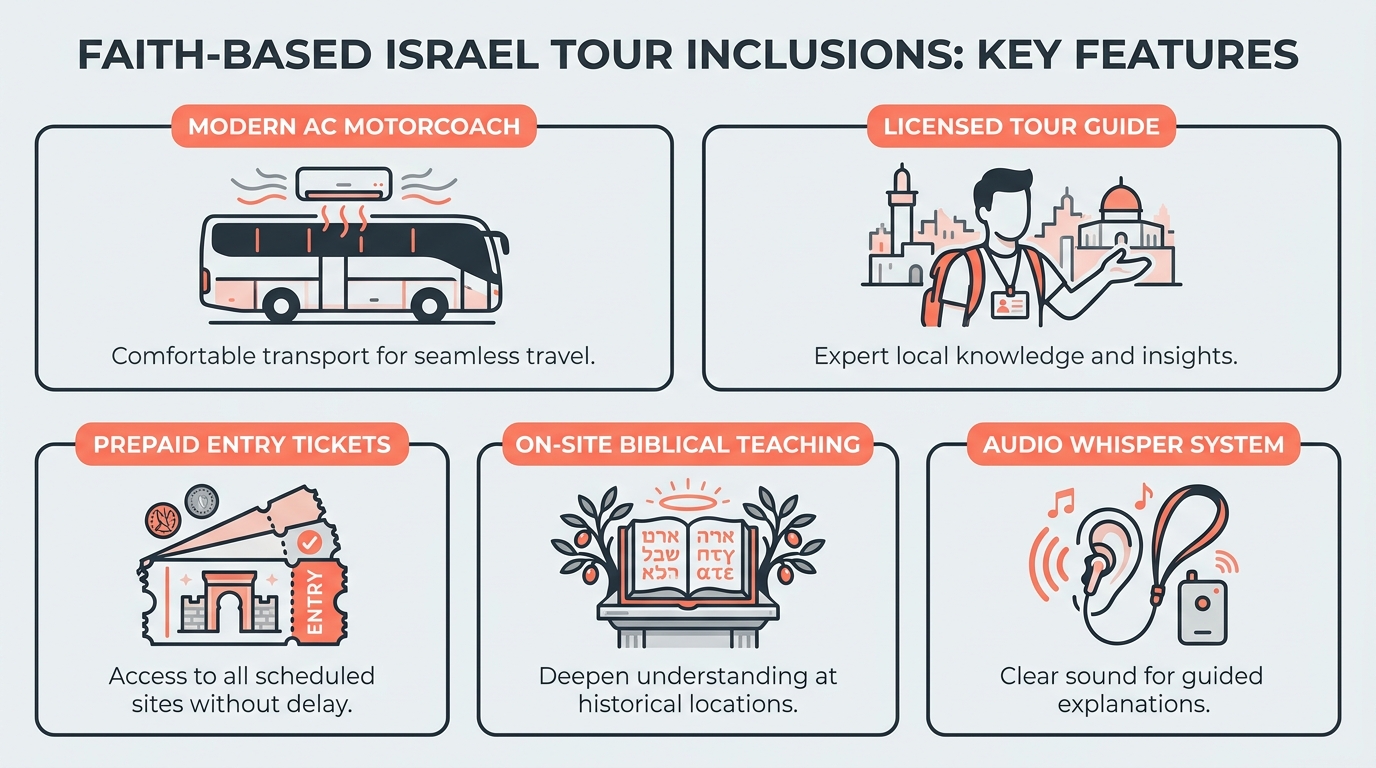
- What is typically included in faith based Israel tours
- Optimal duration for evangelical Christian tours of Israel
- Which biblical sites are included in Protestant Israel tours
- How a Pastor leads a group on these tours
- Official entry requirements and visa rules
- Whether you need a licensed tour guide in Israel
- Safety considerations for faith-based group travel
- Planning baptisms and communion on-site
- Best season to visit the Holy Land
- How Talya Tours customizes evangelical tours of Israel
What is an evangelical tour of Israel?
An evangelical tour of Israel is a faith-centered pilgrimage built for Protestant and evangelical congregations, where the itinerary follows Scripture rather than a museum catalogue. The land is read literally. You stand at a site, open the text, read the passage that happened there, and pray together before moving on.
For these groups the core regions are Jerusalem, the Sea of Galilee, the River Jordan, and the Judean Desert. The day is shaped around communal prayer, daily Bible study on the bus, and group worship at the sites themselves. A licensed guide who understands evangelical expectations does not simply recite excavation dates. He hands the moment back to your pastor when the passage is read.
Why do evangelical tours of Israel feel different from a generic Christian tour?
The difference is doctrinal, and it shows up in the site list before anyone notices it in the mood. Evangelical Christian tours of Israel lean toward active sites of Jesus’ ministry and toward biblical prophecy. Roman Catholic and broader ecumenical itineraries give more weight to traditional churches, relics, and Marian sites.
The most useful way to describe it to American pastors is “living geography.” You are not visiting a relic of an event. You are standing in the place where the text is set, with the lake or the wilderness or the hillside in front of you while the chapter is read aloud. At Capernaum (Mark 1:21-35) this becomes obvious. The synagogue ruins matter less to an evangelical group than the simple fact that this was the base of His Galilean ministry. A guide aligned to that reading will pace the visit accordingly.
Who are faith based Israel tours designed for?
Faith based Israel tours are not only for whole congregations, though entire churches from Atlanta to Phoenix make up the largest share of what gets organized. They also serve multi-generational families traveling together, theological students who want the geography behind the seminary classroom, and ministry leaders scouting a trip before they bring eighty people.
What a trip like this does to a church community is hard to overstate. People who sat three pews apart for years pray together at the Garden of Gethsemane (Luke 22:39-46). Scripture they have read a hundred times reads differently once they have stood in the Judean wilderness. American church groups that want this should pursue customizable Christian tours in Israel built around their own congregation rather than buying a seat on a fixed-departure coach filled with strangers.
Faith based Israel tours balance historical context with devotional moments shaped around the group’s denomination.
How to choose a tour operator for evangelical tours of Israel without falling into generic tourist traps
The trap is the off-the-shelf program. Many incoming operators hand every group the same eight-day route regardless of whether the travelers are Southern Baptist, Pentecostal, or Catholic. For evangelical tours of Israel the operator has to actually understand a Protestant worship environment, build in flexibility, and carry real historical depth rather than a memorized script.
Which critical questions should you ask before booking?
Ask three things before you sign anything. First, is the guide fully licensed by the Ministry of Tourism, not a friend with good English. Second, is the program flexible enough to stop for private group prayer or communion at a major biblical site without renegotiating the whole day. Third, are there hidden fees outside the upfront quote – tips, site registrations, porterage at hotels. A quote that looks low usually has these waiting underneath it.
Plan a Custom Evangelical Tour Around Your Congregation
Tell us your denomination, your group size, and your preferred travel window. We build the itinerary from there – sites, worship arrangements, guide selection, and all logistics handled for your specific congregation.
How much does an evangelical tour of Israel cost?
Price is driven by three levers more than anything else – season, group size, and hotel standard. A March or October departure into central Jerusalem hotels costs more than a January trip lodged on the outskirts. The good news for church groups is that an organic cohort traveling together unlocks group-tier rates on both accommodation and motorcoach transport that an individual booking never sees.
How can you compare quotes accurately?
Compare like for like or the lowest number wins for the wrong reasons. Check whether the price is a land package or flight-inclusive. Check the hotels by name and location, because a Jerusalem-center hotel and one twenty minutes out are not the same product even at the same star rating. And check the dining basis, since half-board and breakfast-only quotes can look identical until your group is paying for dinner out of pocket every night.
| Cost lever | Lower end | Higher end |
|---|---|---|
| Season | Winter (Dec-Feb) | Spring and Easter, Autumn |
| Hotel location | City outskirts | Jerusalem center, Galilee lakeside |
| Group size | 15-25 (modest rates) | 35+ (best group-tier discounts) |
| Dining basis | Breakfast only | Half-board included |
What is typically included in faith based Israel tours?
A complete, professional package is defined by what you never have to think about on the road. Faith based Israel tours done properly include comfortable air-conditioned modern motorcoaches with WiFi, a dedicated government-licensed guide for the full trip, and prepaid entry tickets to the national parks so nobody queues with cash at the gate.
The detail most groups overlook until they are inside a crowded ruin is the audio-whisper system. At a packed site, a small earpiece is the difference between hearing your guide and your pastor or losing the teaching to the noise. A teaching moment at Caesarea Maritima (Acts 10:1-48) that nobody can hear is a wasted morning, which is why a professional operator builds these in as standard rather than as an optional add-on.
What is the optimal duration for evangelical Christian tours of Israel – 7, 10, or 12 days?
Seven days covers the headlines and little else. You will reach Jerusalem and the main Galilee sites, and you will move fast. There is no room for the quiet sit-down at the Sea of Galilee that people remember most, and the Judean Desert usually gets cut.
For full, reflective study, ten to twelve days is the most appropriate range for evangelical Christian tours of Israel. That window lets you give two nights to Galilee, a proper run through Jerusalem, and the Dead Sea region without sprinting. For travelers whose vacation calendar simply will not stretch, an evangelical tour 8 days package hits the practical sweet spot – enough to cover the core without the rush of a seven-day schedule.
Which must-see biblical sites are included in Protestant Israel tours?
The framework of Protestant Israel tours falls into three landscapes. In Jerusalem the core includes the Mount of Olives (Acts 1:9-12), the Garden of Gethsemane (Matthew 26:36-46), the Pool of Siloam (John 9:1-11), and the Garden Tomb, which evangelical and Baptist groups favor for open-air communion in a way that Catholic groups typically do not. In Galilee the core is Capernaum (Mark 1:21-35), the Mount of Beatitudes (Matthew 5:1-16), Tabgha (John 6:1-15), and a boat ride across the Sea of Galilee.
The coastal and wilderness sites round it out – Caesarea Maritima (Acts 23:23-35) where Paul was held, Megiddo (Revelation 16:16) as the Armageddon plain, and the Dead Sea region with Masada and Ein Gedi (1 Samuel 24). These are managed sites, and the Israel Nature and Parks Authority sets their access rules, scheduling, and entry procedures, which is why a serious operator confirms hours and reservations at parks.org.il before locking the day.
This is also where denomination shapes the route meaningfully. A Catholic parish will spend its Jerusalem hours at the Holy Sepulchre and along the Via Dolorosa, while a non-denominational congregation may give that same time to the Garden Tomb and extended Scripture reading. A Lutheran group often wants significant time at the traditional sites tied to Reformation-era thinking about grace and justification, while a Pentecostal congregation may prioritize prayer and spontaneous worship time within the schedule. The sequence is never identical across traditions.
How does a pastor lead a group on these tours?
The partnership is simple once you have run it a few thousand times. The pastor is the spiritual shepherd. The local licensed guide is the historical and logistical coordinator. The guide brings the group to the right spot at the right moment and then steps back, and the pastor delivers the teaching or the sermon while the site does the rest.
The day is built so those teaching moments land where they should – a sermon at the Mount of Beatitudes, a communion meditation at the Garden Tomb, study notes prepared in advance to match the route. Pastors who bring their congregations also typically receive leadership arrangements as part of the group booking, which are discussed directly with the church well in advance of travel.
What are the official entry requirements and visa rules for Israel?
The rules changed and many American travelers still are not aware. U.S. passport holders must now obtain an ETA-IL electronic travel authorization before boarding a flight to Tel Aviv. It is not optional and it is not arranged on arrival. This applies to individual travelers and to every member of a group tour.
For groups, entry is coordinated ahead of the flight schedule rather than left to forty people filing individually at the last minute. The official guidance on the requirement and on how group entry is handled sits on the government’s own page for group entry to Israel. A professional operator handles this coordination as part of the package so no member of your congregation is turned back at the gate.
Do you need a licensed tour guide in Israel?
Yes, and it is a legal requirement, not a recommendation. Guiding groups at Israel’s archaeological and national sites is restricted to guides licensed by the Ministry of Tourism. They complete a multi-year program in history, geography, archaeology, and safety before they ever lead a coach. The Ministry of Tourism licensing framework exists precisely so that the person teaching your group at a sacred site is registered and accountable. An unlicensed guide is both a poorer teacher and a real liability for the group leader who chose them.
Beyond the legal point, the guide’s personal faith orientation and familiarity with evangelical or Protestant worship culture shapes the entire experience. Denomination-aware guide selection is one of the planning decisions that separates a well-built itinerary from a standard one.
Is it safe to travel to Israel on a faith-based tour?
The honest answer is that a structured group operation handles this very differently from an independent traveler with a guidebook. A professional operator maintains close contact with official channels, adjusts an active itinerary the same day when something requires it, and routes groups along established, tourist-vetted corridors.
In practical terms that means a route can be reordered overnight so a group never notices the change beyond a different sequence of sites. That flexibility is built into how a professional operation runs, and it is one of the quieter reasons American churches keep returning to organized pilgrimages rather than improvising individual travel arrangements.
How do you plan special moments like baptisms or communion on-site?
These are the moments people fly for, and they are bookings, not happy accidents. A Jordan River baptism is reserved in advance, often at the Yardenit Baptismal Site, with time and changing facilities arranged so a group of forty moves through without confusion. For the Lord’s Supper, a quiet garden space is reserved – frequently near the Garden Tomb – where a congregation can hold communion without a crowd pressing in.
This is also where the denomination conversation matters most. A Pentecostal ministry may want extended worship and prayer time at the Garden of Gethsemane, while a Presbyterian fellowship often values quieter, contemplative reflection at the same site. A Methodist congregation may prioritize time near sites connected to the Holiness tradition’s understanding of sanctification. The pastor tells us what rites need arranging and we build the timing around them well before the group boards the plane.
What is the best season of the year to visit the Holy Land?
Spring, from March to May, and autumn, from September to November, give the most comfortable temperatures for walking and for the open-air sites. Those windows are also the busiest and the priciest, especially around Easter, when pilgrimage demand peaks across all denominations.
| Season | Weather | Best for | Trade-off |
|---|---|---|---|
| Spring (Mar-May) | Mild, green | Hiking, Easter pilgrimage | Crowds, higher cost |
| Autumn (Sep-Nov) | Warm, settled | Full itineraries | Books up early |
| Winter (Dec-Feb) | Cool, some rain | Savings, fewer crowds | Shorter daylight |
| Summer (Jun-Aug) | Hot | School-holiday families | Heat at desert sites |
Winter brings real savings and quiet sites, with cooler days and the occasional rain. Summer is hot, especially at the Dead Sea and Masada, but it works for American families tied to school holidays. The practical guidance is to choose the season around your people first and the price second.
How does Talya Tours customize evangelical tours of Israel?
Talya Tours does not sell one program to everyone. Each itinerary is built from scratch around the specific tradition of the requesting group, because a Southern Baptist congregation, a United Methodist conference, an Assemblies of God ministry, a Lutheran synod, and an Anglican parish each need a different sequence of sites, a different ceremonial program, and a different pace through the material. The conversation about your evangelical tours of Israel starts with what your church believes and what your pastor wants the group to walk away carrying.
As an owner-led company where tourism is the sole business, every group is touched personally by Talya herself, and operations run directly on the ground rather than through layers of subcontractors. That is what makes it possible to reorder a day, slot in a communion service, or hold a quiet hour at a site that matters to your tradition – without a chain of approval that takes three days to work through.
Frequently Asked Questions
How far in advance should an American church group start planning an Israel pilgrimage?
Twelve months is a sound planning window for most American church groups, and eighteen months is not too early for groups planning around Easter or a significant church anniversary. Popular spring and autumn dates fill up quickly, and visa coordination, group block reservations, and denominational customization all take time to execute properly. Six months is workable for winter departures when the calendar is less compressed, but it leaves little room to adapt if something changes.
What is the minimum group size for a faith based Israel tour?
Most group programs start at fifteen travelers to justify a dedicated motorcoach and guide. Below that threshold, small-group or custom-vehicle arrangements are possible but the per-person cost rises. The most favorable group pricing typically kicks in at twenty-five to thirty travelers, and the best motorcoach rates and hotel block negotiations come with thirty-five or more. If your congregation is smaller, combining with a sister church traveling the same week is one option worth exploring.
Can our denomination’s specific worship needs be accommodated on a group tour?
Yes, and this is a central part of how a well-built itinerary is constructed. Jordan River baptisms, open-air communion at the Garden Tomb, extended prayer time at Gethsemane, contemplative silence at specific sites, or a structured daily devotional tied to the route – all of these are planned in advance based on the tradition and worship culture of the group. A Pentecostal congregation and a Presbyterian fellowship will approach the same sites differently, and the schedule is built to reflect that rather than average it out.
What happens if a site or region becomes temporarily restricted during our trip?
A professional operator with active ground operations adjusts the itinerary in real time rather than waiting for the group to discover the problem at the gate. Routes are reordered, alternative sites with comparable theological significance are substituted, and the group is informed in plain terms. This kind of same-day adjustment is a standard part of professional group management in Israel, not an exceptional situation – and it is the clearest practical argument for organized travel over self-guided arrangements.
Does the itinerary change based on whether our group is Baptist, Methodist, Lutheran, or another denomination?
It does, in meaningful ways. A Baptist congregation typically prioritizes active ministry sites, the Jordan River baptism, and the Garden Tomb, where open-air worship is central. A Methodist group may want time at sites connected to Wesley’s theological themes of grace and sanctification. A Lutheran itinerary often emphasizes sites tied to Reformation-era interpretation of the Pauline texts, particularly Caesarea and Antioch contexts. An Orthodox Christian group follows a different ceremonial calendar and visits different liturgical sites in Jerusalem. The starting point for building any itinerary is the denomination, not a pre-set template.
Are flights included in your tour packages?
Most packages are quoted as land-only arrangements, meaning everything from airport arrival in Tel Aviv through to airport departure is covered, but the transatlantic flight is handled separately. This is common for American church groups because different congregants depart from different U.S. cities, and a single group flight block is often impractical. Flight-inclusive quoting is available when the group departs from a single hub and the numbers justify a block booking. This is one of the items to clarify explicitly when comparing quotes from any operator.
Planning an evangelical pilgrimage to Israel for your American congregation comes down to a few decisions made early – which denomination’s priorities shape the route, what ceremonial moments need to be reserved in advance, how the group size affects pricing, and whether the operator you choose builds from your church’s tradition or applies a generic template to every group. The ETA-IL entry authorization, the licensed guide requirement, and the season choice all have practical answers once the foundational planning questions are settled.
If your church or group is beginning to think about dates, sites, and the shape of a pilgrimage, Talya Tours is glad to work through the details before you commit to anything. Reach Talya directly at [email protected] to begin a conversation about your congregation’s specific tradition and what that means for the itinerary.
Talk to Talya About Your Group’s Pilgrimage
Whether you lead a Baptist congregation, a Pentecostal ministry, a Methodist conference group, or another tradition, we start by understanding your denomination before we recommend a single site. Contact us to begin building an itinerary shaped around your church.

About the Author
Talya Felner
Talya Felner is the Owner and CEO of Talya Tours Services (TTS), a professional tour operator in Israel. With over 35 years of experience and more than 90,000 travelers served, Talya has built TTS into a trusted name for Christian pilgrimages, biblical tours, and conferences for American groups visiting Israel and the Holy Land. Her team designs each itinerary around the specific Christian denomination of the visiting group, whether Protestant, Catholic, Evangelical, Baptist, Methodist, Pentecostal, Lutheran, Presbyterian, Anglican, Orthodox, or another tradition, ensuring that sites, worship arrangements, and guides reflect what matters most to that congregation. From visas and accommodations to guides, transportation, and on-site coordination, TTS handles every detail so American pastors and group leaders can focus on the spiritual experience of their travelers.