
Planning a Christian pilgrimage to Israel means working through more decisions than most American pastors and group leaders expect – duration, sites, seasonal timing, what is actually included in a tour package, and how to shape the itinerary around your congregation’s specific tradition. This article addresses those questions directly, drawn from over 35 years of organizing Holy Land journeys for U.S. church groups across every major Christian denomination.
Reading time: 8 minutes
Key Points
- A pilgrimage to Israel is a structured faith journey through biblical geography – not a sightseeing vacation – and the difference shows in how the itinerary is built.
- The right itinerary length, site selection, and ceremony arrangements depend on the specific Christian denomination of your U.S. group – there is no single format that serves all traditions equally.
- Seven to ten days is the practical range for most American church groups, with the additional days enabling deeper desert, Dead Sea, and private ceremony time.
- Cost, safety, packing, and visa requirements all have specific answers for U.S.-based travelers, and each is addressed plainly below.
Table of Contents
What Is a Christian Pilgrimage to Israel?
A Christian pilgrimage to Israel is a structured journey of faith through the land where the Scriptures were lived, not simply read. For the pilgrim, it turns the page of a Bible into a physical place you can stand on, breathe in, and walk through.
It is not tourism in the ordinary sense. A tourist photographs a view. A pilgrim stands at Capernaum (Mark 1:21-35) and understands, for the first time, how close the synagogue sits to the shoreline where the first disciples were called.
The journey moves through four core regions. The Galilee, green and gentle, where the public ministry unfolded. Nazareth, the hometown years (Luke 2:39-40). The Judean Desert, harsh and quiet, where temptation and reflection belong (Matthew 4:1-11). And Jerusalem, where the final week reaches its climax. Each region carries a different chapter, and the order you walk them shapes how the story lands. This is the spiritual dimension that no museum can replicate – geography becoming theology.
Why Believers Choose Christian Pilgrimage Tours Over Independent Travel
You can rent a car and drive yourself from the Sea of Galilee to Jerusalem. People do. Most of them spend the first three days lost in logistics they never anticipated.
The sites sit across different jurisdictions – national parks, church-controlled basilicas, a West Bank crossing, an army checkpoint near a viewpoint. Each has its own hours, its own entry rules, its own peak crowd window. Capernaum, for instance, runs on tight visiting schedules, and pre-arranged group times keep a coach of forty from standing in a midday line for forty minutes. The Israel Nature and Parks Authority documents these reservation systems clearly enough that you can see how site bookings work in practice.
What independent travelers lose most is the guide. A government-licensed Israeli guide is not a historian reading a plaque. The good ones connect the basalt stones of a first-century house to the New Testament narrative in a way that makes a Texas deacon go quiet. For groups looking to remove the friction entirely, choosing tailored Christian tour packages means the check-ins, the routes, and the timing are already solved before the plane lands.
Christian pilgrimage tours exist to protect the one resource you cannot buy back – the days you have on the ground.
Is a Pilgrimage to Israel Suitable for First-Time Visitors?
It is the best possible first trip, and that surprises people who assume Israel is for veteran travelers.
A structured tour removes the planning stress and softens the culture shock that hits an independent traveler in the first hour. We build first-time itineraries on a rhythm, not a checklist. The morning might be the Old City markets of Jerusalem, loud and crowded and overwhelming in the best way. The afternoon, by contrast, sits you at the edge of the Sea of Galilee where the only sound is water.
That alternation matters. A first pilgrimage to Israel that runs at one intensity from sunrise to sundown exhausts a congregation by day four. We pace it. Heavy site, light site. Walking morning, reflective afternoon. The American pilgrim who has never left the U.S. leaves feeling stretched, not flattened.
How Many Days Do You Need for a Holy Pilgrimage in Israel?
Duration is not a budget line. It is the depth of the spiritual curriculum. A shorter tour touches the primary highlights, and there is honor in that. A longer one allows reflective devotion, communal worship at the sites themselves, and travel into the desert wilderness where Scripture turns austere. A rushed schedule does not just tire people – it quietly reduces the spiritual benefit, because reflection needs room to breathe.
The 7 to 8 Day Itinerary – Best for Limited Timelines
This is the workhorse, and most American church groups land here first. It splits cleanly – two to three days in the North covering Nazareth, the Sea of Galilee, and the River Jordan, then four to five days anchored in the Jerusalem and Bethlehem areas.
It moves quickly but does not skip the spine of the story. Evangelical congregations seeking a time-efficient tour that still walks through the critical biblical milestones often start by reviewing a structured 8-day Evangelical itinerary in the Holy Land to understand what the format delivers. The trade-off is honest – you see the essential sites, but the desert and the Dead Sea get trimmed. For a first trip with a fixed work calendar back home, eight days is the right call far more often than not.
The 9 to 10 Day Itinerary – Designed for Spiritual Depth
Two extra days change the character of the whole trip. Now there is room for the Judean Desert, a float on the Dead Sea, the climb at ancient Masada, and unhurried prayer time inside Jerusalem.
This is also where liturgical planning becomes possible. A private group communion service at the Garden Tomb (John 19:41-42), or a quiet Scripture reading on the Southern Steps of the Temple Mount, needs a schedule that is not racing the sunset. The extra days even allow a visit to Qumran, where the Dead Sea Scrolls discovered in the Judean cliffs are presented in full historical context. Ten days is the length we recommend to groups that want the journey to settle into them, not just pass through.
| Dimension | 7 to 8 Day Tour | 9 to 10 Day Tour |
|---|---|---|
| North (Galilee) time | 2 to 3 days | 3 days |
| Jerusalem area | 4 to 5 days | 5 to 6 days |
| Judean Desert / Dead Sea | Limited or omitted | Included |
| Private ceremonies | 1 to 2 possible | Multiple, unhurried |
| Best for | Fixed work calendars | Reflective depth |
Must-See Stopovers on a Pilgrimage to Israel
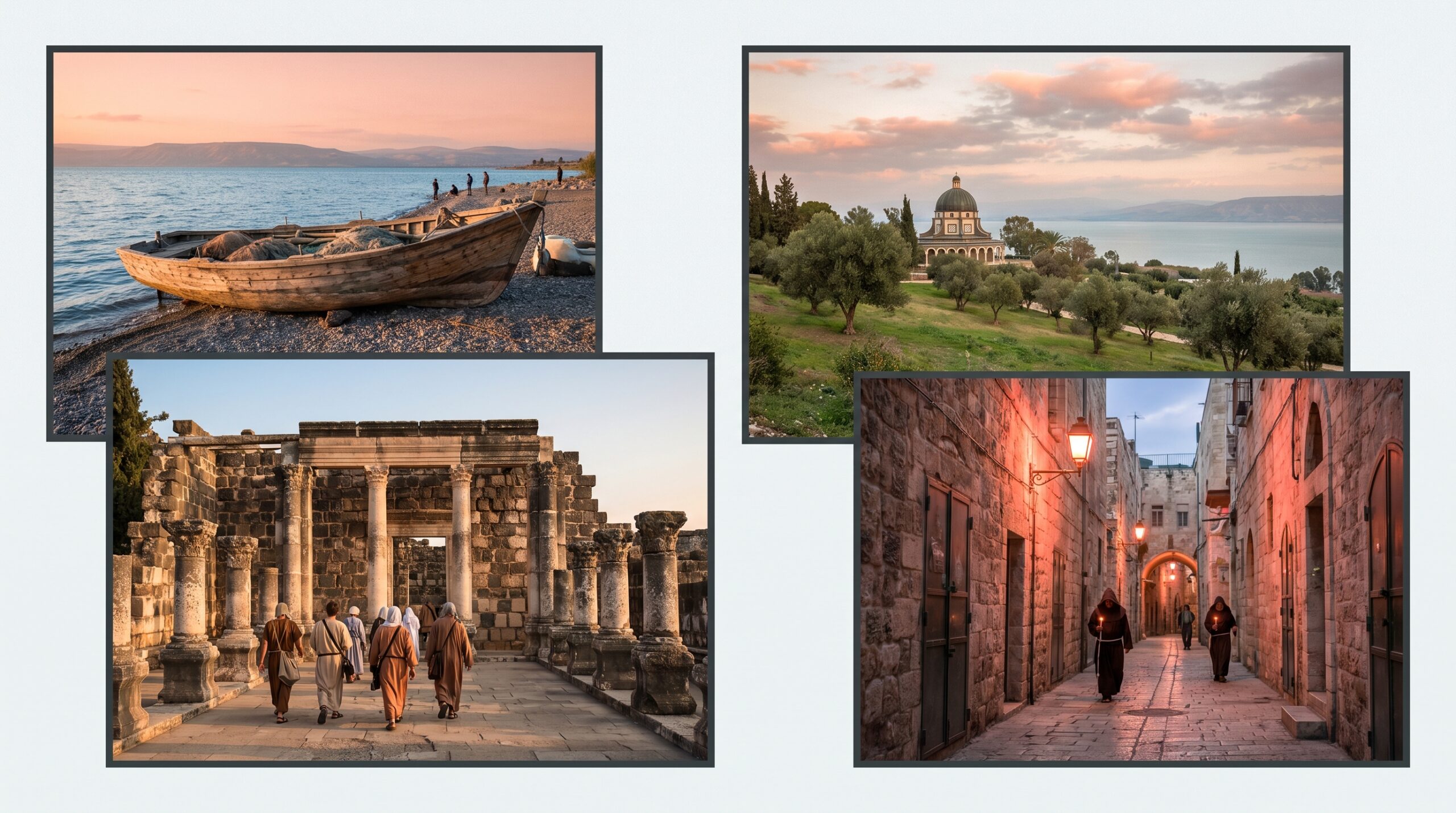
The map of a pilgrimage to Israel follows the chronology of a life. The terrain splits into two spiritual spheres – the years of Galilean ministry in the green north, and the final climactic week in Jerusalem to the south. Walk them in that order and the story builds the way it was written.
Galilee and Nazareth – Walking in the Footsteps of Jesus
The North is where the ministry breathes. Nazareth (Luke 1:26-38) is the hometown, and the basilica and the old lanes have drawn pilgrims for centuries. The Nazareth tourism portal maps the historic routes through the city for those planning ahead.
From there the day opens up. The Mount of Beatitudes (Matthew 5:1-16), where the Sermon on the Mount was given, sits on a slope that looks down over the whole lake. Tabgha (John 6:1-15) marks the feeding of the five thousand. Capernaum (Mark 1:21-35) was the operating center of the ministry, and the synagogue floor is real stone under real feet. Magdala, only recently excavated, adds a first-century synagogue that almost no group expected to see.
Then the boat. A wooden vessel pushes off from the shore and the engine cuts, and forty American pilgrims drift across calm water with the same hills in view that the disciples knew. Out of all the days we run, this is the one that most consistently turns the trip from a tour into something else entirely.
Jerusalem – The Focal Point of the Passion and Resurrection
Jerusalem is where the chronology tightens to a single week. We usually begin on the Mount of Olives (Acts 1:9-12), looking across the Kidron Valley to the Old City walls. From there the descent leads to the Garden of Gethsemane (Matthew 26:36-46), with olive trees that have stood for centuries.
Inside the walls, the Via Dolorosa winds through the markets toward the Church of the Holy Sepulchre, which holds the traditional sites of both crucifixion and burial. The Israel Ministry of Tourism’s own planning documents confirm that the Holy Sepulchre and the Old City remain the most-visited landmarks for faith travelers to this region.
Here is where denomination shapes the day in a concrete way. A Catholic parish from Cincinnati will spend meaningful time inside the Holy Sepulchre and along each station of the Via Dolorosa, often with Mass arranged at one of the licensed side altars. An Evangelical congregation from Nashville will more often gather at the Garden Tomb for Scripture reading and worship. A Lutheran group may want to linger at specific Reformation-era sites within the Old City. We do not hand any two of these groups the same morning, because their traditions call for different approaches to the same sacred ground. The walk along the ancient Southern Steps of the Temple Mount, however, moves everyone in a similar way – these are stones Jesus demonstrably climbed.
Plan a Pilgrimage Built Around Your Denomination
Whether your congregation is Baptist, Catholic, Methodist, Pentecostal, Lutheran, Presbyterian, Anglican, Orthodox, or another tradition, Talya Tours builds each itinerary around the specific priorities of your church – not a generic template. Contact us to start a conversation about dates, group size, and what your group most needs from this journey.
Do Christian Pilgrimage Tours Include Bethlehem?
Almost always, yes, and the logistics are simpler than American groups tend to fear. Bethlehem sits in the West Bank, under Palestinian Authority administration, roughly a 25-minute drive from the Mount of Olives. The crossing requires a coordinated passage, and a licensed operator handles it so smoothly that most groups barely register it as an event.
The destination is the Basilica of the Nativity (Luke 2:1-7). Beneath the main altar, a flight of worn steps leads to the Grotto, where a fourteen-point silver star marks the traditional spot of the birth. Groups go quiet there in a way they rarely do anywhere else on the tour.
The site is no minor stop. The Basilica and its pilgrimage route were inscribed as a UNESCO World Heritage Site, and the Bethlehem tourism guide details the layout for visitors planning ahead. Well-run Christian pilgrimage tours treat Bethlehem as essential, not optional, because the story has to begin somewhere, and it begins here.
Can a Pilgrim Get Baptized in the Jordan River?
Yes, and for many groups it becomes the emotional center of the entire journey. The Jordan is where John baptized Jesus (Matthew 3:13-17), and a pilgrim standing in that water to reaffirm a commitment to God carries the full weight of that moment.
The practical side is well organized. At established sites such as Yardenit, you can rent a white baptismal robe, use proper changing rooms, and step into the river on a controlled, gradual entry. The water there is continuously monitored for safety and ecological health, so a group can focus on the rite rather than the river.
How the ceremony runs depends entirely on the tradition of the visiting congregation. A Pentecostal ministry from Tampa may want extended worship and laying on of hands at the water’s edge. A non-denominational church from Phoenix may bring its own pastor to lead full-immersion rededications. A Methodist congregation may observe the moment more quietly with a brief liturgical reading. We arrange the ceremony around what your church actually practices, never a generic script that fits no tradition particularly well.
What Is Typically Included in a Professional Pilgrimage Package?
Transparency on inclusions is not paperwork. It is what frees a group to focus on the spiritual message instead of calculating costs at the foot of the Garden Tomb. A genuine package removes the financial friction so nobody is managing money mid-pilgrimage.
Core Inclusions You Can Always Expect
A serious itinerary covers the baseline without asterisks. That means half-board or full-board meals, with a full Israeli breakfast and dinner at representative hotels. It means modern air-conditioned coaches with onboard WiFi. It means a government-licensed multilingual guide whose credentials are real and verifiable. And it means prepaid entrance tickets to every site on the program, so no one is fumbling for cash at a national park gate. We arrange visas, insurance, baptism and communion logistics, airport assistance, and Jerusalem Pilgrim certificates under one roof, because this is our only business.
Common Exclusions to Watch Out For
Read the exclusions before you sign anything. Typically outside the package are transatlantic airfare from your U.S. gateway, personal travel and medical cancellation insurance, lunch meals, personal shopping, and customary gratuities for the driver and guide. None of these are hidden if the operator is honest, but an unclear quote can turn a competitive price into a string of surprises. We spell these out in writing before a group commits, which spares the trip leader an awkward conversation later in the journey.
How Much Does a Christian Pilgrimage to Israel Cost?
The honest answer is that a Christian pilgrimage to Israel costs what its weakest component is allowed to cost. Cut corners on hotel location and your group spends an hour commuting each morning. Cut corners on guiding and the sites stay flat. The long-term value sits in getting those choices right, not in the lowest headline number.
The good news is that the right levers make this accessible. Season, lodging tier, and group size move the per-person figure more than anything else. If your group has specific liturgical preferences, reviewing customized pricing for a Catholic Holy Land tour itinerary early helps you build a realistic budget before you over-promise to your congregation.
Six Key Components That Influence Your Tour Budget
Group size drives everything through economy of scale. A coach of 45 from Indianapolis pays far less per person for the same bus and guide than a group of 18. Hotel category is the next lever, with a wide gap between a clean tourist guest house and a five-star international-standard property. Travel season matters sharply, because Easter and Christmas push room pricing to a premium. Meal plans shift the figure too, depending on whether you include lunches or let travelers buy their own midday food. Itinerary customization adds cost when you bring in private venues, guest lecturers, or evening events specific to your denomination. And add-on excursions, such as crossing to Petra in neighboring Jordan, extend both the experience and the price. Knowing which of these your group genuinely cares about is half the budgeting work.
How to Request a Customized Group Quote
A reliable quote needs four things, and church leaders who send them get accurate numbers quickly. Give us an estimated traveler count, even a range. Tell us your preferred months. Name your denomination, because it genuinely changes the itinerary and the ceremony arrangements. And flag any mobility needs in the congregation, since several sites involve stairs and uneven ground.
From there the conversation starts where it should – what does your pastor want this group to walk away with? A Southern Baptist trip leader from Atlanta and a United Methodist conference coordinator from Ohio will receive two different proposals from us, because they are planning two different journeys. That first conversation shapes everything that follows.
Is It Safe to Embark on a Pilgrimage to Israel?
Safety is the question every American group asks first, and it deserves a direct answer rather than a slogan. For a local operator, traveler safety is not one priority among several. It is the precondition for everything else.
In practice that means routes are not fixed in stone. We adjust them in real time based on current local updates and direct coordination with the relevant authorities. A viewpoint that is open one week and quieter the next gets swapped without drama, and the group rarely notices the substitution because the spiritual content stays intact.
Movement matters too. Groups travel by private, GPS-tracked coaches with experienced Israeli drivers and guides who know the terrain the way you know your own neighborhood. They know which gate clears faster, which road avoids a bottleneck, where a 40-person group can step off the bus without standing in traffic. That intimate local knowledge is itself a layer of security.
One practical note for U.S. travelers. Entry rules have changed. Travelers from visa-exempt countries must now obtain a security-approved ETA-IL entry authorization before boarding their flight. It is a short online application, but missing it can stop a pilgrim at the airport at home. We flag it for every group during the planning process so no one is caught off guard at the gate.
Best Time of Year to Schedule Your Spiritual Journey
Timing changes the whole feel of the trip. The shoulder seasons of spring and autumn give the most comfortable weather for outdoor devotionals – mild enough to sit on the Mount of Beatitudes for an hour without anyone wilting. Winter brings cool, green landscapes and noticeably thinner crowds, which some reflective groups prefer. Summer delivers brilliant sun and real heat, requiring midday shade breaks, though it rewards you with long daylight hours that stretch the touring day well into the evening.
Meteorological Data and Optimal Seasons
Israel is small but its microclimates are not subtle. Jerusalem, sitting in the hills, stays cool and can turn genuinely cold after dark even in spring. Drop down into the Jordan Valley or Tiberias on the same day and the air is markedly warmer and more humid, which is exactly why we keep telling groups to pack in layers.
For planning purposes, spring (March to May) and autumn (September to November) deliver the ideal window, with comfortable daytime temperatures and very little rainfall. Before locking dates, it is worth checking the official multi-year datasets from the Israel Meteorological Service Climate Atlas, which records temperature averages by month and region. The numbers confirm what 35 years on the ground already taught us – April and October are hard to beat for a U.S. church group.
What to Pack for a Holy Land Journey
Practical preparation is not separate from the spiritual experience. It protects it. A group walking dusty archaeological digs in the morning and modern Jerusalem pavement in the afternoon needs gear that handles both, so the day’s reflection is not interrupted by a blister or a sunburn.
The Pilgrim Packing Checklist
Start with footwear, because it ruins more days than anything else. Broken-in walking shoes or athletic sneakers with strong arch support are non-negotiable. For clothing, bring lightweight breathable fabrics for hot afternoons, plus a fleece or light jacket for cool Jerusalem nights. On tech, pack Type C or H power adapters, a high-capacity power bank, your camera gear, and a passport neck pouch. For personal care, a wide-brimmed hat, high-SPF sunscreen, polarized sunglasses, and a durable reusable water bottle earn their space every single day. And the spiritual essentials – a compact travel Bible, a journal for daily devotionals, and a comfortable shoulder bag to carry it all through the sites.
Dress Codes and Behavior Rules at Sacred Sites
Modesty at active holy sites is not bureaucracy. It preserves the sacred character of places where people are actively praying around you. The Western Wall, the Basilica of the Annunciation in Nazareth, and the Orthodox monasteries all enforce a dress standard, and your group will be turned away at the door if it is ignored.
The rules are simple. Shoulders and knees must be covered. Low-cut tops and shorts are not permitted inside these spaces. The easiest fix is a habit – have every traveler keep a light scarf or wrap in their daypack, ready to cover up the moment you move from an outdoor walk into an indoor sanctuary. We brief every group on this before the first church visit, so no one is caught off guard at the entrance.
Frequently Asked Questions
How far in advance should a U.S. church group book a pilgrimage to Israel?
Six to twelve months in advance is the working standard for most American church groups. Popular spring travel weeks around Passover and Easter book out especially early, and custom itinerary planning for your specific denomination takes time to do properly. Groups that reach out nine to twelve months ahead have the widest choice of hotels, dates, and private ceremony slots.
How does Talya Tours customize an itinerary for our specific denomination?
The process starts with a conversation about your congregation’s tradition, the pastor’s vision for the journey, and the sites that carry the most theological significance to your stream of Christianity. A Catholic group’s itinerary will build in Mass arrangements, time along the Via Dolorosa, and access to specific Marian sites. An Evangelical group may center more time at the Garden Tomb and the Sea of Galilee. A Presbyterian or Methodist group may have different liturgical priorities altogether. The guide assigned, the ceremony logistics, and the daily pace all follow from that initial conversation about denomination and purpose.
What is the minimum group size for a guided pilgrimage tour?
There is no strict minimum, though smaller groups below 15 travelers tend to see a noticeably higher per-person cost because the fixed overhead of a coach, guide, and hotel negotiations does not scale down proportionally. Most American church groups travel in the 20 to 50 range, which hits the sweet spot for both pricing and group cohesion. For very small groups, contact us to discuss what formats make sense financially.
Do U.S. citizens need a visa to enter Israel?
U.S. passport holders do not need a traditional visa, but they are now required to obtain an ETA-IL (Electronic Travel Authorization for Israel) before departure. It is an online application, not a consulate visit, but it must be completed and approved before boarding the flight to Israel. We walk every group through this requirement during the pre-trip preparation phase so that no one is stopped at their U.S. departure gate.
Can older travelers or those with limited mobility join a pilgrimage group?
Many of our most moved travelers are seniors, and we plan for that. Several major sites involve uneven stone ground, stairs, and inclines, and we note those honestly when we present an itinerary. When groups include travelers with mobility challenges, we adjust the site sequence and pace accordingly, and identify alternative access points where they exist. Flag mobility needs early in the planning conversation so we can build the itinerary around them from the start rather than trying to accommodate them after the schedule is fixed.
Is it possible to combine a pilgrimage to Israel with a visit to Jordan?
Yes, and for groups with enough days, the combination is meaningful. Petra in Jordan is commonly added as a two-day extension. For biblically focused groups, the Jordan side of the Dead Sea region also includes Mount Nebo, where Moses is believed to have viewed the Promised Land (Deuteronomy 34:1-4). These cross-border additions require coordination with separate entry procedures, which a local operator handles as part of the planning process.
After 35 years and more than 90,000 pilgrims, the journey that moves a congregation most is the one built specifically for that congregation. A Presbyterian fellowship and an Assemblies of God church do not need the same week, and treating them as if they do produces a trip that serves neither tradition as well as it should. A well-planned pilgrimage to Israel is shaped around your denomination, your pace, and your pastor’s vision – and that is precisely what makes it the journey your people talk about for years.
If your church or group is beginning to think through dates, sites, and which itinerary fits your tradition, we are glad to work through it with you before you commit to anything. Reach Talya directly at [email protected] or through the contact page.
Ready to Start Planning for Your Congregation?
Tell us your denomination, your preferred travel window, and a rough group size. We will put together a realistic outline – sites, pacing, ceremony options, and pricing – specific to your church’s tradition. No obligation, no generic brochure. Just a straight conversation about what your group needs.

About the Author
Talya Felner
Talya Felner is the Owner and CEO of Talya Tours Services (TTS), a leading professional tour operator in Israel. With over 35 years of experience and more than 90,000 travelers served, Talya has built TTS into a trusted name for Christian pilgrimages, biblical tours, and conferences for American groups visiting Israel and the Holy Land. Her team designs each itinerary around the specific Christian denomination of the visiting group – whether Protestant, Catholic, Evangelical, Baptist, Methodist, Pentecostal, Lutheran, Presbyterian, Anglican, Orthodox, or another tradition – ensuring that sites, worship arrangements, and guides reflect what matters most to that congregation. From visas and accommodations to guides, transportation, and on-site coordination, TTS handles every detail so American pastors and group leaders can focus on the spiritual experience of their travelers.