
Planning a Christian tour to Israel takes more preparation than most American church leaders expect. Flight dates are often confirmed before a single hotel room is held, and the itinerary that suits a Southern Baptist congregation is a genuinely different trip from the one built for a Catholic parish or a Pentecostal ministry. This article walks through the practical details of Christian tour packages to Israel, from pricing structures and itinerary options to entry requirements, seasonal timing, and how denomination-specific planning actually works in practice.
Reading time: 7 minutes
Key Points
- Christian tour packages to Israel are built around the specific denomination of the visiting group – Protestant, Catholic, Evangelical, Baptist, Pentecostal, and others all receive different itineraries, site priorities, and worship arrangements.
- Land package pricing covers ground logistics only and excludes international flights, tips, lunches, and personal travel insurance – understanding each line item prevents budget surprises.
- The 10-day itinerary is the most practical length for American groups, offering enough time for scripture study at each site without the physical strain of a compressed schedule.
- Visa pre-authorization through the ETA-IL system is now required for U.S. travelers before boarding – it cannot be arranged on arrival and should be completed well in advance of departure.
Table of Contents
- What Christian tour packages to Israel actually include
- How much a Christian Israel tour package normally costs
- The best itinerary for an 8-day Christian tour
- The classic 10-day Christian Holy Land itinerary
- How Christian tours differ from general sightseeing tours
- Group escorted tours vs. private custom journeys
- Licensed guides with biblical and denominational knowledge
- Holy sites that belong on every Christian itinerary
- When to book your Holy Land journey
- Entry requirements, visas, and documentation for Israel
- Safety and real-time travel management
- What to pack for a Christian pilgrimage in Israel
What Christian tour packages to Israel actually include
A complete land package removes the guesswork from ground logistics. When an American church group books through Talya Tours, the goal is straightforward – from the moment the group lands at Ben Gurion Airport, every transfer, hotel night, site entry, and guided day is already confirmed and sequenced. Tourism is the only business we run, and the package reflects that depth of focus.
We do not run one generic tour. The itinerary is built around the specific Christian tradition of your group, whether that is a Southern Baptist congregation, a Catholic parish, a Methodist fellowship, or a non-denominational Evangelical church. That shaping begins on the first planning call, not after a contract is signed.
Land packages vs. full flight-and-land deals
A land package covers everything from arrival to departure on the ground. That means airport transfers, hotels, a government-licensed guide, private transportation, and all site admissions. International flights are not included.
Many American church groups prefer this arrangement because it lets them book flights using air miles, choose a preferred U.S. departure city, or work with a travel agent they already know. The congregation keeps control of the airfare while the ground operation is fully handled.
Core components – accommodations, meals, and site entry
Standard inclusions are consistent across our programs. Selected local hotels, typically on half-board basis meaning breakfast and dinner are covered each day. A modern private air-conditioned coach with WiFi. A national guide licensed by the Israeli Ministry of Tourism. And preloaded entry tickets to every site on the route, so there is no fumbling for cash at gates.
To see how these inclusions vary by denomination, you can browse the full catalog of Christian tours arranged for different traditions on our site.
How much a Christian Israel tour package normally costs
Pricing for Christian Israel tour packages is almost always quoted as a land cost per person, based on two travelers sharing a twin room. That single detail confuses many first-time group leaders, who expect an all-in figure that already covers flights and gratuities.
Understanding base pricing vs. total out-of-pocket expenses
Three variables move the base price more than anything else. Hotel category matters significantly – the gap between a solid 3-star property and a 5-star hotel is real and substantial. Group size is the second factor, since a full coach of 40 travelers spreads fixed costs far more efficiently than a van for 8. Season is the third – spring and autumn command the highest ground rates.
Hidden costs to ask about before booking
Some items are routinely omitted from a headline quote. Ask about each of these before you sign anything. Gratuities for your guide and driver, where roughly $10 to $15 per traveler per day is the standard U.S. industry norm. Lunches, which are often on each traveler’s own account. Optional excursions not listed in the base itinerary. And personal travel and medical insurance, which we strongly recommend every group member carries regardless of how short the trip is.
If your congregation is in the early stages of planning a pilgrimage to Israel, we are glad to walk through dates, group size, and the denominational priorities that should shape your itinerary – before any commitment is made.
The best itinerary for an 8-day Christian tour in Israel
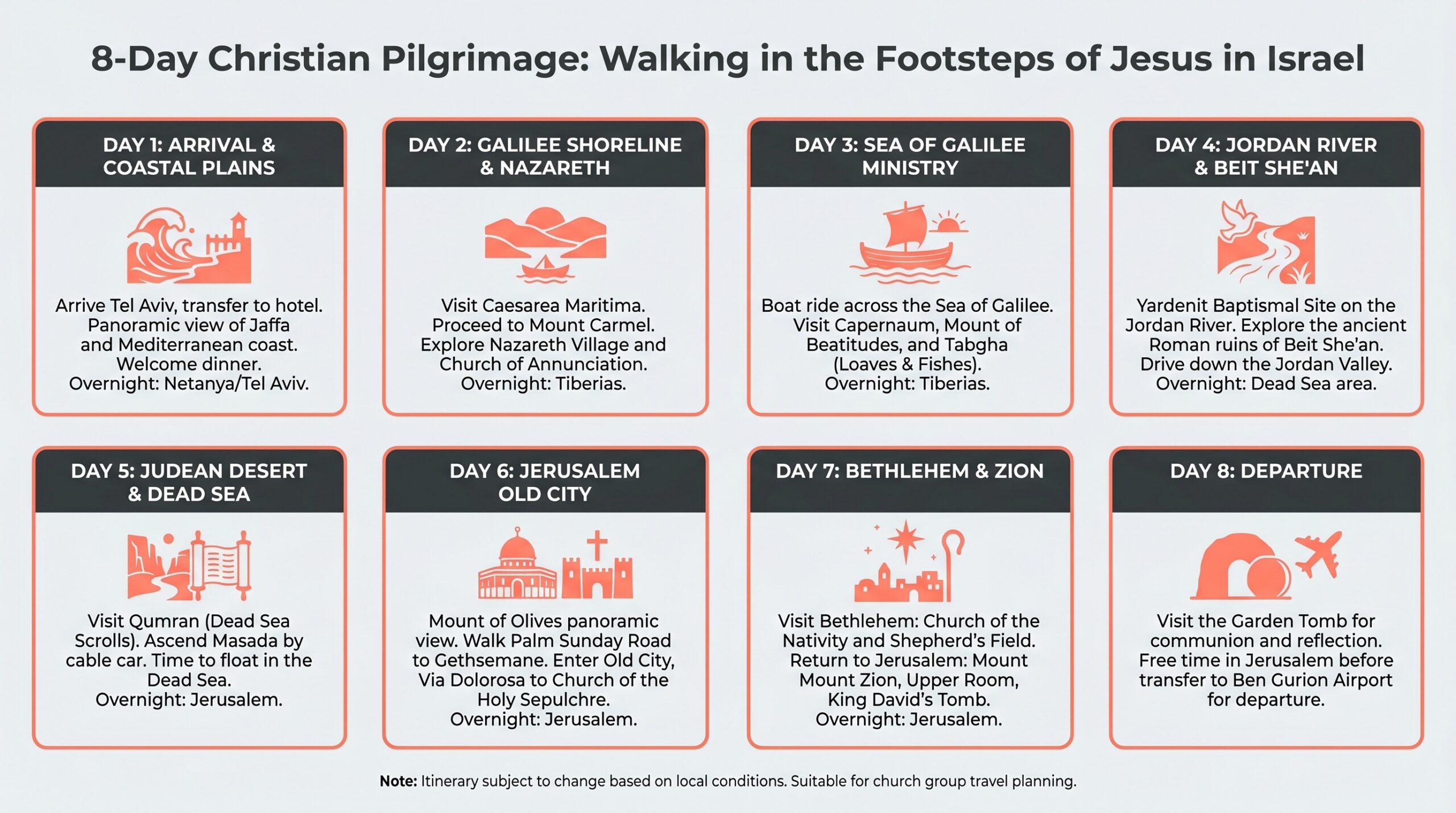
An 8-day itinerary is designed for American congregations that cannot take two weeks away but still want every essential biblical landmark. The pace is brisk, and it works because the sequence is tight rather than because corners are cut.
A recommended day-by-day structure
A classic 8-day frame runs as follows. Day 1 covers the Coastal Plain and Caesarea Maritima, where Cornelius was baptized (Acts 10). Day 2 moves into Galilee, taking in Capernaum (Mark 1:21-35) and the Mount of Beatitudes (Matthew 5:1-16). Day 3 includes the Jordan River baptism site and the Judean Desert. Days 4 through 7 are based in Jerusalem, with Bethlehem and the Mount of Olives (Acts 1:9-12). Day 8 is departure.
For Protestant and non-denominational Evangelical groups who want an efficient, scripturally focused framework, our Evangelical Tour 8 Days weighs the Garden Tomb and Yardenit ahead of the traditional shrines. A Catholic group on the same 8 days would follow a different emphasis, with time at the Basilica of the Annunciation and a Mass schedule confirmed in advance at the relevant sites.
Who the 8-day option is best designed for
Younger congregations generally handle this pace well. So do working professionals with limited vacation days, and budget-conscious travelers who want depth without the cost of a longer stay. One thing to communicate clearly to your group before departure – there is active walking every single day, often over uneven stone ground, and new shoes will cause problems.
The classic 10-day Christian Holy Land itinerary
Ten days is the length most veteran operators would choose for their own family. It is the industry standard for Christian Holy Land packages because it balances depth, a comfortable travel pace, and real time for scripture study and reflection at the sites themselves – rather than a rushed photo stop at each gate.
A detailed 10-day breakdown from Galilee to Jerusalem
A well-built ten-day route moves north to south. Days 1 and 2 cover arrival and settling in Tiberias on the Sea of Galilee. Day 3 takes in the Sea of Galilee shoreline, Tabgha (John 6:1-15), and Peter’s Primacy (John 21:15-19). Day 4 reaches Nazareth (Luke 1:26-38) and Cana (John 2:1-11). Day 5 follows the Jordan Valley route through Jericho and the Judean Wilderness. Day 6 includes the Dead Sea, Qumran, and Masada. Day 7 covers the Mount of Olives (Acts 1:9-12) and Mount Zion. Day 8 enters the Jerusalem Old City for the Via Dolorosa and the Church of the Holy Sepulchre. Day 9 holds communion at the Garden Tomb and continues to Bethlehem (Luke 2:1-20). Day 10 traces the road to Emmaus (Luke 24:13-35) before departure.
This sequence aligns with the GoIsrael Christian Interest 10-day itinerary, which we have refined over decades of running it with American groups across many denominations.
Allocating reflection and devotion time in the schedule
The reason American groups keep requesting the ten-day format is the breathing room it creates. The additional days leave genuine gaps for worship services, group prayer, and quiet reflection beside the Sea of Galilee, rather than moving from one entrance gate to the next with no pause between. For a Pentecostal ministry that wants extended worship time at Gethsemane (Matthew 26:36-46), those gaps are not a scheduling luxury – they are the entire purpose of the trip. An Anglican or Episcopal group might use the same gaps for Evening Prayer at the Mount of Olives. The structure is the same; the content of those pauses reflects the tradition of the congregation.
How Christian tours differ from general sightseeing tours
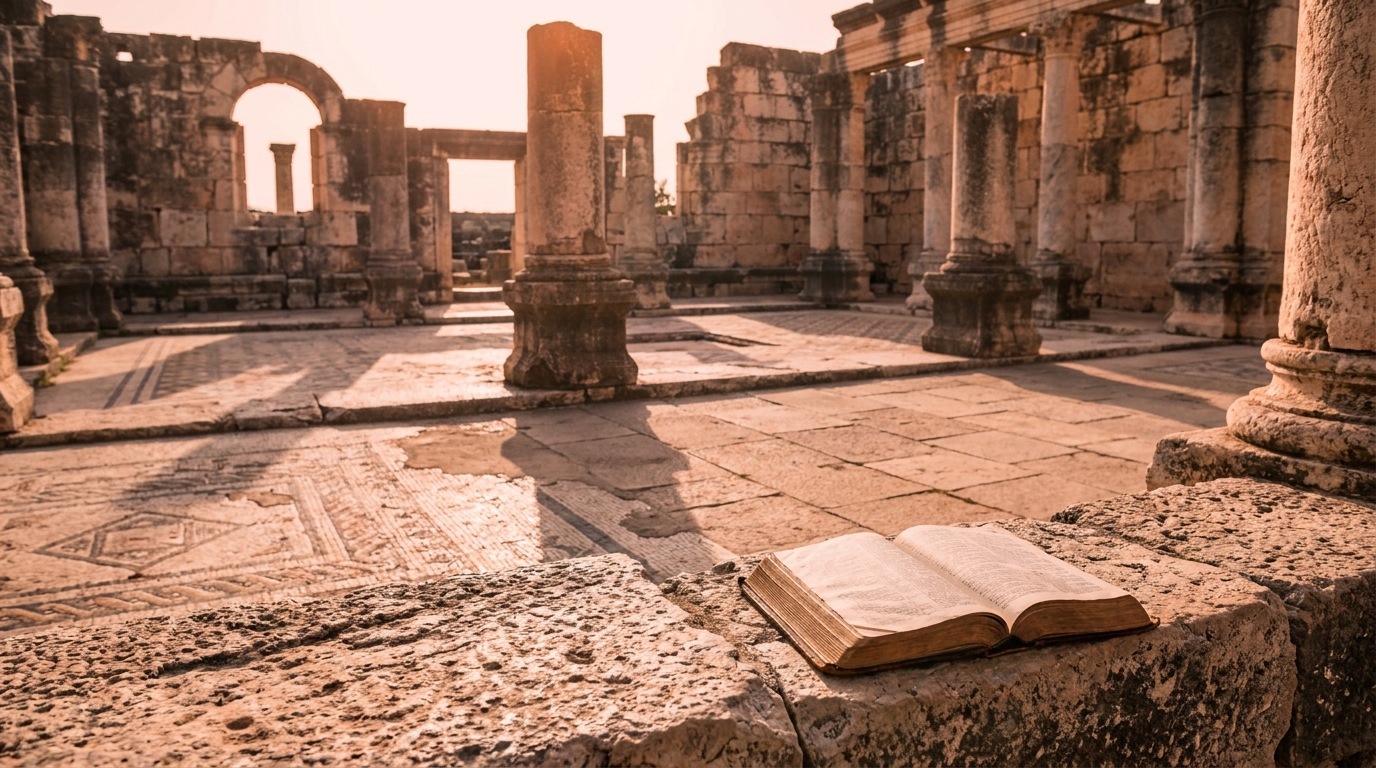
The difference between a Christian pilgrimage program and a standard sightseeing trip is not the bus or the hotel. It is the lens through which every site is understood. A secular tour treats a ruin as architecture and moves on. A faith-based itinerary treats that same stone as evidence of biblical history, read against the geography, the covenants, and the prophetic timeline that the group has been studying for years before they arrived.
Scriptural archaeology vs. standard cultural tourism
On a general tour, Capernaum is an excavated synagogue. On a Christian itinerary, it is where the Gospel narrative becomes physical and the landscape itself becomes part of the text. That is also where denomination matters most. A Catholic Pilgrimage to the Holy Land will prioritize a daily Mass schedule booked in advance at the appropriate shrines, Eucharistic celebrations at the Church of the Nativity, and dedicated time at the Basilica of the Annunciation in Nazareth. A Methodist conference group visiting in the same week would want quieter contemplative time and stronger theological framing at each stop, without the liturgical structure. Same country, same biblical sites – two genuinely different trips, built around two different traditions.
Group escorted tours vs. private custom journeys
There is no single right answer here. The format that suits a 45-member American congregation is the wrong fit for a family of six, and the reverse is equally true.
| Category | Group Escorted Tour | Private Guided Journey |
|---|---|---|
| Cost Structure | Fixed costs spread efficiently across a full coach of travelers. | Higher per person – fewer travelers sharing the same vehicle and guide. |
| Schedule Flexibility | Set departures and a fixed daily rhythm that the whole group follows. | Full control of timing, pacing, and which sites receive more time. |
| Denominational Customization | Built around your congregation’s tradition when the whole group belongs to one church. | Fully tailored, including private ceremonies, devotional stops, and liturgical arrangements. |
| Logistical Support | Dedicated guide and full ground handling throughout the itinerary. | Same level of support, scaled to a smaller and more nimble vehicle. |
Choosing based on group size
U.S. church congregations with 15 or more members benefit heavily from a dedicated private coach and an itinerary designed entirely around their congregation’s tradition. A smaller family group of 4 to 8 travelers usually finds a customized luxury van far more intimate – able to linger at a quiet overlook or extend a devotional without holding up 40 other people.
Licensed guides with biblical and denominational knowledge
Every guide we use is licensed by the Israeli Ministry of Tourism. The ones we assign to pilgrimage groups go further than that certification – they bring genuine theological depth and the ability to read each site through the specific lens of the visiting tradition, rather than reciting a single script to every group that passes through.
The role of a guide fluent in biblical narrative
A guide who understands the difference between Catholic, Protestant, Lutheran, and Orthodox emphases will connect the Scripture to the stone correctly. A Presbyterian group at the Garden of Gethsemane is asking different theological questions than a Pentecostal group standing in the same place. The guide’s ability to recognize that distinction is what separates a meaningful experience from a competent geography lesson. That is the entire reason we ask, on the first planning call, which tradition your group belongs to and what your pastor wants the congregation to carry home from the trip.
Three questions to ask any tour provider before booking
Three questions sort the serious operators from the rest. Ask whether your guide is certified and specifically experienced with Christian pilgrimage groups. Ask whether the itinerary includes dedicated time for on-site liturgies or devotions – not just photo stops. And ask whether the guide can adapt commentary to your denomination’s preferred Bible translation and theological emphasis. The answers tell you a great deal about how the company actually works.
Holy sites that belong on every Christian itinerary
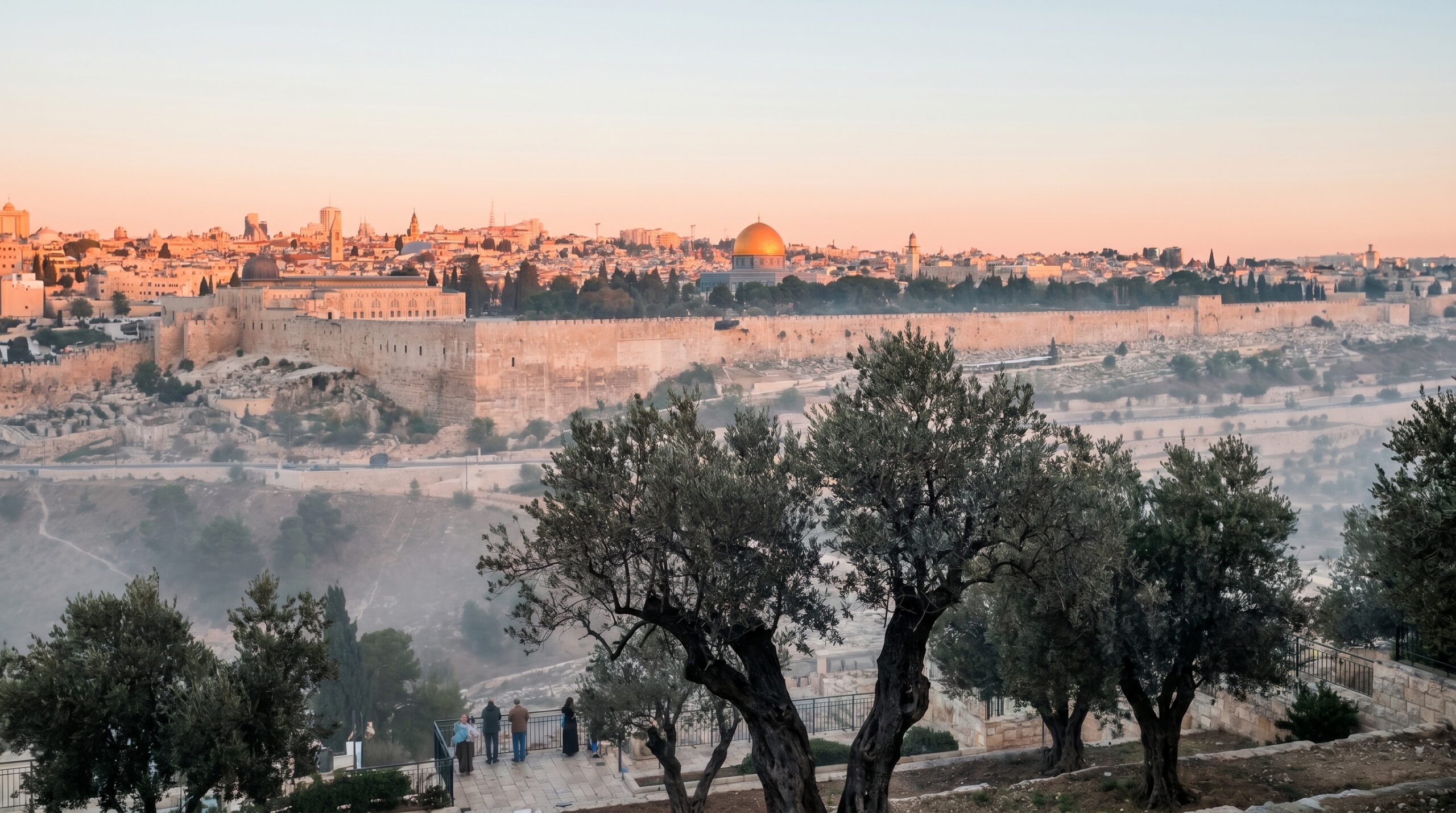
Out of tens of thousands of American travelers, the site that moves groups most deeply is rarely the one they expected before arrival. The largest and most famous church is seldom the most meaningful stop. The smaller and quieter ones often are.
Galilean ministry highlights – Capernaum, Tabgha, and the Mount of Beatitudes
The freshwater Sea of Galilee is the cradle of Jesus’ public ministry, and the northern shore holds three sites that almost every well-built itinerary keeps close together. Capernaum (Matthew 4:13), the town Jesus made his base and where the ruins of the synagogue and Peter’s house are now excavated. Tabgha (John 6:1-15), the traditional scene of the Feeding of the Five Thousand, described in detail on the GoIsrael Tabgha page. And the Mount of Beatitudes (Matthew 5:1-16), looking down over the lake with the full sweep of the water visible below. These three sit close enough to cover in a single unhurried morning, part of the Gospel Trail the Ministry of Tourism maps across the region.
Jerusalem and Judean landmarks – Mount of Olives, Gethsemane, and the Garden Tomb
Jerusalem carries the weight of the Passion narrative. Groups typically begin on the Mount of Olives (Luke 19:28-44), with the view across the Old City described in the GoIsrael guide to the Mount of Olives. From there they walk down to the Garden of Gethsemane (Matthew 26:36-46) and its ancient olive trees, then trace the Via Dolorosa (John 19:17) through the Old City toward the end of the Passion route.
Where that route ends differs by denomination – and by design. Evangelical, Baptist, and non-denominational groups typically close at the Garden Tomb (John 20:1-18) for a communion service in the open-air garden. A Catholic group will weight the Church of the Holy Sepulchre as the primary destination and will have a Mass scheduled there in advance. Same morning, same scriptural territory – two different endings, shaped by two different traditions. That is not an accident in the planning. It is the point.
When to book your Holy Land journey
If your group can choose dates freely, spring and autumn are the most practical windows. Walking is a constant feature of these itineraries, and the weather largely decides whether that walking is pleasant or punishing.
Seasonal weather across the country
Spring (March to May) and autumn (September to November) offer the most comfortable conditions for outdoor sites. Jerusalem sits at elevation and stays relatively cool, while the Dead Sea and Jericho in the same week can run 15 to 20 degrees warmer – a contrast the Israel Meteorological Service Climate Atlas documents region by region. Winter is quieter and less expensive, with cold and occasionally wet days in the hill country, but manageable for groups that prepare for it.
Religious holidays and crowd patterns
Check your dates against local High Holidays and Christian Holy Week before you confirm anything. During Easter, hotel availability in Jerusalem tightens sharply and rates climb, because pilgrim traffic from across the United States converges on the same few weeks. Book that window as early as possible – ideally 8 to 12 months out for a large group – or choose a slightly earlier or later week that avoids the peak pressure entirely.
Entry requirements, visas, and documentation for Israel
Getting the paperwork wrong can result in a traveler being turned away at the departure gate before they ever board. This is the area American group leaders most consistently underestimate, because the process changed and many older resources online still describe the pre-authorization rules incorrectly.
Navigating the ETA-IL pre-authorization system
Travelers from visa-exempt countries, including the United States, must now secure an approved Electronic Travel Authorization – the ETA-IL – before they board their flight to Israel. It is not optional and it is not processed on arrival at the airport. The official Israeli Ministry of Foreign Affairs entry visa page explains the current process, and the ETA-IL system update from the Embassy confirms the current requirements. We flag this requirement for every group member well before departure, because a single missing authorization can hold up an entire travel party at check-in.
Passport validity rules
Each passport must be valid for at least six months beyond the planned date of departure from Israel – not just through the arrival date. We ask group coordinators to collect passport details during the early planning stages, because renewing a passport that expires too soon can take several weeks, and a late booking leaves almost no margin for that.
Safety and real-time travel management
This is the question we hear most often from American pastors and church group leaders, and it deserves a straight answer rather than either reassurance that dismisses concern or alarm that overstates risk.
Consulting official government travel advisories
Before you book and again in the weeks before you fly, read the official guidance directly. The U.S. Department of State publishes an Israel, West Bank and Gaza travel advisory that is updated on a regular basis. Reading it yourself, rather than relying on news headlines, gives your group an accurate and current picture of specific regions and conditions.
How experienced operators manage safety in real time
A reputable ground operator does not run a fixed program regardless of what conditions on the ground look like on a given week. We stay in continuous contact with the relevant Israeli authorities, monitor routes daily, and adjust a group’s schedule away from any sensitive area when needed. In 35 years of operation, the most common adjustment is simply reordering a day – swapping a southern site for a northern one, or moving an outdoor site indoors for a morning. Groups rarely notice the change because the alternative was planned in advance. That flexibility only exists because we run these routes ourselves, every week, and know the full range of alternatives firsthand.
What to pack for a Christian pilgrimage in Israel
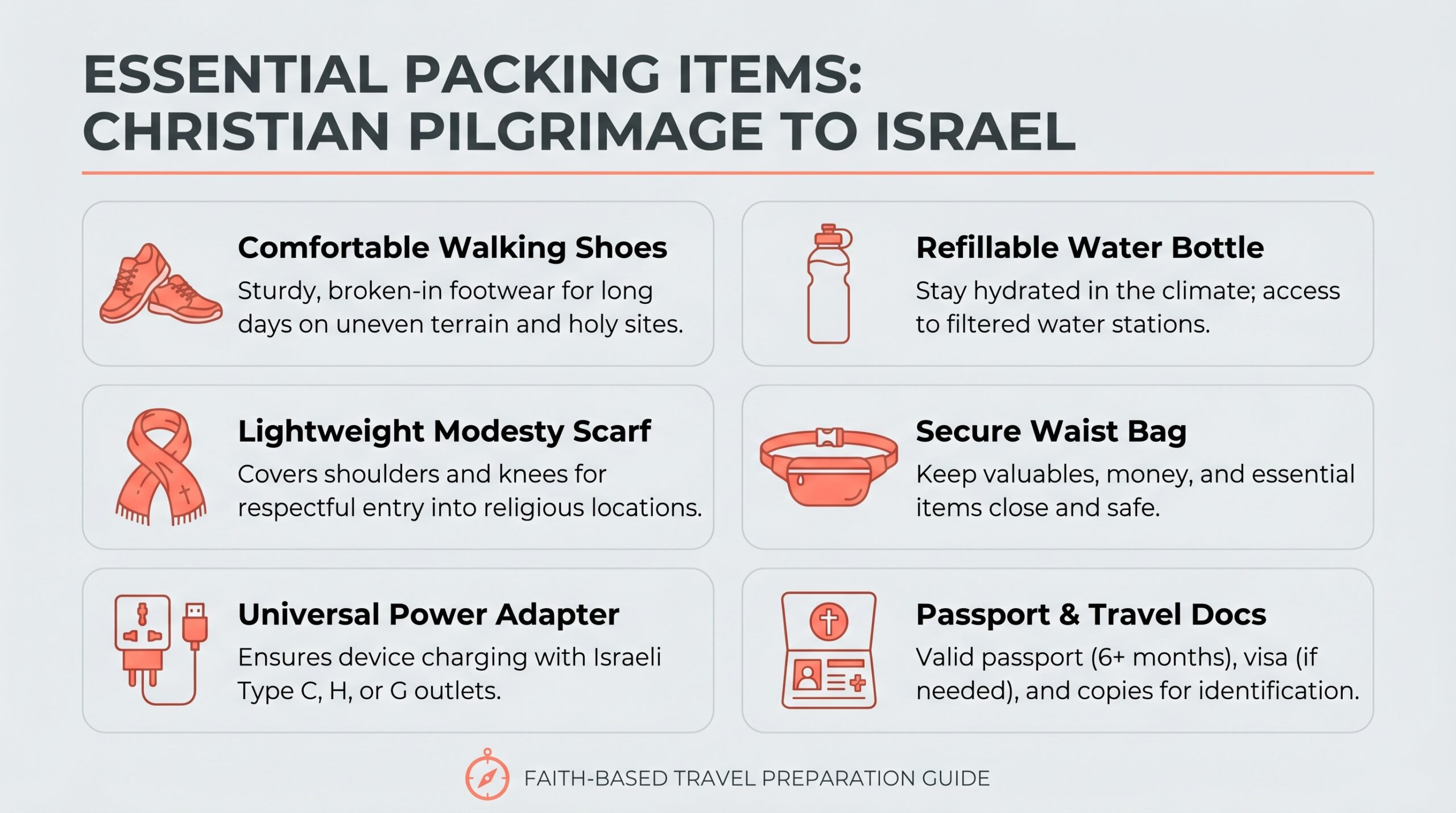
Packing for a Holy Land pilgrimage comes down to two practical priorities – comfort on foot and respectful dress at the sites themselves.
Dress requirements at holy sites
At traditional churches and sacred sites, both men and women are expected to have shoulders and knees covered before entering. This applies at the Church of the Holy Sepulchre, the Mount of Beatitudes, the Church of the Nativity in Bethlehem, and the Western Wall. A light scarf or a thin wrap stored in a day bag solves almost all of these situations without adding meaningful weight to luggage.
Footwear, adapters, and daily essentials
Bring walking shoes that are fully broken in before departure. Jerusalem is built on uneven stone stairs and ancient paving, and new footwear that has not been worn in will cause real discomfort within a day. Pack physical power adapters for Israeli plug types C and H, a secure waist bag or dry case for your passport and travel documents, and a refillable water bottle since afternoon temperatures at outdoor sites can climb quickly, particularly in the Jordan Valley and the Dead Sea region.
Frequently Asked Questions
How far in advance should an American church group book a tour to Israel?
For most American congregations, 8 to 12 months before departure is the right window, particularly for spring travel when hotel availability and coach scheduling get tight. Groups planning to be in Jerusalem during Holy Week should give themselves even more lead time than that. Starting a year out also allows time to collect passport details, process ETA-IL pre-authorizations, arrange flights, and communicate the itinerary properly to group members before they commit to the trip.
Can an itinerary be fully built around our specific denomination?
Yes, and this is how every Talya Tours program is designed. The denomination of your group shapes site selection, the order of visits, which worship arrangements we secure in advance (such as a Mass at a specific shrine for a Catholic group, or a communion service at the Garden Tomb for an Evangelical or Baptist congregation), and which biblical emphases the guide uses at each location. Whether your group is Presbyterian, Adventist, Lutheran, Methodist, Anglican, Pentecostal, or another tradition, the itinerary reflects what matters theologically to that congregation – not a generic Christian template applied to everyone.
What is the minimum group size for a private dedicated tour?
There is no strict minimum. We work with American church groups of 15 and above on full private coaches, and with smaller family or ministry groups of 4 to 10 in customized vehicles suited to that size. The planning process and the level of denominational customization are the same regardless of group size – what changes is the vehicle, the room-sharing economics, and the pace flexibility a smaller group naturally has.
Is the Garden Tomb always included in Protestant and Evangelical itineraries?
For Protestant, Evangelical, Baptist, and non-denominational American groups, the Garden Tomb is almost always included and is typically the emotional and devotional peak of the Jerusalem days. We pre-arrange communion service time there as part of the booking. Catholic groups generally center on the Church of the Holy Sepulchre for the same theological weight. The guide adjusts the commentary accordingly so that each group arrives at their version of that moment having followed the full Passion narrative through the preceding stops.
What kind of travel insurance do you recommend for American group members?
We strongly recommend that every traveler carries both travel insurance covering trip cancellation and interruption, and separate medical insurance that is valid internationally. Standard U.S. health insurance plans typically do not cover treatment abroad. Most comprehensive travel insurance policies bundle both elements and are straightforward for American travelers to purchase before departure. We are happy to point group coordinators toward what to look for in a policy, though the purchasing decision remains with each individual traveler.
Can the itinerary be adjusted if conditions change during the trip?
Yes, and built-in flexibility is one of the concrete advantages of working with an operator that runs these routes every week. If a site is temporarily closed, if an area requires rerouting, or if weather makes an outdoor site impractical on a given day, we already know the alternatives and can substitute without disrupting the overall denominational focus of the itinerary. Groups are notified of any change and the reasoning behind it. The goal is always to maintain the spiritual and biblical integrity of the day even when the specific geography changes.
Planning a Christian tour to Israel involves more moving parts than most American church leaders realize at the start – from denomination-specific itinerary design and licensed guide assignment, to hotel blocks, ETA-IL pre-authorization, and real-time on-the-ground flexibility. The 10-day itinerary remains the most practical frame for most American congregations, though 8-day programs work well for groups with compressed schedules. Pricing is almost always quoted as a land-only per-person figure, and understanding what sits outside that figure prevents budget surprises later. On all of these points, the earlier you start the planning conversation, the more smoothly the trip comes together.
If your congregation or ministry is beginning to think seriously about a pilgrimage to Israel, we are glad to talk through the denomination-specific details, the realistic timeline, and what your group would actually need before you commit to anything.
Ready to start planning your group’s pilgrimage to Israel?
Reach Talya directly at [email protected] or use our contact page to describe your group’s denomination, size, and travel window. We will respond with a tailored itinerary framework and a clear breakdown of what is included.

About the Author
Talya Felner – Owner and CEO, Talya Tours Services (TTS)
Talya Felner is the Owner and CEO of Talya Tours Services (TTS), a leading professional tour operator in Israel. With over 35 years of experience and more than 90,000 travelers served, Talya has built TTS into a trusted name for Christian pilgrimages, biblical tours, and conferences for groups visiting Israel and the Holy Land. Her team designs each itinerary around the specific Christian denomination of the visiting group – whether Protestant, Catholic, Evangelical, Baptist, Methodist, Pentecostal, Lutheran, Presbyterian, Anglican, Orthodox, or another tradition – ensuring that sites, worship arrangements, and guides reflect what matters most to that congregation. From visas and accommodations to guides, transportation, and on-site coordination, TTS handles every detail so American pastors and group leaders can focus on the spiritual experience of their travelers.