
Planning a Christian pilgrimage to Israel involves more decisions than most American pastors and group leaders expect when they first start researching. Which sites are genuinely essential for your congregation’s tradition, how many days your group actually needs, what a realistic budget looks like, and how entry requirements work for U.S. travelers – these are practical questions that shape the entire experience. This guide works through each one with specifics drawn from 35 years of organizing faith-based tours for American church groups, denominations, and individual pilgrims.
Reading time: 8 minutes
Key Points
- Ten days is the practical minimum for covering Galilee, Jerusalem, and Judea without cutting the sites that matter most to your congregation.
- Every itinerary Talya Tours builds is shaped by the specific Christian denomination of the visiting group – Catholic, Evangelical, Baptist, Pentecostal, Methodist, Lutheran, Presbyterian, Anglican, Orthodox, and others each receive a different plan.
- U.S. citizens now enter Israel through the electronic ETA-IL authorization system, completed online before departure.
- What drives cost variation is hotel category, travel season, and group size – understanding each lever lets you build a budget that holds.
What Christian Travel to Israel Actually Means, and Who It Is For
Christian travel to Israel is faith-based tourism built around the geography of Scripture. It tracks the life and ministry of Jesus across real ground, from the synagogue at Capernaum (Mark 1:21-35) to the Mount of Olives (Acts 1:9-12), and it ties theology to places you can stand in. It is part pilgrimage and part historical study, and most groups feel both halves more strongly than they expected.
It appeals to American church groups, to families traveling together, to faith-centered couples, and to solo travelers who join a structured departure rather than coordinate everything alone. What surprises most first-time visitors from the United States is how small the country is. The places you read about your whole life sit closer together than any Bible map suggested. That compression is part of why a well-built itinerary connects the verses to the land so quickly.
What makes or breaks the trip is not the list of sites. It is the sequence – and whether that sequence is built around what your specific congregation holds most central. A Southern Baptist group and a Catholic parish visiting the same country have different theological anchors, different liturgical needs, and different moments they will carry home. Choosing one of the Christian Tours Israel packages that accounts for those differences from the first day of planning is what keeps the journey coherent rather than generic.
Why American Believers Choose Organized Tours Over Going It Alone
The Holy Land crosses several administrative regions, security zones, and different driving rules within a single day. Bethlehem and the Mount of Olives are barely six miles apart, yet moving a group bus between them involves crossings and permits that a rental car cannot handle smoothly. Add Hebrew and Arabic signage, holy-site entry windows that close earlier than groups expect, and parking that simply does not exist for a forty-seat coach, and the do-it-yourself version becomes a daily negotiation that pulls the pastor away from the spiritual work of leading his congregation.
An established operator absorbs all of that. Licensed vehicles, timed entry to high-demand sites, a government-licensed scripture-literate guide who knows when the Garden Tomb opens and when Capernaum fills with other groups – these are not luxuries. They are what allows your pastor to lead the devotional moments instead of managing logistics. The organized version of Christian tours to Israel from the U.S. exists so the group can do what it came to do.
If you want to understand how a native operator with deep roots handles the moving parts, the About Talya Tours page lays out the structure of a one-roof company that has been doing exactly this for over three decades.
How Much Does a Christian Trip to Israel Cost, and What Drives the Price
Set your expectations around land arrangements first, since that is where an operator has the most control. A Christian trip to Israel is priced by three levers: hotel category, season, and group size. Three-star pilgrim hotels in Tiberias and Jerusalem cost considerably less than deluxe five-star properties. Peak weeks around Easter and Christmas run higher than the shoulder months of spring and fall. And a group of 40 spreads fixed costs like the bus and guide much further than a group of 12.
The numbers that catch people off guard are the ones outside the headline price. Lunches are usually on your own. Tipping the driver and guide is expected and adds up across a ten-day trip. Single travelers pay a supplement for a room to themselves. Optional excursions – a Jordan crossing or a cable car at Masada – sit on top of the base price.
| Tier | Hotels | Typical Land Cost (per person, 10 days) | Best For |
|---|---|---|---|
| Budget | 3-star pilgrim hotels | Lower band | Large church groups, tight budgets |
| Mid-range | 4-star, central locations | Middle band | Most American congregations |
| Premium | 5-star deluxe | Upper band | Smaller groups, couples, comfort-focused |
We quote land and flights separately on purpose. It lets you see exactly what you are paying for and compare quotes from other operators on equal footing.
What a Standard Israel Package Includes, and What It Leaves Out
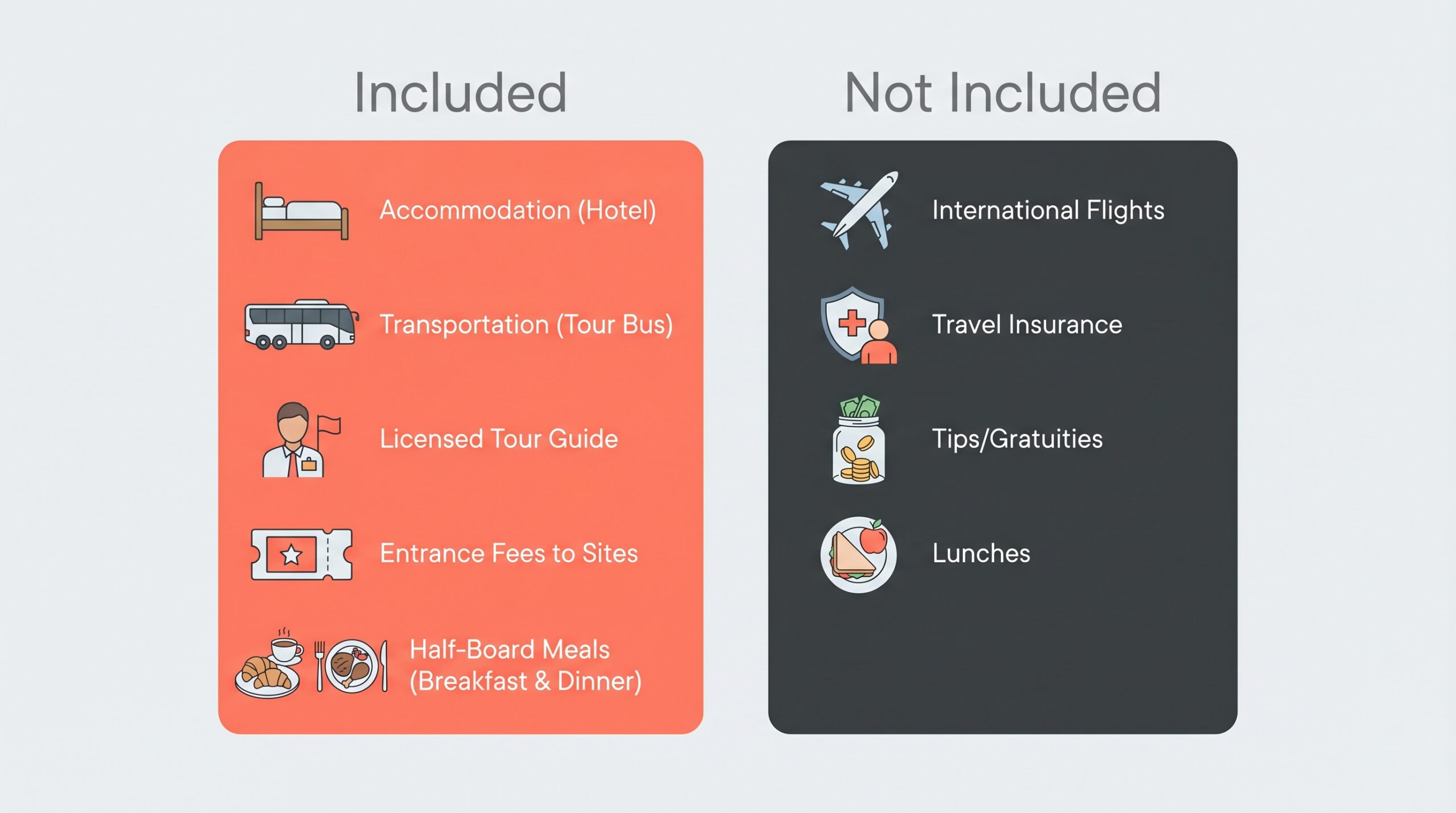
A standard land package covers hotel nights, a private air-conditioned coach with a dedicated driver, a licensed guide, entrance tickets to the national parks and historic sites on the itinerary, and daily breakfast and dinner. That is the spine of nearly every program we run.
What it usually does not cover is the trans-Atlantic flight, travel medical insurance, your personal tipping fund, and lunches. This is where the distinction matters most: a land-only price assumes your group arrives at Ben Gurion on its own arrangements, while an all-inclusive flight-plus-land price bundles the airfare from your U.S. departure city. Knowing which you are comparing keeps quotes honest when you are evaluating options.
Questions to Ask Before You Sign
Ask the operator plainly whether lunches and any special entry fees are included or extra. Ask whether a dedicated spiritual leader or your own pastor is guaranteed to lead the group, and how the professional guide works alongside him. Ask what the deposit and final payment deadlines are, and what the refund policy is if your group’s numbers drop. The answers to those questions tell you more about an operator than any brochure they produce.
How Many Days You Really Need for an Israel Pilgrimage
Most American groups try to cover the Galilee in one day. In our experience hosting tens of thousands of travelers, almost none later said one day was enough. That single fact shapes the whole length question.
A 7-day trip is usually too rushed. Something always gets cut – normally the south, sometimes the north – and the group spends the flight home listing what they missed. A 10-day trip is the practical standard for a Christian pilgrimage itinerary. It gives Galilee two nights, Jerusalem three or four, and room for Caesarea, Bethlehem, and the Jordan River without anyone watching the clock. Our Catholic Pilgrimage to the Holy Land follows roughly this shape and shows what a balanced ten days looks like in practice.
A 12-to-15-day program adds breathing space: a leisure half-day on the Sea of Galilee, deeper time at a single site your congregation holds dear, or an extension to Jordan and Petra. Longer trips suit groups who want reflection, not just coverage. The right length is always tied to what your denomination values most – a Pentecostal group that wants extended worship time at Gethsemane needs a different schedule than a Lutheran study group working through Reformation-era church history in the region.
What the Perfect 10-Day Holy Land Itinerary Looks Like
The route should move in one direction and avoid backtracking. Start on the Mediterranean coast, move inland and up to the Galilee, then descend to Jerusalem and the Judean wilderness. That order is both geographically efficient and spiritually right: the ministry sites come first, the Passion and Resurrection narrative arrives at the end, where the trip naturally peaks.
A Balanced Multi-Region Distribution
Days 1 and 2 sit on the Coastal Plain: arrival, Tel Aviv, Jaffa (Acts 10:9-16), and Caesarea Maritima. Days 3 through 5 move to the Lower Galilee and Lake Kinneret: Nazareth, Capernaum (Mark 1:21-35), the Mount of Beatitudes (Matthew 5:1-16), and Mount Tabor. Days 6 through 10 settle in Jerusalem and Judea: the Mount of Olives, Gethsemane (Matthew 26:36-46), the Old City, Bethlehem (Luke 2:1-7), the Jordan River, and the Dead Sea.
You arrive at the Resurrection sites at the end, not the middle, and the difference in how the group receives that moment is real. Within that framework, the specific stops, the duration at each site, and the worship arrangements shift based on your congregation’s tradition. The structure holds; what fills it is built around your denomination.
Planning a Pilgrimage for Your Congregation?
Tell us your denomination and your travel dates. We will put together a draft itinerary built around your group’s specific theological priorities – at no cost and with no obligation.
Which Biblical and Historic Sites Are the Non-Negotiables
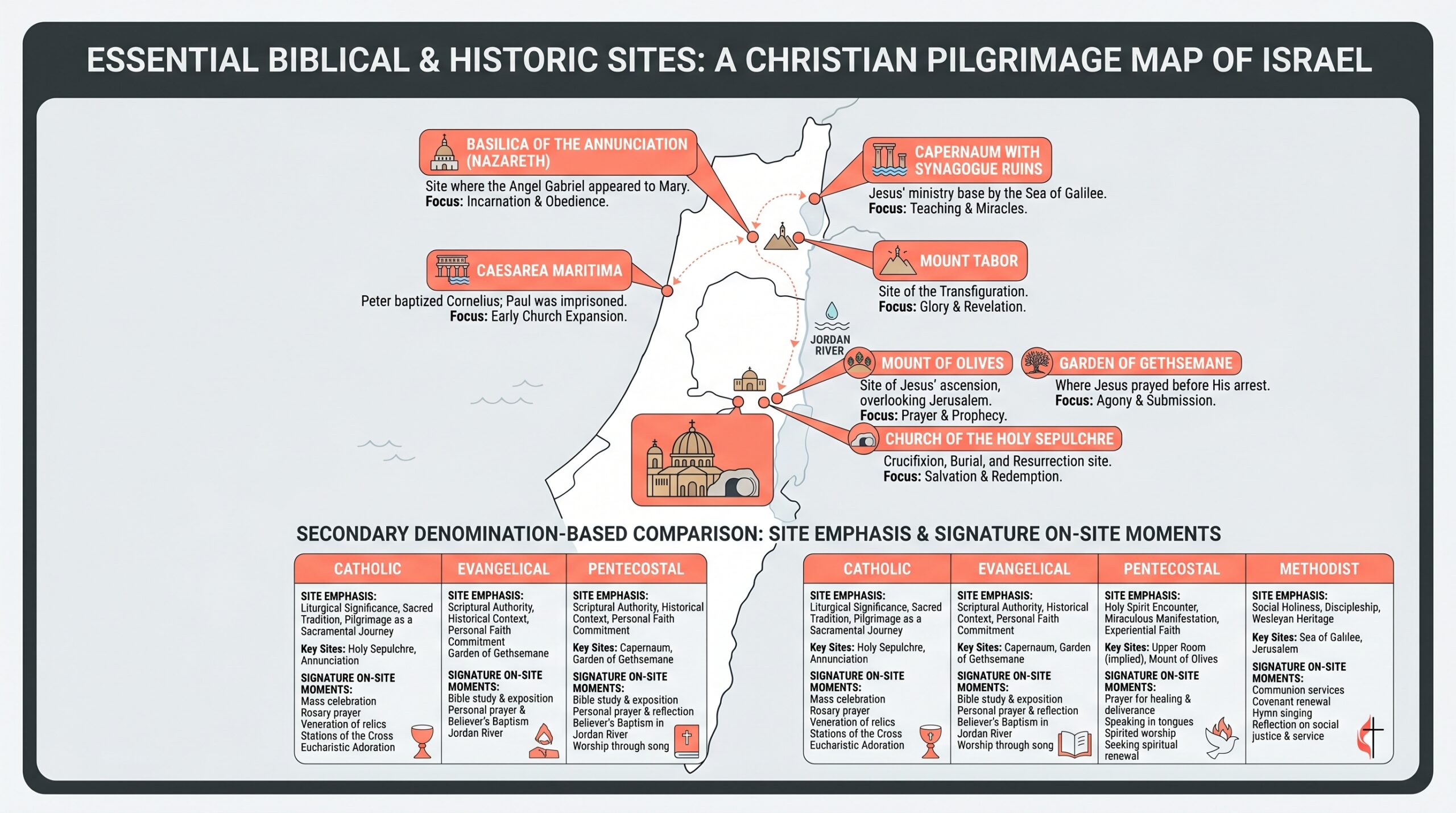
A handful of sites carry the trip. The Basilica of the Annunciation in Nazareth marks where the angel came to Mary (Luke 1:26-38). Capernaum (Matthew 4:13) is the focal point of the Galilean ministry, with the synagogue ruins and Peter’s house preserved inside the national park. Mount Tabor carries the long tradition of the Transfiguration (Matthew 17:1-9). Caesarea Maritima holds the Roman harbor where Cornelius was baptized and where Paul was held (Acts 10, Acts 23-26), its excavated layers documented in the park’s official material.
In Jerusalem the weight gathers: the Mount of Olives, the Garden of Gethsemane, and the Church of the Holy Sepulchre (Luke 23-24). This is precisely where denomination shapes the visit most clearly. A Catholic parish will move along the Stations of the Via Dolorosa to the Holy Sepulchre, often with Mass arranged at an approved chapel inside. A Southern Baptist or non-denominational Evangelical group will more often gather at the Garden Tomb for a quiet service and renew baptisms at Yardenit on the Jordan River. Same city, two entirely different days. Because opening hours at these sites shift, we plan each day against current schedules rather than assumptions carried over from previous years.
| Tradition | Resurrection Site Emphasis | Signature On-Site Moment | Pacing |
|---|---|---|---|
| Catholic | Church of the Holy Sepulchre | Mass, Via Dolorosa stations | Liturgical, structured |
| Evangelical / Baptist | Garden Tomb | Scripture reading, Jordan baptism | Teaching-driven |
| Pentecostal | Mount of Olives, Gethsemane | Extended prayer and worship | Flexible, longer stops |
| Methodist / Presbyterian | Both, with historical context | Quiet contemplation, theological reflection | Measured |
| Anglican / Episcopalian | Garden Tomb, Holy Sepulchre | Common Prayer readings, liturgy at site | Liturgical, meditative |
| Orthodox Christian | Church of the Holy Sepulchre | Veneration, candle-lighting, icon sites | Reverent, slower |
Is It Safe to Travel to Israel Right Now
This is the first question most American group leaders ask, and it deserves a direct answer rather than reassurance. Tourist regions – Tel Aviv, the Galilee, and Jerusalem – operate normally and maintain heavy, visible security. Geopolitical conditions can shift, and when they do, an experienced operator adapts the route the same day. We stay in constant contact with security personnel and reroute a group’s itinerary within hours when needed.
The practical advice we give every group: rely on official guidance, not headlines. Check the U.S. State Department travel advisories before you finalize plans, and trust the operator who is on the ground over a news cycle that often does not distinguish between tourist regions and areas that are genuinely inaccessible.
Security Questions to Ask Your Operator
Ask whether the operator has a direct security contact, not a hotline number. Ask how they adjust an itinerary if conditions change mid-trip, and what that process looked like the last time they had to do it. Ask what protocols the bus driver follows, because the driver is often your first line of awareness on the road. An operator who answers these questions with specifics has handled them before.
When to Go – Reading the Seasons
Spring (March through May) and autumn (September through November) are the best windows for most American groups. The weather is mild, the light is good for the long walking days at sites like Caesarea, and the heat stays manageable. These are also the seasons when the land itself is at its most alive, which matters when you are walking the hills above Galilee or the gardens outside Jerusalem.
Summer brings real heat – often into the high 90s around the Dead Sea – along with the largest crowds. Groups that book summer should plan very early starts, carry water throughout the day, and build rest time into the afternoon hours. Winter (December through February) is the quiet season: fewer crowds, a softer pace, and a genuine chance of rain in Jerusalem and the north. Christmas in Bethlehem is the obvious exception, and it books out far in advance due to consistent demand from American congregations wanting to mark the Nativity in its historic location.
Visa and Entry Requirements for U.S. Citizens
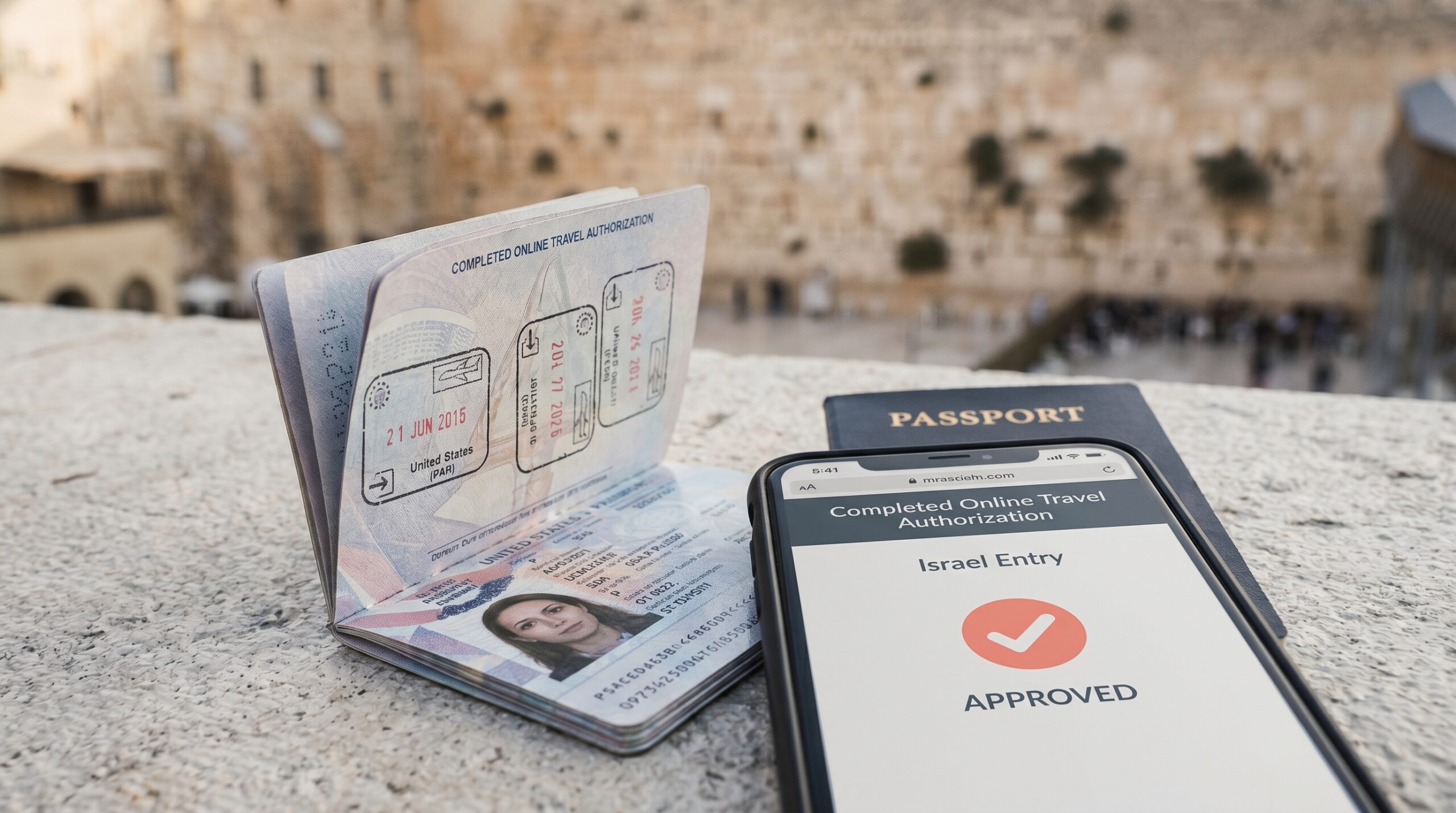
American visitors now register through the electronic travel authorization system, ETA-IL, before flying. It is a short online form for citizens of visa-exempt countries, the United States included, and it must be completed before departure – not at the airport. The authorization is valid for up to two years or until your passport expires, whichever comes first, and it permits stays of up to 90 days.
For groups, we walk every traveler through the ETA-IL step so no one arrives without it. The Israeli Population and Immigration Authority’s ETA-IL announcement confirms the rollout details and requirements. Have it completed weeks before your departure date, not the night before.
Arriving at Ben Gurion – Logistics and Accessibility
Flights from New York run roughly 10 to 11 hours nonstop; from Los Angeles, expect a connection or a significantly longer haul. Israel sits 7 hours ahead of Eastern time, so an evening departure from the U.S. lands you in Tel Aviv the following afternoon. The first night is for sleep, not sightseeing – and any itinerary that puts meaningful activity on arrival day is one to question.
At Ben Gurion you clear immigration, collect bags, and exit Terminal 3 to the arrivals hall, where our representative meets the group with a sign and walks everyone to the coach. For travelers with limited mobility, Terminal 3 provides assistance services arranged in advance through the airline, and we flag those needs when we confirm your booking. Before any departure, we check the airport’s notifications for live operational updates so we are never working from outdated information.
Respecting Local Customs and Holy-Site Etiquette
Dress codes at holy sites are consistent across faiths: shoulders and knees covered, for men and women both. Some churches and synagogues ask for a head covering, and we tell groups to carry a light scarf so no one is turned away at a doorway. A pashmina kept in the day bag has prevented more than one missed entrance over the years.
Shabbat – the Jewish Sabbath – runs from Friday evening to Saturday evening and reshapes the practical week. Public transport slows or stops, many restaurants and shops close, and hotels switch to modified service. We plan Friday and Saturday around this rhythm, which is why a Galilee Shabbat often feels like the calmest, most restful stretch of the whole trip. American groups who arrive expecting a standard Saturday frequently find that the enforced slower pace becomes one of their more memorable days.
Health and Packing Before You Fly
No special vaccines are required for Israel beyond your routine ones, though the Israeli Ministry of Health travel directory is the right place to confirm anything specific to your situation or region of origin within the U.S. Bring personal medications in original packaging, with enough for the full trip plus a few extra days as a buffer. Tap water is clean and safe to drink across the country, which matters most in summer when staying hydrated on a full walking day is not optional – it is a health matter.
One rule trips people up at the border: do not bring agricultural or plant products into the country without a permit. Seeds, fresh produce, and certain foods are restricted. Leave those at home and pack a wide-brimmed hat, well broken-in walking shoes, a refillable water bottle, and layers for the cool evenings in Jerusalem – even in seasons that feel warm at midday.
Why Booking With an Experienced Local Operator Is Essential
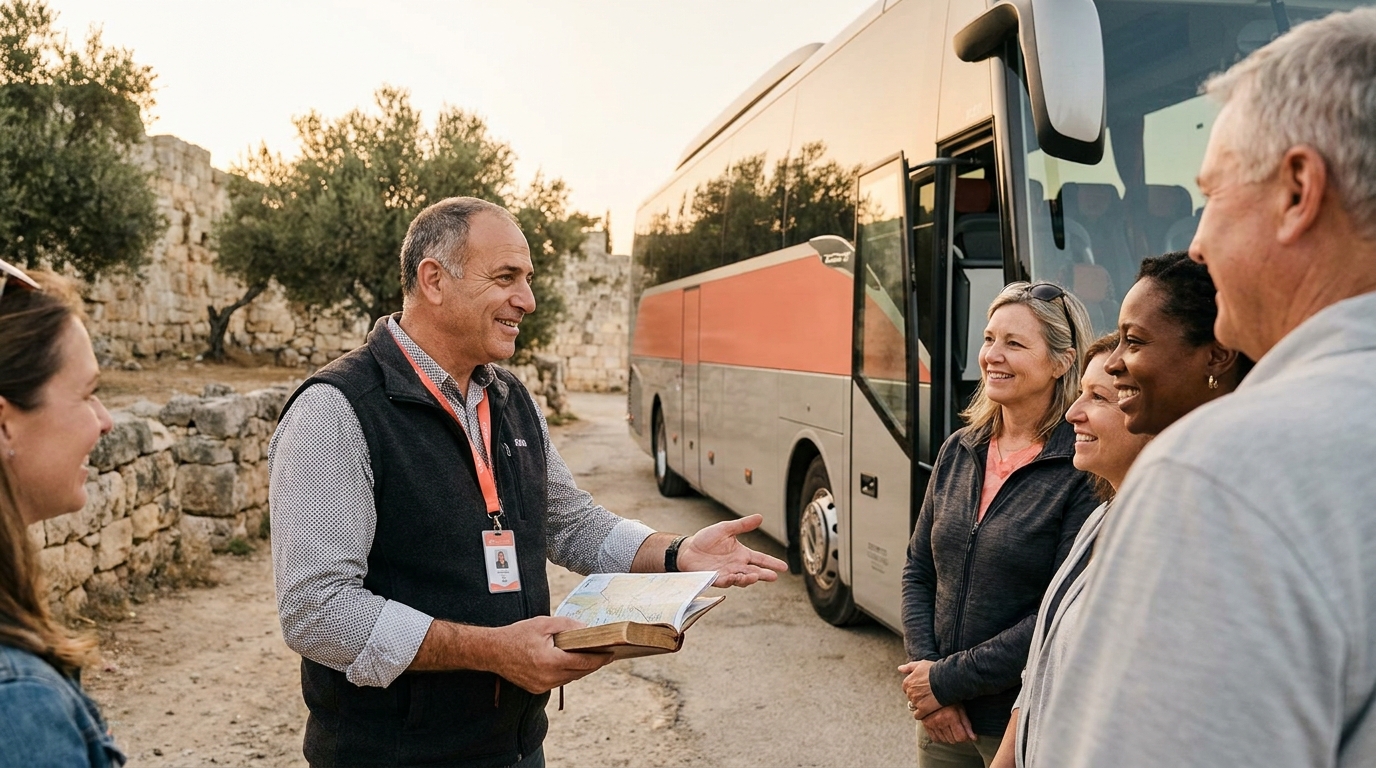
A successful faith-based trip is a stack of moving parts: security coordination, timed site permits, hotel blocks held months in advance, a guide who can read Scripture at the right place at the right hour, and a worship program that fits your tradition’s needs. Miss one element and the whole day wobbles. Get them all right and the group never notices the machinery at all – which is exactly the point.
Talya Tours is owner-led, and every group is touched personally by Talya herself, which is how the denominational fit gets built correctly rather than guessed. A Pentecostal ministry from Houston and a Presbyterian fellowship from Indianapolis do not receive the same ten days from us, and they should not. The theology is different, the worship style is different, the sites that carry the most weight for each congregation are different. Tourism is our only business, and organizing Christian travel to Israel for American groups – shaped precisely around each group’s own tradition – is, after 35 years, the thing we know best.
Christian travel to Israel is a decision that takes planning, the right partner on the ground, and a clear-eyed understanding of what your group needs before any booking is confirmed. The practical details covered in this guide – trip length, what packages include, how cost works, which sites matter and how they differ by denomination, what the visa process looks like, and how to read the seasons – are the same questions we work through with every American pastor and group leader who contacts us. None of them have a one-size answer, because no two congregations bring the same tradition, the same budget, or the same hopes for what they want to carry home.
If your congregation is beginning to think seriously about a pilgrimage to Israel, the most useful next step is a direct conversation – not a brochure. Tell us your denomination, your approximate dates, and roughly how many people are traveling, and we will work through what a realistic itinerary looks like for your specific group.
Ready to Start Planning Your Group’s Pilgrimage?
Reach Talya directly at [email protected] or use the contact form below. We will start with the question that shapes everything: what is your denomination, and what does your pastor want your group to carry home from Israel.
About the Author

Talya Felner
Owner and CEO, Talya Tours Services (TTS)
Talya Felner is the Owner and CEO of Talya Tours Services (TTS), a professional tour operator in Israel. With over 35 years of experience and more than 90,000 travelers served, Talya has built TTS into a trusted name for Christian pilgrimages, biblical tours, and conferences for groups visiting Israel and the Holy Land. Her team designs each itinerary around the specific Christian denomination of the visiting group – whether Protestant, Catholic, Evangelical, Baptist, Methodist, Pentecostal, Lutheran, Presbyterian, Anglican, Orthodox, or another tradition – ensuring that sites, worship arrangements, and guides reflect what matters most to that congregation. From visas and accommodations to guides, transportation, and on-site coordination, TTS handles every detail so American pastors and group leaders can focus on the spiritual experience of their travelers.