
A pastor in Nashville called us in late February. His congregation of 38 wanted to be at the Garden Tomb (John 19:41-42) for the week before Easter, and he had already collected deposits from his people. What he had not done was decide whether his program included flights, or only the land arrangements. That single open question, left unanswered, is where most American church groups lose money and sleep.
An all inclusive pilgrimage is meant to remove exactly that kind of uncertainty. When it is built correctly, it brings accommodation, faith-based guiding, ground transportation, and a structured meal plan under one upfront figure, so the people in your pews are paying for a finished journey rather than assembling pieces from three different invoices. Tourism is our only business, and in 35 years of organising all inclusive Christian tours to Israel for American groups, we have learned that peace of mind is the real product. Your group leader should be free to shepherd people through Capernaum (Mark 1:21), not to chase a missing dinner reservation at nine at night.
Reading time: 9 minutes
Key Points
- The phrase “all inclusive” is not standardised. Before committing, confirm in writing exactly which fees, gratuities, and services sit inside the quoted price and which do not.
- Every Talya Tours itinerary is built around the specific Christian denomination of the visiting group – Catholic, Evangelical, Baptist, Methodist, Pentecostal, Lutheran, Presbyterian, Anglican, Orthodox, and others – not around a generic Christian template.
- Flight-inclusive and land-only structures each carry real advantages. The right choice depends on your group size, departure airport, and how much coordination you want to manage yourself.
- Ten days on the ground is the practical minimum for a pilgrimage that does justice to both the Galilee and Jerusalem. Transit days should never be counted as programme days.
Why “All Inclusive” Does Not Always Mean the Exact Same Thing
The phrase is not standardised across operators, which is where confusion begins. The largest split is between a “Land Only” package and a flight-inclusive plan. A Land Only program covers everything once your group lands at Ben Gurion, but the international flights remain your responsibility. A flight-inclusive plan folds the airfare into the same price.
Before your church wires a deposit, read the written list of included services line by line. You want to know whether entrance fees, guide gratuities, and hotel taxes sit inside the number you were quoted or outside it. We always send that breakdown in writing first. You will not regret asking for it.
What is typically included in a full package Christian Israel tour
A genuine full package Christian Israel program rests on a few pillars that rarely change. You should see premium, centrally located accommodation, a private air-conditioned coach assigned to your group alone, professional itinerary planning, and a daily meal plan that almost always means breakfast and dinner at the hotel.
The pillar that carries the whole experience is the guide. In Israel, guiding is regulated. Anyone leading your group at a national site must hold a current state license, a requirement you can verify through the Ministry of Tourism’s own guide licensing standards. A serious inclusive package gives you a government-licensed guide trained in Christian theology, biblical history, and local geography – not a generalist reading from a script. For a Baptist group reading the Sermon on the Mount aloud at the Mount of Beatitudes (Matthew 5:1-16), that depth is the difference between a tour and a pilgrimage.
Checklist of essential elements to look for in an inclusive package
When you compare quotes, confirm that the price already carries entrance fees to all biblical sites and national parks, hotel portage and luggage handling, high-quality whisper headsets so every member hears the guide clearly at a crowded site like the Church of the Holy Sepulchre, and all local tips, gratuities, and administrative taxes. These small items, left out, are what quietly inflate a “cheap” package after you have already committed.
What is usually excluded from an inclusive Christian Israel tour
Trust is built on what an operator tells you it does not cover. In almost every all inclusive Israel Christian tour, a few categories sit outside the base price by design.
Travel insurance and personal medical policies are external, and we strongly advise every traveler to carry their own. An optional single-occupancy room is a supplement, since base pricing assumes shared rooms. Daily lunches are usually on your own, which most groups prefer anyway, because it lets people eat near a site at their own pace. Specialty beverages with dinner, laundry, and personal shopping are also yours to manage.
None of this should ever be a surprise. We put exclusions in writing next to inclusions, on the same page, so a group treasurer in Columbus can read both columns side by side before presenting a budget to the congregation. Clarity here is not a courtesy. It is how a trip stays honest.
Are flights included in Christian Israel tours with airfare
Packages marked “with airfare” bundle the international flights – from major U.S. hub airports – directly into the land operation in Israel. One contract, one payment schedule, one party responsible from your departure gate to your return.
For a church group, the appeal of Christian Israel tours with airfare is mostly about who absorbs the headaches. Airline schedule changes, seat assignments across 40 people, and the timing of the airport transfer to meet your guide all become our problem rather than yours. A pastor in Phoenix does not need to learn how to rebook a group of 42 when a connection shifts. That coordination is precisely why flight-inclusive structures stay popular with American congregations and community pilgrimages.
Key questions to ask before paying a deposit
Ask three things before you commit. Which departure airports does the flight package actually cover, and is yours one of them? Are flight changes, delays, and upgrade requests managed directly by the tour organiser or handed back to you? And is baggage allowance, seat selection, and airport tax fully built into the initial quote rather than added later? The answers tell you whether “with airfare” is a real service or just a label.
How much does an all inclusive Israel Christian tour cost, and what moves the price
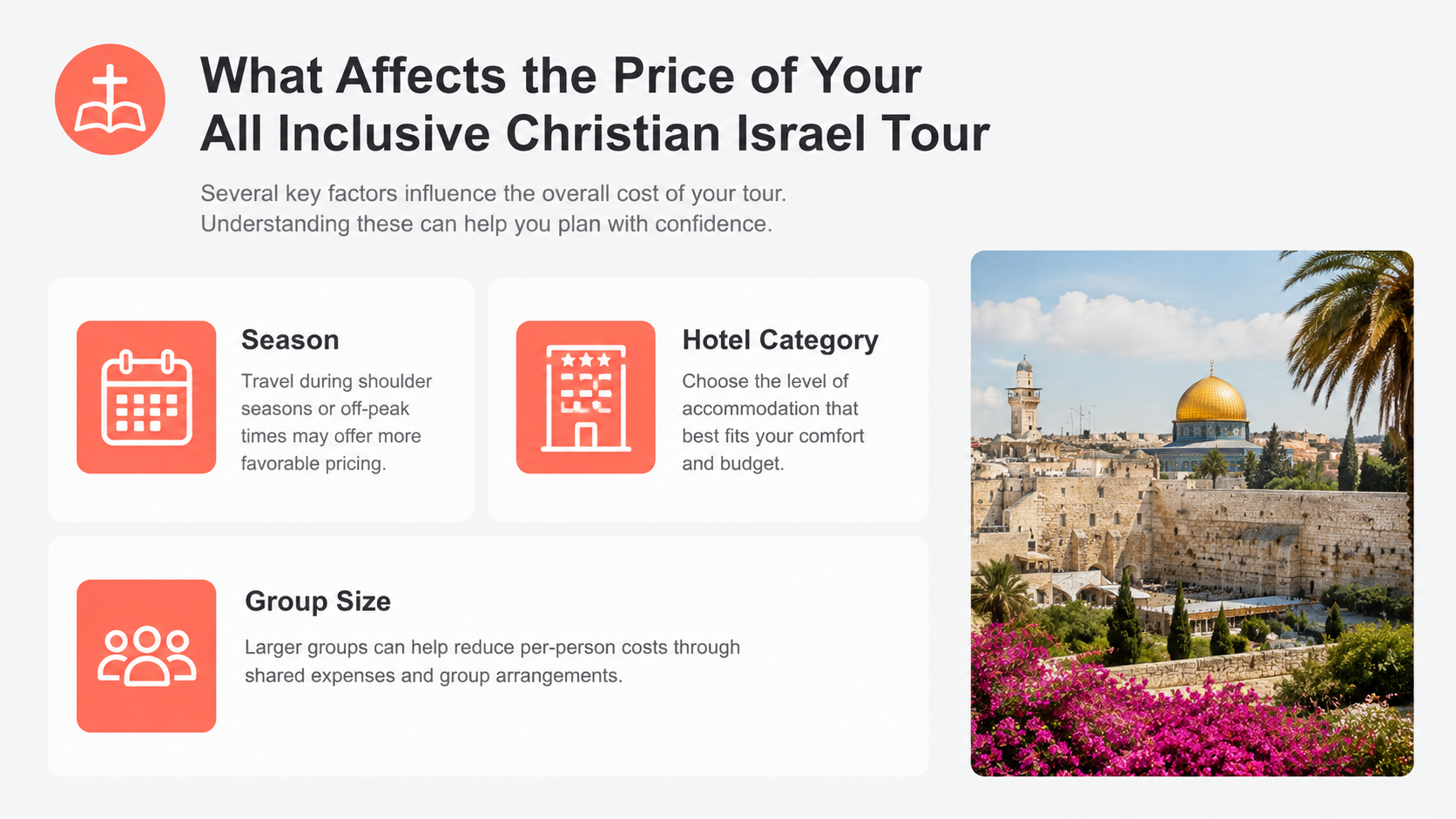
There is no single figure, and any operator who gives you one before asking about your group is guessing. The cost of an all inclusive Israel Christian tour is shaped by a handful of real levers.
Season is the heaviest one. Peak spring and peak autumn command higher rates than the winter and summer shoulder seasons, simply because demand for hotels and coaches surges in those windows. Hotel category is the second lever. A boutique three-star base in Tiberias prices very differently from premium or luxury properties in Jerusalem. Group size is the third. A private family of six and a 45-seat church coach do not share the same per-person economics.
An inclusive package also does something a stack of separate bookings cannot. By fixing your major costs in advance, it shields your travelers from on-site price inflation and from currency swings between the day you book and the day you fly. Predictability, for a congregation budgeting a year out, is worth real money.
How many days do you actually need for a Holy Land pilgrimage
Most groups underestimate this, then rush. For a satisfying Christian itinerary, the practical range is 9 to 12 days on the ground, and a 10-day program is the one we recommend most often.
Ten days lets you give the Galilee its own two or three nights before moving south, instead of trying to fold Capernaum, the Mount of Beatitudes, and the Sea of Galilee into a single exhausting afternoon. It leaves room for Jerusalem to breathe across several days rather than one. The honest caution for any all inclusive Christian tours to Israel plan is to count your transit days. Your flight to Ben Gurion and your flight home each eat into the calendar. A “10-day tour” that includes two travel days is really eight days on the ground. We always state the on-ground figure plainly, because that is the number your people will actually remember.
Which holy sites belong on a Christian tour in Israel
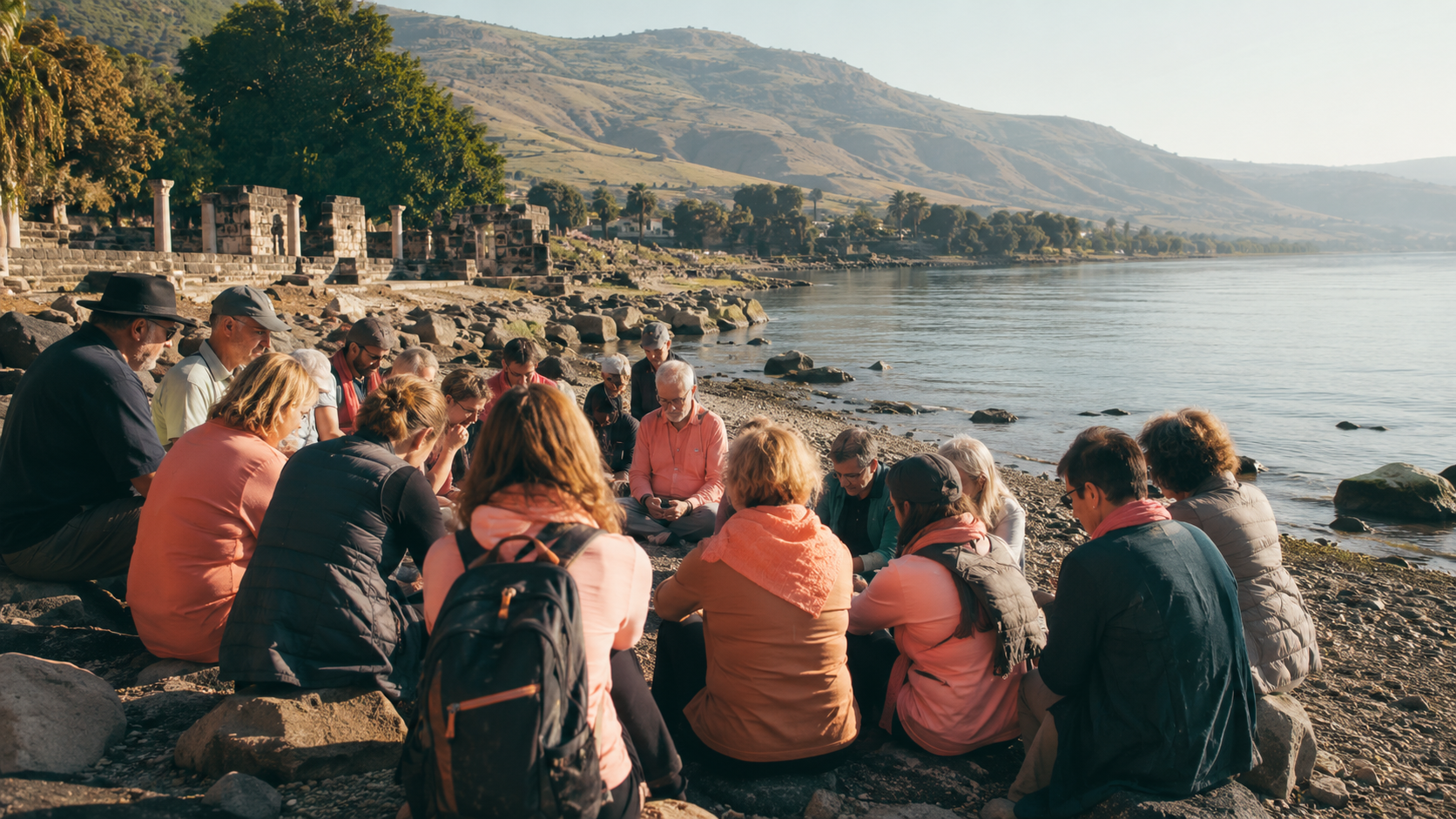
The journey reads best when it moves the way the Gospels do – from the Galilee where the ministry began, southward to Jerusalem where it reached its climax. A well-built full package Christian Israel itinerary follows that arc rather than zig-zagging across the map.
This is also where the denomination of your group changes everything. We do not run one generic Christian tour. Before we draft a single day, we ask what tradition your church belongs to and what your pastor wants the group to carry home. A Catholic parish will spend meaningful time at the Basilica of the Annunciation (Luke 1:26-38), the Church of the Nativity (Luke 2:1-7), and the stations of the Via Dolorosa – often with Mass arranged at the right location. An Evangelical or Baptist congregation will more often gather at the Garden Tomb (John 20:1-18) rather than the Church of the Holy Sepulchre, renew baptisms at Yardenit on the Jordan River (Matthew 3:13-17), and read Scripture aloud at Capernaum and the Mount of Beatitudes (Matthew 5:1-16). A Pentecostal ministry may want extended worship time at the Mount of Olives or the Garden of Gethsemane (Matthew 26:36-46). Methodist, Lutheran, Presbyterian, Anglican, Orthodox, and Adventist groups each carry their own theological priorities, and each itinerary we build reflects those priorities directly.
Key regions and places to include in your spiritual itinerary
In the Galilee and Nazareth, plan for Capernaum, the Mount of Beatitudes, a boat ride on the Sea of Galilee, the Jordan River baptismal site at Yardenit, and the Basilica of the Annunciation. In Jerusalem and its surrounds, you will walk the Mount of Olives, the Garden of Gethsemane, the Via Dolorosa, the Church of the Holy Sepulchre, and the quiet of the Garden Tomb. In Judea and toward the Dead Sea, add Bethlehem and the Church of the Nativity, Jericho, and the desert fortress of Masada. Which of these receives the most time and theological attention on your specific program will be shaped entirely by your denomination’s emphasis.
Planning a group pilgrimage from the United States?
We build every itinerary around your group’s specific Christian denomination – selecting sites, worship arrangements, and guide assignments that reflect what matters most to your congregation. Tell us about your group, your tradition, and your dates, and we will put together a detailed proposal at no obligation.
Is the pace suitable for seniors and older adults
A large share of the American pilgrims we host are mature travelers, and we plan around that reality rather than against it. A thoughtful itinerary builds in seated breaks, keeps the coach close to the entrance of each site, and chooses accessible pathways wherever the terrain allows.
The real work happens in logistics. When a group from a Methodist congregation in Indianapolis includes members in their seventies and eighties, we adjust the order of the day so the most demanding walk falls in the cool morning hours, not the afternoon heat. Good planning lets older adults absorb the teaching at the Pool of Bethesda (John 5:1-9) without arriving worn out.
Tailoring walking distance and accessibility for comfortable travel
Tell us about mobility needs before you book, not after you land. When we know in advance, we use the coach to shorten or skip the steepest climbs near complex sites, and we build the day so no one is left behind on a hill. Communicated early, almost every requirement can be accommodated quietly.
How physically demanding is the trip, honestly
A pilgrimage involves walking. That is simply the nature of it, and pretending otherwise helps no one. An all inclusive Israel Christian tour asks for moderate walking ability rather than athletic fitness.
You will meet uneven historic stone steps in the Old City, optional walks through archaeological ruins, and warm Mediterranean afternoons that take more out of you than you expect. None of it requires exceptional stamina. It does reward a little preparation. We tell every group the same thing – start a light walking routine at home a few weeks before departure, even twenty minutes a day on varied ground. The travelers who do this are consistently the ones still smiling at the top of Masada while others wait below. Build the habit early, and the trip opens up considerably.
| Dimension | Large group tour | Private or small group tour |
|---|---|---|
| Typical size | 25 to 45 travelers | 2 to 15 travelers |
| Schedule control | Fixed daily flow for the whole group | Full control over timing and sites |
| Theological focus | Built around one denomination’s emphasis | Tuned to a family or fellowship’s specific wishes |
| Pacing | Set in advance, predictable | Adjusted day by day |
| Cost per person | Lower, shared across the group | Higher, with more flexibility |
Group or private – which all inclusive structure fits your church
A large, pre-arranged church group moves on a shared rhythm, which keeps cost per person down and suits a congregation traveling together as one body. A private family or small fellowship trades that shared price for full command of the schedule, the theological highlights, and the hotel level.
Talya Tours runs both, and runs them with the same care. We coordinate a 45-person Presbyterian fellowship from Charlotte with the same precision we bring to a bespoke private journey for a single American family. The all inclusive Christian tours to Israel we build are never copied from a shelf. Talya touches each program personally, because in a company where tourism is the only business, the itinerary is the whole reputation.
What are the arrival and security procedures for groups

Every group enters Israel through Ben Gurion Airport (TLV), and the process is more straightforward than most first-time American travelers expect. Security screening is thorough, document checks are standard, and groups move through together when the arrival is coordinated in advance. You can review the official process through the airport’s published security guidelines before you fly.
A genuine full package Christian Israel service meets you on the right side of the headache. A pre-arranged transfer waits at the terminal, your guide is identified and ready, and your luggage moves to the coach without 40 people negotiating taxis at midnight. For group travel, the entry visa arrangements are also handled in advance, which removes one of the most common late-stage scrambles. The first hour on Israeli soil sets the tone for the whole trip, and we treat it accordingly. A calm arrival is a planned arrival.
Can your group receive an official pilgrim certificate
Many American travelers do not know this exists. The State of Israel formally recognises pilgrims who complete a spiritual journey to the country, issuing an official Pilgrim Certificate through the Ministry of Tourism.
It is a small thing that means a great deal back home – a tangible record of the journey to hang in a church office or carry in a family Bible. An experienced operator coordinates these directly with the state tourist office, so your group does not have to navigate the application alone. You can see the official program through the Ministry’s pilgrim certificate service. We fold this into the inclusive arrangements when a group asks, and many do, once they hear it is possible.
What health and medication steps should travelers take
The practical health advice for any all inclusive Israel Christian tour is unglamorous and important. Carry copies of your essential prescriptions in your hand luggage, not your suitcase. Pack a small travel first-aid kit. Drink more water than you think you need, because the climate is drier and warmer than most American travelers anticipate, especially in the Judean desert.
For older adults, the right step is to match the trip’s activity level to professional medical advice before departure. Israel’s Ministry of Health publishes useful planning recommendations for travelers on medications, vaccinations, and preparation. A short conversation with your own physician, paired with that guidance, settles most concerns. We would rather a traveler ask one question too many before flying than discover a gap at the foot of Masada.
How does the tourist VAT refund work when you shop
Your travelers will buy things. Olive wood carvings from Bethlehem, Dead Sea cosmetics, fine religious jewelry – these are eligible for a VAT refund for tourists, which puts real money back in their pockets.
The process is simple if you know it in advance, and worth folding into the briefing for any group on Christian Israel tours with airfare, since refunds are processed at the airport on departure. Ask the participating shop for an official tax-free invoice at the time of purchase, keep it with the goods, and present both at the refund terminal before you fly home. The official rules are published through Israel’s tourist VAT refund service. We mention it during the trip so no one realises only afterward that they left a refund on the table.
When is the best time of year to travel
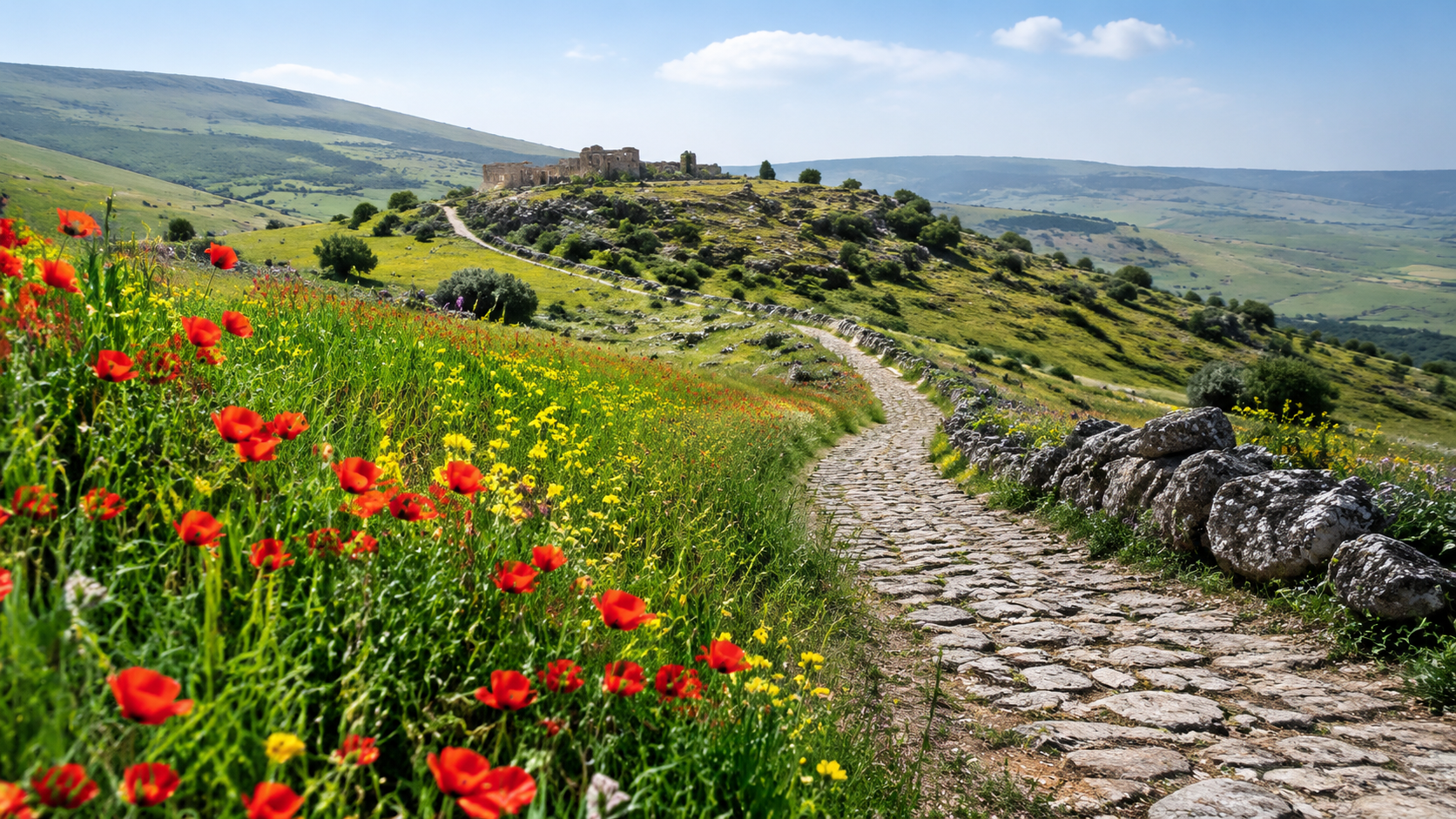
Two windows stand above the rest. Spring – roughly March to May – and autumn – roughly September to November – give you mild walking weather across both the Galilee and Jerusalem, which is why these months book out first for all inclusive Christian tours to Israel.
The off-seasons have their own quiet rewards, and we are honest about them. Winter brings cool days, far fewer crowds at the major sites, and green hills across the Galilee that surprise people who expected only desert. Summer is hot inland but offers brilliant clear skies along the coast, which suits groups combining their pilgrimage with a few leisure days in Tel Aviv or Caesarea. The right season depends on what your congregation values most – which is the first thing we ask.
How should travelers pack for a Holy Land pilgrimage
The single most important item is footwear. Durable, well-broken-in walking shoes with real traction – not new ones bought the week before – save more trips than any other piece of advice we give.
Dress codes at sacred sites matter, and they apply to both men and women. Shoulders and knees must be covered to enter many churches, so pack accordingly rather than improvising at the door. Beyond that, bring light layers for cool mornings and warm afternoons, polarized sunglasses, a hat with a brim, and a lightweight plug adapter. Keep the suitcase lighter than instinct tells you. You will be moving between hotels in the Galilee and Jerusalem, and a heavy bag becomes a burden by day four of a full package Christian Israel itinerary. Pack for walking, not for a fashion show.
What are the booking and payment terms
Professional booking follows a clear shape. An initial deposit holds your group’s space, progressive payment milestones spread the cost across the months before departure, and a written refund and cancellation policy tells everyone where they stand if plans change. With Talya Tours, all of this is on paper before any money moves.
The practical reason to book early is not pressure, it is supply. The premium flight rates and the best hotel room blocks in Jerusalem are finite, and they go to the groups that confirm first, especially for an inclusive spring or autumn departure. A congregation that locks dates twelve months out simply has better options than one calling in March for Easter. If your group is beginning to plan a pilgrimage to Israel, we are glad to walk through dates, denominational emphasis, sites, and logistics with you before you commit to anything.
Frequently Asked Questions
An all inclusive Christian tour to Israel is a practical structure as much as a spiritual commitment. When the inclusions and exclusions are clear, when the guide holds a state license and understands your denomination’s theological priorities, when flights and logistics are coordinated under one agreement, and when the itinerary is built around what your specific congregation – whether Baptist, Catholic, Evangelical, Methodist, Lutheran, Presbyterian, Pentecostal, Anglican, Orthodox, or Adventist – actually needs from this journey, the experience can be what it is meant to be. The group focuses on the sites. The pastor focuses on the people. We focus on everything else.
If your American congregation is beginning to take this trip seriously, we are glad to be the first conversation. You can reach Talya directly at [email protected] or send us details through our contact page. There is no commitment involved in the initial conversation, just a chance to understand what your group needs and whether we are the right fit for the journey ahead.
Ready to plan your group’s pilgrimage to Israel?
Share your denomination, group size, preferred travel window, and any questions you have about the itinerary. We will respond with a detailed, denomination-specific outline and a transparent cost breakdown – no pressure, no obligation.
About the Author

Talya Felner
Owner and CEO, Talya Tours Services (TTS)
Talya Felner is the Owner and CEO of Talya Tours Services (TTS), a leading professional tour operator in Israel. With over 35 years of experience and more than 90,000 travelers served, Talya has built TTS into a trusted name for Christian pilgrimages, biblical tours, and conferences for groups visiting Israel and the Holy Land. Her team designs each itinerary around the specific Christian denomination of the visiting group – whether Protestant, Catholic, Evangelical, Baptist, Methodist, Pentecostal, Lutheran, Presbyterian, Anglican, Orthodox, or another tradition – ensuring that sites, worship arrangements, and guides reflect what matters most to that congregation. From visas and accommodations to guides, transportation, and on-site coordination, TTS handles every detail so American pastors and group leaders can focus on the spiritual experience of their travelers.