
At eight in the morning, a family of five from Charlotte, North Carolina stands at Jaffa Gate. They booked a private tour for the day, and their guide has already done something a fifty-passenger coach excursion cannot do: he changed the plan. The line at the Holy Sepulchre was short at seven, so they went there first. By the time the tour buses arrive at ten, they will be sitting in the shade of the Jewish Quarter with cold water, halfway through their day.
We have been organizing travel in Israel for over 35 years and have hosted more than 90,000 travelers, most of them from the United States. In that time we have learned that Jerusalem is the one city where the difference between a private tour and a group excursion is not comfort. It is what you actually see, and what you understand of what you are seeing. This article explains what a private tour includes, what it costs, how the day is structured, and how we tailor each itinerary to the Christian tradition of the travelers walking it.
Reading time: 5 minutes
Key Points
- Private tours in Jerusalem are usually priced per group, not per person, which often makes them the more economical option for American families and small church groups.
- A licensed guide handles timing, queues, and route sequencing, which is the real difference between a private day and a coach excursion.
- Itineraries are built around the specific Christian denomination of each group, so a Baptist congregation and a Catholic parish walk the city differently.
- Shabbat closures, Temple Mount restrictions, and modest dress rules are all plannable, and a private arrangement removes most of the friction.
Table of Contents
- What a private tour in Jerusalem actually means
- Why a private tour guide in Jerusalem earns the fee
- How much does a private tour in Jerusalem cost
- What is included, and what is not
- Half day or full day
- A first-timer’s day: the route we would actually build
- Tailoring the day to your heritage
- The sites that anchor any private day inside the walls
- Can you visit the Temple Mount
- What to wear
- Shabbat and holidays
- How to choose the right private guide
What a private tour in Jerusalem actually means
A private tour in Jerusalem means the day is built around you. Your walking pace, your historical interests, your spiritual priorities. If your party includes a grandmother who cannot manage steep inclines, the route changes. If you want forty minutes at the Western Wall rather than fifteen, you take forty minutes. No roll call, no waiting for strangers, no stop at a shop you did not ask for.
It also means a dedicated guide who handles the logistics that eat a day in Jerusalem: the queues at the Church of the Holy Sepulchre, the timing at the Temple Mount entry, the security lines, the maze of alleys where signage is in Hebrew and Arabic before English. The contrast with a large coach excursion is real. A fifty-passenger bus tour moves at the speed of its slowest group bathroom stop. A Talya Tours private group moves at your speed.
One practical point that surprises many American travelers: private tours are usually priced per vehicle or per group, not per person. For a family or a small church group of six, this is often the more economical option, not the more expensive one.
Why a private tour guide in Jerusalem earns the fee
Jerusalem has over 3,000 years of layered history. Jewish, Christian, Muslim, Roman, Byzantine, Ottoman, British Mandate. On a single walking hour through the Old City you cross four quarters and pass sites sacred to three faiths. A licensed guide who has studied this for years can tell you which wall is Herodian, which is Crusader, and why it matters. A generic tour script cannot.
Then there are the small operational advantages that only accumulate with experience. Our guides know which terrace gives you the quiet view over the Kidron Valley, which bakery in the Christian Quarter opens at six, and the best hour to enter the holy sites before the crowds. They speak Hebrew, Arabic and English fluently, which matters in a city where a wrong turn into a sensitive area can cost you an hour or an uncomfortable exchange at a checkpoint.
For multigenerational families, this adaptability is the whole point. We have guided American families where the children got a scavenger-hunt version of the Via Dolorosa while the grandparents walked a slower, quieter route, and everyone met at the same spot for lunch. Try arranging that on a group bus tour.
How much does a private tour in Jerusalem cost?
Americans planning this trip ask us about price before almost anything else, so here is the honest picture. A licensed private walking guide in Jerusalem typically charges a full-day rate for roughly eight to nine hours, or a half-day rate for about four. Adding a chauffeured tourist vehicle raises the rate, because those vehicles carry special licensing, commercial insurance, and city parking access that private cars do not.
Three factors move the price most. Whether you walk or take a vehicle, whether you book a half day or a full day, and when you travel. Peak periods, meaning spring, autumn, Passover, Sukkot and Christmas, carry premium rates for guides, drivers and hotel rooms alike. A private guide also gives you cost predictability. When the itinerary is planned upfront, there are no surprise transport surcharges at the end of the day.
Extra hours and evening additions, such as the sound-and-light show at the Tower of David or a night walk through the Old City, are quoted upfront at an hourly rate, not improvised.
Per group versus per person: a quick calculation
Take a family of five from Ohio comparing options. A high-end group excursion at roughly $120 per person comes to $600 for the family, and the family still shares the day with forty strangers and stops when the group stops. A flat private group rate for a full day with your own guide is often in the same range, and sometimes below it. Factor in the saved time, no roll calls, no waiting for a bus of forty people to reassemble, no retail detours, and the private option frequently wins on pure arithmetic.
| Option | Typical pricing structure | Who it suits | Flexibility |
|---|---|---|---|
| Large coach excursion (40-50 people) | Per person | Solo travelers on a tight budget | Very low, fixed route and timing |
| Private walking tour with licensed guide | Flat rate per group, half or full day | Couples, families, small groups focused on the Old City | High, route adjusts on the fly |
| Private guide with chauffeured vehicle | Flat group rate plus vehicle fee | Families of 4-7, groups combining Old City with Bethlehem, Yad Vashem or the Dead Sea | Highest, full-day regional range |
What is included in a private Jerusalem tour, and what is not
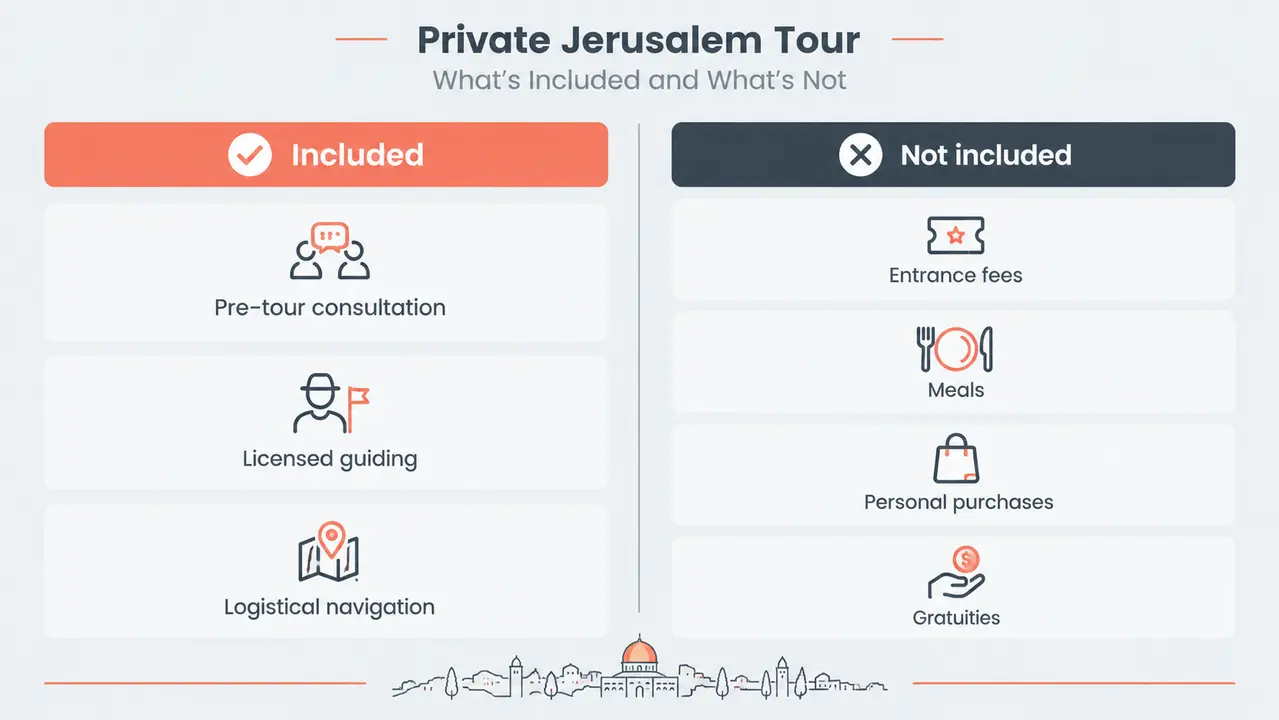
A private day includes full-time licensed guiding and local logistical navigation.
Every private tour we build starts with a pre-tour consultation. That is where the itinerary is designed, and it is not a formality. It includes full-time licensed guiding on the day itself, and all local logistical navigation, meaning parking, entry timing, and route sequencing.
Standard exclusions are site entrance fees, meals, personal purchases, and gratuities for the guide and driver. Entrance fees are modest but real: the Western Wall Tunnels, the City of David, and the Tower of David each charge separately, and current rates and hours are listed on the Israel Nature and Parks Authority site. The Western Wall plaza itself is free and open around the clock, year round.
On packing, bring more water than you think you need, sun protection, and walking shoes that are already broken in. The Old City paving is polished smooth by centuries of feet and becomes slippery. Modest clothing layers we cover below.
Half day or full day?
A half-day tour of roughly four hours works well for a short layover, for families with very young children, or for a first pass strictly through the Old City core: the Western Wall, the Church of the Holy Sepulchre, and the bazaars of the Christian and Muslim Quarters. You will leave with the geography fixed in your head, which is worth something in itself.
A full day of seven to nine hours is what we recommend to almost every American traveler coming this far. It allows the sequence that actually makes Jerusalem click: the panorama from the Mount of Olives in the morning, down through Gethsemane, into the Old City through the Four Quarters, and an afternoon either at the City of David or in Machane Yehuda Market in the New City.
Be realistic about the physical side. The Old City sits on hills. There are steep inclines, Roman paving stones, and long flights of steps in the Jewish Quarter where no vehicle can enter. Our guides plan rest points accordingly, but you should plan your shoes and your stamina accordingly too.
A first-timer’s day: the route we would actually build for you
Start at the Mount of Olives at eight in the morning. From that one lookout you read the whole city: the Kidron Valley below, the Temple Mount, the walls of the Old City, and the desert beginning just past the horizon. Every group we have brought here, and we have brought thousands, understands Jerusalem better after twenty minutes on that ridge than after a week of guidebooks.
Walk down the Palm Sunday Road (Luke 19:28-40) to the Garden of Gethsemane (Matthew 26:36-46), where the ancient olive trees predate every building you can see. Enter the Old City through Lion’s Gate. The sequence is deliberate. Done early, it beats both the midday heat and the tour bus crowds that arrive at the gates from ten onward.
Midday belongs to the Four Quarters. The Roman Cardo in the Jewish Quarter, with its Byzantine shopfronts excavated beneath modern rooftops, the Herodian remains of the Upper City, and then the Via Dolorosa (John 19:17) walking west toward the Church of the Holy Sepulchre. For Catholic travelers especially, this route is the heart of the visit, and groups that want to extend it into a full spiritual program often continue with our Catholic pilgrimage to the Holy Land, which builds Mass arrangements and extended prayer time into the itinerary. Evangelical groups, by comparison, usually want more time at the Garden Tomb and a Scripture reading at each stop, and we build their day differently. That is the whole point of a private program.
End the day at the Western Wall as daylight fades and evening prayers begin, or, if your legs allow, walk into Machane Yehuda for halva, rugelach, spices and a cold local beer before heading back to your hotel.
| Time | Stop | Why in this order |
|---|---|---|
| 08:00 | Mount of Olives lookout | Topography first, empty of crowds, best light |
| 09:00 | Palm Sunday Road, Garden of Gethsemane | Downhill walk before heat builds |
| 10:00 | Lion’s Gate, Via Dolorosa | Enter Old City before bus groups arrive |
| 11:30 | Church of the Holy Sepulchre | Beat the midday queue at the Tomb |
| 13:00 | Lunch, Jewish Quarter, Cardo | Shade and rest in the middle of the day |
| 15:30 | Western Wall or Machane Yehuda | Wall plaza is open around the clock, market closes Friday afternoon |
Tailoring the day to your heritage, Christian, Jewish, or both
The same city reads differently depending on who is walking it, and a good private guide adjusts the narrative rather than delivering one script to everyone.
A Jewish heritage focus goes deep into the First and Second Temple periods: the Western Wall Tunnels, the water systems of the City of David, the Hurva Synagogue, and the Southern Wall excavations at the Davidson Center. A Christian pilgrimage focus retraces the ministry of Jesus: the Palm Sunday road, the Upper Room on Mount Zion (Acts 1:13-14; 2:1-4), the Stations of the Cross, and the Holy Sepulchre. Pilgrims seeking a fuller theological and scriptural program often extend into our specialized Christian tours in Israel, where the entire multi-day itinerary is built around their tradition.
That last point matters more than most American travelers realize. We do not build one generic Christian itinerary and hand it to every church. A Southern Baptist congregation from Tennessee and a Catholic parish from Boston receive different sequences of sites, different ceremonies, different pacing. The Baptists will usually want the Garden Tomb, extended Scripture reading at Capernaum (Mark 1:21-35), and a baptism renewal at the Jordan River. The Catholic parish will want the Holy Sepulchre, the Basilica of the Annunciation, and arrangements for Mass. A Pentecostal ministry may ask for extended worship time on the Mount of Olives. Each request changes the plan, and the plan is built from scratch. The first question we ask any group is what tradition it belongs to and what its leader wants the group to carry home.
For interfaith and multigenerational families, the guide presents archaeology and historical evidence alongside living tradition, honoring the different beliefs inside one traveling party. It can be done, and it is done well, when the guide knows the ground.
Planning a private Jerusalem day for your church or family?
We build every private itinerary around the denomination and priorities of the group walking it, whether that is a Catholic parish, a Baptist congregation, a Methodist choir, or a single American family. Tell us your tradition, your dates, and your pace, and we will plan the day with you before you commit to anything.
The sites that anchor any private day inside the walls
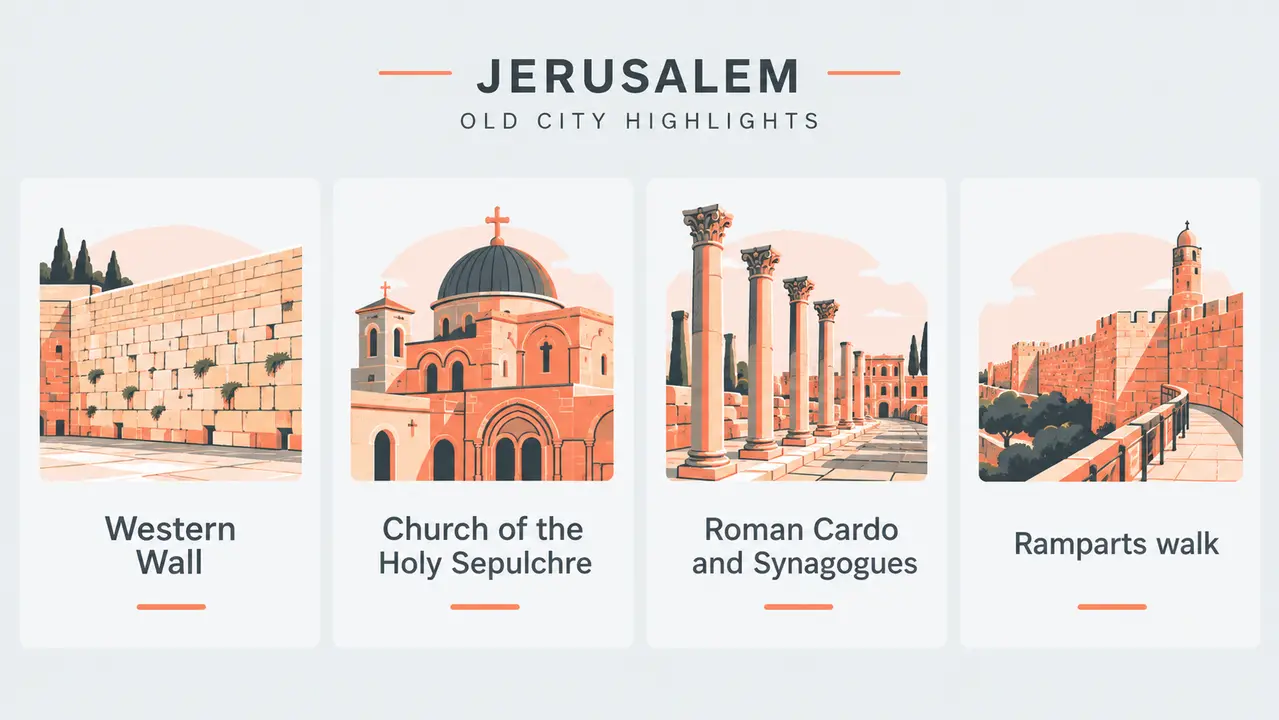
Four sites form the core of any private day inside the Old City.
Four places form the core of the Old City. The Western Wall, the surviving retaining wall of the Temple Mount, with its separate prayer areas and the custom of placing folded paper prayers into the stones. The plaza is open every hour of the year, per the official Western Wall visitor information.
The Church of the Holy Sepulchre, covering both Calvary and the Tomb, and governed under shared custody by six historic Christian denominations. A guide who understands that arrangement saves you confusion and queue time. The Roman Cardo and the synagogues of the Jewish Quarter, where Byzantine-era shops sit excavated beneath modern residences. And the ramparts walk along the Old City walls, which lifts you above the alleys for a full circle of spires, minarets and domes. It takes about ninety minutes and is the most underrated hour and a half in the city.
Can you visit the Temple Mount?
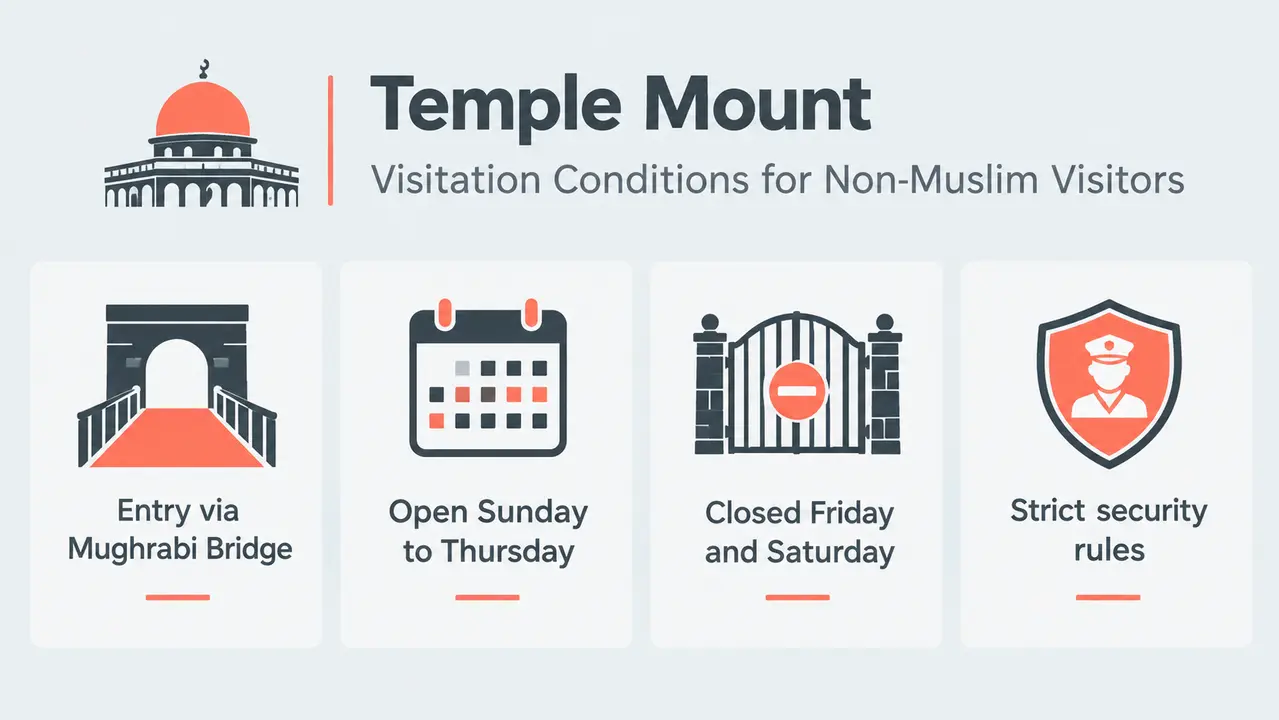
Temple Mount entry for non-Muslim visitors runs on set hours and strict rules.
Yes, with conditions, and this is precisely where an experienced guide earns their fee. Non-Muslim visitors enter only via the Mughrabi Bridge next to the Western Wall plaza, during designated morning and early afternoon hours, Sunday through Thursday. The site is closed to non-Muslim visitors on Fridays and Saturdays.
The security rules are strict and enforced. No religious items of any kind, meaning no prayer books, Bibles, crosses worn visibly outside clothing, or tefillin. No vocal prayer by non-Muslim visitors, and a conservative dress code. Procedures also change with the security situation, sometimes overnight. A guide who checks the morning’s conditions before you leave the hotel is not a luxury here. He is the difference between entering smoothly and standing at a checkpoint. Background on visitation policy is documented in a Knesset Research and Information Center report.
What to wear, so nobody turns you away
The modesty standard is consistent across all three faiths: shoulders, chests, and knees covered, for men and women both. A lightweight scarf or shawl in your daypack solves most situations at the entrance to a church, synagogue or mosque in ten seconds. The Ministry of Tourism’s own visitor guidance recommends modest dress at holy sites, as set out in its official conduct regulations.
Footwear is the other practical issue. The Old City stones are worn smooth and get slippery, especially when wet. Thin sandals, flip-flops and heels are a bad idea. Sturdy walking shoes with real grip are not.
Shabbat and holidays: plan around them, or lose a day
From Friday sunset to Saturday night, Jerusalem changes rhythm. Public transportation stops. Machane Yehuda Market and the shops of West Jerusalem close. The Jewish Quarter slows to a near standstill, which has its own quiet appeal.
Saturday is still a good touring day. The Christian and Muslim Quarters of the Old City remain open and lively, and Friday evening at the Western Wall, as Sabbath prayers begin, is one of the most memorable sights in the city. What a private arrangement solves is mobility. With your own guide and arranged vehicle, the transit shutdown simply does not affect you. The whole weekend opens up, Jerusalem, Bethlehem, or the Dead Sea, without waiting for the buses to restart. Official explanations of Shabbat transport restrictions are available from the Tel Aviv municipal tourism site.
Jewish festivals are a separate planning matter. Sukkot and Passover bring road closures and heavy crowds around the Old City, and the authorities publish traffic arrangements in advance. Timed entries matter too. Yad Vashem requires advance booking, and visiting it well demands a guide who knows how to pace the museum and when to stop. The Israel Museum and the Shrine of the Book, home of the Dead Sea Scrolls and the 1:50 scale model of Second Temple Jerusalem, pairs naturally with Yad Vashem on a second full day. For American travelers building a longer visit, Jerusalem anchors most itineraries, including our comprehensive 10 day holy land tour itinerary, which connects the city with the Galilee and the coast.
How to choose the right private guide
Verify licensing first. Legitimate guides in Israel complete a rigorous two-year academic course certified by the Ministry of Tourism, covering history, archaeology, religion, and geography. Ask to see the license. It is a blue badge card, and no reputable guide will mind being asked.
Then ask real questions. What is your primary area of expertise? How do you adapt when someone in the party walks slowly, because there is always someone who walks slowly? What happens in rain, or when the Temple Mount closes without warning? What is the cancellation policy?
We hand-pick every guide we work with, and the selection is done by Talya herself, who has been building these programs for over three decades. Tourism is our only business. It is the reason we can be calm about a changed plan at eight in the morning, and why the family from Charlotte finished their day before the tour buses had even parked.
Frequently asked questions about Jerusalem private tours
Is a private tour guide in Jerusalem worth the extra cost?
Yes. The density of theological, historical and geopolitical context in one square kilometer is unmatched anywhere. Without an expert you lose time, miss nuance, and finish the day exhausted without knowing quite what you saw.
Can a private tour accommodate wheelchairs or limited mobility?
Partially, and better than you might expect. The Old City has thousands of steps, but an expert guide knows the step-free paths, ramps and vehicle drop-off points that reach most of the principal sites.
How far in advance should we book?
Two to four months for most dates, earlier for spring and autumn high season, Passover, Sukkot and Christmas, when licensed guides and hotel rooms in Jerusalem are booked out first.
Will the itinerary reflect our denomination?
Yes, that is standard practice for us. A Lutheran group, an Episcopal parish, and a Pentecostal congregation each receive a different sequence of sites, different worship arrangements, and where possible a guide familiar with their tradition. The plan is built from scratch for each group, never from a template.
Is Jerusalem safe for private walking tours?
Tourist areas and the Old City maintain an active police and security presence, and a local guide keeps you on verified, safe routes throughout the day. We would not send our own families any other way, and frequently we do exactly that.
Start planning your private day in Jerusalem
Whether you are an American pastor planning a church pilgrimage, a family arranging a single meaningful day, or a group leader building a longer program, we are happy to talk through routes, pacing and pricing before you commit to anything.
A private tour in Jerusalem is priced per group rather than per person, moves at your pace, and is built around your tradition, your stamina, and your priorities. The difference from a coach excursion is not comfort. It is what you see, and what you carry home. If you are ready to plan a private day, or a longer visit to Israel shaped around your congregation’s denomination, reach Talya directly at [email protected] or through our contact page.

About the Author
Talya Felner is the Owner and CEO of Talya Tours Services (TTS), a leading professional tour operator in Israel. With over 35 years of experience and more than 90,000 travelers served, Talya has built TTS into a trusted name for Christian pilgrimages, biblical tours, and conferences for groups visiting Israel and the Holy Land. Her team designs each itinerary around the specific Christian denomination of the visiting group, whether Protestant, Catholic, Evangelical, Baptist, Methodist, Pentecostal, Lutheran, Presbyterian, Anglican, Orthodox, or another tradition, ensuring that sites, worship arrangements, and guides reflect what matters most to that congregation. From visas and accommodations to guides, transportation, and on-site coordination, TTS handles every detail so American pastors and group leaders can focus on the spiritual experience of their travelers.