
A ten day trip to Israel is one of the most common lengths American church groups choose, and it is also the length most often planned poorly. Pastors and group leaders from the United States frequently ask for a schedule that simply adds three days onto a seven day tour, which almost always produces a rushed itinerary with too many hotel changes and not enough time at the sites that matter. This article explains how Talya Tours builds a balanced ten day Holy Land itinerary, why the order of regions matters, and how the plan changes depending on the specific Christian denomination of the traveling group.
Reading time: 6 minutes
Key Points
- A ten day Holy Land tour is structured around three regions, the coast, the Galilee, and Jerusalem, not stretched out from a shorter itinerary.
- Every itinerary is built around the visiting group’s specific Christian denomination, since sites, worship arrangements, and pacing differ between Baptist, Catholic, Pentecostal, Methodist, and other traditions.
- Basing the group in two to three hotels instead of four or five preserves energy for the sites that require it, particularly in Jerusalem.
- Masada, Ein Gedi, and the Dead Sea can be done in a single day from Jerusalem, but only with a firm early departure time.
Table of Contents
- Why Ten Days Is a Different Structure, Not a Longer One
- Pilgrimage Tour or Standard Israel Tour
- Why Denomination Is the First Question We Ask
- Group Departure or Private Itinerary
- Two to Three Hotels for the Entire Trip
- The Day by Day Itinerary We Build Most Often
- The Desert Day, Masada, Ein Gedi, and the Dead Sea
- What We Cover Before Departure
- Frequently Asked Questions
Why Ten Days Is a Different Structure, Not a Longer One
A well built ten day programme divides Israel into regional blocks. One to two days cover arrival and the Mediterranean coast, roughly three days are spent in the Galilee, four to five days are anchored in Jerusalem with Bethlehem and a desert excursion included, and the final day is a proper departure window rather than a rushed morning tour.
Israel’s small size makes this workable. A group can leave the Jordan Valley in the morning, reach the hills above the Sea of Galilee by mid-morning, and arrive in the Judean Desert the same afternoon, with most transfers running two to three hours. Compactness does not mean ease, however. The real difference between a seven day trip and a balanced ten day itinerary is where the fatigue lands.
| Element | Seven day compressed trip | Ten day balanced itinerary |
|---|---|---|
| Coast and arrival | Arrival evening only | Arrival night plus a full Caesarea morning |
| Galilee | 1.5 days, sites squeezed together | 2.5 to 3 days, lakeside sites unhurried |
| Jerusalem | 2 to 2.5 days, Old City half seen | 3 to 4 full days, split into themed halves |
| Bethlehem | Often reduced to 90 minutes | Half day, including Shepherd’s Field |
| Masada and Dead Sea | Often dropped | Full desert day from Jerusalem |
| Hotel changes | 4 to 5 nights of packing | 2 to 3 bases for the whole trip |
American church groups working with an experienced local operator tend to notice this in small details, entry slots that hold, licensed guides matched to the group’s tradition, and buses already positioned where the walk ends. More on how we approach this is available on the Talya Tours home page.
Pilgrimage Tour or Standard Israel Tour
Group leaders often use “pilgrimage” and “Israel tour” as though they mean the same thing. They do not. A general Israel tour gives real weight to Tel Aviv evenings, the Carmel market, and the coastline. It is a good vacation. A Holy Land pilgrimage tour is organized around biblical chronology instead, the Galilean ministry first, then the ascent to Jerusalem, then Passion week sites, then Bethlehem, with Scripture read at the location it describes rather than treated as background history.
The order affects the experience more than the list of sites does. Reading the Sermon on the Mount at the Mount of Beatitudes on day three and walking the Via Dolorosa on day seven produces a very different week than seeing the same locations in reverse. Groups still deciding which type of trip fits their congregation can review our guide to Christian tours in Israel before setting dates.
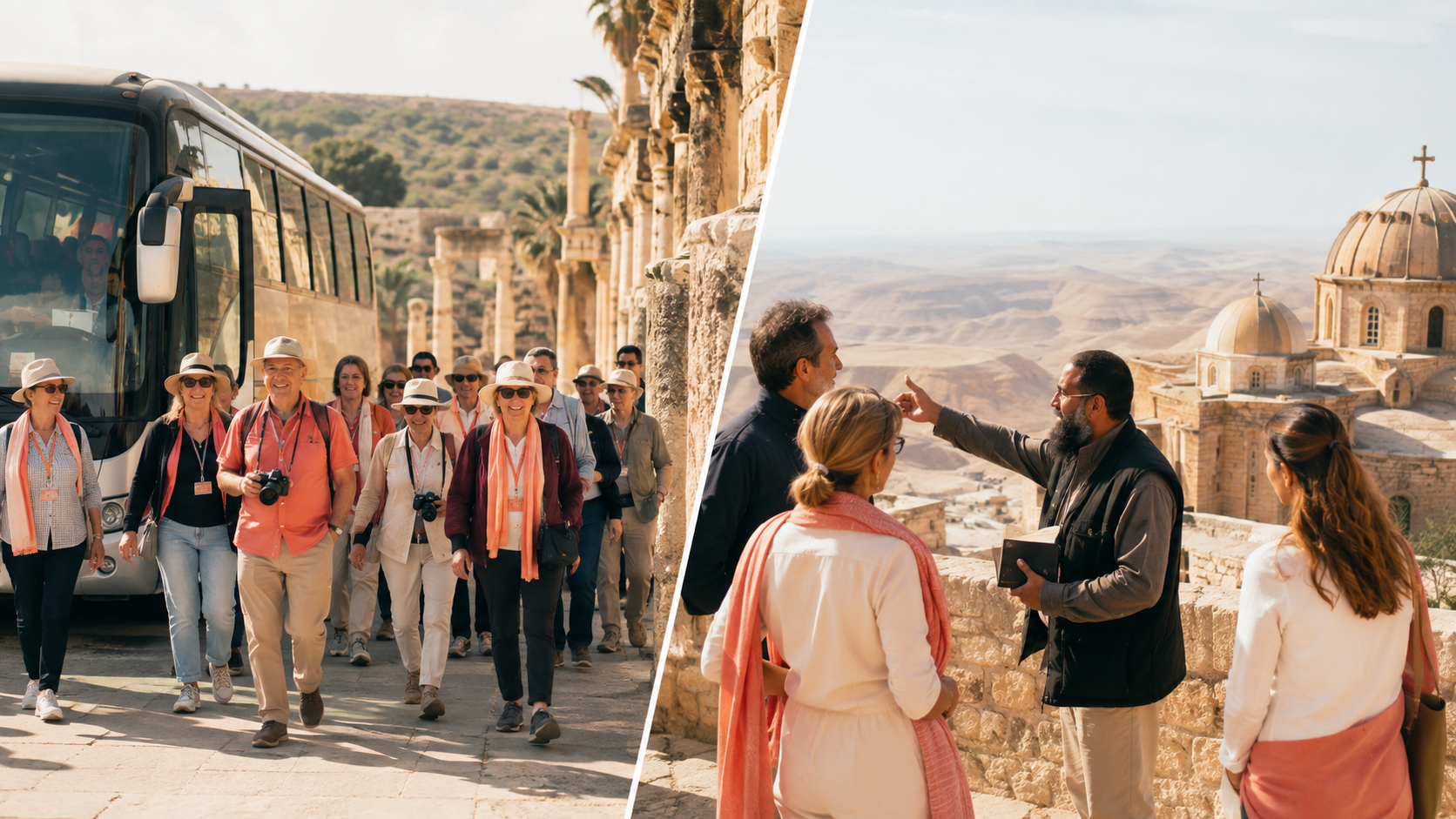
A side by side look at how site selection and pacing differ between a general tour and a pilgrimage itinerary.
Why Denomination Is the First Question We Ask
Before we discuss dates, we ask which Christian tradition the group belongs to. A ten day tour for a Southern Baptist congregation and the same ten days for a Catholic parish share perhaps sixty percent of their sites and almost none of their worship arrangements.
Many operators hand every group an identical itinerary. Talya Tours does not. We ask what the pastor or priest wants the congregation to carry home, and which rites need arranging on site before pricing anything. Groups traveling with daily Mass, for instance, need chapel bookings confirmed months in advance, which is why we maintain a dedicated Catholic pilgrimage to the Holy Land program rather than treating it as an add-on to a general tour.
| Tradition | Sites weighted heavily | Arranged on site |
|---|---|---|
| Southern Baptist and non-denominational Evangelical | Garden Tomb, Yardenit, Capernaum, Mount of Beatitudes | Baptism renewal at the Jordan, communion at the Garden Tomb |
| Catholic parish or diocese | Holy Sepulchre, Basilica of the Annunciation, Church of the Nativity | Daily Mass slots, Stations of the Cross at first light |
| Pentecostal and Assemblies of God | Mount of Olives, Gethsemane, Upper Room | Extended prayer blocks, private garden areas booked in advance |
| Methodist, Presbyterian, Episcopal | Magdala, Bethesda and St. Anne’s, Southern Steps | Teaching sessions, hymn singing, quiet contemplative time |
Group Departure or Private Itinerary
A scheduled group departure costs less per person and gives the congregation the shared fellowship of a common week. Entries at busy sites are secured as a block, which matters at the Church of the Nativity in December and at the Holy Sepulchre most mornings.
A private itinerary buys control. Start times can be adjusted for a congregation with older members, and site selection can include a specific excavation or monastery a teaching pastor wants included. As a general guide, groups under 20 travelers usually do better on a scheduled departure, while groups above 25 often find a private program costs less per head than expected once hotel blocks are negotiated.
Two to Three Hotels for the Entire Trip
The most avoidable exhaustion on a ten day trip comes from repacking suitcases. A hub and spoke plan solves this. One night on the coast, near Tel Aviv or Netanya, about 40 minutes from Ben Gurion Airport, so nobody drives two hours after a long overnight flight. Then three nights at the Sea of Galilee, in Tiberias or at a lakeside hotel, which puts every northern site within an hour’s drive. Then four to five nights in Jerusalem, from which Bethlehem is under 10 kilometers away and Masada is a 90 minute drive.
Jerusalem itself needs to be split geographically rather than covered in one long day. The Mount of Olives in the morning and Mount Zion after lunch, the Old City on one day and museums or memorial sites on another. This pacing is what allows a ten day itinerary to be described accurately once the group returns home.
The three hotel bases used for a balanced ten day itinerary, coast, Galilee, and Jerusalem.
The Day by Day Itinerary We Build Most Often
This is the backbone we run most often for American church groups, adjusted each time for the group’s denomination, the season, and mobility needs. The route moves north to south so nothing is driven twice.
| Day | Hotel base | Main sites |
|---|---|---|
| 1 | Coast | Arrival, transfer, orientation |
| 2 | Sea of Galilee | Caesarea Maritima, Mount Carmel, Megiddo |
| 3 | Sea of Galilee | Boat ride, Beatitudes, Capernaum, Tabgha |
| 4 | Sea of Galilee | Nazareth, Cana, Magdala or Mount Arbel |
| 5 | Jerusalem | Jordan River baptism, Jordan Valley, first view of Jerusalem |
| 6 | Jerusalem | Mount of Olives, Gethsemane, Mount Zion |
| 7 | Jerusalem | Old City, Western Wall, Via Dolorosa, Holy Sepulchre |
| 8 | Jerusalem | Bethlehem, Shepherd’s Field, Yad Vashem or Israel Museum |
| 9 | Jerusalem | Masada, Ein Gedi, Dead Sea |
| 10 | Departure | Free morning, farewell dinner, transfer to airport |
Days 1 to 4, the Coast and the Galilee
Nobody tours on arrival day. After landing at Ben Gurion International Airport, the group transfers to a coastal hotel, has dinner, and rests. Day two covers Caesarea Maritima and Mount Carmel before reaching the Galilee by evening. Day three is the ministry day, a boat ride on the lake, the Mount of Beatitudes, Capernaum, and Tabgha, with lunch of St. Peter’s fish at the shore. Baptist and Evangelical groups often prefer the Beatitudes late in the afternoon once the hillside empties, and the order is reversed for them. Day four moves through Nazareth, Cana of Galilee, where couples frequently renew their vows, and either Magdala or Mount Arbel depending on whether the group prefers archaeology or the view over the plain.
Days 5 to 10, Jerusalem, Bethlehem, and the Desert
Day five includes a baptism renewal service at the Jordan River before the drive to Jerusalem, with the first view of the city arranged deliberately from the Mount of Olives. Day six covers the Passion sites, the Mount of Olives, Gethsemane, and Mount Zion including the Upper Room. Day seven is the Old City, the Western Wall, the Via Dolorosa, and the Holy Sepulchre, with communion at the Garden Tomb in the afternoon for groups whose tradition includes it. One planning detail costs groups a whole afternoon if missed, the Garden Tomb does not receive visitors on Sundays, so a Sunday communion service has to be moved elsewhere. Day eight covers Bethlehem and Shepherd’s Field, followed by Yad Vashem or the Israel Museum. Day nine is the desert day, described below. Day ten is a free morning followed by transfer to the airport, with four hours recommended before flight time on group departures.
The Desert Day, Masada, Ein Gedi, and the Dead Sea
All three fit into a single day from a Jerusalem base, but only with a firm departure time, typically leaving the hotel by 7 30 in the morning. Masada is reached by cable car rather than on foot for most groups, since the plateau time is what matters and the Snake Path can use up ninety minutes and most of the group’s energy before arrival. Midday is spent at Ein Gedi, on the shaded lower Nahal David trail, where David hid from Saul according to the biblical account. The reserve’s entry closes well before the site itself does, so timing has to be checked in advance, particularly in summer. Late afternoon is reserved for a float at an authorized Dead Sea beach once the heat has broken. We recommend at least two liters of water per person for the day.
If your congregation is planning a ten day trip to Israel, Talya Tours will build the itinerary around your group’s specific denomination, whether Baptist, Catholic, Pentecostal, Methodist, Lutheran, Presbyterian, Anglican, Orthodox, or another Christian tradition. Contact us with your dates and group size, and we will walk through the route and the worship arrangements before anything is booked.
What We Cover Before Departure
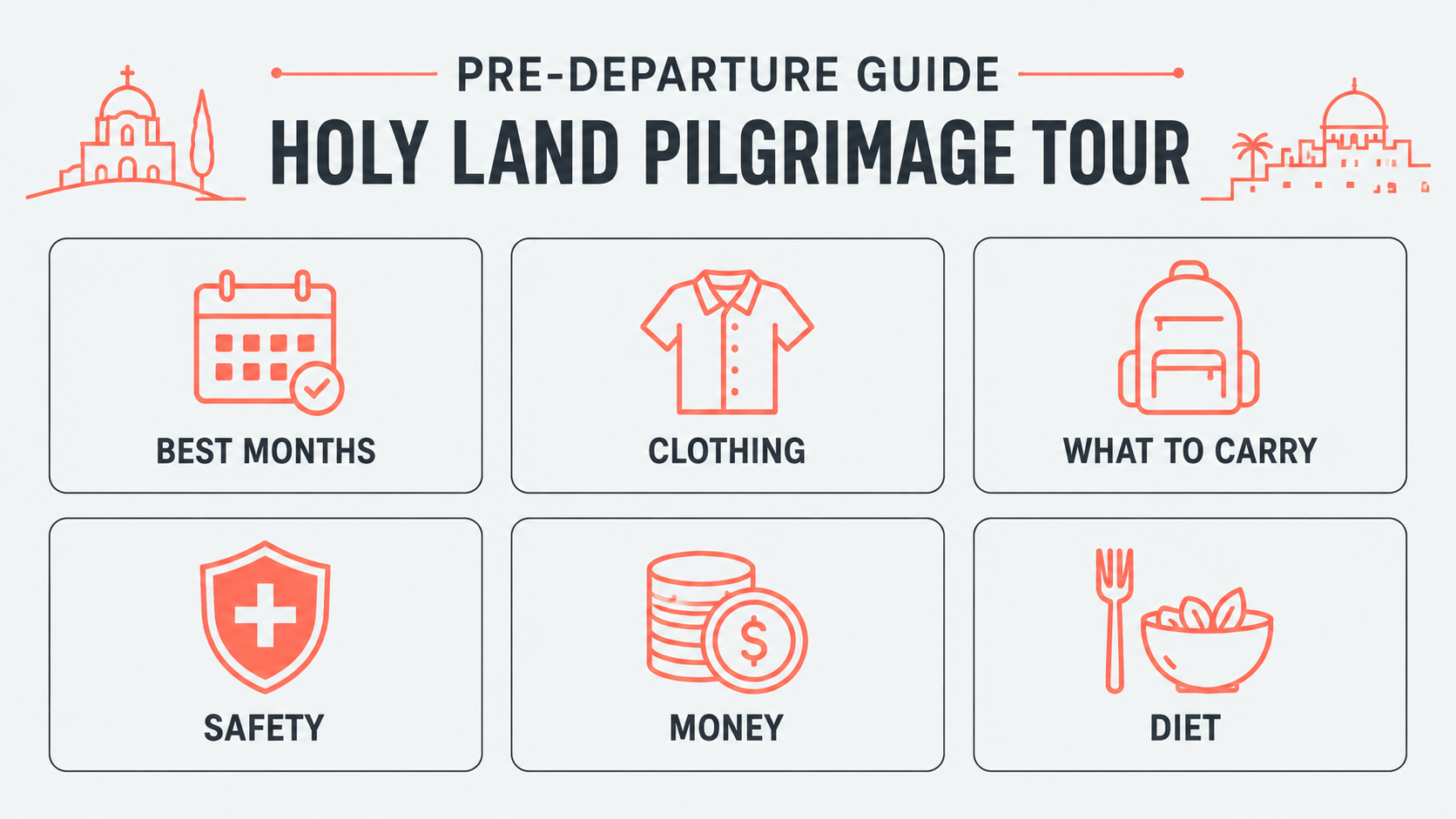
The best months for a ten day Holy Land tour are March through May and September through November, when Jerusalem is mild and the Galilee hills are green. Summer travel is possible but the desert day shifts earlier and the pace changes.
Shoulders and knees need to be covered at churches and holy sites, without exception at the Nativity or the Holy Sepulchre. Broken in walking shoes with good grip matter, since Old City stones are polished smooth and the Ein Gedi trail is loose gravel. Layers help for Jerusalem evenings, which surprise many travelers from warmer parts of the United States.
Kosher, halal, gluten free, vegan, and low sodium diets are all straightforward to arrange, since hotel buffets in Israel run heavily on fresh produce and every hotel is notified in writing before arrival. On both a general Israel tour and a pilgrimage itinerary, dietary needs have rarely been the difficulty first time travelers expect.
Bring US dollars for tipping guides, drivers, and hotel staff, a card for shops and restaurants, and a small amount of local currency for market stalls. Licensed guides and vehicles accompany the group throughout the standard route through the coastal plain, the Galilee, Jerusalem, and the Dead Sea, with our staff coordinating daily so that any changes on the ground happen before the group notices them.
Frequently Asked Questions
Can our itinerary be built specifically around our denomination?
Yes, this is the starting point of every itinerary we build. Whether your congregation is Baptist, Catholic, Pentecostal, Methodist, Lutheran, Presbyterian, Anglican, Orthodox, or another Christian tradition, site selection, worship arrangements, and guide assignment are shaped around what matters most to your group.
Is ten days enough time to see the Galilee and Jerusalem properly?
Yes, provided the days are distributed correctly. Roughly three days in the Galilee and four to five in Jerusalem, including Bethlehem and a desert day, is the minimum needed to cover the major sites without rushing.
Should our group choose a scheduled departure or a private tour?
Groups under about 20 travelers usually do better financially on a scheduled group departure. Groups above 25 often find that a private itinerary costs a similar amount per person once hotel blocks are negotiated, while offering more flexibility on timing and site selection.
What happens if our group wants communion at the Garden Tomb on a Sunday?
The Garden Tomb does not receive visitors on Sundays, so that service needs to be moved to another location, typically arranged for early morning at an alternative site depending on the group’s tradition.
Do you handle groups with mixed dietary needs?
Yes. Kosher, halal, gluten free, vegan, and low sodium requirements are communicated to every hotel in writing before arrival, and Israeli hotel buffets are generally well equipped to handle a range of needs within one group.
A balanced ten day Holy Land tour depends on the order of regions, the number of hotel bases, and how closely the itinerary reflects your congregation’s specific denomination. Talya Tours has spent over 35 years building these itineraries for American church groups, and every plan starts with a conversation about your tradition and your dates. Write to Talya directly at [email protected] or through our contact page to begin planning.

About the Author
Talya Felner is the Owner and CEO of Talya Tours Services (TTS), a professional tour operator in Israel. With over 35 years of experience and more than 90,000 travelers served, Talya has built TTS into a trusted name for Christian pilgrimages, biblical tours, and conferences for groups visiting Israel and the Holy Land. Her team designs each itinerary around the specific Christian denomination of the visiting group, whether Protestant, Catholic, Evangelical, Baptist, Methodist, Pentecostal, Lutheran, Presbyterian, Anglican, Orthodox, or another tradition, ensuring that sites, worship arrangements, and guides reflect what matters most to that congregation. From visas and accommodations to guides, transportation, and on site coordination, TTS handles every detail so American pastors and group leaders can focus on the spiritual experience of their travelers.