
Planning a pilgrimage to Israel around a major Christian holiday requires working with at least two separate liturgical calendars, a Jewish civic calendar, and seasonal logistics that change the way Jerusalem, Bethlehem, and Nazareth function on the ground. American church groups and U.S. congregations frequently discover this late – after hotels are booked and flights are set – when the operational reality of holiday travel in Israel no longer matches the simple picture they imagined. This article walks through the main Christian holidays observed in Israel, explains why dates differ between traditions, and gives American group leaders the practical framework to plan Holy Week, Easter, and Christmas with their denomination’s specific needs at the center.
Reading time: 9 minutes
Key Points
- Israel observes three separate Christmases and two separate Easters, each tied to a distinct Christian tradition, and knowing which calendar your denomination follows is the first planning decision.
- Access to major sites like the Church of the Holy Sepulchre and the Midnight Mass in Bethlehem requires advance coordination, and in some cases formal permits or tickets requested months ahead.
- The Jewish Shabbat and major Jewish holidays directly affect transport, hotel pricing, and restaurant availability regardless of which Christian season you are traveling in.
- What a Baptist congregation from Texas needs during Holy Week is genuinely different from what a Catholic diocese or a Pentecostal ministry requires – and a well-run itinerary is built around those differences from the start.
The main Christian holidays Israel travelers plan around
Two large liturgical seasons dominate the year for the Christian holidays Israel draws American pilgrims toward. The first is spring, built around Holy Week and Easter, when Jerusalem becomes the center of the Christian world. The second is winter, built around Christmas, when Bethlehem and Nazareth carry the weight of the season.
Pentecost sits fifty days after Easter, quieter than the other two, observed mainly at the traditional site of the Cenacle on Mount Zion (Acts 2:1-4). These are religious observances, but they are also civic events. They close roads, fill hotels, and change the operating hours of nearly every holy site. Over 35 years of bringing American groups here, we have learned that the season you choose matters more than almost any other planning decision.
| Holiday | Typical Timing | Primary Locations | Core Tradition |
|---|---|---|---|
| Easter (Western) | March or April (Gregorian) | Holy Sepulchre, Garden Tomb, Via Dolorosa, Jerusalem | Holy Week processions, Resurrection liturgy |
| Easter (Orthodox) | April or May (Julian) | Church of the Holy Sepulchre, Jerusalem | Holy Fire ceremony on Holy Saturday |
| Pentecost | 50 days after Easter | Cenacle, Mount Zion (Acts 2:1-4) | Commemoration of the descent of the Spirit |
| Christmas (Western) | December 24-25 | Bethlehem, Church of the Nativity, Manger Square | Midnight Mass at St. Catherine’s |
| Christmas (Orthodox) | January 7 | Church of the Nativity, Bethlehem | Orthodox liturgy and procession |
| Christmas (Armenian) | January 18-19 | Church of the Nativity, Bethlehem | Armenian Apostolic celebration |
When Easter is celebrated in Israel and why dates differ between churches
The reason there is no single answer is the calendar itself. Roman Catholic and Protestant churches calculate Easter on the Gregorian calendar, while the Orthodox churches still use the older Julian calendar. The same theological feast lands on two different Sundays, sometimes the same weekend, sometimes more than a month apart.
You can check the Western dates on the published Catholic and Protestant Easter calendar for Israel, and the separate Orthodox Easter dates for the years you are considering. In the years when the two Easters overlap, Jerusalem’s Old City carries close to double the liturgical load in a single week. That is when scheduling stops being a convenience and becomes the difference between a group walking the Via Dolorosa at dawn or standing in a closed alley for two hours.
How to choose travel dates based on crowd patterns
For an American group wanting spiritual depth without standing shoulder to shoulder with thousands, we usually steer toward the window right after Western Easter passes and before the Orthodox ceremonies reach their peak. The major sites are still dressed for the season, the city has exhaled, and access is far more manageable. Whether the group is Methodist, Lutheran, or Presbyterian, that window gives denominational worship time at the key sites without the worst of the seasonal congestion.
What Holy Week in Israel involves and where to experience it best
Holy Week runs from Palm Sunday to Easter Sunday, and it is the single most concentrated stretch of the Christian year in Jerusalem. The geography is compact and dramatic. It begins on the ridge of the Mount of Olives, descends to the Garden of Gethsemane (Matthew 26:36-46), and ends along the Via Dolorosa inside the Old City walls.
The Via Dolorosa, the traditional Way of Sorrows, is named in Israeli state tour-guide licensing materials as a core route every credentialed guide must know, reflected in the official government guiding curriculum. When we plan Holy Week Israel tours, the order of these stops is everything. A Catholic parish will weight the stations and the Holy Sepulchre heavily. A Baptist congregation from Charlotte will often anchor the same week at the Garden Tomb instead, with extended Scripture reading at each stop. Same week, genuinely different itinerary – built around what that specific tradition prioritizes.
What to do in Jerusalem during Holy Week, day by day
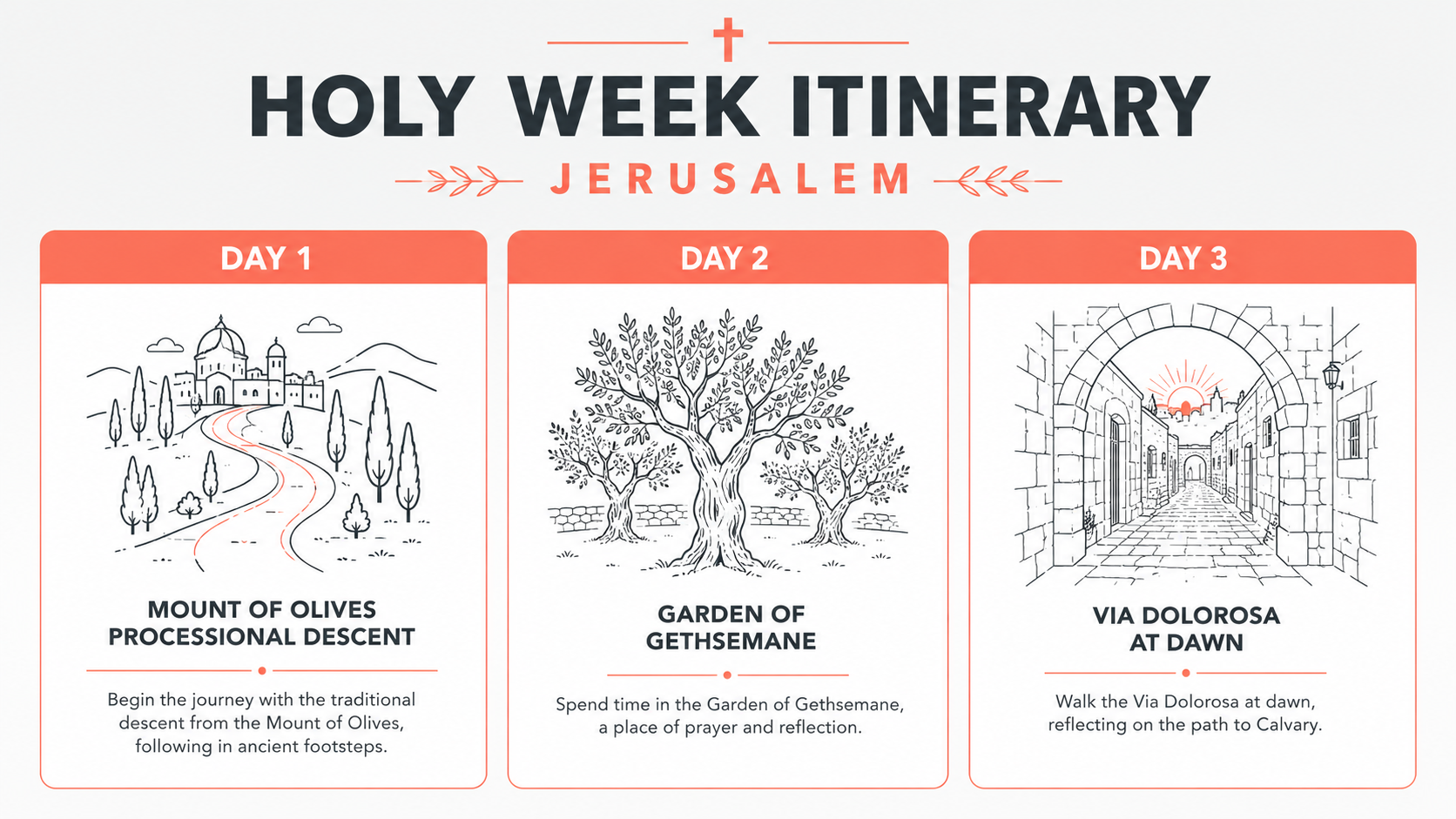
The week builds toward Easter through a sequence of liturgical highpoints. Palm Sunday opens with the processional down the Mount of Olives. Maundy Thursday brings the washing of the feet. Good Friday carries the cross along the Via Dolorosa, and Holy Saturday holds the night before the Resurrection.
The sensory experience is part of why American pilgrims travel this far. The smell of incense thick in the Holy Sepulchre. Church bells answering each other across the Old City. Chanting in Greek, Latin, Armenian, and Arabic, overlapping in the same stone courtyard. You do not so much watch Holy Week as stand inside it.
A flexible three-day Holy Week framework
We often build a three-day backbone that groups can shift around based on their tradition. Day one follows the processional track, walking from the ridge of the Mount of Olives down into the Kidron Valley. Day two centers on Gethsemane, with afternoon prayer at the Church of All Nations and quiet meditation among the ancient olive trees. Day three is the path of sorrows, an early dawn walk on the Via Dolorosa before the midday crowds arrive. The dawn start is worth it without exception. How those days are weighted – how long you linger at each site, what Scripture is read, whether Communion is held on location – depends entirely on whether the group is Evangelical, Anglican, Catholic, or another tradition. That structure does not change; the denominational content that fills it does.
Guided Holy Week tours versus traveling independently
This is the question that decides whether the week becomes meaningful or exhausting. Independent travel during Holy Week runs into friction most people never see coming – unannounced road closures, military security lanes through the Christian Quarter, and language gaps with local guards controlling access at the choke points around the Holy Sepulchre.
Well-run Holy Week Israel tours – the kind Talya Tours has organized for American congregations for over three decades – work through pre-arranged access, trusted local guides, and timing built around the police management of the day. A guided program is best for families, elderly travelers, and first-time American pilgrims who cannot afford to lose half a day in a security queue. Independent travel suits individuals with open schedules who are comfortable skipping a major liturgy if access closes that morning.
Planning a Holy Week or Easter pilgrimage for your congregation?
Talya Tours builds each Holy Week itinerary around the specific denomination of your group – whether Catholic, Baptist, Evangelical, Pentecostal, Methodist, Lutheran, Anglican, or another tradition. We handle transport, guide assignments, site access, and timing so your group can focus on the journey.
The Church of the Holy Sepulchre during Easter in Israel
The Church of the Holy Sepulchre is the gravitational center of Easter in Israel, sitting inside the Old City of Jerusalem and listed on the UNESCO World Heritage register with its Resurrection rotunda named as a central feature. During Holy Week the church is technically open, but access is governed by Israel Police crowd caps, especially on Holy Saturday.
That is the day of the Holy Fire ceremony, when the courtyard and surrounding alleys fill far beyond comfortable capacity. Local reporting has documented strict participant limits and tense crowd management, covered by both Ynet and The Jerusalem Post. The practical takeaway is straightforward. Entry at peak hours is never guaranteed for a group arriving on its own. With a licensed local operator coordinating timing and position in advance, the odds change considerably.
Celebrating Easter in Israel outside Jerusalem
Jerusalem is not the only place to mark Easter in Israel, and for some American groups it is not even the best one. The Galilee offers open-air services along the Sea of Galilee, near sites like Tabgha (John 6:1-15) and the Mount of Beatitudes (Matthew 5:1-16), where a congregation can read and pray surrounded by water and hills instead of stone walls and crowds.
There are Catholic processions in Jaffa and historic parishes in Haifa that carry real meaning with a fraction of the pressure. For a Methodist or Presbyterian group from Ohio that values quiet, contemplative time over spectacle, we sometimes split the week – the major Jerusalem liturgies for a day or two, then north for the calmer Galilee services. The trip ends up deeper, not thinner, when it is built around what that denomination actually values.
How Christmas is celebrated in Israel
Winter shifts the center of gravity among the Christian holidays Israel observes from Jerusalem to Bethlehem and Nazareth, and the mood changes with it. Jerusalem’s Old City keeps a quieter, more local Christmas, with festive corners woven through the Christian Quarter, something Jerusalem media has described in detail in pieces like this account of searching for Christmas in the Old City.
It is not the polished, commercial Christmas an American visitor knows from a department store window. It is smaller, older, and tied to actual worshipping communities. For many of the American groups we accompany, that contrast is the point. They came to see where it began, not a brighter version of home.
Planning Christmas in Bethlehem around crowds and timing
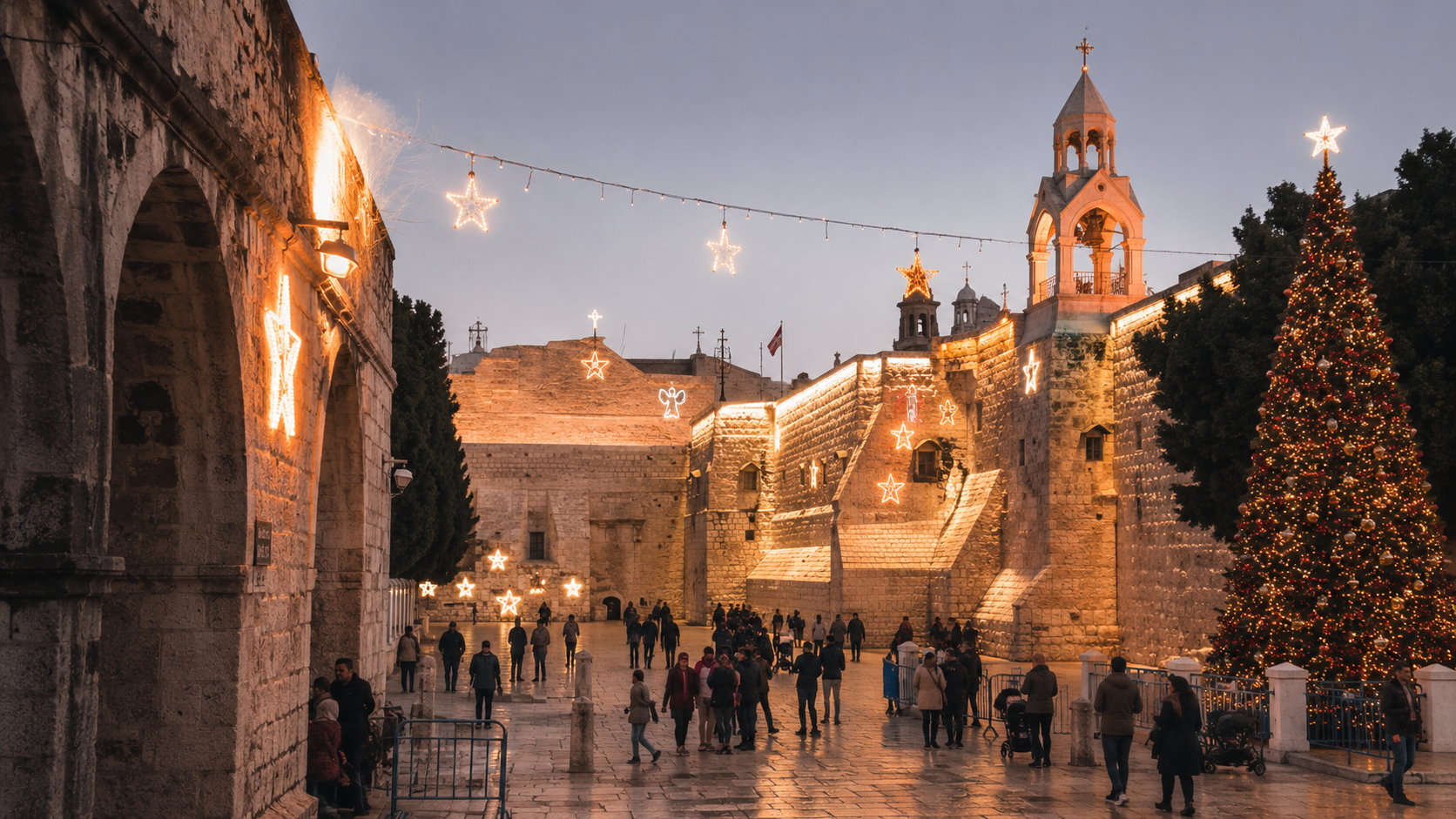
Christmas in Bethlehem draws the largest single concentration of the winter season, centered on the Church of the Nativity and Manger Square. The church, the Pilgrimage Route, and Star Street are inscribed together on the UNESCO World Heritage list, with the components detailed in the advisory body evaluation, including the Cave of the Nativity itself.
Getting there means crossing the checkpoint from Jerusalem into Area A. On an ordinary day this is straightforward. On Christmas Eve, without a pre-cleared logistics provider, the crossing and return can swell to several hours of waiting.
What to do if Christmas Eve availability is fully booked
If Christmas Eve availability is gone, we steer American groups toward Manger Square during the first two weeks of December. The decorations are up, the spirit is present, and the crush has not yet arrived. Pairing that with a private day trip that manages transport both directions removes the worst of the seasonal checkpoint congestion – and it leaves room for the kind of extended devotional time that a Pentecostal or Evangelical group often wants at the site but rarely gets on Christmas Eve itself.
The Midnight Mass in Bethlehem and what it requires
The Roman Catholic Midnight Mass for Christmas in Bethlehem takes place inside the Church of St. Catherine, adjoining the Church of the Nativity. The tickets are free, but they are heavily restricted and must be requested months in advance through the Franciscan Pilgrims’ Office.
This is where late planning hurts most. Without official paper tickets, your group will not be admitted to the Mass. You will stand in Manger Square watching the service on large screens, often in cold and dense crowds. A Catholic parish from Indianapolis that contacts us in October has a real chance at seats inside. The same parish calling in mid-December does not.
What makes Christmas in Nazareth distinctive
Nazareth is the largest Arab-Christian city in Israel, and it holds one of the country’s biggest annual Christmas parades. The Israeli tourism ministry’s own Nazareth page frames it as the city of the Annunciation, anchored by the Basilica of the Annunciation (Luke 1:26-38).
The basilica is worth understanding before you arrive. The Custodia di Terra Santa describes its two-level structure, with the Grotto of the Annunciation preserved below and the upper church above – a layout explored further in their note on the mystery of the Annunciation. For most American groups, one full day in Nazareth is enough during the season; two days if you want the parade and the quieter morning prayer both.
The city’s position as a bridge between communities gives it a particular holiday character. For Anglican or Lutheran groups who want Christmas grounded in the Annunciation narrative, Nazareth often becomes the emotional center of the winter itinerary, not Bethlehem.
How Shabbat and Jewish holidays affect travel during Christian holiday seasons
This is the logistics layer most American groups overlook. Regardless of which Christian holiday brought you here, the country runs on a Jewish civic calendar. The national railway and most public bus networks shut down from Friday afternoon until Saturday evening for Shabbat, which is why we check the official public transport portal and the broader Ministry of Transport information against every itinerary. Private transport during those hours is not a luxury; it is the only way to move.
When Easter overlaps with Passover, the picture tightens further. Many bakeries close, kosher rules narrow restaurant menus, and domestic Israeli tourism surges, pushing hotel prices up sharply.
A practical logistics checklist for American groups
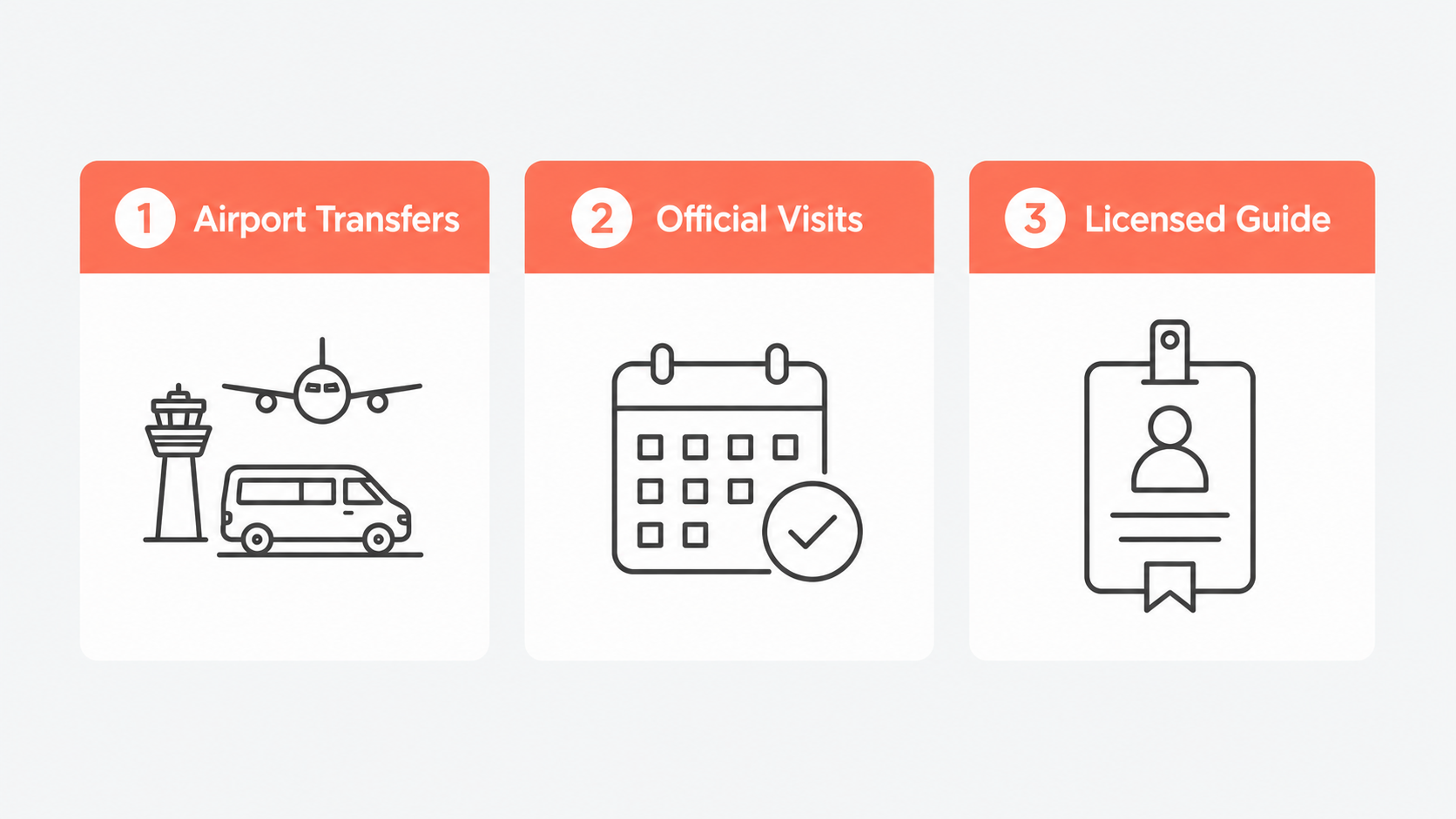
Three steps save groups repeatedly. Pre-book airport transfers through the official Ben Gurion shuttle directory to avoid peak taxi surges. Register any official or institutional visits ahead of time through the government appointment system. And confirm that your guide holds a state-licensed Ministry of Tourism credential before you commit – this is a non-negotiable for any serious pilgrimage program.
How a unified Christian holidays Israel calendar helps your planning
The single most useful planning tool we build with an American group is a unified Christian holidays Israel calendar. It overlays Western Catholic and Protestant dates, Orthodox dates, the Armenian timetable, and the Jewish civil holidays onto one sheet. Done properly, it shows every collision before it becomes a booking conflict.
It also reveals the opposite – the quiet windows. Those are the weeks of lower hotel pricing and far better site availability, the periods where a group gets the full spiritual weight of the season without the worst of the crowding or the cost. For an Adventist congregation or a smaller Evangelical church traveling on a modest budget, finding those windows can make the difference between a trip that works financially and one that does not.
The difference between Western, Orthodox, and Armenian Christmas in Bethlehem
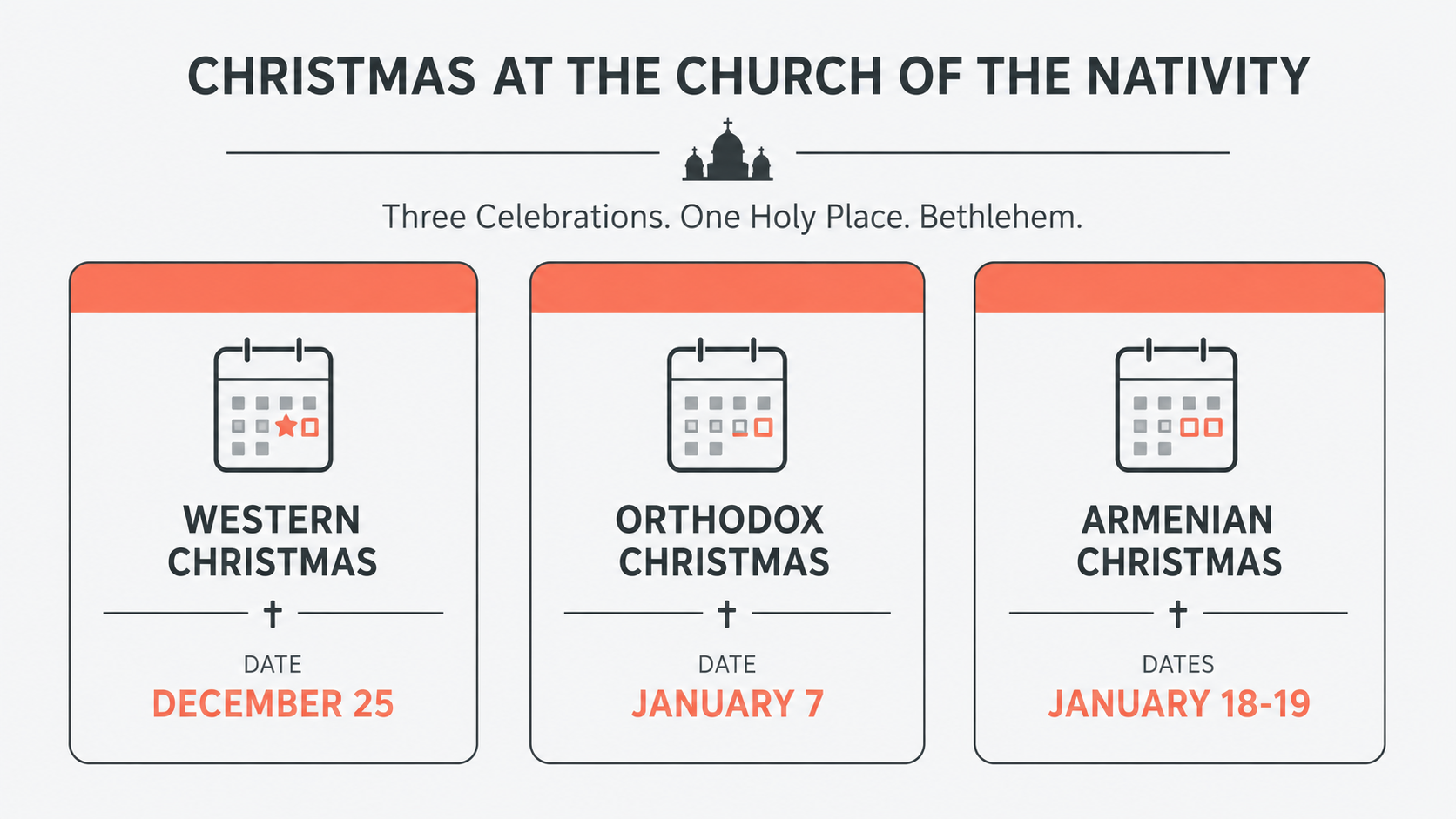
Here is the detail that surprises almost everyone planning Christmas in Bethlehem for the first time. The Church of the Nativity hosts three separate Christmases. The Catholic and Protestant celebration falls on December 25th. The Orthodox celebration follows on January 7th. The Armenian Apostolic celebration comes later still, on January 18th and 19th.
The practical result is that Bethlehem stays festive for nearly a full month. An American group that cannot travel in late December has two more genuine Christmases waiting in January, each with its own liturgy, its own worshipping community, and far thinner crowds than the December peak. For an Orthodox Christian congregation traveling from the United States, arriving for the January observance is not a second-best option – it is the one that matches their tradition exactly.
How Talya Tours supports American groups during holiday-season pilgrimages
Holiday logistics in Israel reward operators who run these seasons every year, not occasionally. Talya Tours organizes door-to-door private transport, works with guides who understand the differences between denominations, and arranges priority access at the sites where minutes decide whether a group gets in. Our local guides know how to read a sudden security change and reroute a day without losing the heart of it.
A Pentecostal ministry from Phoenix wanting extended worship time at the Garden of Gethsemane (Mark 14:32-42) needs a different day than a Catholic diocese wanting Mass at the Holy Sepulchre. We build each program around what your tradition actually requires. That level of planning detail only comes from having done this across more than 90,000 American travelers over more than three decades.
Security and entry protocols during major Christian holidays
Expect security checks at the entrances to major churches and a full crossing protocol at the checkpoint into Area A heading toward Bethlehem. Bags are screened, lines form quickly during peak liturgies, and the pace is set by police rather than by your schedule.
There is also a preservation dimension running underneath all of this. Israel’s Antiquities Authority and the relevant archaeology oversight units work to protect these sacred sites precisely during the high-traffic windows when they are most exposed. Understanding that these are protected heritage sites – not simply tourist attractions – helps a group move through them with the patience the protocols require.
Key takeaways for planning your pilgrimage
The essentials are few and firm. Check the three Christmas dates and the two Easter calendars against your travel window before anything else. Arrange reliable private transport, especially around Shabbat and holiday peaks. Book months ahead for anything ticketed – the Midnight Mass above all. Know which denomination your group belongs to and make sure your itinerary reflects it, because the sites that matter, the worship arrangements that work, and the schedule that gives your group what it came for are all shaped by that answer.
If your church or group is beginning to shape a Holy Week, Easter, Pentecost, or Christmas pilgrimage, we are glad to walk through dates, denominational priorities, and ground logistics with you before you commit to anything. You can reach Talya directly at [email protected] or through our contact page.
Frequently asked questions
The Christian holidays Israel observes each year are not a single season but several, layered across three calendars and experienced very differently depending on which tradition your group belongs to. The planning decisions that matter most – travel dates, site priorities, worship arrangements, and logistics – are all shaped by that denominational starting point. Getting those decisions right, and getting them made early enough, is what allows an American congregation to move through Jerusalem, Bethlehem, or Nazareth with purpose rather than pressure.
If your congregation or group is beginning to take shape around a pilgrimage this season, we welcome the conversation. Reach out through our contact page or write directly to [email protected] to discuss your group’s denomination, travel window, and what you want the experience to be.
Ready to plan your group’s pilgrimage to Israel?
Tell us your denomination, your travel window, and the size of your group. Talya Tours will build a custom itinerary around what your specific tradition requires – from Holy Week in Jerusalem to Christmas in Bethlehem and everywhere in between.
About the Author

Talya Felner
Owner and CEO, Talya Tours Services (TTS)
Talya Felner is the Owner and CEO of Talya Tours Services (TTS), a leading professional tour operator in Israel. With over 35 years of experience and more than 90,000 travelers served, Talya has built TTS into a trusted name for Christian pilgrimages, biblical tours, and conferences for groups visiting Israel and the Holy Land. Her team designs each itinerary around the specific Christian denomination of the visiting group – whether Protestant, Catholic, Evangelical, Baptist, Methodist, Pentecostal, Lutheran, Presbyterian, Anglican, Orthodox, or another tradition – ensuring that sites, worship arrangements, and guides reflect what matters most to that congregation. From visas and accommodations to guides, transportation, and on-site coordination, TTS handles every detail so American pastors and group leaders can focus on the spiritual experience of their travelers.