Planning a Christian pilgrimage to Israel involves dozens of decisions, but the one that shapes everything else is often the last one American pastors and group leaders think about seriously – group size. The number of people traveling together determines the pace of each day, the quality of access at sacred sites, the depth of spiritual reflection available at each stop, and whether a group returns home changed or simply tired. For U.S. congregations, church groups, and individual American travelers considering a trip to the Holy Land, understanding what small group Christian tours of Israel actually involve – and how they differ from standard commercial packages – is the right place to begin.
Reading time: 7 minutes
Key Points
- Small group Christian tours of Israel typically carry between 8 and 24 travelers, and that range directly affects pacing, guide access, site access, and the quality of worship moments at sacred locations.
- Every Talya Tours itinerary is built around the specific Christian denomination of the visiting American group – Protestant, Catholic, Evangelical, Baptist, Pentecostal, Methodist, Lutheran, Presbyterian, Anglican, Orthodox, or another tradition – never a single generic program applied to all.
- Licensed guides approved by Israel’s Ministry of Tourism are essential, not optional – they connect the physical landscape to Scripture in ways that align with the theological priorities of each denomination.
- Booking 6 to 9 months in advance is recommended, particularly for private boat arrangements on the Sea of Galilee and boutique hotel rooms that fill quickly around major Christian holidays.
Table of Contents
- What Are Small Group Christian Tours of Israel
- Why Choose Small Christian Groups in Israel Over Massive Bus Tours
- How Group Size Affects Your Spiritual Journey
- What Makes Boutique Christian Israel Tours Different
- Where an Intimate Christian Tours Israel Itinerary Should Take You
- How to Choose the Right Group Size for Your Trip
- Why Licensed Guiding Is Critical for Your Holy Land Pilgrimage
- What Is Included in Premium Boutique Christian Israel Tours
- How Talya Tours Builds Each Small Group Experience
- Small Group Tours vs. Large Commercial Bus Tours
- Frequently Asked Questions
What Are Small Group Christian Tours of Israel
A small group Christian tour of Israel is a pilgrimage built for somewhere between eight and twenty travelers, not for a coach packed with fifty strangers. The difference is not cosmetic. It changes what the trip can actually be.
Commercial multi-coach travel treats the Holy Land as a list of stops to clear before sundown. A genuine small group setting does the opposite. It gives a tailored itinerary the space to focus directly on Christian history, Scripture, and the geography that ties them together.
When a group is small enough to gather in a half-circle, a stop at Capernaum – the site described in Mark 1:21-35 – stops being a photo opportunity and becomes a place to read, reflect, and understand why Jesus made it the base of His Galilean ministry. Fewer people in the group is what converts a tourist trip into a pilgrimage. And that principle holds whether the group arriving is a Southern Baptist congregation from Nashville, a Catholic parish from Boston, or a Pentecostal fellowship from Phoenix.
Why Choose Small Christian Groups in Israel Over Massive Bus Tours
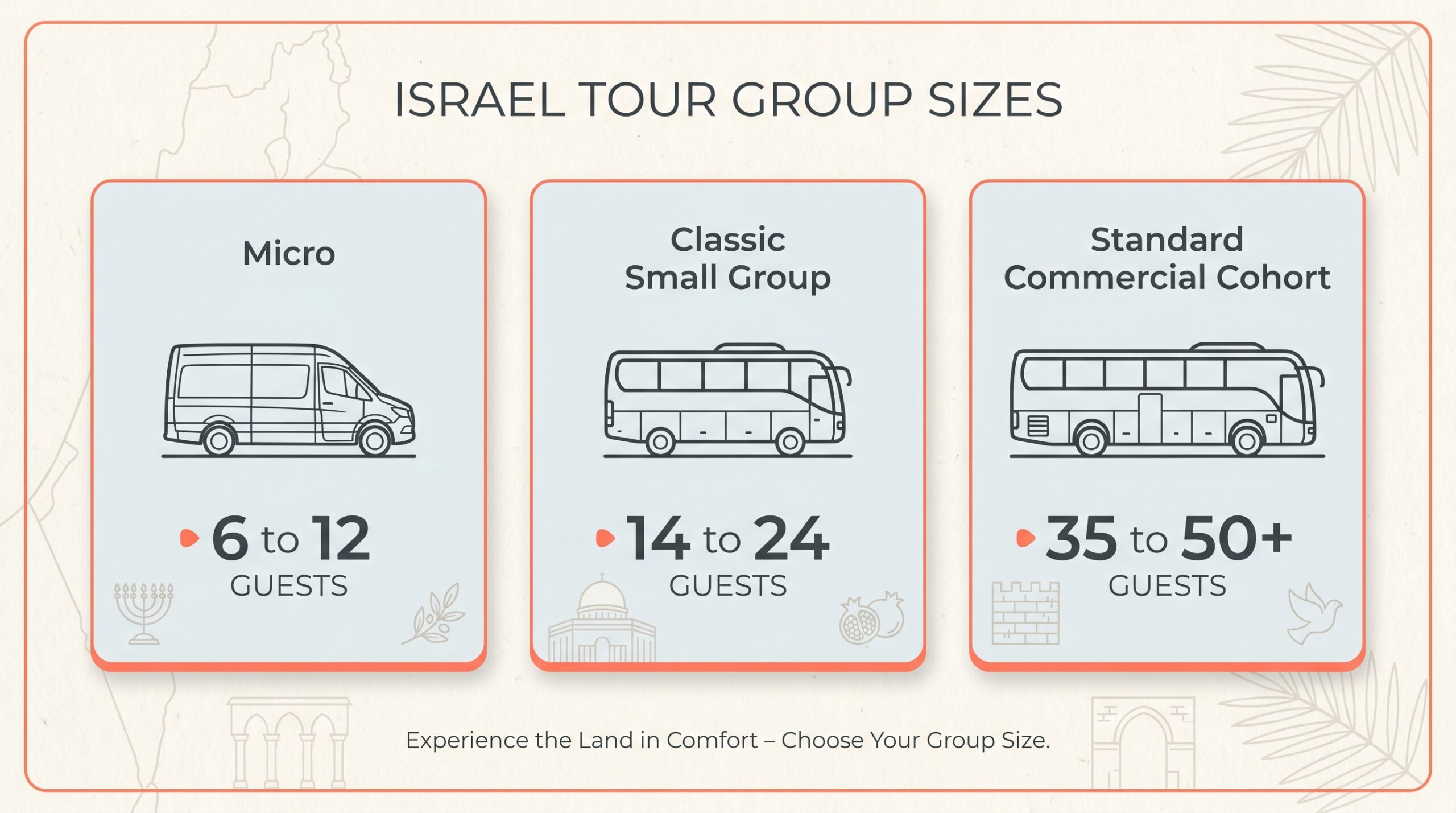
Group size shapes every aspect of the day, from boarding time to the quality of quiet moments at sacred sites.
The first advantage is mechanical. A group of fourteen boards a vehicle in under two minutes. A coach of forty-eight needs a roll call, a head count, and ten minutes of waiting for the last two people who wandered into a gift shop. Multiply that across six site visits a day, and large groups lose roughly an hour of daylight to logistics alone.
At high-traffic sites this matters even more. Small Christian groups in Israel can reach the Garden Tomb, the Mount of Beatitudes, or the Western Wall plaza before the parking lots fill with tour buses. That timing window is one of the most practical advantages a boutique operator can offer, and it requires a group small enough to move quickly.
There is a quieter benefit too. When a Pentecostal fellowship from Phoenix travels together for ten days in a group of fifteen, they come home as a community. That kind of bond does not form across forty-eight seats and a microphone. A small group also fits into the narrow lanes of the Old City and the winding roads above the Sea of Galilee that a full-sized coach simply cannot enter.
How Group Size Affects Your Spiritual Journey
Group size is the single most underrated factor in how a pilgrimage feels. A lower head count removes the countdown clock. There is room for personal devotion, for group prayer, and for someone to read a passage aloud at the site where it happened without the guide tapping a watch.
Access to the guide changes completely. In a group of fifteen, every traveler can ask the detailed theological, historical, and geological questions they have been holding for years. In a group of fifty, those questions rarely get asked, and when they do, the answer is broadcast to a crowd rather than offered in conversation.
A communion service on the shore of the Sea of Galilee, with a dozen people standing quietly at the water, is a different event from the same service performed for a crowd. The smaller the gathering, the more personal the moment. This holds true regardless of the denomination traveling – whether a Methodist congregation values quiet contemplation or an Assemblies of God ministry comes ready to worship aloud, a small group gives each tradition the room it needs to practice its faith authentically on holy ground.
What Makes Boutique Christian Israel Tours Different
Boutique is an overused word, so here is what it actually means in practice. Boutique Christian Israel tours are built around quality of attention, not quantity of stops.
The practical elements are real. Handpicked hotels are chosen for location and quiet rather than for accommodating a hundred guests at once. Meals reflect the region rather than a buffet line. Government-licensed vehicles are sized to the group, equipped with WiFi and air conditioning. A climate-controlled executive van for fifteen is a different day than a packed standard coach.
The deeper difference is pacing. A boutique operator resists the checklist instinct. Two unhurried hours at the Mount of Beatitudes (Matthew 5:1-16) are worth more than rushing three sites before lunch. And the itinerary itself is shaped by the tradition of the American group making the journey. A Presbyterian fellowship and a Baptist congregation do not receive the same program. They receive the one built for their theological priorities, their liturgical habits, and the sites that matter most within their tradition.
Talya Tours builds every itinerary around the specific denomination and spiritual priorities of your American group. If your congregation is beginning to think about a pilgrimage to Israel, we are glad to talk through what that would look like for your tradition.
Where an Intimate Christian Tours Israel Itinerary Should Take You
A well-constructed intimate Christian tours Israel route follows the land logically, moving from the green north down through the Judean desert and into Jerusalem. That sequence is not arbitrary. It roughly traces the geography of the Gospels and keeps driving time sensible across a 10 to 14 day program.
Smaller groups carry an advantage here that larger ones cannot use. Arrivals at the most sacred spots can be timed to sidestep the crowd peaks, reaching a site early while the coaches are still loading at their hotels.
Retracing the Footsteps of Jesus in Galilee and Capernaum
Most of Jesus’ public ministry unfolded in the north, so most of a meaningful itinerary belongs there. At least two nights in Galilee is a consistent recommendation for any American group, regardless of denomination.
Kfar Nahum, known as Capernaum and described in Mark 2:1-12, is where the Gospel accounts gain a physical address. Standing among the ruins of Peter’s house and the limestone synagogue, the text becomes geography. Opening hours and conduct rules are set by the parks authority, and we plan around them using the official Kfar Nahum National Park information.
A short distance along the shore sits Magdala, the hometown of Mary Magdalene referenced in Luke 8:1-3, where a first-century synagogue was uncovered during construction. The excavation details on the Magdala official site help a group understand exactly what they are seeing before they arrive.
Between these stops, a private wooden boat ride across the Sea of Galilee gives a small group room for praise and worship that a public ferry never could. For Evangelical and Pentecostal groups in particular, this moment on the water tends to be one of the most vivid memories of the entire trip.
Experiencing the Jordan River and Nazareth
The historic baptismal site at Qasr al-Yahud on the Jordan River, described in Matthew 3:13-17, is where many Evangelical and Baptist groups hold baptism renewals. The site has formal visitor arrangements, and we coordinate timing carefully to allow for a private, unhurried ceremony rather than a rushed stop between coaches.
Nazareth, the childhood home of Christ referenced in Luke 2:39-40, offers a living-history experience of first-century daily life at Nazareth Village. Booking ahead through the Nazareth Village plan-your-visit page matters, because small-group time slots fill in peak season and availability cannot be assumed on short notice.
Walking the Via Dolorosa and Exploring Jerusalem
Jerusalem is the climax of any Christian pilgrimage to Israel. The route moves through the Mount of Olives (Luke 19:37-44), the Garden of Gethsemane (Matthew 26:36-46), the Pools of Bethesda (John 5:1-9), and along the Via Dolorosa into the Old City.
The site selection within Jerusalem often differs by denomination. For Catholic groups, the Church of the Holy Sepulchre (Matthew 27:33-35) carries deep liturgical significance, and arrangements for Mass can be made at appropriate chapels within. For many Evangelical and non-denominational American groups, the Garden Tomb (John 19:41-42) is the emotional center of the Jerusalem experience. A small group can hold a quiet communion service there without being crowded out by the next bus. Orthodox Christian groups and Anglican congregations each bring their own Jerusalem priorities, and the itinerary is built to reflect those rather than defaulting to a universal program.
How to Choose the Right Group Size for Your Trip
It helps to know the standard spectrum before you book. Group size determines almost everything downstream, from the vehicle assigned to the pacing of each day to safety management in challenging terrain.
| Category | Guests | Typical Vehicle | Best For |
|---|---|---|---|
| Micro | 6 to 12 | Executive van | Family groups, study circles, custom theological themes |
| Classic Small Group | 14 to 24 | Large van or mini-coach | Single-church U.S. congregations seeking cohesion |
| Standard Commercial | 35 to 50+ | Full-sized coach | Budget-driven open-enrollment tours |
Desert sites raise the stakes further. At Masada, summer temperatures climb past 40°C, and the parks authority closes the Snake Path in extreme heat. The official Masada National Park directives guide our planning. A smaller group lets the guide manage hydration and pacing for each person individually, which is far harder to do with fifty travelers strung out along a cliff path.
Why Licensed Guiding Is Critical for Your Holy Land Pilgrimage
In Israel, a tour guide must hold a license from the Ministry of Tourism. This is not a formality. Earning it requires formal training in history, archaeology, and geography, and the credential must be renewed on a regular basis. The regulatory framework is documented on the Ministry’s guide license renewal page and through its professional training unit.
A faith-aligned licensed guide does something a generic tourist guide cannot. They connect the physical landscape to Scripture in ways that align with the worldview the group brought with them. A guide who knows that a Methodist group from the American Midwest wants theological context and contemplative space will shape the day differently from one who knows a Pentecostal ministry from Texas arrives expecting room for worship. That alignment is not incidental to the experience – it is the experience.
The licensed guide also handles the practical work that keeps a trip safe and smooth – site logistics, timing, and knowing which paths close when and why. That kind of institutional knowledge only comes from years of guiding American groups across the same terrain, season after season.
What Is Included in Premium Boutique Christian Israel Tours
The line between a budget operator and a proper boutique tour shows up in what is actually covered versus what is implied. In the programs Talya Tours designs for American groups, entrance fees to the key archaeological parks are included, accommodation is verified rather than promised, and meals are arranged on a half-board or full-board basis so evenings are not spent hunting for dinner in an unfamiliar city.
Preparation matters before departure as well. American travelers should review standard traveler health advice and any recommended immunizations well before flying. The Israeli Ministry of Health publishes guidance for travelers on its vaccination abroad page, which is a sensible starting point for the conversation with your own physician.
Transparent pricing is the last test. A real boutique tour states the full cost up front, including driver and guide gratuities and every site entry. Hidden fees, surprise tipping envelopes, and unexpected entrance charges at the gate are the marks of an operator cutting corners. They are also entirely avoidable when the quote is built honestly from the start.
How Talya Tours Builds Each Small Group Experience
Tourism is Talya Tours’ only business, and the team does not run one generic Christian tour applied to every group that calls. Each itinerary is built from scratch around the specific tradition of the American congregation or group making the journey.
A Catholic parish from Boston will spend meaningful time at the Church of the Holy Sepulchre, the Basilica of the Annunciation, and the Church of the Nativity, with arrangements for Mass at appropriate chapels where possible. A non-denominational Evangelical congregation from Dallas will more often emphasize the Garden Tomb, baptism renewal at the Jordan River, and extended Scripture reading at the Mount of Beatitudes. A United Methodist group typically asks for quieter contemplative time at each site, while an Assemblies of God ministry asks for room to worship openly at the Mount of Olives. A Lutheran group from the American Midwest and a Presbyterian congregation from the Pacific Northwest each bring a different theological lens to the same sacred geography, and the itinerary reflects that.
The conversation with Talya always begins with one question – what tradition does your group belong to, and what does your pastor want the group to experience? From there, the team selects licensed guides whose background aligns with the denomination, secures the hotels and private boat slots, and arranges any on-site ceremonies. Whether the group is a single American congregation, a pastor-led study tour, or an open-enrollment departure, that personal design process is what every program begins with.
Small Group Tours vs. Large Commercial Bus Tours
| Feature | Boutique Small Group Tour | Standard Mass Coach Tour |
|---|---|---|
| Pacing | Custom, unhurried, room to linger at meaningful sites | Strict schedule, clock-driven throughout |
| Guide Access | Direct, conversational, every question heard | Microphone only, limited personal interaction |
| Logistics | Fast boarding, minimal waiting, agile routing | Long roll calls, frequent delays at each stop |
| Spiritual Reflection | Ample time for prayer, Scripture reading, and communion | Few genuine reflective stops |
| Denomination Fit | Itinerary built around the specific tradition of the group | Generic program applied to all denominations equally |
| Vehicle Comfort | Executive van or mini-coach, right-sized for the group | Full-sized standard bus regardless of group size |
Frequently Asked Questions
What is the ideal group size for a Christian pilgrimage to Israel?
In practice, the sweet spot sits between twelve and twenty participants. That range keeps the group cohesive, comfortable in a single vehicle, and small enough for direct access to special sites, private ceremonies, and meaningful conversations with the guide throughout the day.
Can the itinerary be customized for our church or denomination?
Yes – and that is the starting point of every program, not an add-on. Talya Tours builds each itinerary around the specific tradition of the visiting American group. A Presbyterian fellowship and a Baptist congregation receive different sequences, different site emphasis, and different arrangements for worship and ceremony. The denomination is the first question we ask, not an afterthought addressed at the end.
Are small group tours to Israel safe for American travelers?
Yes, with sensible planning. A licensed guide stays with your group throughout and manages routing, timing, and site conditions. American travelers are also advised to stay informed through official portals such as the Israeli National Security Council travel warnings page before and during the trip. We advise every group leader to review current advisories before finalizing travel dates.
How far in advance should a U.S. church group book a small group tour?
Six to nine months out is the practical minimum. Boutique hotels hold limited room allotments, private boat bookings on the Sea of Galilee fill early, and on-site ceremony arrangements at certain locations require advance coordination. Groups planning travel around Easter or the autumn Jewish holidays should allow even more lead time, as those windows fill faster than any others.
What if our American group has travelers with different denominational backgrounds?
Mixed-tradition groups are not unusual, and the itinerary is designed with that in mind. The conversation at the start of the planning process covers the primary tradition of the group and any specific theological priorities the pastor or leader wants to center. When a group includes travelers from different Protestant backgrounds, the itinerary is built to honor the broadest shared ground while still giving space to the specific sites and practices that matter most to the majority.
Does Talya Tours handle all the logistics, or does the group leader manage some of it?
Talya Tours handles the full logistical structure – itinerary design, hotel confirmation, licensed guide assignment, vehicle arrangement, site entry coordination, and on-the-ground support throughout. The goal is for the American pastor or group leader to focus entirely on the spiritual experience of the people in their care, not on spreadsheets and vendor calls. Pre-trip communication is direct with Talya’s team, and every question gets answered before departure.
The core argument for small group Christian tours of Israel comes down to this – the smaller the group, the more the trip can actually do what a pilgrimage is supposed to do. It removes the rush, restores direct access to the guide and to the site, and gives each denomination the room to engage with the land through its own theological lens rather than a program built for the broadest possible crowd.
For American pastors and U.S. group leaders beginning to plan a trip to Israel, the right next step is a direct conversation about your tradition, your group’s size, and the kind of experience you want your congregation to carry home. Reach Talya directly at [email protected] or visit the contact page to begin that conversation.
Ready to plan a small group Christian pilgrimage to Israel built around your denomination and your congregation’s specific priorities? Contact Talya Tours to receive a custom itinerary proposal for your U.S. group.
Plan Your Group’s Pilgrimage with Talya Tours
Or write directly to [email protected]
About the Author
Talya Felner
Owner and CEO, Talya Tours Services (TTS)
Talya Felner is the Owner and CEO of Talya Tours Services (TTS), a professional tour operator in Israel. With over 35 years of experience and more than 90,000 travelers served, Talya has built TTS into a trusted name for Christian pilgrimages, biblical tours, and conferences for groups visiting Israel and the Holy Land. Her team designs each itinerary around the specific Christian denomination of the visiting group – whether Protestant, Catholic, Evangelical, Baptist, Methodist, Pentecostal, Lutheran, Presbyterian, Anglican, Orthodox, or another tradition – ensuring that sites, worship arrangements, and guides reflect what matters most to that congregation. From visas and accommodations to guides, transportation, and on-site coordination, TTS handles every detail so American pastors and group leaders can focus on the spiritual experience of their travelers.