
A pastor in Tulsa called us in early February. Forty-one people from his congregation had already paid deposits, they wanted to be in Jerusalem for Easter week, and nobody had checked hotel rates for that week. We found him rooms. They were forty minutes outside the city, at a price higher than what the same group would have paid for a Jerusalem hotel in late January. He learned the most expensive lesson in pilgrimage budgeting, which is that the calendar costs more than the itinerary. Over 35 years of organizing tours in Israel for American groups, and something north of 90,000 travelers, we have watched the same handful of decisions decide whether a trip lands at 1,900 dollars per person or 3,400. Most of them have nothing to do with cutting sites.
Reading time: 6 minutes
Key points in this article
- Land-only pricing for a 10-day program with a group of 30 to 40 travelers in 3-star hotels typically runs between 1,900 and 2,600 dollars per person.
- Traveling in late January, February, or early December instead of Easter week can lower costs by 20 to 35 percent for an identical itinerary.
- Meals beyond half board, gratuities, single supplements, and travel insurance are commonly left out of quotes and should be confirmed in writing before a deposit is paid.
- Every itinerary is built around the visiting group’s specific Christian denomination, which shapes site selection, worship arrangements, and guide assignment.
Table of contents
- Cheap and affordable are two different invoices
- What a Holy Land trip actually costs, line by line
- The items that are almost never in the price
- Late January is quiet, and quiet is cheap
- The cheapest quote we ever reviewed
- Ten ways to bring the per-person price down
- Where the denominational question changes the budget
- Budget tier or standard tier, and what actually differs
- Frequently asked questions
Cheap and Affordable Are Two Different Invoices
A cheap quote is a number. An affordable quote is a number you can actually pay and still finish the trip with money in your pocket.
The difference shows up in what sits under the line. We regularly review competing quotes for church leaders who send them to us, and the pattern repeats. Site admissions are paid at the gate, guide and driver gratuities are listed as “customary” without a figure, airport transfers are charged separately for anyone who books a different flight, and travel insurance is left entirely to the traveler. A quote that excludes four items at 40 to 90 dollars each is not cheaper than a quote that includes them. It is simply less honest about the total.
Entry documentation is another line that people forget to budget for. Americans traveling to Israel need either a valid visa or an approved ETA-IL travel authorization before departure, and for a group of forty that is forty separate applications with a processing window that has to be managed. We handle this for our groups, but the point stands. If it is not in the quote, it is in your wallet.
Transparent pricing is what makes an affordable Holy Land tour possible. Everything else is arithmetic.
What a Holy Land Trip Actually Costs, Line by Line
Land-only pricing covers everything from the moment your group clears Ben Gurion arrivals until the coach drops you back at Terminal 3. Flights are separate. Almost every serious pilgrimage operator quotes this way, and American group leaders who are used to seeing one all-in number sometimes read a land-only rate as suspiciously low.
As an order of magnitude for a group of 30 to 40 travelers in tourist-class hotels on half board, a 7-night program lands roughly between 1,400 and 1,900 dollars per person, a 10-night program between 1,900 and 2,600, and a 12-night program between 2,300 and 3,100. Move the same group into 4-star hotels and add 350 to 700 dollars. Round-trip airfare from a U.S. gateway typically adds 900 to 1,600 dollars depending on the season and the departure city.
| Trip length | Realistic coverage | Recommended night clustering | Land-only range, 3-star, group of 35 |
|---|---|---|---|
| 7 to 8 days | Jerusalem, Bethlehem, one full Galilee day, Dead Sea float | 2 nights Tiberias, 4 nights Jerusalem | 1,400 to 1,900 USD |
| 10 days | Galilee in depth, Nazareth, Caesarea, Jericho, Dead Sea, Jerusalem with breathing room | 3 nights Tiberias, 5 nights Jerusalem | 1,900 to 2,600 USD |
| 12 days | All of the above plus Negev, Masada, Beit Shean or Golan, extra devotional time | 3 nights Tiberias, 1 night Dead Sea, 6 nights Jerusalem | 2,300 to 3,100 USD |
The 10-day program is the one we quote most often to American congregations, because it absorbs the jet lag day without eating into a biblical site.
The Items That Are Almost Never in the Price
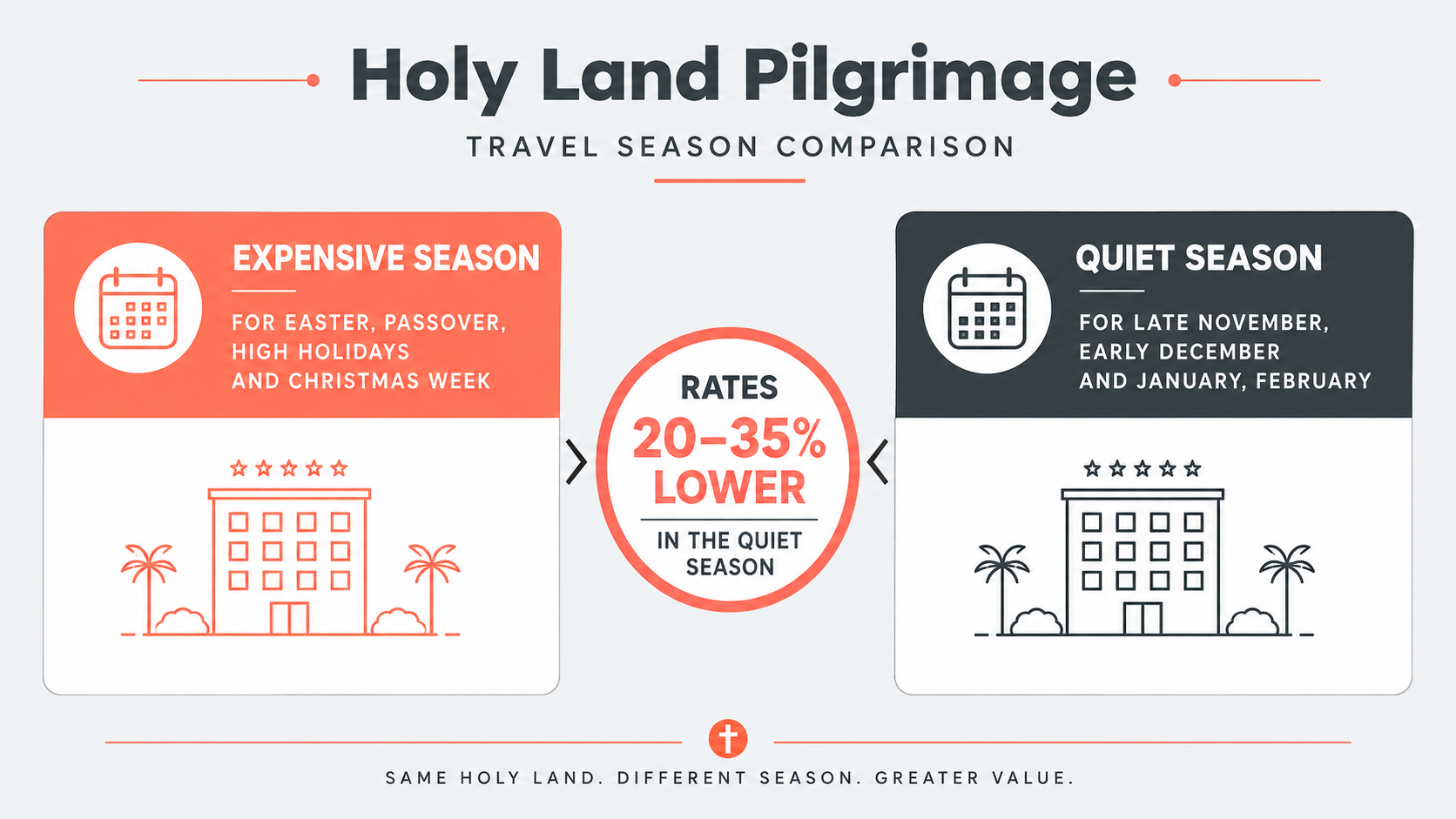
Hotel pricing in Israel follows occupancy, and occupancy follows the calendar.
Lunches are the first item left out. Half board means breakfast at the hotel and dinner at the hotel, which is standard across budget Christian tours to Israel and which we consider correct, because hotel dinners in Tiberias and Jerusalem are large buffets and nobody leaves hungry. Lunch is on you, at 12 to 20 dollars a day if you eat where the guide eats.
Gratuities for the guide and the driver are the second item, and they are not small. Figure 8 to 10 dollars per traveler per day for the guide and 5 to 6 for the driver. Across ten days that is roughly 140 dollars per person. Group leaders who collect this in advance with the trip payment avoid a difficult conversation on the last morning.
Personal travel and medical insurance is the third item, and we require it. The fourth is the single supplement, which for a 10-day program runs somewhere between 500 and 900 dollars. That is a real number for a traveler on a fixed pension who wants to see the Mount of Beatitudes (Matthew 5:1-16), and it is avoidable more often than people think.
How to Estimate What You Will Spend on the Ground
For a free afternoon in Jerusalem, budget 40 to 60 dollars per person per day and you will be comfortable. That covers lunch, a coffee, one taxi, and something small from a shop. Public transport is inexpensive in Israel, and current fares for buses, the Jerusalem light rail, and the train are published on the Ministry of Transport fares page, with a single urban ride costing a fraction of what a taxi from the Old City to a hotel in the German Colony will cost you.
Six Questions to Ask Before Your Deposit Becomes Non-Refundable
Ask the operator, in writing, to answer six specific questions before you commit any money.
- What is the exact cancellation schedule by date.
- What is the full list of included admissions, site by site.
- What are the names and locations of the hotels, not the star rating alone.
- What is the age and standard of the coach, and is the guide government-licensed.
- What is the single supplement figure, and is room matching offered.
- Which meals are included on each day, including the arrival and departure days.
An operator who answers all six in one email is an operator you can plan a budget around.
Late January Is Quiet, and Quiet Is Cheap
Hotel occupancy in Israel is strongly seasonal, and hotel pricing follows occupancy. The pattern is visible in the official Central Bureau of Statistics hotel data, and it has not changed much in three decades.
The expensive windows are Easter and Passover, the Jewish High Holidays in September and October, and Christmas week. The quiet windows are late November into the first ten days of December, and the whole of January and February. Rates in those weeks can sit 20 to 35 percent below Easter for an identical program, and flights from most U.S. gateways drop as well.
The trade is weather. January in Jerusalem is cold and wet, sometimes 45 degrees at 8 in the morning on the Mount of Olives (Acts 1:9-12), and the Sea of Galilee boat can be canceled for wind. Groups from warmer U.S. climates should know this before they pack. The seasonal picture is described plainly on the Ministry of Tourism’s weather overview. What we tell pastors is that the cheapest Holy Land tour dates and the most comfortable dates are rarely the same week, and that early March and mid-November sit in between, with softer pricing and pleasant walking weather.
The Cheapest Quote We Ever Reviewed Housed a Group Fifty Minutes From Jerusalem
It was a 9-day program for a Baptist congregation, priced about 400 dollars per person under anything else on the table. The hotels were in a coastal town. Every Jerusalem day started with an hour on the coach and ended with an hour back, which is roughly fourteen hours of the trip spent on the highway, and the group would have reached the Church of the Holy Sepulchre after tour buses from four other operators.
The red flags are consistent. Hotels described by region rather than by city. Itineraries with two or three “shopping opportunities” per day, because the operator earns commission on them. Admission fees described as payable locally. A guide who is a “tour leader” rather than a government-licensed guide, which in Israel is a license that takes two years of study and a state examination to obtain.
Operator vetting is the part of the process most group leaders rush, and it is worth reading our note on how to choose the best Holy Land tour companies for your trip before you shortlist anyone. A licensed guide at Capernaum (Mark 1:21-35) who knows which synagogue stones are first-century and which are fourth is not an upgrade. He is the trip.
Ten Ways to Bring the Per-Person Price Down
One. Fill the coach. The vehicle, the driver, and the guide cost the same daily rate for 18 travelers or 44. Going from 20 travelers to 35 typically drops the per-person land price by 200 to 350 dollars.
Two. Move the dates. Late January, February, or the first week of December against Easter is the single largest saving available to you, and it costs you nothing in itinerary.
Three. Twin-share everything, and ask for room matching. We keep a matching list for every departure. Two travelers from the same congregation who have never met usually end the trip as friends, and each of them keeps roughly 600 dollars.
Four. Take half board. Dinner in a Jerusalem restaurant runs 35 to 55 dollars per person. Dinner in the hotel is already paid for.
Five. Book land-only if your people have miles. A congregation with heavy airline loyalty can often beat a group air contract. A congregation in a small market with one connection usually cannot.
Six. Cluster the nights. Three nights in Tiberias and five in Jerusalem beats six hotel changes. Every hotel change costs a morning of luggage handling and roughly 100 kilometers of coach movement.
Seven. Book 6 to 10 months out. Hotel blocks in Jerusalem for spring are contracted early. Groups that come to us in January for April are paying whatever is left.
Eight. Choose pilgrim guesthouses and tourist-class hotels. Clean, well located, breakfast at 6:30, no spa. Nobody remembers the lobby.
Nine. Defer the extensions. Petra and Eilat add real money and two days. The Dead Sea and Masada add half a day and very little cost, because you pass them anyway.
Ten. Do not rent cars. Parking near the Old City, fuel at roughly double U.S. prices, and separate admission tickets erase any saving within three days.
| Saving lever | Realistic effect per person, 10-day program | What it costs you |
|---|---|---|
| Group of 35 instead of 20 | 200 to 350 USD | Recruitment effort |
| Low season instead of Easter | 300 to 600 USD including airfare | Cooler, wetter weather |
| Twin share instead of single | 500 to 900 USD | A roommate |
| 3-star instead of 4-star | 350 to 700 USD | Hotel comfort, not location |
| Dropping a Petra extension | 450 to 700 USD | Two days and one country border |
The Sites You Do Not Cut
Whatever the budget, the core sites remain fixed. These typically include the following.
- The Sea of Galilee boat crossing (Luke 5:1-11)
- Capernaum (Mark 1:21-35)
- The Mount of Beatitudes (Matthew 5:1-16)
- Tabgha (John 6:1-15)
- The Jordan River at Yardenit (Matthew 3:13-17)
- Nazareth (Luke 1:26-38)
- The Mount of Olives and Gethsemane (Mark 14:32-42)
- Bethlehem (Luke 2:1-20)
- The Via Dolorosa (Luke 23:26-32)
- The Western Wall
- The Church of the Holy Sepulchre or the Garden Tomb (John 19:41-42), depending on the group’s tradition
Caesarea Maritima (Acts 10:1-48) costs almost nothing to add because it sits on the road north from the airport.
Small Money Leaks in the Old City
Use a credit card with no foreign transaction fee and skip the airport exchange kiosks entirely. Keep receipts on purchases above the VAT refund threshold and claim the refund at Ben Gurion before check-in, which most groups forget and which is real money on olive wood from a Bethlehem workshop. Bring a refillable bottle, modest clothing that covers shoulders and knees for the churches, and shoes you have already broken in. A pair of shoes bought in a panic on Jaffa Street costs three times what it costs at home.
Where the Denominational Question Changes the Budget
We do not run one generic Christian tour. The first question we ask any American group leader is which tradition the congregation belongs to, because the answer changes the itinerary, the ceremonies, and sometimes the price.
A Catholic parish needs Mass arranged daily, which means booking chapels at the Church of the Nativity, at Gethsemane, and at the Basilica of the Annunciation (Luke 1:26-38) months ahead, and it means real time inside the Church of the Holy Sepulchre and along the stations of the Via Dolorosa. A Southern Baptist congregation will usually want the Garden Tomb (John 19:41-42) for communion instead, a full baptism service at Yardenit with robes and towels for the group, and extended Scripture reading at each site, which slows the day and means we plan fewer stops. A Pentecostal ministry wants extended worship time on the Mount of Olives and will accept a shorter museum morning to get it. A Presbyterian or Methodist group tends to ask for archaeological and theological depth, which affects which guide we assign. Lutheran, Anglican, Adventist, and Orthodox groups each bring their own priorities as well, and our planning process accounts for them from the first conversation.
Each of those choices has a cost. Baptism robes, chapel reservations, a sound system on the Mount of Beatitudes, a longer boat charter for a worship session on the water. None of them are expensive individually. All of them are impossible to arrange three weeks out. This is why the pastor’s answer about what his people should experience comes before the quote, and not after it.
If you are planning a trip for a Protestant, Catholic, Evangelical, Baptist, Pentecostal, Methodist, Lutheran, Presbyterian, Anglican, Orthodox, or Adventist congregation, we can build a first draft itinerary and a realistic per-person figure around your specific tradition and budget before anyone pays anything. This service is available to U.S.-based church groups and conference organizers.
Budget Tier or Standard Tier, and What Actually Differs
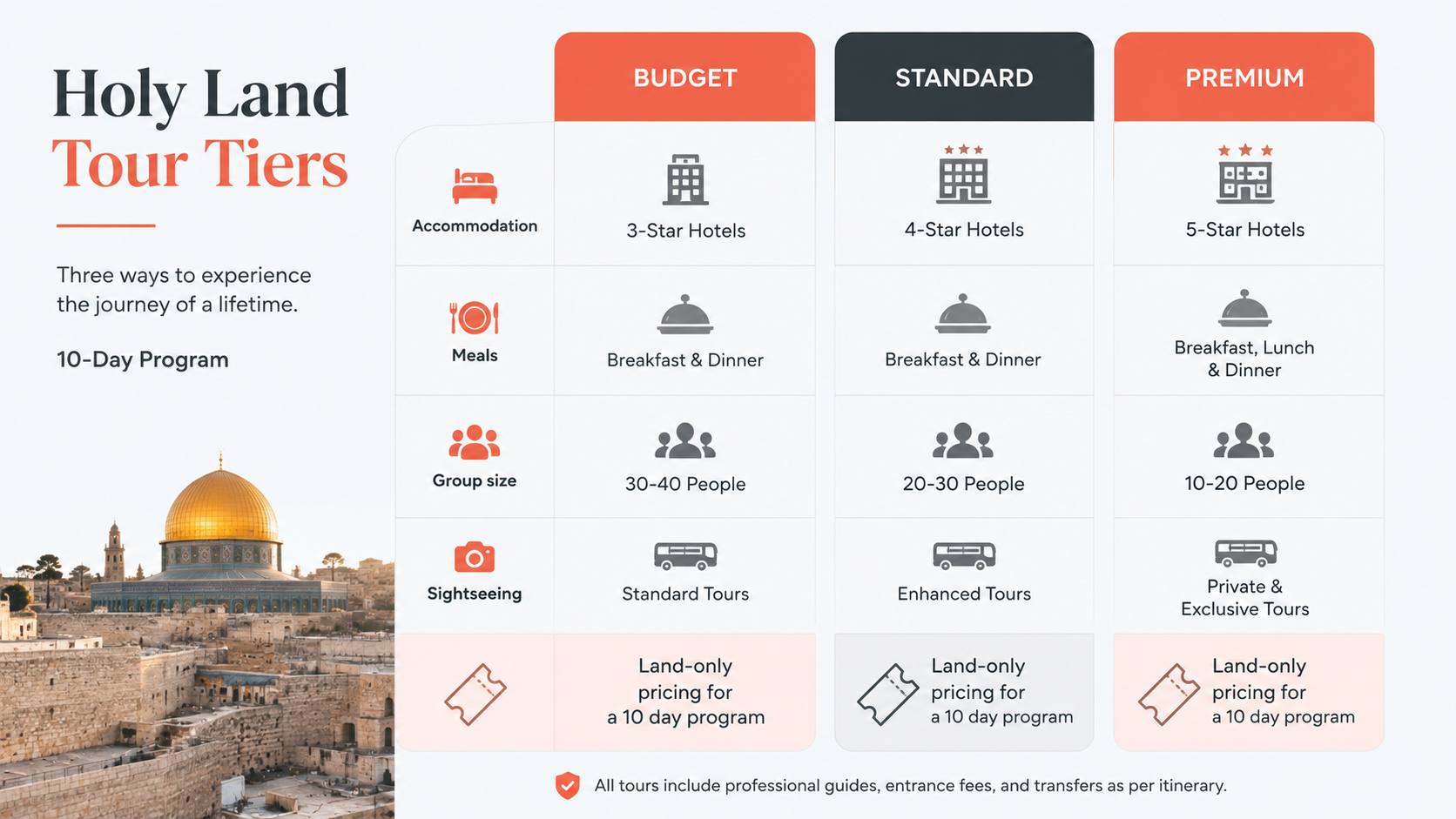
The spiritual content of the itinerary stays constant across every price tier.
The spiritual content does not change between tiers. Every guide in Israel, on every price level, holds the same national license. The group standing at Muhraqa on Mount Carmel (1 Kings 18:16-40) hears the same guide whether they slept in a guesthouse or a resort the night before.
| Element | Budget | Standard | Premium |
|---|---|---|---|
| Accommodation | 3-star tourist hotels and pilgrimage guesthouses | 4-star tourist class, central locations | 5-star, Old City views, resort properties |
| Meals | Half board, buffet breakfast and dinner | Half board plus two or three included lunches | Full board, restaurant lunches, one festive dinner |
| Group size | 35 to 48 passengers | 20 to 30 passengers | Private, 8 to 16 passengers |
| Sightseeing | All core biblical sites, ceremonies included | Core sites plus lectures and one extension | Core sites, extensions, private access arrangements |
| Land-only, 10 days | 1,900 to 2,600 USD | 2,600 to 3,600 USD | 4,200 USD and up |
Church youth groups, seminary students, first-time pilgrims, travelers on fixed pensions, and multi-generational families are the profiles that get the most out of the budget tier. A congregation that fills a coach at the budget level brings sixty people to Israel. The same congregation at the premium level brings twenty-two. We know which one changes a church.
Frequently Asked Questions
Are budget tours safe?
The coach, the driver’s license, the guide’s license, and the safety protocols are identical across every tier. Price affects the hotel and the meal plan. It does not affect the standards that Israeli regulation applies to every vehicle carrying tourists.
Can a solo traveler join without paying the double occupancy rate?
Often, yes. Tell us when you register and we will place you on the room-matching list for that departure. If no match is found, the single supplement applies, and we say so before you pay.
Are communion and baptism included on budget programs?
They are part of the program, not an upgrade. The Galilee boat, communion at the site your tradition prefers, and the baptism service at Yardenit are built into the itinerary from the first draft, regardless of price tier.
How early should our congregation reserve?
Six to ten months for hotel blocks and airline allocations. For Easter, ten to fourteen months. The pastor from Tulsa mentioned earlier now books eleven months out, and his more recent group paid less per person than his earlier one.
Will our itinerary look different from a group of a different denomination?
Yes. A Catholic group’s schedule is built around daily Mass and chapel reservations. A Baptist group’s schedule prioritizes the Garden Tomb and a full baptism service. A Pentecostal group receives extended worship time on the Mount of Olives. We ask about denomination before we draft any itinerary, not after.
Bringing a per-person price down does not require cutting the sites that matter. It requires filling the coach, choosing dates outside the peak windows, taking half board, matching rooms where possible, and confirming in writing what is and is not included before anyone signs a deposit. The itinerary itself, built around the specific denomination of the visiting group, is what makes the trip worth the cost in the first place.
Talya Felner has been putting these programs together since the late 1980s, and tourism is the only business this company has ever been in. If your congregation is starting to look at dates, sites, and a realistic per-person figure, write to Talya directly or reach out through the contact page, and we will build a first draft around your tradition and your budget before anyone pays anything.

About the Author
Talya Felner is the Owner and CEO of Talya Tours Services (TTS), a professional tour operator in Israel. With over 35 years of experience and more than 90,000 travelers served, Talya has built TTS into a trusted name for Christian pilgrimages, biblical tours, and conferences for groups visiting Israel and the Holy Land. Her team designs each itinerary around the specific Christian denomination of the visiting group, whether Protestant, Catholic, Evangelical, Baptist, Methodist, Pentecostal, Lutheran, Presbyterian, Anglican, Orthodox, or another tradition, ensuring that sites, worship arrangements, and guides reflect what matters most to that congregation. From visas and accommodations to guides, transportation, and on-site coordination, TTS handles every detail so American pastors and group leaders can focus on the spiritual experience of their travelers.