
A pastor in Nashville called us on a Tuesday in late February. Forty-four people from his congregation wanted to be in Jerusalem for Easter, and he had not booked a single hotel room.
That call is a reasonable description of how a good number of Land of the Bible tours begin. Someone finishes a sermon series, the congregation asks when they are going, and the group leader discovers that a trip through the Bible lands is not something you assemble from a website in an afternoon. It has an order. It has driving distances. It has opening hours that decide whether forty people stand quietly at a site or file past it in seven minutes.
We have been organizing tours in Israel and the Holy Land for more than thirty-five years, and over 90,000 travelers have come through our programs. Almost everything below comes from watching American church groups succeed or plan poorly on the same roads, in the same months, with the same three or four decisions.
Reading time: 9 minutes
Key points in this article
- Land of the Bible tours typically run 9 to 11 days on the ground, tracing a route from Galilee through the Jordan Valley to Jerusalem and the Judean Desert.
- Every itinerary is built around the specific Christian denomination of the visiting group, shaping site selection, worship time, and ceremonies such as baptism renewal or Mass.
- Season affects both weather and price. Spring and autumn are the most comfortable months and also the most expensive.
- Before paying a deposit, group leaders should confirm hotel names, coach size, cancellation policy, and guide licensing in writing.
Table of contents
- What a Land of the Bible tour is
- How a biblical land tour differs from a sightseeing holiday
- Choosing a trip length, nine to eleven days
- A ten-day routing, region by region
- The archaeological sites that move groups most
- How itineraries change by denomination
- Weather, packing, and choosing a month
- Safety, accessibility, price, and questions to ask
- Frequently asked questions
What a Land of the Bible Tour Is, Once You Strip Away the Brochure Language
A Land of the Bible tour is a routed itinerary through the geography of Scripture, built so that the text a group already knows is read on the ground where it happened. Not a sightseeing circuit with a chapel stop added at the end.
The geography is compact and predictable. Galilee in the north, the Jordan Valley running down the eastern side, Jerusalem and Bethlehem in the center, the Judean Desert and the Dead Sea in the south, and the Mediterranean coastal plain on the way in and out. Five regions, roughly 250 kilometers from the top of the itinerary to the bottom.
These trips are booked by church groups of 25 to 45, pastoral and staff delegations of eight to twelve, families traveling three generations together, and individual American travelers who prefer to join a fixed departure. We run Christian tours in Israel for all of these, and the difference between them is not the site list. It is the pacing and the ceremonies.
What changes for most people is small and physical. You read the Sermon on the Mount your whole life. Then you sit on the slope at the Mount of Beatitudes (Matthew 5:1-16), see how the ground curves down toward the lake, and understand why a crowd could hear one man speaking.
A Biblical Land Tour Runs on a Different Clock Than a Sightseeing Holiday
A leisure visitor to Israel is optimizing for variety. A biblical land tour is optimizing for continuity.
The practical difference shows up in the schedule. A general tour gives a site twenty minutes and moves on. A pilgrimage group needs the guide to explain the archaeology, then step back so the pastor can read the passage, then hold ten minutes of quiet before anyone gets back on the coach. At Tabgha (John 6:1-15) that is the difference between a photograph and a memory.
Guides are the second difference. A general guide can tell you when Herod built something. A guide working with a faith group has to hold first-century archaeology and the biblical text in the same sentence, and know when to stop talking.
The third difference is the group itself. Forty people from one congregation who worship together in the morning at Gethsemane (Matthew 26:36-46) behave differently for the rest of the day than forty strangers assembled by a booking engine. The Bible readings on site are what turns a coach into a fellowship.
Nine to Eleven Days. We Have Tried Every Other Number.
For comprehensive Bible land travels, the working answer is nine to eleven days on the ground, not counting flights. Shorter trips are possible and we sell plenty of them. They cost you the desert.
| Length | What fits comfortably | What gets dropped | Suits |
|---|---|---|---|
| 7 to 8 days | Two nights Galilee, four nights Jerusalem, coastal drive on arrival | Masada, Qumran, Dead Sea, Valley of Elah, Beit She’an | Working pastors, tighter budgets, first-time groups |
| 9 to 11 days | Three to four days Galilee, four to five days Jerusalem, a full Dead Sea day, Bethlehem | Very little. Occasionally the Negev or Caesarea Philippi | Most American church groups |
| 12 to 14 days | All of the above plus study time, second visits to Jerusalem sites, a rest day | Nothing significant | Bible study groups, seminaries, repeat pilgrims |
The 7 to 8 Day Express Itinerary
This works for congregations where the pastor cannot be away from the pulpit for two Sundays, and for groups where the price point decides whether thirty people come or twelve. You keep Jerusalem and the Sea of Galilee basin intact and you skip the south. Groups accept this trade-off easily until they meet someone at church who floated in the Dead Sea and climbed Masada.
The 10 to 11 Day Comprehensive Itinerary
This is the length we recommend when the group has the freedom to choose. Three to four days based on the lake, four to five nights in Jerusalem, one long day in the Judean wilderness. The geography stays continuous, which matters more than most people expect. You travel the way the biblical narrative travels, north to south, and nothing feels bolted on.
A Ten-Day Routing, Region by Region
Routing is where operators separate. The site list on two brochures can look identical while one itinerary keeps groups in the coach for five hours a day and the other keeps them under three.
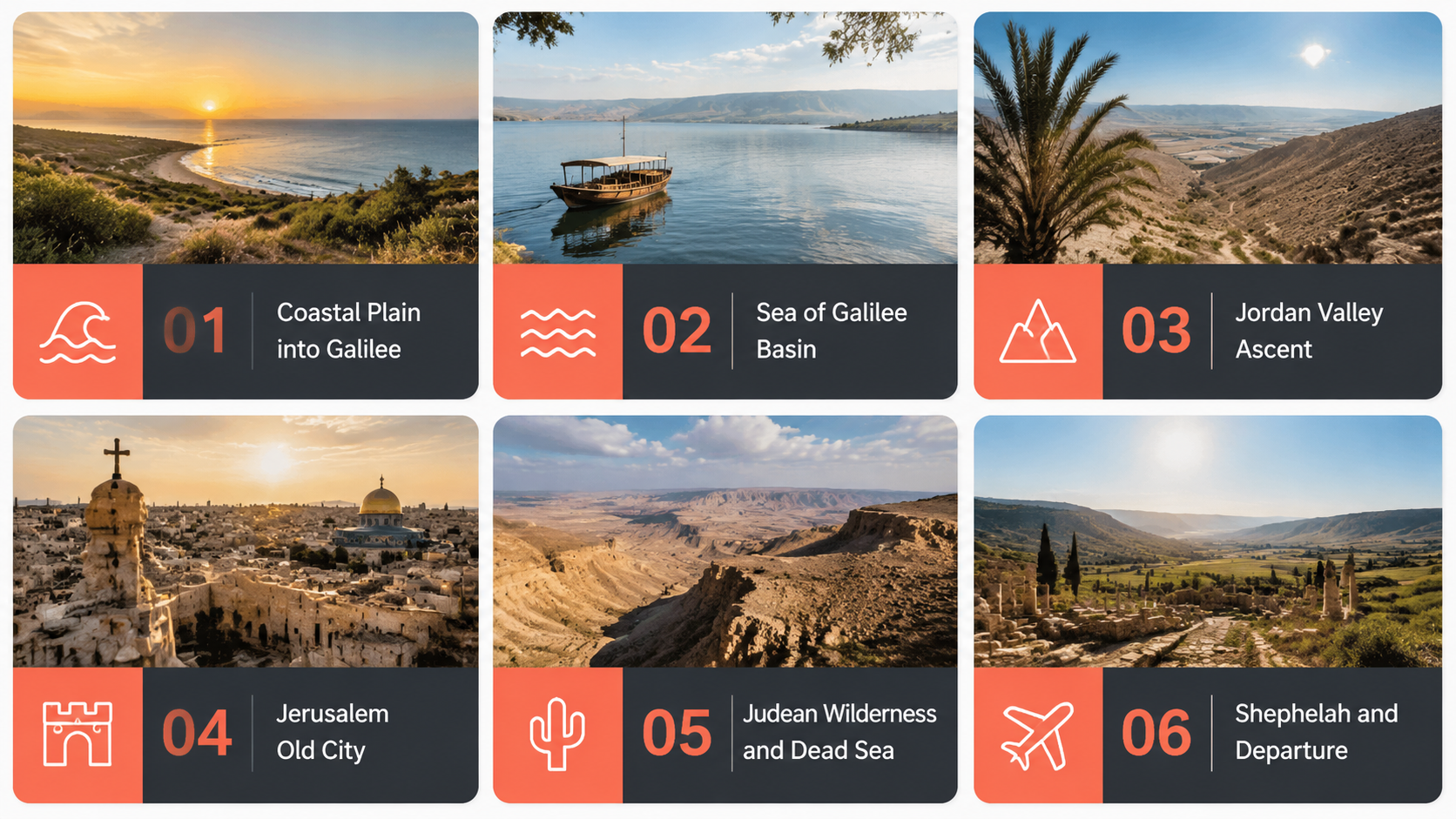
A regional breakdown of a ten-day Land of the Bible itinerary.
| Days | Region | Main sites | Notes on movement |
|---|---|---|---|
| 1 to 2 | Coastal plain into Galilee | Caesarea Maritima (Acts 10:1-48), Mount Carmel and Muhraqa (1 Kings 18:16-40), Megiddo (1 Kings 9:15) | Roughly 160 km from the airport to the lake, broken by two stops |
| 3 to 4 | Sea of Galilee basin | Mount of Beatitudes (Matthew 5:1-16), Capernaum (Mark 1:21-35), Tabgha (John 6:1-15), Magdala (Luke 8:1-3), boat crossing (Mark 4:35-41), Jordan River (Matthew 3:13-17) | Everything within 20 km of the hotel. Shortest driving days of the trip |
| 5 to 6 | Jordan Valley ascent | Beit She’an (1 Samuel 31:8-13), Jericho (Joshua 6:1-20; Luke 19:1-10), Mount of Olives overlook (Acts 1:9-12) | The classic pilgrim ascent to Jerusalem, about three hours with stops |
| 7 to 8 | Jerusalem Old City | Western Wall, Southern Steps (Luke 2:41-47), Pool of Bethesda (John 5:1-9), Via Dolorosa and Holy Sepulchre (John 19:17-20), Garden Tomb (John 20:1-18), City of David and Hezekiah’s Tunnel (2 Kings 20:20) | Walking days. Six to nine kilometers on stone |
| 9 | Judean wilderness and Dead Sea | Masada, Ein Gedi (1 Samuel 24:1-2), Qumran, Dead Sea bathing | Jerusalem down to the Dead Sea is about 40 km and a descent of over 1,200 meters |
| 10 | Shephelah and departure | Valley of Elah (1 Samuel 17:1-51), Jaffa (Jonah 1:3; Acts 9:36-43) | Ends 25 minutes from the airport |
Group leaders who want the full daily program with hotels, meals, and ground coordination written out can look at our Christian tour packages to Israel, which follow this regional logic in several lengths.
The Stones That Argue – Megiddo, Caesarea, Jericho, and Mount Carmel
Ask American pilgrims six months later which stop moved them most and the answer is often an archaeological site nobody lobbied for in the planning meetings.
Megiddo (1 Kings 9:15; 2 Kings 23:29-30) is twenty-six layers of city stacked on one mound, with Solomonic gates, Canaanite altars, and a water shaft cut through bedrock. Standing on top, you see the Jezreel Valley open below and the name Armageddon (Revelation 16:16) stops being abstract.
Caesarea Maritima (Acts 10:1-48; Acts 23:23-35) is where Peter’s vision reached Cornelius and where Paul was held for two years before sailing to Rome. The harbor Herod engineered, the theater, and the inscription bearing Pontius Pilate’s name give groups something the text alone cannot.
Jericho (Joshua 6:1-20) holds Neolithic walls and a tower older than almost anything built by human hands, and it sits in view of the road where Zacchaeus climbed his tree (Luke 19:1-10).
Mount Carmel (1 Kings 18:16-40) at Muhraqa looks straight across the valley toward Megiddo, so the two sites explain each other in a single afternoon.
In Galilee, the cluster that carries the ministry years is Capernaum (Mark 1:21-35) with the house venerated as Peter’s, Magdala (Luke 8:1-3) with its excavated first-century synagogue, the Mount of Beatitudes (Matthew 5:1-16), and a crossing of the lake itself (Mark 4:35-41). In Jerusalem, the cluster is the Mount of Olives and Gethsemane (Matthew 26:36-46), the City of David with Hezekiah’s Tunnel (2 Chronicles 32:30), the Southern Steps of the Temple Mount, and the two resurrection sites, the Church of the Holy Sepulchre and the Garden Tomb (John 20:1-18).
Two Congregations Flew the Same Week and Never Saw the Same Itinerary
One was a Southern Baptist church from Charlotte. The other was a Catholic parish from Columbus. Same ten days, same season, two completely different programs.
The Baptist group spent their resurrection morning at the Garden Tomb with communion served in the garden, held a baptism renewal service at the Jordan River (Matthew 3:13-17), and read Scripture aloud at every stop, with extended time at Capernaum (Mark 1:21-35) and the Mount of Beatitudes (Matthew 5:1-16). The parish from Columbus had Mass arranged at the Church of the Nativity in Bethlehem (Luke 2:1-20), walked the Via Dolorosa with the stations in order, prayed at the Basilica of the Annunciation in Nazareth (Luke 1:26-38), and stayed considerably longer inside the Holy Sepulchre.
This is the first question we ask on the first call. Which tradition, which pastor or priest is leading, and what does the congregation expect to do at each site. A Pentecostal ministry from Tulsa usually wants extended worship time on the Mount of Olives (Acts 1:9-12). A United Methodist or Presbyterian group tends to ask for teaching depth and quiet at the same locations. A non-denominational church from Phoenix often wants wider coverage with room in the schedule for its own worship sets. There is no single Christian itinerary, and we have never sent two denominations out on the same one.
Customizing for a Church Delegation
The workflow is straightforward. We agree on a theme with the group leader, whether that is the ministry of Jesus, prophets and kings, or the early church. We then reserve what needs reserving, and some of it books out months ahead, garden areas at the Garden Tomb, private boat charters for worship on the Sea of Galilee, and grotto space near Gethsemane. Registration materials and a program sheet for the congregation come after that. For Bible land travels built around a sermon series, this conversation usually starts nine to twelve months before departure.
Private Group or Joining a Fixed Departure
A private biblical land tour gives you control over start times, service locations, and how long you stay anywhere. It suits families, leadership teams, and ministries under twenty people who want their own pastor leading every devotion. Joining a scheduled departure lowers the cost per person substantially, because a 45-seat coach and a contracted hotel block spread across more travelers, and it puts your people alongside believers from other American congregations. Both work. The choice is usually budget and control, in that order.
If your congregation is planning a trip, we build the itinerary around your specific denomination, whether Baptist, Catholic, Pentecostal, Methodist, Presbyterian, Lutheran, Anglican, Orthodox, or non-denominational. Tell us your tradition and your dates, and we will put together a program and a line-item quote.
Weather, Shoes, and the Month You Choose
Spring and autumn are the honest answer for Bible land travels, and they are also the most expensive months. That is not a coincidence.
| Season | Conditions on the ground | Crowds and pricing | Watch for |
|---|---|---|---|
| March to May | Wildflowers across Galilee, comfortable desert walking | Peak. Easter and Passover book first | Sudden heat waves. April can jump twelve degrees in a day |
| September to November | Warm days, cooler evenings, excellent Dead Sea bathing | Peak but slightly softer than spring | Jewish holiday closures affecting site hours |
| December to February | Cool and often bright, occasional rain in Jerusalem | Best value of the year | Christmas services in Bethlehem require early booking |
| June to August | Hot and dry, especially in the Jordan Valley and Dead Sea | Moderate | Sites must be visited early. Afternoons move indoors |
Groups that check the Israel Meteorological Service climate atlas before choosing a month tend to plan realistic days. Jerusalem sits at about 800 meters and the Dead Sea at 430 meters below sea level, which means one itinerary day can span a twelve to fifteen degree spread in temperature.
Packing is simple and people still get it wrong. Broken-in walking shoes with grip, because Roman pavement is polished and uneven. Layers, and a scarf or shawl for covered shoulders and knees at holy sites, which is the same standard of dignified dress that applies at official buildings across the country. A wide-brim hat, high-SPF sunscreen, sunglasses, a refillable water bottle, a small daypack, a power bank, and a compact travel Bible with a journal. That last item is the one travelers thank us for.
Safety, Access, Price, and the Five Questions to Ask Before You Wire a Deposit
Safety on Land of the Bible tours is an operational function, not a slogan. Routes are reviewed daily, alternates exist for every day of every itinerary, and the operator stays in contact with local authorities and site managers. Any serious operator holds licenses that fall under the Ministry of Tourism’s operational standards and quality oversight, and any serious group leader reads current advisories before committing dates. We rebuild routing when conditions require it. That is the job.
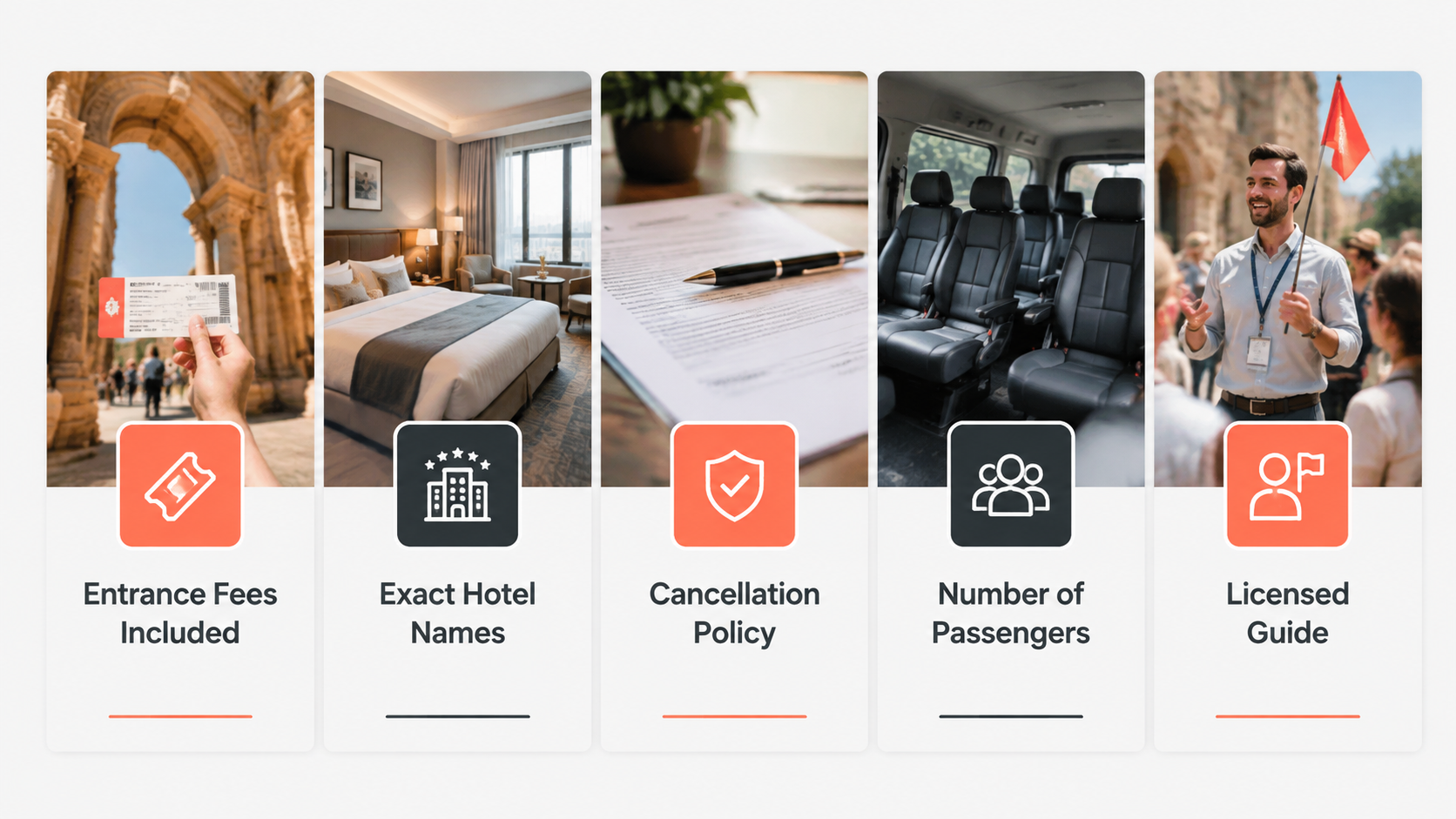
Key questions to confirm with any tour operator before paying a deposit.
Accessibility is the second question we hear from group leaders with older congregations, and the answer is better than most people assume. National parks and heritage sites publish their own accessibility information, coaches can be dropped closer at several sites when arranged in advance, Masada has a cable car, and panoramic alternatives such as the Mount of Olives overlook let anyone opt out of a climb without missing the day.
Price on Bible land tours depends on four factors, season, group size, hotel category, and what is genuinely included. A 40-passenger coach spreads its cost far better than a 16-seat minibus. A pilgrim guest house in Jerusalem and a five-star property twelve minutes away can differ by a third of the total package. Tips, lunches, and insurance either appear in the quote or appear later.
Before any deposit, ask five things. Are entrance fees, porterage, and whisper headsets in the published rate. What are the exact hotel names, not “or similar”. What is the cancellation and postponement policy in writing. How many passengers will be on the coach. And is the guide licensed by the Ministry of Tourism with real biblical training, which is why we work only with certified Christian tour guides in Israel who can hold an excavation report and a Scripture passage in the same breath. Talya herself reviews every group program before it goes out, and the dedicated team at Talya Tours handles visas, vehicles, guides, accommodation, insurance, baptism and communion arrangements, and airport assistance under one roof. Tourism is our only business.
Frequently Asked Questions
How far in advance should a church group book a Land of the Bible tour
For groups of 25 or more traveling around Easter or Christmas, nine to twelve months ahead is realistic. Garden space at the Garden Tomb, private boat time on the Sea of Galilee, and grotto access near major sites book out early, and hotel blocks in Jerusalem tighten well before the season starts. Smaller delegations of eight to twelve can often plan with four to six months of lead time.
Does Talya Tours build a different itinerary for each Christian denomination
Yes. A Southern Baptist congregation and a Catholic parish traveling the same week will have different programs, not just different worship services layered onto the same stops. Site emphasis, time allotted at each location, and ceremonies such as baptism renewal, Mass, or extended worship on the Mount of Olives are all set based on the group’s tradition and what the pastor or priest wants the congregation to experience.
What is the ideal length for a first-time congregation trip
Nine to eleven days on the ground covers Galilee, Jerusalem, and a full day in the Judean wilderness without feeling rushed. Groups working with a tighter budget or a pastor who cannot be away for two Sundays often choose the seven to eight day version, which keeps Galilee and Jerusalem intact but drops the Dead Sea, Masada, and Qumran.
Are these tours manageable for older travelers or those with mobility limitations
Generally yes, with some planning ahead of time. Masada has a cable car so climbing is not required. Coaches can be dropped closer to entrances at several sites when arranged in advance. Sites with uneven terrain, such as the Mount of Olives, have panoramic overlook points that let travelers experience the view and the Scripture reading without a difficult walk.
What should be confirmed in writing before paying a deposit
Confirm whether entrance fees, porterage, and whisper headsets are included in the published rate, the exact hotel names rather than “or similar,” the cancellation and postponement policy in writing, the number of passengers the coach will carry, and whether the guide is licensed by the Ministry of Tourism with training in biblical sites specific to your denomination.
A Land of the Bible tour works best when the length, the route, and the ceremonies are set around the group traveling, not fitted into a generic template. Nine to eleven days lets a congregation move from Galilee to the Judean Desert without losing the thread of the biblical narrative, and building the itinerary around a specific denomination, whether Baptist, Catholic, Pentecostal, Methodist, Presbyterian, Lutheran, Anglican, or Orthodox, shapes which sites get more time and which ceremonies are included.
If your congregation is starting to think about dates, we are glad to talk through length, season, denomination-specific ceremonies, and a line-item quote before you commit to anything. Tell us which tradition your group belongs to, and we will build the itinerary from there.
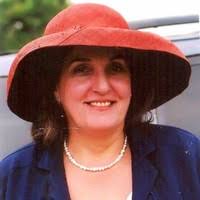
About the Author
Talya Felner is the Owner and CEO of Talya Tours Services (TTS), a leading professional tour operator in Israel. With over 35 years of experience and more than 90,000 travelers served, Talya has built TTS into a trusted name for Christian pilgrimages, biblical tours, and conferences for groups visiting Israel and the Holy Land. Her team designs each itinerary around the specific Christian denomination of the visiting group, whether Protestant, Catholic, Evangelical, Baptist, Methodist, Pentecostal, Lutheran, Presbyterian, Anglican, Orthodox, or another tradition, ensuring that sites, worship arrangements, and guides reflect what matters most to that congregation. From visas and accommodations to guides, transportation, and on-site coordination, TTS handles every detail so American pastors and group leaders can focus on the spiritual experience of their travelers.