
A pastor in Nashville calls the office in late January. His congregation of 38 wants to be at the Garden Tomb on the morning of Good Friday, and he has already booked flights. He has not, however, booked a guide, and he assumes any guide who speaks English and knows the Bible will do. This is the single most common and most costly assumption an American church group makes, and it is the reason this article exists.
The difference between a standard sightseeing trip and a journey that genuinely moves a congregation almost always comes down to the person standing at the front of the bus, and to whether that itinerary was actually built around your church’s specific tradition. This article explains how licensing works in Israel, what questions to ask before booking, what a Christian guide should offer versus what a licensed guide is legally required to hold, and how costs and durations typically break down for U.S. groups.
Reading time: 5 minutes
Key points in this article
- Every guide working for payment in Israel must hold a license from the Ministry of Tourism. There is no informal or gray-area category for paid guiding.
- “Licensed,” “certified,” and “Christian” describe three different things, and only one of them is a legal credential you can verify in a public registry.
- Itineraries should be built around a group’s specific denomination, since a Baptist congregation, a Catholic parish, and a Pentecostal ministry each read the same sites differently.
- Daily rates for a private guide depend most on whether a vehicle is included, the season, and the length of the trip, not on a single flat number.
Table of contents
- What does “Christian tour guides in Israel” actually mean
- How do I choose a Christian tour guide in Israel
- Are Christian tour guides in Israel required to be licensed
- Licensed guide versus certified guide versus Christian guide
- How can I verify a guide is truly licensed
- Finding a guide who leads devotionally, not just historically
- Questions to ask before booking
- What a private guide costs
- Booking a guide for a single day
- Which sites to prioritize by denomination
- Handling the Church of the Holy Sepulchre
- Ideal length for a full pilgrimage
What does “Christian tour guides in Israel” actually mean
A general guide points at a wall and tells you when it was built. A guide working with a faith group does something different. Standing above the Sea of Galilee, a good guide connects the physical geography in front of you to the text your congregation already knows, so that Matthew and 1 Kings stop being pages and start being places.
The strongest guides in this field hold two things at once. They tell you what the archaeology confirms, and they tell you what Christian tradition holds, without blurring the line between the two. At Capernaum they will show you the excavated first-century house beneath the modern church and let your group decide what it means to them.
They also read the room by denomination. Scripture readings, silent prayer, and pacing at each site look different for a Catholic parish than for a Pentecostal ministry, and different again for a Lutheran or Presbyterian group. A good guide asks which tradition your group belongs to before planning a single stop, not after.
How do I choose a Christian tour guide in Israel
Five things matter, roughly in this order. Government licensing first. Verified experience with actual biblical itineraries second. Alignment with your congregation’s specific tradition third. Real logistical backup fourth. Honest, itemized pricing fifth. Reverse that order and groups tend to pay more for less.
Start with the license badge issued by the Ministry of Tourism. This is not paperwork for its own sake. An unlicensed operator is generally an uninsured operator, and if a vehicle is involved, that exposure falls on your group.
Ask for a sample day before committing. A claim of certification means little until you see whether the itinerary leaves room for a baptism renewal at the Jordan or a quiet hour at Gethsemane, or whether it moves your group through several gift shops before lunch. When we build routes through our Christian Tours Israel biblical sites and holy places planning, the biblical logic of the day comes first, and it is shaped around the group’s own denomination from the start.
Then decide the structure. Booking a licensed guide directly gives you one person and no safety net. Working with a full incoming operator gives you back-office support, transport coordination, and a replacement guide if someone falls ill the night before your Jerusalem day. With 38 people depending on the schedule, that difference is not academic.
A short consultation checklist
On a first screening call, ask four questions and notice how quickly the answers come. Can you provide your official license number issued by the Ministry of Tourism? A genuinely licensed guide answers this in one breath.
How do you handle denominational differences or specific requests from our group? What is your backup plan if a site closes suddenly or the vehicle breaks down? And the one most groups forget to ask, does your quoted daily rate cover vehicle insurance, driver hours, parking, and entry tickets, or are those billed separately? A serious operator will have all four answers ready before the call ends.
Are Christian tour guides in Israel required to be licensed
Yes, without exception. Israeli law requires that anyone guiding tourists for commercial payment hold a valid guide license from the Ministry of Tourism. There is no informal category and no gray area for paid work.
Earning that license is not a weekend course. It is an academic program of roughly two years covering theology, archaeology, geography, and history, followed by field examinations. A properly credentialed guide has been tested standing on the ground your group will walk.
Licensed guides also renew through mandatory seminars, which is why a working guide stays current on site conditions and standards. The official framework for license renewals and the operational standards and inspections are published directly by the government, and they are the real system behind any claim of certification.
Licensed guide versus certified guide versus Christian guide
These three terms get used interchangeably in marketing, and the confusion costs travelers money. They are not the same thing.
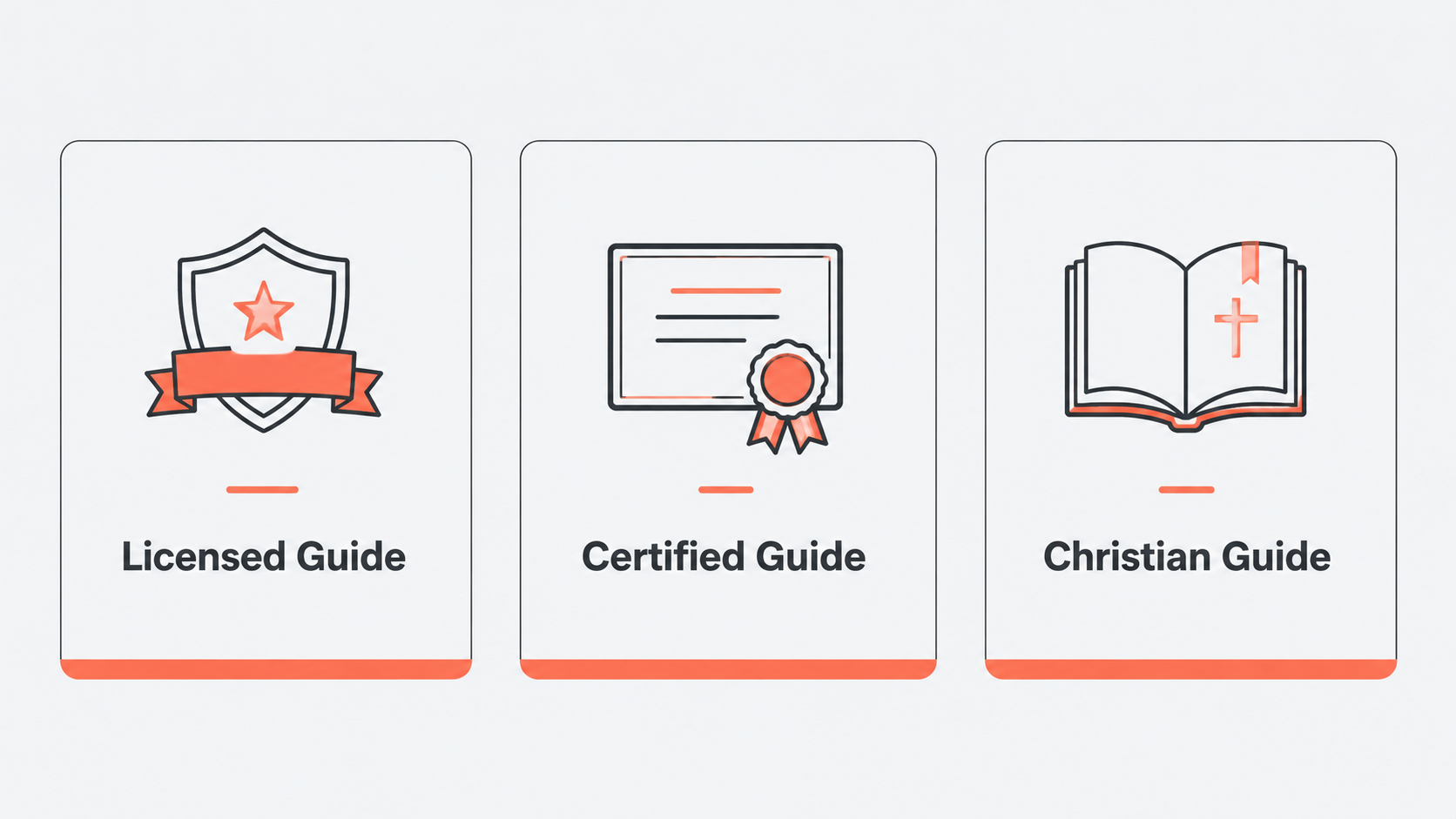
A licensed guide is a legally registered professional who passed the state examinations, carries an official Ministry of Tourism ID, and may lawfully guide inside every national park and historical landmark. This is the only category the law recognizes.
A certified guide is often just a phrase on a website. Certification by whom is a fair question to ask directly. Unless it traces back to the Ministry of Tourism, the word tells you nothing about legal standing.
A Christian guide is a description of specialization, personal faith, or denominational knowledge. It is a genuinely useful thing to look for, but it is not a legal credential. The strongest guides offer both, a real Ministry license and real fluency in the theology and worship style your congregation practices. One without the other should give you pause.
How can I verify a guide is truly licensed
Do not take the word licensed on faith. Before any deposit changes hands, ask for the guide’s full legal name and license number in writing, in an email or in the contract itself.
Then check it against the government’s own registry of registered tour guides. It takes about two minutes, and a real license holder will happily provide the number because it checks out.
Watch for warning signs. A guide who refuses to put license details in writing, or who insists on meeting your group inside a site rather than at the official entrance, which usually means avoiding staff who check credentials. A trustworthy guide never makes verification difficult.
Finding a guide who leads devotionally, not just historically
This is the question American pastors ask most often, usually in different words. They want to know whether the guide leading their group will pray with them, read Scripture at the site, and hold silence when silence is right, rather than deliver a purely academic lecture.
This is possible, but it takes clear communication up front. Many excellent licensed guides are historians first. Some U.S. groups specifically want a believing guide who leads devotionally. Others deliberately choose a guide whose command of Hebrew roots and biblical geography adds a layer they could not get otherwise. Both approaches are valid, and the right choice depends on the group.
The way to get it right is to say it out loud during booking. Tell the operator whether your congregation wants worship led at Gethsemane, communion at the Garden Tomb, or quiet contemplative time at each stop, and whether your tradition is Baptist, Methodist, Anglican, Orthodox, or another stream. A guide can be matched to a group’s devotional style, but only if someone knows what that style is first.
If your church is planning a trip and wants an itinerary built around your specific denomination, we can walk through dates, sites, and worship needs before you commit to anything.
Questions to ask before booking a guide
Move past the license and get practical. On pacing, ask how the guide adjusts the route for members with limited mobility or a slower walking pace. A congregation of 40 rarely walks at one speed.
On denominational needs, ask whether private space for worship or communion can be reserved at sites like the Garden Tomb or on the Sea of Galilee. This is where the difference between traditions becomes concrete. A Catholic parish may need arrangements for Mass, a Baptist group may want a full immersion baptism at the Jordan, and a good operator handles both without hesitation.
On transport and safety, ask what vehicle is used, whether it carries commercial transportation permits, and whether toll roads and parking are covered in the quote. A real licensed guide pairs with a licensed vehicle, not a personal car.
Questions about the daily itinerary itself
Three more questions save groups from difficult days. How many hours of active driving versus actual time at sites are planned each day. A day that looks full on paper can be four hours on the road. Are lunch stops genuine local dining or tourist traps. And how does the plan adjust if weather or heavy crowds force a change on short notice. A flexible guide already has a plan B for the Holy Sepulchre when a feast day fills it.
What a private Christian tour guide costs
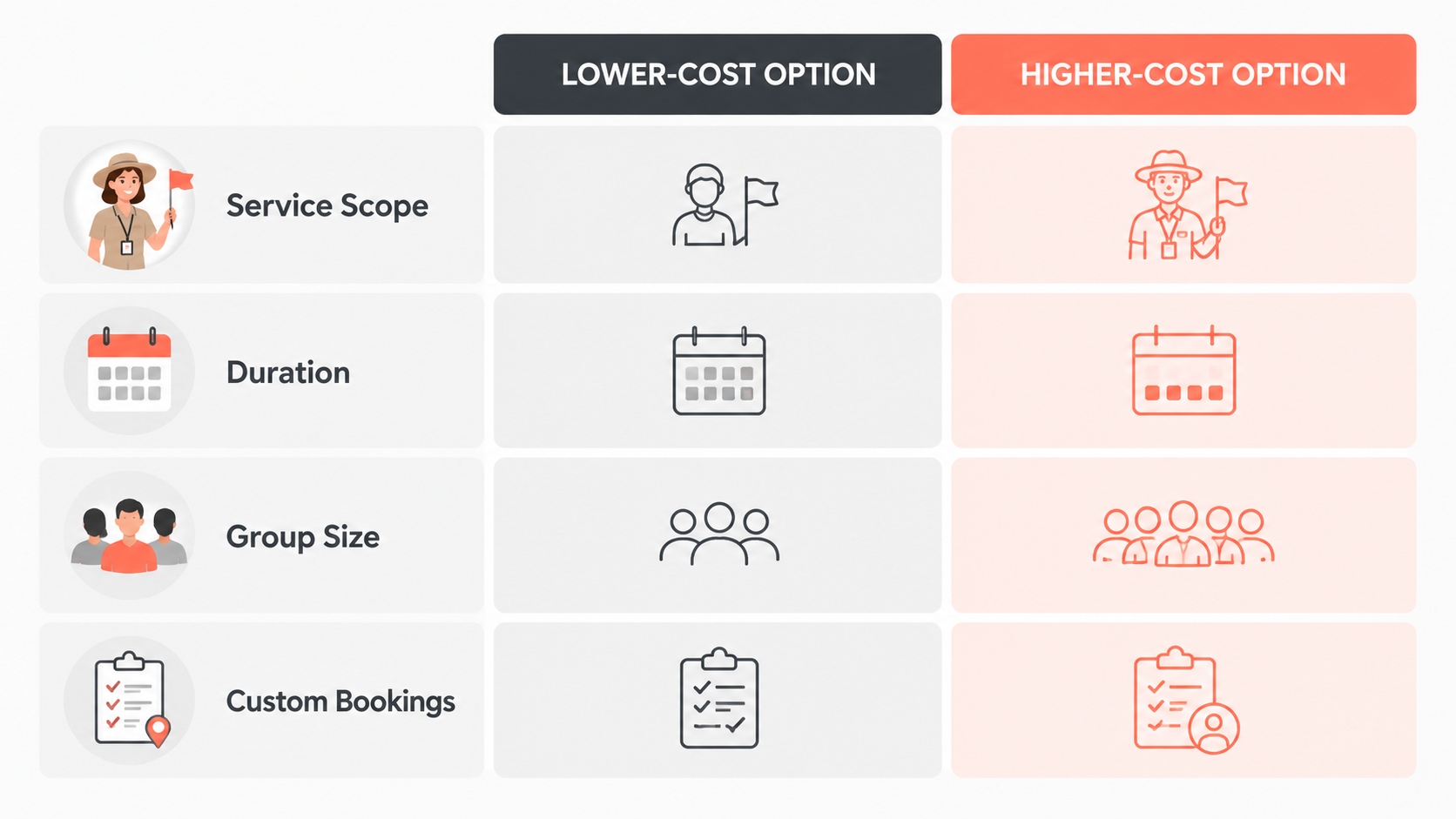
Daily rates for a licensed private guide vary with group size, season, and whether a vehicle is included. That last factor is the biggest variable. A guiding-only rate covers the guide’s time. A guide-plus-vehicle rate folds in commercial insurance, fuel, and the driver’s licensing, and it runs higher.
Budget for the extras that catch first-time groups off guard, including guide per diems on overnight itineraries, entrance fees to national parks, parking, and customary tips. A transparent operator lists these upfront.
Two factors move the final number most. Season, since weeks around Christmas and Easter cost more than shoulder months like early November or late February. And duration, since multi-day bookings usually carry a better daily rate than single days.
Lower cost is guide only, where you rent and drive. Higher cost is guide plus touring vehicle, which includes insured transport.
Lower cost is a single-day excursion. Higher cost is a multi-day journey, which covers the guide’s overnight lodging and meals.
Lower cost applies to a couple or small family in a standard van. Higher cost applies to a church group in a full commercial bus with a separate driver and guide.
Lower cost is a standard shared itinerary. Higher cost is a specialized pilgrimage with private baptisms, Mass reservations, or guest speaker coordination.
Booking a guide for a single day
This is possible and it is one of the more common requests we receive. Groups already based in Jerusalem or Tel Aviv often want one focused day in a single region rather than a full package. The Sea of Galilee, Nazareth, or the Dead Sea each make a strong standalone day.
A single day forces sharp choices, and distances are real. Galilee sits roughly two to two and a half hours north of Jerusalem, so a Galilee day means an early departure, often by 7 a.m., to make the driving worthwhile. A good guide will tell you honestly how many sites fit before the light goes.
If a fully private day is more than your group needs, our small group Christian tours of Israel let travelers join a compact group to a key biblical region without the cost of a private booking.
Which sites to prioritize by denomination
Every serious Holy Land itinerary rests on three regions, Galilee, Jerusalem, and the coastal plain with the Judean desert. Building in that order lets the biblical narrative unfold in sequence.
Galilee is where Jesus’s ministry begins. It typically includes the Mount of Beatitudes, Tabgha, and Capernaum with its first-century synagogue ruins and Peter’s house, and the official Capernaum National Park page gives useful visit details. Jerusalem carries the Passion and Resurrection, including the Mount of Olives, the Garden of Gethsemane, the Via Dolorosa, and the Garden Tomb.
On the coast, Caesarea Maritima ties directly to the Apostle Paul, and the Caesarea harbor visitors’ center anchors that visit. This is where denomination shapes the map most clearly. An Evangelical or Baptist group tends to lean toward the Garden Tomb, Yardenit for baptism, and extended Scripture readings in Galilee. A Catholic parish gives weight to the Church of the Holy Sepulchre, the Basilica of the Annunciation, and the Church of the Nativity. An Orthodox group may prioritize different chapels within the same sites entirely. The same three regions become two very different weeks depending on which congregation is walking through them.
Handling the Church of the Holy Sepulchre
This site overwhelms first-time groups more than any other. The Basilica of the Holy Sepulchre sits over layers of construction going back to the fourth century, and its administration is shared among six churches, Roman Catholic, Greek Orthodox, Armenian, Coptic, Syrian, and Ethiopian.
That shared arrangement is known as the Status Quo, and it explains why the atmosphere shifts from chapel to chapel. A guide who understands it reads the space for your group rather than letting it read them. The Franciscan Custody’s official page and the church’s own visitor guidance cover the history and hours in detail.
The practical value of a strong guide here is timing and crowd management. Knowing the early window that avoids a two-hour line, showing quieter side chapels most groups miss, and protecting the spiritual weight of the visit from the crush of the queue are skills built over many repeat visits, not something learned from a guidebook.
Ideal length for a full pilgrimage
A five to seven day tour covers the headline sites of Jerusalem and Galilee well and is enough for a first visit. Many groups leave satisfied, though the pace moves quickly.
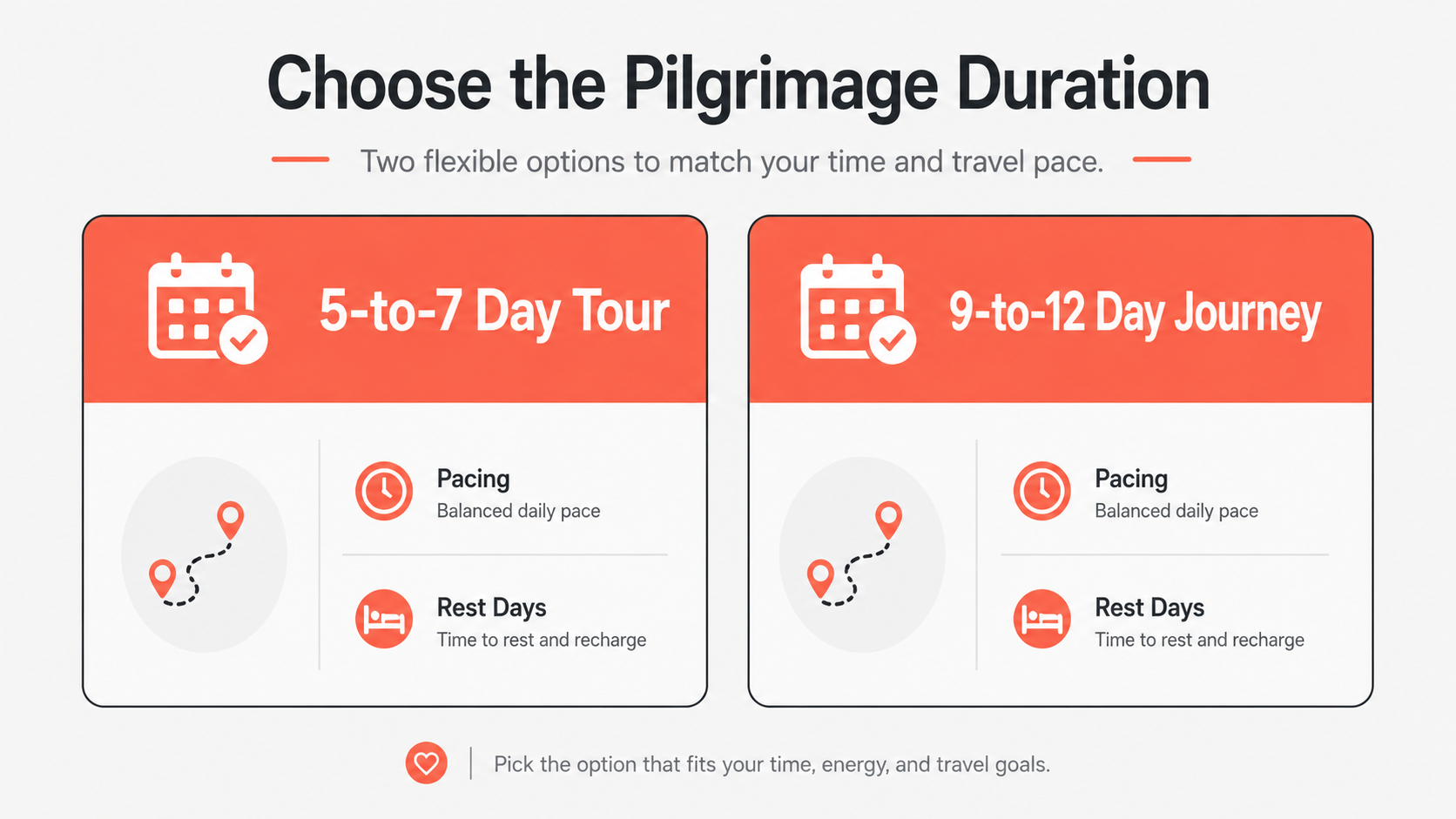
A nine to twelve day journey is a different experience. It opens room for the desert regions, quiet time at Capernaum, a stretch of the Jesus Trail on foot, and older sites like Megiddo and Caesarea that a shorter trip skips. The longer arc lets a group live the biblical chronology rather than sample it.
The real skill in designing either length is pacing. A well-built itinerary alternates full active days with slower, reflective ones so a congregation of 40 does not burn out by day six. Rest is part of the plan, not a gap in it. For groups that want flights, hotels, guiding, and meals handled together, our all-inclusive Christian tours to Israel with airfare fold the whole journey into one arrangement built around your congregation’s tradition from the first planning call.
Frequently asked questions
Do U.S. citizens need a visa to visit Israel for a church trip
American passport holders traveling for tourism do not need a visa in advance for a standard stay. A valid U.S. passport with at least six months of validity is generally required. Group leaders should confirm current entry requirements with official sources before finalizing travel dates, since requirements can be updated by government agencies independently of any tour operator.
How far in advance should our church book a guide
For trips around Christmas or Easter, booking six to nine months ahead is reasonable, since guides and vehicles for those weeks fill early. For shoulder-season travel, three to four months ahead is usually enough, though earlier booking gives more flexibility on guide selection and hotel availability.
Can the itinerary be built specifically around our denomination
Yes, this is the starting point rather than an add-on. Whether your congregation is Baptist, Methodist, Lutheran, Presbyterian, Anglican, Pentecostal, Catholic, Orthodox, Adventist, or another Christian tradition, the site selection, worship arrangements, and guide assignment should reflect what matters most to your specific group, not a generic Christian template.
What happens if our flight is delayed and we miss the first day
A full incoming operator with local staff can usually adjust the following days to recover lost time, reschedule a guide, or rearrange hotel check-in without the group leader having to manage it directly. This is one of the practical advantages of working with an operator rather than booking a guide alone.
Can our pastor lead worship or communion at biblical sites
In most cases yes, though some sites require advance coordination or permits, particularly for reserved space at locations like the Garden Tomb or for baptism services at the Jordan River. This should be discussed and arranged during itinerary planning, not assumed on arrival.
Choosing a Christian guide in Israel comes down to verifying a real license, asking specific questions about denomination, worship, and logistics, and understanding how season and vehicle needs affect cost. A congregation that gets these details right before departure spends its time in Israel focused on the trip itself rather than managing it.
If your church or group is beginning to plan a pilgrimage or a professional delegation to Israel, we are glad to talk through dates, sites, denominational needs, and logistics before you commit to anything.
Or write directly to [email protected]

About the Author
Talya Felner is the Owner and CEO of Talya Tours Services, a professional tour operator in Israel. With over 35 years of experience and more than 90,000 travelers served, Talya has built the company into a trusted name for Christian pilgrimages, biblical tours, and conferences for groups visiting Israel and the Holy Land. Her team designs each itinerary around the specific Christian denomination of the visiting group, whether Protestant, Catholic, Evangelical, Baptist, Methodist, Pentecostal, Lutheran, Presbyterian, Anglican, Orthodox, or another tradition, ensuring that sites, worship arrangements, and guides reflect what matters most to that congregation. From visas and accommodations to guides, transportation, and on-site coordination, the team handles every detail so American pastors and group leaders can focus on the spiritual experience of their travelers.