
A pastor from Nashville calls us in February. His congregation of 38 wants four days in Jerusalem, a Communion service at the Garden Tomb, and one free afternoon for the Old City markets. He has not booked hotels, and Easter is eleven weeks away. We have had this exact conversation, in some variation, hundreds of times over the past 35 years. Christian Jerusalem tours are the single most requested program we run, and the difference between a good one and a disappointing one is almost never the sites. It is the planning around them.
Reading time: 4 minutes
Key Points
- One day in Jerusalem is a visit; two or three days is a pilgrimage, with time for unhurried prayer.
- Every itinerary should be built around your group’s specific denomination, from site selection to worship arrangements.
- Private touring fees are per vehicle and guide, not per person, which makes them cost-effective for small groups.
- Starting at 7:30 in the morning avoids the heaviest crowds at the Church of the Holy Sepulchre and Gethsemane.
Table of Contents
What is a Christian Jerusalem tour, exactly?
Which Christian sites in Jerusalem are included in most tours?
How long does a Christian Jerusalem tour take?
Is a private Christian Jerusalem tour worth it?
How much do Christian Jerusalem tours cost?
What is included, and what is not
Can the tour include Mass, Communion, or dedicated prayer time?
Walking the Via Dolorosa with a Christian guide
The Church of the Holy Sepulchre, and why denominations see it differently
Can a Christian Jerusalem tour include Bethlehem in the same day?
What is a Christian Jerusalem tour, exactly?
A Christian Jerusalem tour is a guided, faith-centered journey through the places where Jesus taught, was tried, was crucified, and, according to the Gospels, rose again. That sounds obvious. What separates these programs from ordinary sightseeing is that the route follows Scripture rather than convenience. The standard frame covers the Mount of Olives (Luke 19:28-44), the Palm Sunday Road down to Gethsemane (Matthew 26:36-46), the Via Dolorosa, and the Church of the Holy Sepulchre (John 19:17-20). A guide reads the relevant passage at each stop. The Bible comes out of the suitcase and into the street.
How that frame is filled in depends entirely on the group. A Catholic parish will want the full Via Dolorosa and time at the Holy Sepulchre. A Southern Baptist church from Texas will often prefer the Garden Tomb (John 19:41-42) for its quiet and its open garden setting. We never send both groups the same itinerary. When a church leader contacts us, our first questions are about their tradition, their pastor’s priorities, and which ceremonies they want held on site. That conversation shapes everything that follows.
Which Christian sites in Jerusalem are included in most tours?
Most Christian sites inside and around the Old City walls fall into a natural sequence, and the sequence matters more than the list. Below are the twelve sites we build Jerusalem programs around, with the reason each one earns its place.
Mount of Olives (Luke 19:29-44), the panoramic overview where most tours begin, looking across the Kidron Valley at the Old City. Chapel of the Ascension (Acts 1:6-12), the traditional site of the ascension. Dominus Flevit (Luke 19:41-44), where Jesus wept over Jerusalem, a small teardrop-shaped chapel with a view most groups remember long after the trip. Pater Noster (Matthew 6:9-13), the Lord’s Prayer rendered in over a hundred languages on ceramic panels along the cloister. Garden of Gethsemane and the Church of All Nations (Matthew 26:36-46), the ancient olive trees and the Rock of Agony before the altar. Tomb of Mary (John 19:26-27), a dim, stepped crypt in the Kidron Valley that many groups skip and later regret.
Mount Zion and the Upper Room (Luke 22:7-38), the traditional Room of the Last Supper. Church of Saint Peter in Gallicantu (Matthew 26:69-75), built over the traditional house of Caiaphas, where Peter denied Christ three times. Pools of Bethesda and St. Anne’s Church (John 5:1-15), the healing pools, and a Crusader church whose acoustics turn any hymn into something groups talk about for years. Via Dolorosa (John 19:17), the traditional Way of the Cross. Church of the Holy Sepulchre (John 19:17-20, 20:1-9), Golgotha, the Stone of Anointing, and the Tomb. Garden Tomb (John 19:41-42), the alternative site favoured by many Protestant and Evangelical groups, where a Communion service in the garden is often the emotional peak of the whole pilgrimage.
Must-see core versus extended stops
A single day in Jerusalem forces choices. Here is how we usually frame them for American groups planning their first visit.
| Must-see core, one full day | Extended stops, second or third day |
|---|---|
| Mount of Olives overview | Ein Karem, Church of the Visitation (Luke 1:39-56) |
| Palm Sunday Road and Gethsemane | St. John the Baptist Church, Ein Karem |
| Upper Room and St. Peter in Gallicantu | Chapel of the Flagellation (John 19:1) |
| Via Dolorosa, all fourteen stations | Tomb of Mary, Kidron Valley |
| Church of the Holy Sepulchre or Garden Tomb | David’s Citadel, Israel Museum model |
Walking speed decides what actually fits. The Old City is small, roughly one square kilometre, but it is all stone steps, inclined lanes, and crowds. A group of 45 with an average age over 60 covers less ground in a morning than a group of 25 in their thirties, and no amount of scheduling fixes that. We plan around the group we actually have, not the group we wish we had.
How long does a Christian Jerusalem tour take?
The honest answer, after more than 90,000 travelers, is that one day is a visit and two or three days is a pilgrimage. Half-day programs of four to five hours exist, but they limit a group to two or three locations, usually the Mount of Olives and part of the Via Dolorosa ending at the Holy Sepulchre. There is little time for prayer. Groups that choose them usually do so because they are connecting to a wider tour of Israel, which is a reasonable trade.
A full day of eight to nine hours allows the Passion narrative to unfold in order. The Mount of Olives in the morning light, down the Palm Sunday Road to Gethsemane (Matthew 26:36-46), across to Mount Zion for the Upper Room, a lunch stop in the Christian Quarter, and the Via Dolorosa in the afternoon when the morning tour buses have thinned. Buffers matter. Security checks at the Holy Sepulchre entrance, narrow staircases at Calvary, and unexpected processions inside the church can each cost fifteen minutes. We build them in.
Groups with two or three days for Jerusalem can add Ein Karem (Luke 1:39-56), the Israel Museum, and a slower rhythm that leaves room for what most groups say afterwards they wanted most, unhurried time to sit, pray, and absorb. If your schedule allows it, take the third day.
Is a private Christian Jerusalem tour worth it?
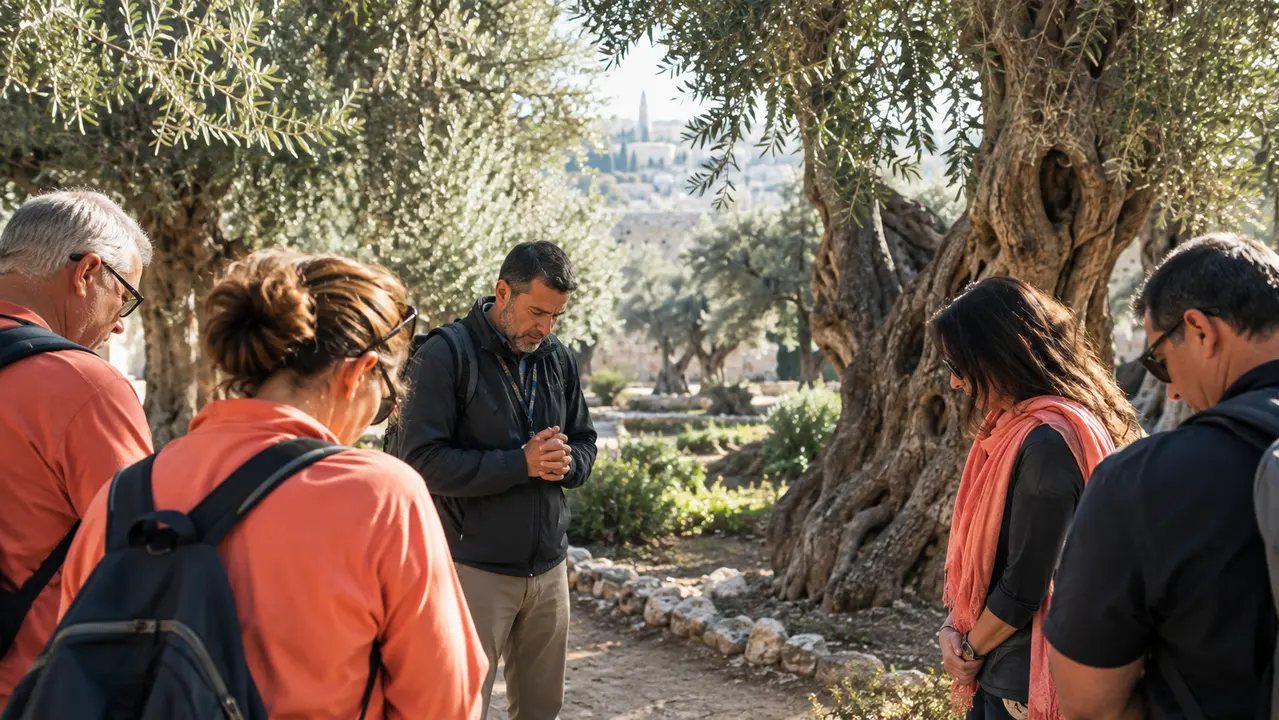
Worth is a question of what the group wants to do at the sites. A large public bus excursion of 40 to 50 passengers moves on a fixed clock. It shows you the sites. A private Christian tour arrangement in Jerusalem lets the group itself set the weight of the day, twenty extra minutes in Gethsemane because the pastor is not finished praying, Scripture read aloud without competing with three other groups, a start time moved to 7:30 to reach the Holy Sepulchre before the crowds.
The logistical gains are real as well. Hotel pickup, a licensed vehicle and driver, and the ability to reverse a route when a cruise-ship crowd floods the Via Dolorosa. In our experience the groups that gain most from a private guide are multi-generational families traveling with grandparents who need rest stops, church leadership groups and study circles who want deeper theological discussion than a bus microphone allows, and visitors with limited mobility who need step-free route adjustments through the Old City quarters. For families of four or more, private touring is often comparable in per-person cost to a large-group excursion, because the fee is structured per vehicle and guide rather than per passenger.
How much do Christian Jerusalem tours cost?
Two pricing structures cover most situations. A walking private tour, meeting your guide inside the Old City, is the mid-range option, a flat daily guiding fee with no vehicle. A private tour with a licensed tourist vehicle, driver, and hotel pickup is the premium full-service option. In both cases the fee is per day, not per person, which is why private touring becomes cost-effective for small groups.
Several variables move the final quote. Guiding hours beyond the standard eight-hour day are billed as overtime. Vehicle class matters, from a standard van to a Mercedes minivan. Many churches are free to enter, but Bethesda, Pater Noster, and David’s Citadel carry modest admission charges. Gratuities for guide and driver are customary in Israel and should be budgeted separately, usually in the range of ten to fifteen percent of the guiding fee. Groups watching their budget can combine private guiding days with our affordable Holy Land travel options to balance the private experience with sensible overall spending.
What is included, and what is not
Clarity before booking saves disputes afterwards. This is what a standard program includes and excludes in our practice, and most serious operators work within similar lines.
| Typically included | Typically excluded |
|---|---|
| Ministry of Tourism licensed guide | Meals, snacks, and bottled water |
| Customised route matching your tradition | Personal donations at shrines and candle stations |
| Full pre-trip coordination | Entrance fees at secondary historic venues |
| Private air-conditioned vehicle with driver | Tips for guide and driver |
Can the tour include Mass, Communion, or dedicated prayer time?
Yes, and arranging worship well is one of the main reasons groups come to an operator rather than assembling a trip themselves. Private chapel time and altar reservations at key sanctuaries, including the olive groves near Gethsemane (Luke 22:39-46), Dominus Flevit, and Latin altars at the Church of the Holy Sepulchre, must be requested in advance through the Franciscan Custody of the Holy Land or the site caretakers. Protestant and Evangelical groups usually book a private enclosure at the Garden Tomb for Communion. Catholic groups can align daily Mass with their itinerary through our Catholic pilgrimage to the Holy Land programs, where the Mass schedule is built into each day before anything else is fixed.
The practical advice is simple. Tell your operator your denomination, your prayer preferences, and the passages your pastor wants to read, weeks before arrival. Worship moments that are coordinated in advance do not disrupt the day. They become its structure.
Walking the Via Dolorosa with a Christian guide
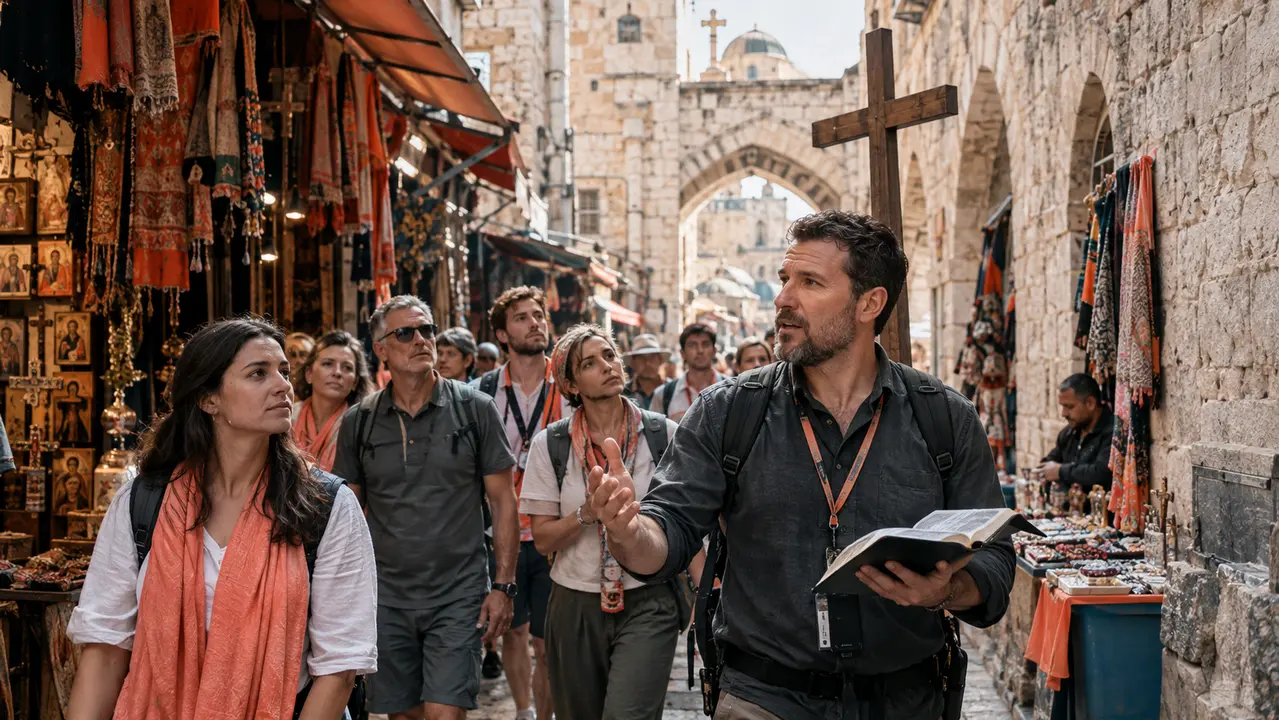
The Via Dolorosa runs roughly 600 metres from the area of the Antonia Fortress near the Lion’s Gate, through the alleys of the Muslim Quarter souk, to Golgotha inside the Church of the Holy Sepulchre. Fourteen stations mark the traditional Way of the Cross, and the last five sit inside the church itself, as the Ministry of Tourism’s own Via Dolorosa documentation confirms. Walking it is not difficult. Walking it with intention, through a working market with vendors calling and carts passing, is something else entirely.
This is where an experienced Christian tour guide in Jerusalem earns their fee. The guide sets the pace, holds the group together on crowded staircases, positions the pastor where the group can hear, and, when needed, pauses the devotion to let a delivery cart pass and then resumes it. We have watched the same guide turn a chaotic lane into a procession and back again a dozen times in a season. It is craft, and it cannot be improvised.
The Church of the Holy Sepulchre, and why denominations see it differently
The Church of the Holy Sepulchre is the anchor of virtually every Jerusalem Christian itinerary, and for many groups it is the moment the whole pilgrimage has pointed toward. Inside one complex, the Rock of Golgotha (John 19:17-20), the Stone of Anointing, and the Aedicule containing the Tomb. The church is shared by six traditions, Greek Orthodox, Roman Catholic, Armenian Apostolic, Coptic, Syrian, and Ethiopian, under a historic arrangement called the Status Quo that governs everything down to which lamp may be moved, a situation the Tower of David Museum explains in detail.
Not every group treats it the same way, and this is where the itinerary must follow the tradition. A Catholic diocese group will typically schedule a full visit with time at multiple altars and possibly a reserved Mass. A Pentecostal congregation may prefer extended prayer and worship time there or at Gethsemane (Acts 1:12-14). A non-denominational Evangelical church may visit the Holy Sepulchre for its history and then hold its main service at the Garden Tomb, where the setting better suits their worship style. We build each of these programs differently, from the first email. That is not a marketing line. It is the first question we ask, and it has been for 35 years.
Can a Christian Jerusalem tour include Bethlehem in the same day?
Yes. Bethlehem lies about 10 kilometres south of Jerusalem, and crossing between them involves a checkpoint and a change of vehicle and guide, which we arrange routinely. A combined day works like this. The Passion narrative in Jerusalem in the morning, then the Church of the Nativity (Luke 2:1-7), St. Catherine’s Church, and the Shepherds’ Field (Luke 2:8-20) in the afternoon.
It is feasible, and it is also the most common planning mistake we see. The combined day is dense, fast, and leaves almost no room for personal prayer, reflection, or the Old City markets. Groups that do both cities in one day and then tell us it went by in a blur are numerous. If your dates allow, split it. Bethlehem deserves a morning of its own, unhurried, and Jerusalem deserves the afternoon you would otherwise lose to a border crossing.
What to wear, and when to go
Modest dress applies at all Christian sites and, importantly, at the Jewish and Muslim holy places you may pass between them. Shoulders covered, knees covered, no sleeveless shirts. The rule is enforced unevenly, and the inconsistency is part of the problem. You may be refused entry at one church in shorts that were fine at another. Assume it applies everywhere. Footwear matters more than most groups expect. The Old City’s paving stones are ancient, polished by centuries of feet, and treacherous when wet. Shoes with real tread, not smooth soles.
Seasonally, light layers and sun protection for a Jerusalem summer, warm fleece, an umbrella, and water-resistant footwear for the rainy winter months. Jerusalem sits at altitude and its winters are colder than most American visitors expect.
On timing within the day, the answer is consistent. Start at 7:30 to 8:00 in the morning. Between 10:00 and 14:00 the Church of the Holy Sepulchre and Gethsemane absorb the full weight of the tour bus arrivals, and lines at the Aedicule can stretch past an hour. Early morning gives you the church nearly to yourselves, quiet conditions for prayer before the markets open fully, and cooler walking in summer. Save museums and open-market strolls for the crowded afternoon hours.
How to choose a licensed Christian guide in Jerusalem
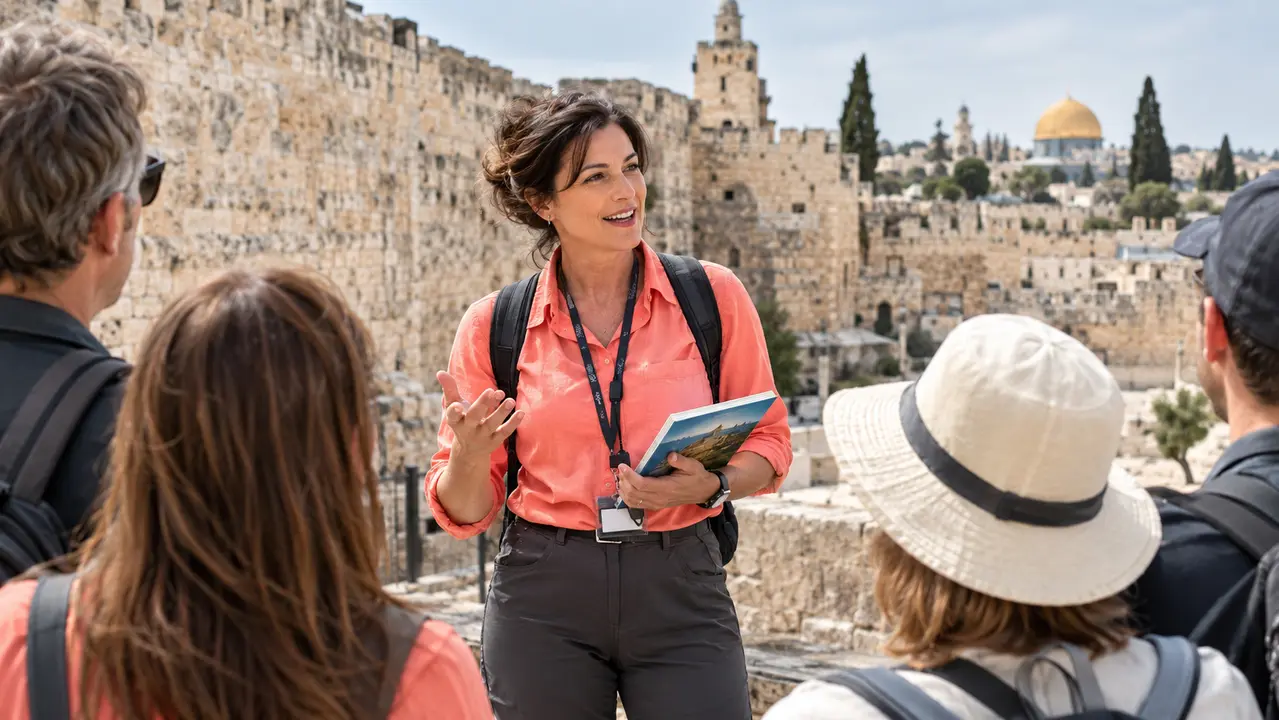
By Israeli law, any commercial guide must hold a valid license from the Israel Ministry of Tourism, earned through a multi-year academic course at an approved institution and maintained through ongoing refresher requirements, as the Ministry’s licensing regulations set out. This is a genuine bar. The course includes archaeology, history, and the geography of every route a pilgrim group will walk. Ask any operator you consider whether their guides for Christian tours in Jerusalem are licensed, and ask whether the guide specialises in Christian theology.
The second question matters as much as the first. A guide who understands the difference between a Catholic group’s expectations and a Presbyterian one’s will not make the small mistakes that quietly deflate a day, like scheduling a long liturgical stop for a group that wanted biblical exposition, or racing a Baptist congregation past the Garden Tomb because the schedule was built for someone else. Denominational fluency is not common. It is the thing we screen for when we assign guides.
Why groups travel with us
Talya Tours has been organising Christian Jerusalem tours and wider Holy Land programs for over 35 years, for churches and ministries across the United States. Every itinerary is built from scratch around the group’s tradition, whether that is a United Methodist conference from Ohio, an Assemblies of God youth group from Arizona, or a Catholic parish from Boston. Talya Felner, our owner, is involved in every group personally. Tourism is our only business.
A single day in Jerusalem often becomes the seed of a longer journey, and our faith-based Christian tours across Israel connect Jerusalem to Galilee, Nazareth, and the Jordan River in one continuous program. Travelers with limited time can also join our daily tours in Israel, which run regularly in English and cover Jerusalem and the surrounding regions without a multi-day commitment.
If your church or family is beginning to plan a pilgrimage to Jerusalem, we will build the itinerary around your denomination, your pastor’s priorities, and the worship moments that matter most to your group. Share your dates and traditions and we will prepare a plan before anything is committed.
Frequently asked questions
Can our itinerary follow specific Gospel passages?
Yes. Custom tours can be mapped along chosen texts, Matthew 26 to 28 or Luke 22 to 24 for the Passion week, so your group reads each passage at the location it describes.
Are these tours suitable for visitors with walking difficulties?
The Old City has many stairs and cobbles, but experienced guides can route step-free paths, arrange transport where it is permitted, and avoid the steepest inclines. Tell us in advance and we plan accordingly.
How far ahead should we book?
For peak pilgrimage seasons, spring around Easter and autumn around the Feast of Tabernacles, three to six months ahead is what secures the strongest guides and chapel reservations.
Do guides cater to both Catholic and Protestant traditions?
Yes. Guides adjust the site selection itself, including both the Church of the Holy Sepulchre and the Garden Tomb where a group wants both perspectives, and present traditional sacred history and modern archaeological findings with equal respect.
| If your group cares most about | Prioritise |
|---|---|
| Mass at authentic sites | 2 days Jerusalem, Holy Sepulchre altars reserved in advance |
| Quiet Communion in a garden setting | Garden Tomb booking, morning slot |
| Biblical teaching depth | Extended Galilee program plus 2 days Jerusalem |
| Seeing the most in limited days | Jerusalem and Bethlehem split across two mornings |
A Christian Jerusalem tour succeeds or fails on planning, not on the sites themselves. Match the length of the visit to what your group wants, two or three days rather than one if prayer time matters. Build the itinerary around your denomination, since a Catholic parish, a Baptist congregation, and a Pentecostal church each need different sites, worship arrangements, and guides. Book early for peak seasons, dress modestly, start each day at 7:30, and split Jerusalem and Bethlehem across separate days if your schedule allows. If you would like help applying any of this to your own group, reach Talya directly at [email protected] or through our contact page.

About the Author
Talya Felner is the Owner and CEO of Talya Tours Services (TTS), a leading professional tour operator in Israel. With over 35 years of experience and more than 90,000 travelers served, Talya has built TTS into a trusted name for Christian pilgrimages, biblical tours, and conferences for groups visiting Israel and the Holy Land. Her team designs each itinerary around the specific Christian denomination of the visiting group, whether Protestant, Catholic, Evangelical, Baptist, Methodist, Pentecostal, Lutheran, Presbyterian, Anglican, Orthodox, or another tradition, ensuring that sites, worship arrangements, and guides reflect what matters most to that congregation. From visas and accommodations to guides, transportation, and on-site coordination, TTS handles every detail so American pastors and group leaders can focus on the spiritual experience of their travelers.