
Jerusalem works as a single base for nearly every day trip American travelers come to Israel to take. The Old City, Bethlehem, Jericho, the Dead Sea, Masada, Ein Gedi, and even the Sea of Galilee all sit within a few hours of the city, which is why most of the itineraries we build at Talya Tours for groups from the United States use one Jerusalem hotel for the entire stay. This article explains which day tours fit which kinds of groups, what a professional day tour includes and what it costs, and how the route through the same holy sites changes depending on whether your congregation is Catholic, Baptist, Evangelical, Methodist, or another Christian tradition.
Reading time: 5 minutes
Key Points
- Jerusalem can serve as the single hotel base for day tours to the Old City, Bethlehem, the Dead Sea, Masada, Ein Gedi, and the Galilee.
- A professional day tour includes a government-licensed guide, a licensed vehicle and driver, and a route planned around the pace and denomination of the group.
- Catholic, Baptist, Evangelical, and other groups follow meaningfully different routes through the same city, and a good operator builds the itinerary accordingly.
- Standard group day tours from Jerusalem generally cost between $90 and $150 per person, depending on destination and inclusions.
Table of Contents
- Which Jerusalem day tour best fits your group?
- What is typically included in professional day tours?
- How long does a standard day tour take?
- Can you really experience Jerusalem in just one day?
- What does a classic Old City day tour cover?
- What is an Old and New Jerusalem day tour?
- Dead Sea and Masada day tours from Jerusalem
- Bethlehem day trips from Jerusalem
- Guided group tour or private day tour?
- Day tours versus self-guided exploration
- What to pack and wear
- What do day tours from Jerusalem cost?
- How seasonal weather affects day trips
- Why book your Jerusalem day tour with Talya Tours?
- Frequently asked questions
Which Jerusalem day tour best fits your group?
The first question we ask a church group from Texas or a family from Atlanta is not which sites they want to see. It is what kind of day the group can physically handle. First-time visitors almost always need the Old City. Repeat visitors who have already walked the Via Dolorosa (John 19:17) usually want the desert or the coast. Families with children need a day that mixes one major site with one relaxed stop, or the day collapses by mid-afternoon. Drive times below assume a normal morning departure from a central Jerusalem hotel.
| Day trip destination | Drive time from Jerusalem | Typical format |
|---|---|---|
| Old City Jerusalem | 15 to 25 minutes | Half day or full day |
| Bethlehem | 20 to 30 minutes | Half day, often with Shepherds’ Field |
| Jericho | 45 to 50 minutes | Half day, can combine with Qumran |
| Dead Sea, northern shore | about 45 minutes | Half day or relaxed full day |
| Ein Gedi Nature Reserve | about 1 hour 20 minutes | Combined with Masada or the Dead Sea |
| Masada | about 1 hour 30 minutes | Full day, usually with Ein Gedi and the Dead Sea |
| Sea of Galilee region | about 2 hours 15 minutes | Full day, early departure required |
Note the last row. The Galilee is reachable as a day trip, and we run these regularly, but the drive each way consumes more than four hours. For groups whose priority is Capernaum (Mark 1:21-35), the Mount of Beatitudes (Matthew 5:1-16), and Tabgha (John 6:1-15), we say it plainly: two nights by the Sea of Galilee beats one exhausting day trip.
What is typically included in professional day tours?
A professional day tour in Israel includes three things that are easy to verify and worth verifying. The first is a government-licensed tour guide; the licensing course runs about two years and covers history, archaeology, and religion, and guides carry an official license number. The second is a government-licensed vehicle with a licensed driver, air-conditioning, and, in most of our vehicles, WiFi. The third is the route itself, planned around opening hours, traffic patterns, and the physical pace of the group.
What is not included matters just as much. Meals are generally paid separately unless lunch is arranged in advance, guide gratuities are discretionary, and some site fees are separate, such as the Masada cable car, which is charged in addition to park admission per the official Nature and Parks Authority cable car notice. Before confirming any booking, a group leader from the U.S. should have five things in writing: the exact pick-up point and time, whether the route suits anyone with limited mobility, the guiding language, the cancellation terms, and the dress requirements for the sites on that specific day, since Bethlehem and the Temple Mount have entry rules that differ from the Old City markets.
How long does a standard day tour take?
Half-day tours run four to five hours and cover the core of the Old City, including the Mount of Olives lookout, the Western Wall, and either the Christian Quarter or the Jewish Quarter depending on the group. Full-day tours run eight to ten hours and reach further, into West Jerusalem, Yad Vashem, or the desert sites. Desert departures leave early, usually between 7 and 7:30 in the morning, because summer heat in the Judean Desert does not negotiate. Return timing also deserves attention, since traffic entering Jerusalem in the late afternoon can add forty minutes to a drive from the Dead Sea, and our drivers plan around it.
Can you really experience Jerusalem in just one day?
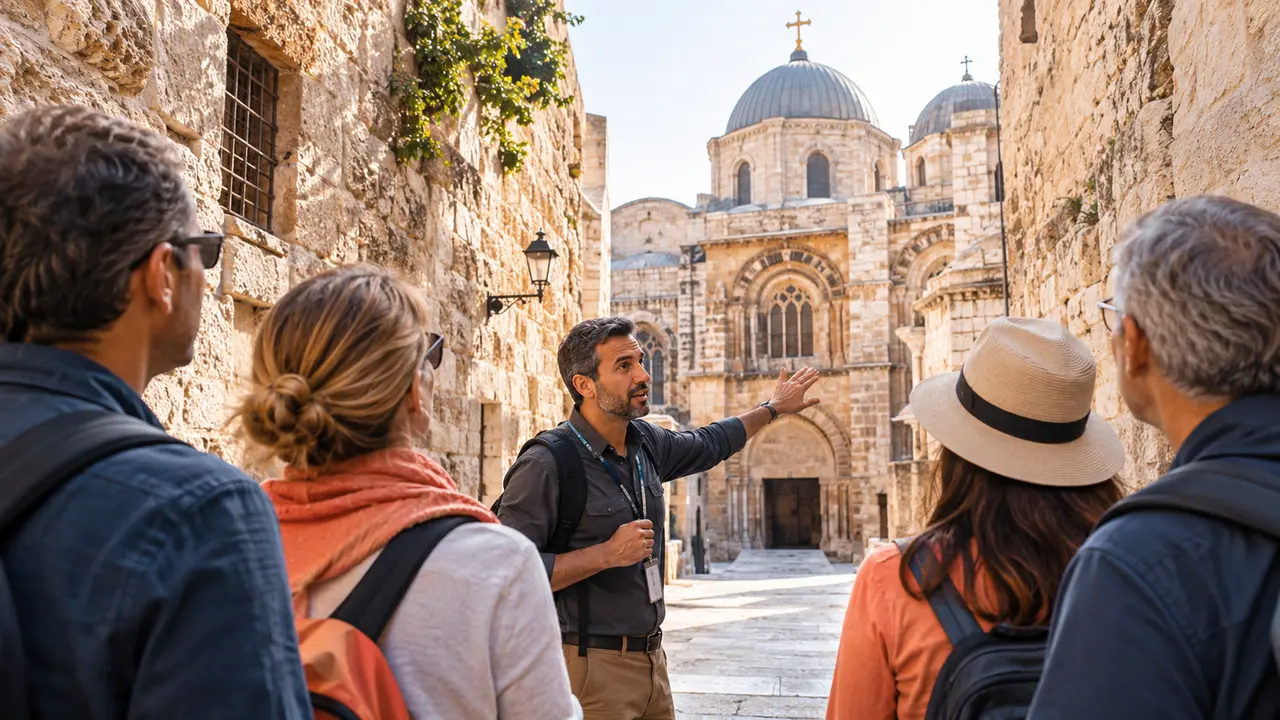
The Old City of Jerusalem seen from the Mount of Olives, the traditional first stop that orients every guided day tour.
This question comes up on almost every first call with a pastor or group leader from the United States, and the honest answer is that the core of the city, yes. Three thousand years of history cannot be absorbed in a day, but the spiritual and historical center of Jerusalem can be walked in one well-planned tour. The difference between a good one-day visit and a frustrating one is rarely the choice of sites. It is the sequencing. A licensed guide knows which alleys connect the Mount of Olives to Gethsemane (Matthew 26:36-46) without backtracking, which gate to enter, and when the Church of the Holy Sepulchre (John 19:41-42) is least crowded. Groups we guide through the Old City typically see more in five hours than independent walkers manage in two full days. For travelers building a longer trip, our schedule of daily tours in Israel extends the same approach across the whole country.
What does a classic Old City day tour cover?
The classic route starts above the walls. From the Mount of Olives (Luke 19:37-44) the whole Old City lies below, and this is where a guide earns their fee in the first ten minutes, orienting the group before anyone descends. Then Gethsemane (Matthew 26:36-46), the Western Wall, and the Via Dolorosa (John 19:17) winding through the Christian Quarter to the Church of the Holy Sepulchre (John 19:41-42). The day usually closes with the Jewish Quarter and the Cardo, the main street of Roman Jerusalem, still visible in the paving.
For Christian groups, the route bends according to tradition, and this is a point we raise on every planning call. A Catholic parish will want extended time at the Holy Sepulchre, often with Mass arranged in advance at an agreed hour. A Southern Baptist congregation or a non-denominational Evangelical church will frequently prefer the Garden Tomb (John 20:1-18) with a communion service in the garden, plus more time at the Western Wall plaza. Neither choice is wrong. Running the same route for both groups is where many operators go wrong, and it is the reason we build each itinerary around the denomination of the visiting group rather than around a fixed template.
Who benefits most from a guided Old City day?
Independent travelers lose hours in the Old City, because the alleys look alike, signage is inconsistent, and the most meaningful spots are easy to walk straight past. Without a guide, the Western Wall is an impressive wall. With a guide, it is the retaining wall of a platform built by Herod the Great, the closest remnant to the Temple that stood in Jesus’ time, and the reason two thousand years of Jewish prayer gathered at that exact spot. Church groups benefit most of all, since a guided day keeps forty people moving as one, on schedule, with the scriptural context delivered at the site rather than guessed at afterward.
What is an Old and New Jerusalem day tour?
Some of the best Jerusalem day tours leave the ancient stones for the afternoon. The morning covers the Old City as described above, and after lunch the day shifts to West Jerusalem, anchored by the Israel Museum with the Shrine of the Book housing the Dead Sea Scrolls, and Yad Vashem, the World Holocaust Remembrance Center. We recommend this combination for groups on their second or third visit and for professional and educational delegations from the U.S. who need both the historical context and modern Israeli institutions in one frame. Yad Vashem alone requires a minimum of two hours, and we build in a real break between the Old City morning and what is, for most American visitors, an emotionally heavy afternoon.
Dead Sea and Masada day tours from Jerusalem
The drive south is part of the experience. Jerusalem sits roughly 800 meters above sea level and the Dead Sea shore about 430 meters below it, so in under an hour you descend more than 1,200 vertical meters through the Judean Desert. The sea’s heavy salt concentration makes sinking physically impossible, and most trips include time for the mineral mud and the beach resorts along the northern shore. One scheduling note from experience: insist on at least two to three continuous hours at the beach rather than a rushed forty-five minutes, and bring water shoes, because the salt crystals underfoot are sharp.
What to expect at Masada
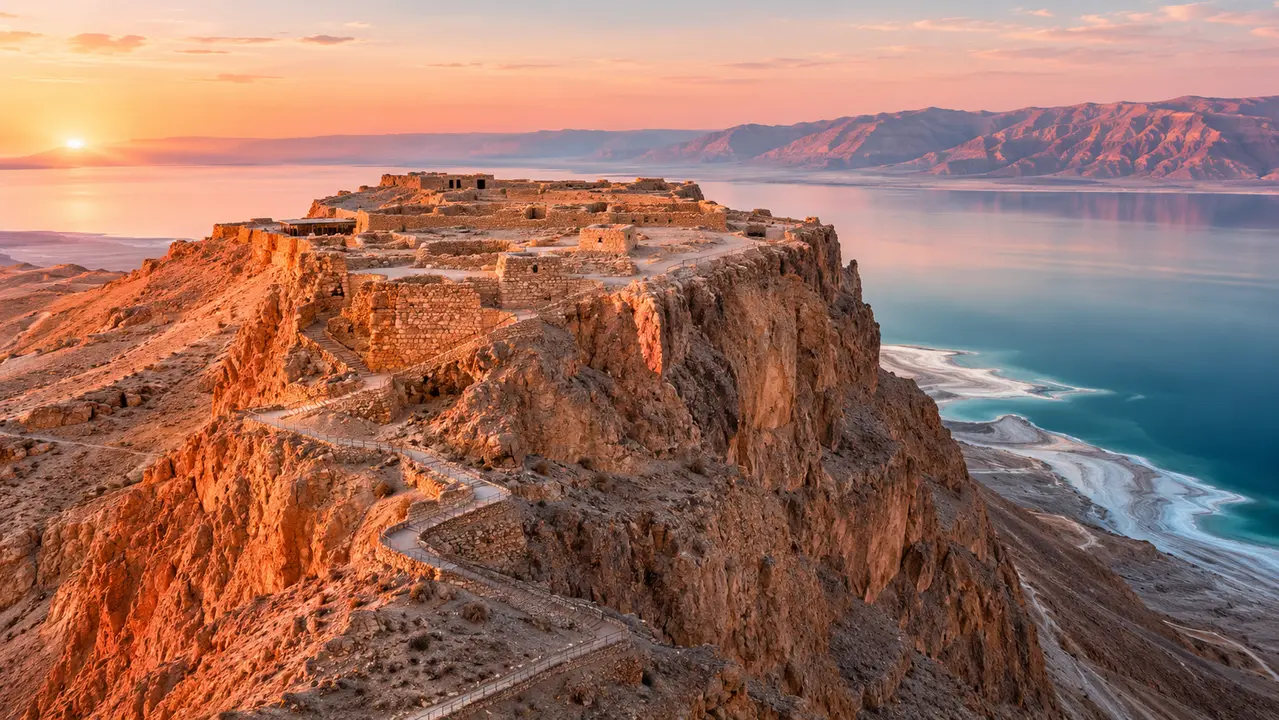
Masada National Park, where Herod’s palace-fortress overlooks the Dead Sea basin toward the mountains of Moab.
Masada is King Herod’s palace-fortress on a diamond-shaped plateau above the Dead Sea, the site where Jewish rebels held out against a Roman siege in 73 or 74 CE. The Roman siege ramp is still there, and the storerooms, bathhouse, and mosaics are among the best-preserved in the country. Two ways up exist. The cable car takes about three minutes and costs extra beyond the park entrance fee, while the Snake Path is the original ascent, forty-five minutes to an hour of steady climbing. In summer the Snake Path closes to upward hikers from around 8 in the morning because of heat, and current hours are published by the Nature and Parks Authority for Masada National Park, which we check the day before every departure.
Combining Masada, Ein Gedi, and the Dead Sea in one day is the most popular full-day desert itinerary we run, and it works when the departure is early. The working version leaves Jerusalem shortly after seven, reaches Masada for opening, spends about two hours on the plateau, then moves to Ein Gedi, where David hid from Saul (1 Samuel 24:1-22), for the freshwater walk to David’s Waterfall, and finishes with the Dead Sea beach in the early afternoon before the drive back as the desert cools. Trail status at Ein Gedi can change, so the reserve’s official visitor information page is part of our routine pre-departure check.
Bethlehem day trips from Jerusalem
Bethlehem is closer than most American travelers expect, a twenty to thirty minute drive through a checkpoint, and suddenly you are in Manger Square looking at the Church of the Nativity (Luke 2:1-7), the oldest continuously operating church in the Holy Land. Most trips add Shepherds’ Field (Luke 2:8-20) in nearby Beit Sahour, where groups can hold a short service in the cave chapel if arranged in advance. The logistics are worth knowing before you go. Bethlehem is administered by the Palestinian Authority, so passports are required, and the guide changes at the crossing, since Israeli-licensed guides cannot guide inside; we arrange the handover with a local Palestinian guide so it takes minutes rather than leaving the group standing at the barrier. Sunday is the natural day for church groups, and we schedule the visit so it does not collide with local services at the Nativity.
Guided group tour or private day tour?
A scheduled group departure is the economical option, with a fixed itinerary, a shared vehicle of roughly fifteen to forty passengers, and a per-person price that makes sense for solo travelers and couples. A husband and wife from Kansas City joining a Masada and Dead Sea departure will pay a fraction of the private rate and meet other American travelers along the way; our schedule to join a tour in Israel lists the standing departures. A private tour is the right call for multi-generational families and for church groups with a specific spiritual program. Privacy buys three things: pick-up at your hotel at the hour you choose, pacing that adapts on the day, and the ability to spend an unplanned extra hour somewhere that turns out to matter to the group. For twenty or more travelers, the per-person difference shrinks enough that most groups choose private.
Day tours versus self-guided exploration
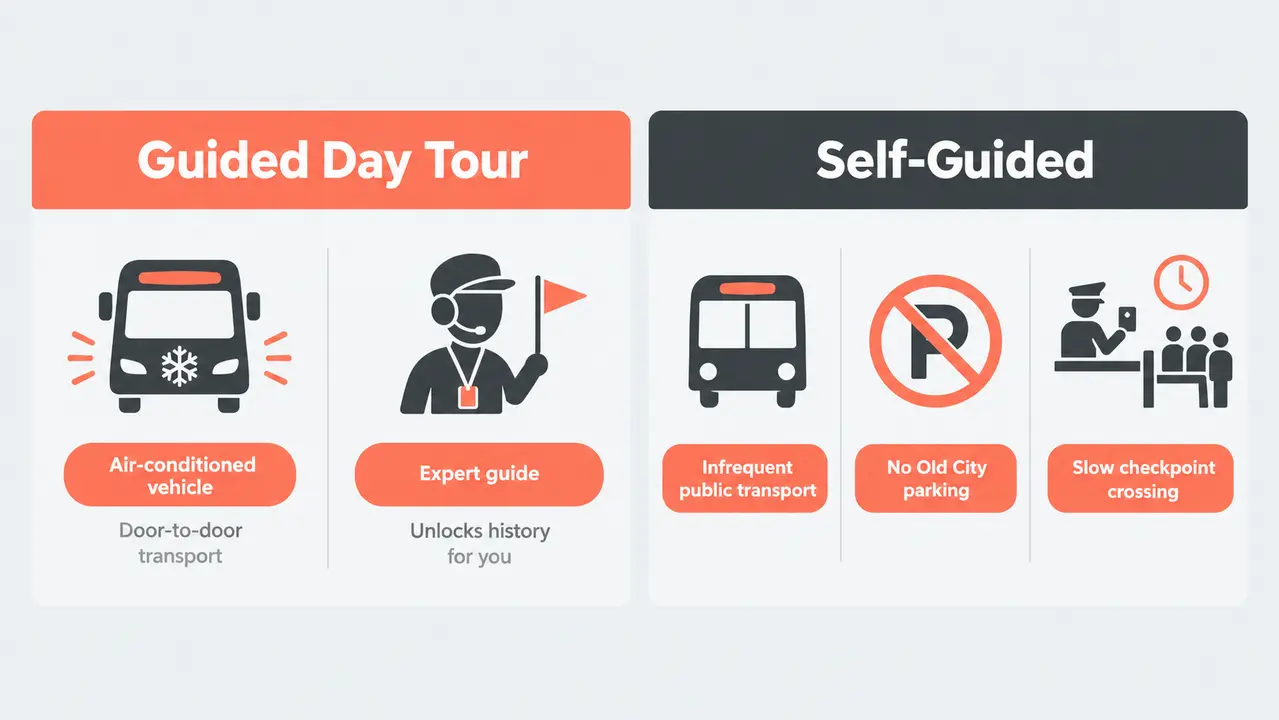
The alleys of the Old City, where signage is inconsistent and a licensed guide prevents hours of backtracking.
Self-guided travel in Jerusalem is possible, and we say that honestly, before describing what it actually involves. Public transport to the Dead Sea runs infrequently and drops you far from the resort beaches. Parking inside the Old City does not exist, and parking around it is a profession of its own. The checkpoint crossing to Bethlehem by public transport can take most of a morning if anything goes slowly. An organized day tour replaces all of that with an air-conditioned door-to-door vehicle and a driver who knows the day’s rhythm, plus a certified guide who unlocks the layers a solo traveler walks straight past, such as which stone in the Holy Sepulchre is Crusader and which is Byzantine. After 90,000 travelers, we can also say that the sites solo visitors report as disappointing are almost always the ones they reached exhausted, with no one to explain what they were standing in front of.
What to pack and wear
Dress is the packing item that ends day trips early. Holy sites, meaning churches, the Western Wall, and mosques, require covered shoulders and knees, and visitors in shorts or cropped tops are turned away at entrances without exceptions. A light scarf or wrap solves the problem and weighs nothing. Footwear matters more than travelers expect, because the Old City’s limestone alleys are polished by centuries of feet to something closer to ice than stone when damp; closed walking shoes with grip, not sandals. Desert days need sun protection, more water than feels reasonable, and water shoes for the Dead Sea. Jerusalem evenings, at 800 meters altitude, are brisk for most of the year, so bring a layer for the return drive. For older travelers, we build holy land tours for seniors around exactly these considerations, with seating breaks built into every route.
What do day tours from Jerusalem cost?
Standard group day tours from Jerusalem generally run between $90 and $150 per person, depending on the destination and inclusions. An Old City half-day sits at the lower end, a full Masada, Ein Gedi, and Dead Sea day toward the upper end because of the distances and site fees, and a Galilee day trip costs more again given the driving. What moves a price up or down is a short list of variables: whether national park entry fees are included, whether the Masada cable car is included, whether lunch is arranged or left open, and whether the group upgrades to a private vehicle and guide. When we quote a church group from North Carolina or a delegation from Chicago, we itemize these so the treasurer can see exactly what the per-person figure contains, because vague quotes produce disputes, and disputes are bad for everyone’s pilgrimage.
How seasonal weather affects day trips
Jerusalem and the Dead Sea sit an hour apart and in different climates. The city is in the Judean hills, cooler than the coast, with rain between November and March, while the desert is hot most of the year and brutally so from June through August. Planning a day trip without checking which climate your chosen day crosses is how groups end up hiking Ein Gedi in the early afternoon in August.
| Season | Jerusalem and the hills | Judean Desert and Dead Sea | Planning advice |
|---|---|---|---|
| Spring, March to May | Mild, occasional rain, wildflowers | Warm, comfortable mornings | Best all-round season; book early |
| Summer, June to August | Warm, dry, pleasant mornings | Extreme heat, trail closures possible | Desert sites at opening, Dead Sea late afternoon |
| Autumn, September to November | Warm days, cool evenings | Hot through September, cooling after | Good for full desert days from October |
| Winter, December to February | Cool, rainy spells, occasional snow | Mild and dry | Best desert season; keep Jerusalem days flexible |
Winter is the season most American groups underestimate. A January group can float in a pleasantly warm Dead Sea in the morning and need a coat in Jerusalem by nightfall. Pack for both, and the season works in your favor.
Why book your Jerusalem day tour with Talya Tours?

A guided group with Talya Tours at one of the sites surrounding Jerusalem.
We have been organizing tours in Israel for over 35 years, and tourism is our only business. Over 90,000 travelers have traveled with us, the great majority of them church groups and individual travelers from the United States. Every itinerary is built for the specific group requesting it. A Catholic parish receives a program with Mass arrangements at agreed sites. A Pentecostal ministry receives extended prayer time at the Mount of Olives and Gethsemane. A United Methodist conference receives the theological context its leaders ask for. A non-denominational Evangelical congregation receives the Garden Tomb (John 20:1-18) and Yardenit (Matthew 3:13-17) baptism renewals as the emotional anchors of the trip. Our owner and CEO, Talya Felner, is involved with every group personally, and our staff stays with your group throughout the stay.
Planning day tours for your church or group from the United States?
Tell us your denomination, your dates, and the sites that matter most to your congregation, and we will sketch a day-by-day structure before you commit to anything. There is no cost for the initial plan.
Frequently asked questions
Can our pastor preach or lead worship during the tour?
Yes. We regularly arrange short services, communion, and worship moments at sites such as the Garden Tomb, Shepherds’ Field, the Mount of Beatitudes, and Yardenit. The location and format are chosen to fit your denomination’s practice, and we secure the time slot in advance so the moment is not rushed.
How far in advance should a church group book?
For spring and autumn departures, which are the most popular seasons for American groups, we recommend starting nine to twelve months ahead. This secures hotel availability in Jerusalem, the right licensed guide for your group, and any worship or Mass arrangements that require advance scheduling.
Is a Galilee day trip from Jerusalem realistic?
It is possible, and we run it, but the drive each way takes over two hours. For groups whose priority is Capernaum, the Mount of Beatitudes, and Tabgha, we usually recommend two nights by the Sea of Galilee instead of one long day trip, because the sites deserve unhurried time.
Do Catholic and Protestant groups visit different sites?
The core sites overlap, but the emphasis and the worship arrangements differ. Catholic groups typically spend extended time at the Church of the Holy Sepulchre with Mass arranged in advance, while many Baptist and Evangelical groups prefer the Garden Tomb with a communion service. We build each route around the tradition of the visiting group rather than running one fixed itinerary.
What is not included in the quoted price?
Meals are generally separate unless lunch is arranged in advance, guide gratuities are discretionary, and some site fees, such as the Masada cable car, are charged in addition to park admission. We itemize all of this in writing before a group confirms, so there are no surprises at the entrance.
Jerusalem is a practical base for nearly every day trip that matters, from the Old City and Bethlehem to Masada, Ein Gedi, and the Dead Sea. A professional day tour pairs a government-licensed guide with a licensed vehicle and a route sequenced around traffic, opening hours, and the physical pace of the group, and it typically costs between $90 and $150 per person depending on destination and inclusions. Most importantly, the route through the holy sites should reflect the tradition of your congregation, whether Catholic, Baptist, Evangelical, Methodist, Pentecostal, or another stream, and that is exactly how we build every itinerary.
Start planning your Jerusalem day tours
Reach Talya directly at [email protected] or through our contact page. Share your denomination, your group size, and your travel dates, and we will begin shaping an itinerary around what matters most to your congregation.

About the Author
Talya Felner is the Owner and CEO of Talya Tours Services (TTS), a leading professional tour operator in Israel. With over 35 years of experience and more than 90,000 travelers served, Talya has built TTS into a trusted name for Christian pilgrimages, biblical tours, and conferences for groups visiting Israel and the Holy Land. Her team designs each itinerary around the specific Christian denomination of the visiting group, whether Protestant, Catholic, Evangelical, Baptist, Methodist, Pentecostal, Lutheran, Presbyterian, Anglican, Orthodox, or another tradition, ensuring that sites, worship arrangements, and guides reflect what matters most to that congregation. From visas and accommodations to guides, transportation, and on-site coordination, TTS handles every detail so American pastors and group leaders can focus on the spiritual experience of their travelers.