
Planning a pilgrimage to Israel requires more than selecting a list of sites. It requires understanding the geography, the sequencing, and the way each location connects to a specific passage of Scripture your group already knows. American pastors and group leaders who have organized trips here before will tell you the same thing: the sites are powerful, but the planning determines whether your congregation actually experiences them or simply passes through them. This article walks through the major Christian sites in Israel by region, explains how each one fits into a coherent route, and addresses the practical decisions that shape whether a group of 20 or 80 comes away with something lasting.
Reading time: 7 minutes
Key Points
- Israel divides into two planning regions – Galilee in the north and Jerusalem with Judea in the south. Most itineraries move north to south to follow the Gospel narrative in sequence.
- The right route, site emphasis, and on-site arrangements depend on the specific Christian denomination of the visiting group. Catholic parishes, Evangelical congregations, Pentecostal ministries, and other traditions each require a different sequence and different ceremonial logistics.
- Timing within each site matters as much as which sites you include. Several locations fill by mid-morning and require early arrival for meaningful access.
- A well-built itinerary handles worship arrangements, baptism logistics, guide assignment, and transport before departure, so the pastor can focus on the congregation’s spiritual experience once on the ground.
Table of Contents
- The Two Planning Regions of Israel
- Why American Pilgrims Travel to the Holy Land
- The Church of the Holy Sepulchre
- Walking the Via Dolorosa
- Christian Landmarks on the Mount of Olives
- The Garden of Gethsemane
- Christian Sites Around the Galilee
- Capernaum – The Town of Jesus
- Tabgha and the Feeding Narratives
- The Mount of Beatitudes
- Jordan River Baptism Sites
- Planning a Holy Land Itinerary with Talya Tours
- Frequently Asked Questions
What Are the Most Important Christian Sites in Israel?
Israel is where Scripture becomes geography. The Christian sites in Israel that American groups travel to are the actual locations where verses your congregation has read for decades acquire a slope, a shoreline, and a temperature. That shift from text to ground is what makes the journey worth the planning it requires.
For planning purposes the country divides into two regions. Jerusalem and Judea hold the Passion narrative – the Old City, the Mount of Olives, Gethsemane, the Via Dolorosa, and Bethlehem nearby. The Galilee in the north holds the childhood, the early ministry, the healing miracles, and the Sermon on the Mount, gathered around the Sea of Galilee in a relatively compact radius.
Most well-built itineraries move from north to south. You begin in Galilee and follow the ministry toward Jerusalem, arriving in the south for the final days of the trip – which mirrors the arc of the Gospel narrative. Israel’s Ministry of Tourism documents this same regional structure in its official Holy Land biblical sites brochure, a useful reference when you are first mapping the ground.
Why Do American Pilgrims Travel to Christian Holy Sites in Israel?
There is a phrase older guides here use – the Fifth Gospel. The idea is that the land itself reads alongside Matthew, Mark, Luke, and John. You see why a crowd of five thousand could gather on that particular shore. You understand why the ascent to Jerusalem is described with such weight. The Christian holy sites in Israel do much of this interpretive work on their own; the traveler needs to be in the right place at the right hour, with the right passage open in front of them.
This is why the practice on the ground matters as much as the travel itself. Groups read Scripture aloud at the site it describes. They pray together. They sit in silence in a Byzantine sanctuary that has held pilgrims since the fourth century – because believers have been walking to these exact spots for the same reasons your congregation is walking to them now.
How a group structures all of this depends on its tradition. A Southern Baptist congregation and a Catholic parish will draw on different passages at different sites, in a different order, with different ceremonial needs. Our Christian Tours Israel programs are built around that difference rather than around a single template handed to every group regardless of their faith background.
What Is the Historical Significance of the Church of the Holy Sepulchre?
Inside one set of walls sit two of the most important locations in Christian history. Golgotha – Calvary – where the crucifixion took place. And the Edicule, the small shrine built over the tomb where the burial and Resurrection occurred (John 19:17-20:18). Both are under the same roof, a few dozen steps apart.
The church is shared among six ancient Christian denominations under an arrangement known as the Status Quo, a centuries-old agreement that fixes which community controls which chapel, which lamp, and which section of floor. The Israeli government’s official documentation on Christianity in Israel provides historical context for how this custodial structure works in practice.
The Stone of Anointing greets you at the entrance – the slab where tradition holds that Jesus’ body was prepared for burial. The Chapel of St. Helena lies below, reached by a descending stairway. For Catholic groups hoping to arrange Mass at one of the side chapels, arrival before the site fills is not optional. The church is visited by large numbers each day and the quiet window available in the early morning closes quickly.
How Can Travelers Experience the Steps of the Via Dolorosa?
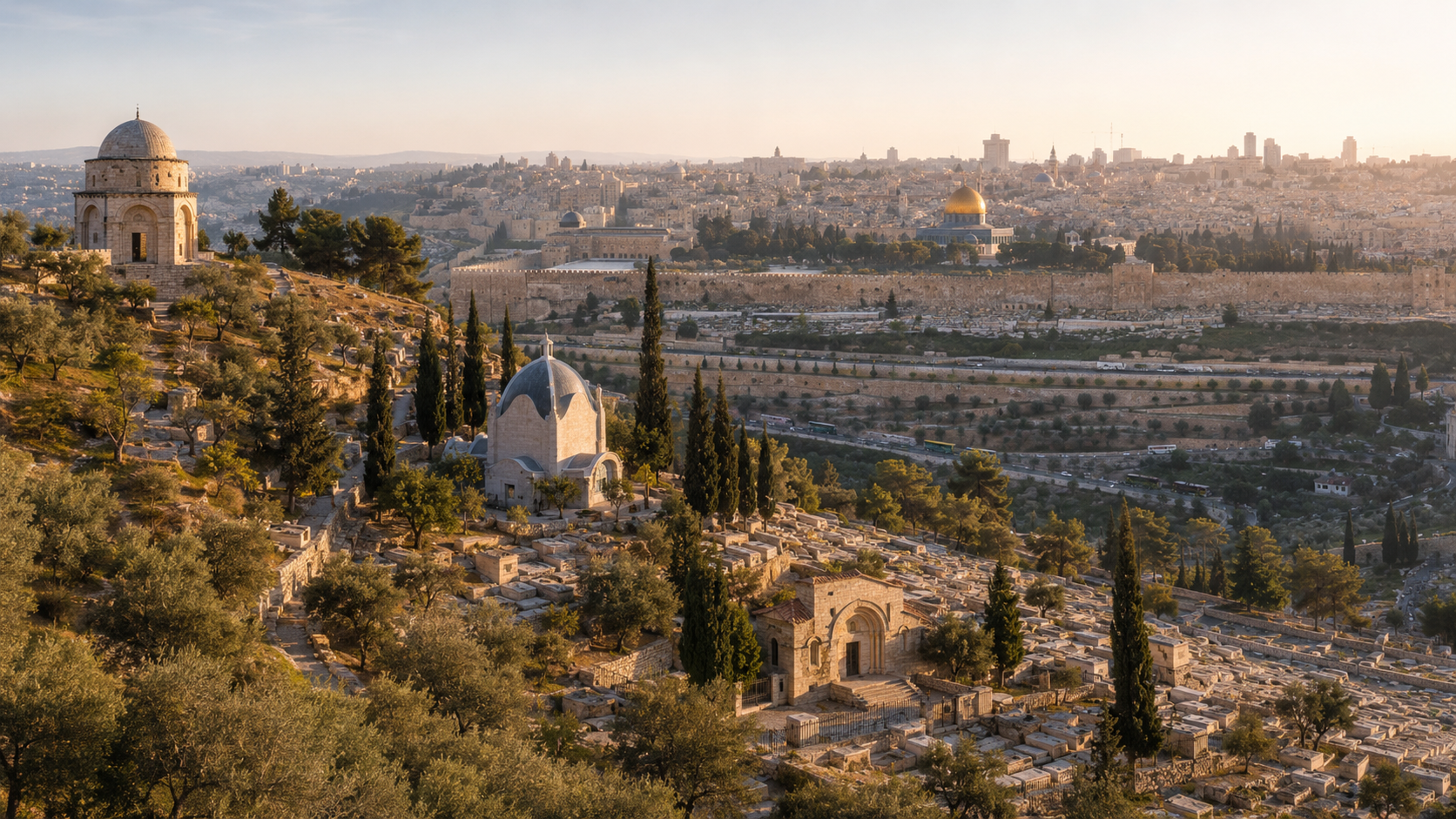
The Mount of Olives, overlooking Jerusalem’s Old City and the Temple Mount
The Via Dolorosa follows the 14 Stations of the Cross from the area of the former Antonia Fortress to the Church of the Holy Sepulchre, where the final five stations sit inside the church itself. It is not a quiet ceremonial avenue. The route threads through a working marketplace in the Muslim and Christian Quarters, past spice stalls and storefronts, the way a city street has operated here for centuries.
That reality surprises many first-time American groups. They arrive expecting solemn processional space and find a busy urban corridor. We brief every group on this in advance, because the contrast is itself part of the truth of the place – the sacred has always occupied the same ground as the ordinary here.
If your dates allow it, time your visit for a Friday afternoon. The Franciscan friars lead a public procession along the full route each week, and walking behind them with the traditional liturgy spoken aloud gives a group an experience that no private walk-through replicates. Arriving early to hold a position along the route is essential.
Which Are the Key Christian Landmarks Israel Boasts on the Mount of Olives?
Stand at the crest of the Mount of Olives and the entire narrative lays itself out below you. The ridge overlooks the Old City and the Temple Mount directly, which is why it carries such weight – the Ascension (Acts 1:9-12) and Christ’s weeping over the city (Luke 19:41-44) both belong here. Among the Christian landmarks Israel offers, few give you this single unbroken biblical sightline.
Three sites anchor the ridge. The Chapel of the Ascension at the summit. The Pater Noster Church, which marks where the Lord’s Prayer was taught (Luke 11:1-4). And lower down, the teardrop-shaped Dominus Flevit chapel, built deliberately in the form of a falling tear to commemorate Christ weeping over Jerusalem. The ridge also holds one of the oldest continuously used burial grounds in the region; the Israel Antiquities Authority’s archaeological research on the ancient burial caves here provides context for what the landscape around these sites represents.
How to Combine the Mount of Olives and the Old City in One Morning
The practical trick is to walk downhill rather than up. Begin at the crest just after sunrise for the panoramic view of the city, while the light falls on Jerusalem and the tour buses have not yet arrived. Then walk down past Dominus Flevit toward the bottom of the Kidron Valley, which places the Garden of Gethsemane at the foot of your descent. From there, enter the Old City through St. Stephen’s Gate – also called the Lion’s Gate – and you arrive almost exactly at the starting point of the Via Dolorosa. One morning, one logical descending line, and very little uphill walking for the group.
Planning a pilgrimage for your congregation?
Talya Tours builds each itinerary around your group’s specific Christian denomination – whether your congregation is Catholic, Evangelical, Baptist, Pentecostal, Methodist, Presbyterian, Anglican, or another tradition. Tell us your dates, your group size, and your faith background, and we will design a route that reflects what matters most to your travelers.
What Is the Spiritual Atmosphere of the Garden of Gethsemane?
At the foot of the Mount of Olives sits the garden where Jesus prayed in agony, was betrayed, and was arrested (Matthew 26:36-50). Of all the holy sites a group visits, this is the one where quiet is not a preference – it is a condition. We ask groups to hold back their conversation before they even arrive, because the place rewards stillness and the presence of noise removes something that cannot easily be restored.
The olive trees carry much of the weight. Some of the gnarled trunks sit on root systems more than a thousand years old, twisted and low to the ground, and they hold the silence of the garden in a way no constructed space could. Alongside them stands the Church of All Nations – the Basilica of the Agony – named for the many countries that funded its construction. Inside, a mosaic dome rises above the exposed rock where Jesus is traditionally said to have prayed.
A Pentecostal group that wants extended prayer time and a quieter Presbyterian fellowship seeking contemplative reflection both find what they need in this garden. The site accommodates a wide range of expressions within American Christianity, as long as the noise remains low and the schedule allows enough time to simply be there.
Which Are the Top Christian Sites to Visit in Israel Around Galilee?
Drive two hours north from Jerusalem and the register changes completely. Jerusalem is stone, walls, and the weight of the Passion. The Galilee is open water, green hills, and the rural landscape where Jesus spent His formative years and conducted most of His public ministry. American groups frequently tell us this region surprised them more than any other part of the trip.
Four hubs organize the north. Nazareth, where the Annunciation took place (Luke 1:26-38). Capernaum, His ministry base on the lakeside. Tabgha on the northern shore. And the Mount of Beatitudes above it. The majority of the parables, the healings, and the calling of the first disciples (Matthew 4:18-22) happened within this relatively small radius around the Sea of Galilee.
How a group works through this region depends on tradition. Catholic parishes often weight Nazareth significantly and require Mass arrangements along the coast. Our Catholic Pilgrimage to the Holy Land itinerary builds the Annunciation Basilica, the Grotto, and liturgical scheduling around exactly that priority. An Evangelical or Baptist congregation will typically want more extended Scripture reading at Capernaum and open time at the Beatitudes hillside. The sequence, the pacing, and the ceremonial arrangements change accordingly.
What Makes Capernaum the Historical Town of Jesus?
Capernaum served as His operational base during the Galilean ministry (Mark 1:21-35) – a fishing village on the northern shore of the lake. What the excavations make visible is the layering of history. A white limestone synagogue from a later century sits built directly over the black basalt foundations of the first-century synagogue where Jesus taught. Both are visible simultaneously, and the vertical distance between them is only a few feet.
A modern octagonal church stands nearby on pillars, suspended above the excavated remains of what tradition identifies as St. Peter’s house. The glass floor allows visitors to look directly down at the walls. The healing of the centurion’s servant (Matthew 8:5-13) and the paralytic lowered through a roof by his friends (Mark 2:1-12) both belong to this place. The Israel Nature and Parks Authority’s official page on the Capernaum excavations lists current visiting hours and details what has been uncovered at the site.
Why Is Tabgha Central to Biblical Feeding Narratives?
A short drive along the shore brings you to Tabgha (John 6:1-15), the site of the feeding of the five thousand. The Church of the Multiplication holds a fifth-century Byzantine mosaic set into the floor near the altar – a basket of loaves flanked by two fish, among the most recognizable images from the early church period. The original tesserae are still there.
Walk down to the water from the church and you reach the Church of the Primacy of St. Peter, built on the rocky shoreline where the risen Jesus prepared breakfast and asked Peter three times whether he loved Him (John 21:1-17). The flat stone shelf at the water’s edge is identified as the surface on which the fire was built. Most American groups stand there quietly for a long time.
We schedule Tabgha as the first stop of the Galilee day when the itinerary allows it. By mid-morning the shoreline draws significant numbers of visitors, and the quality of the experience – particularly the stillness on the water – changes considerably. The early hour is the practical advantage.
What Is the Significance of the Mount of Beatitudes?
Above Tabgha rises the hillside traditionally identified with the Sermon on the Mount (Matthew 5:1-16). The octagonal Church of the Beatitudes, designed by the Italian architect Antonio Barluzzi, dedicates one side of its octagonal form to each of the eight blessings, so that the geometry of the building reflects the structure of the sermon it commemorates.
The gardens surrounding the church are the real reason many American groups list this among their most significant stops. They slope naturally down toward the Sea of Galilee in a form that functions as a natural amphitheater, with quiet alcoves set among the plantings. We bring groups to sit in those gardens and read Matthew 5 through 7 aloud while looking down at the same hillside where the words were first spoken. For many travelers, regardless of denomination, this is the stop that stays with them longest.
Where Is the Best Jordan River Baptism Site Located?
There are two primary baptism sites, and the right choice depends on the denomination and the intention of your group. Yardenit sits near where the Jordan River exits the Sea of Galilee in the north. It offers changing facilities, baptismal robes, and organized water access. The setting is green and managed, which makes it a comfortable choice for Evangelical, Baptist, and other American Protestant congregations conducting baptism renewals or reaffirmations of faith.
Qasr el-Yahud sits further south, near Jericho, and carries greater historical weight. It is the site recognized as the location where John baptized Jesus (Matthew 3:13-17), and sits near where the Israelites crossed into the Promised Land (Joshua 3). The area was inaccessible for decades due to landmines; it has since been fully cleared and renovated. The Israel Nature and Parks Authority’s official Qasr el-Yahud page lists current hours, safe entry points, and seasonal river conditions, which vary and affect water access.
| Site | Location | Setting | Best Suited For |
|---|---|---|---|
| Yardenit | Near Sea of Galilee, north | Green, managed facilities, organized access | Evangelical, Baptist, and Protestant baptism renewals |
| Qasr el-Yahud | Near Jericho, south | Historical site, desert riverbank, authentic setting | Groups wanting the traditional site of Christ’s baptism |
How to Plan a Holy Land Itinerary with Talya Tours
The hard part of any pilgrimage is never the sites themselves. It is the sequencing – the real driving time between Galilee and Jerusalem, the opening-hour windows that close earlier than groups expect, the peak-crowd patterns at the most-visited locations, the language logistics, and the licensed transport requirements. This is the planning work that an experienced operator absorbs before departure so a pastor does not have to manage it on the ground.
Every planning conversation with Talya Tours begins the same way. What denomination is your congregation? What does your pastor want the group to carry home? Which ceremonies need arranging on site – baptism, communion, Mass, certificates? A United Methodist church conference, an Assemblies of God ministry group, and a Catholic diocese each receive a different sequence, different worship arrangements, and different pacing through the same region.
For congregations that prefer a smaller, more intimate dynamic, our Small Group Christian Tours of Israel operate with a government-licensed biblical guide rather than a large coach format, which allows more flexible scheduling, space for in-group devotionals, and quieter access at the sites that reward it.
| Tradition | Site Emphasis | On-Site Focus |
|---|---|---|
| Catholic | Holy Sepulchre, Annunciation Basilica, Nativity, Via Dolorosa | Mass arrangements, liturgical scheduling |
| Evangelical / Baptist | Garden Tomb, Yardenit, Beatitudes, Capernaum | Extended Scripture reading, baptism renewals |
| Pentecostal | Mount of Olives, Gethsemane, Galilee shore | Prayer time, open worship at the sites |
| Methodist / Presbyterian | Full biblical itinerary with theological context | Quieter contemplative time, structured reflection |
| Lutheran / Anglican / Orthodox | Tradition-specific site priorities and worship spaces | Liturgical coordination, denomination-appropriate guides |
Frequently Asked Questions
How many days does a typical Christian pilgrimage to Israel take?
Most groups from the United States plan between 8 and 12 days. Eight days is the practical minimum to cover both Galilee and Jerusalem without rushing. Ten to twelve days allows time for sites outside the main circuit – Masada, the Dead Sea, Caesarea, and Nazareth with full liturgical scheduling. The right length depends on what your denomination prioritizes and how much time the group can take away from home. We have built itineraries ranging from 6 to 14 days depending on what the congregation wanted to accomplish.
Do American citizens need a visa to travel to Israel?
American citizens do not require a visa in advance for tourism visits to Israel. Entry is permitted for stays of up to 90 days under the existing agreement between the United States and Israel. Travelers need a valid U.S. passport. We advise all groups to verify their passport expiration well ahead of travel, since some airlines require validity beyond the return date. Entry requirements can change, and we confirm current conditions for every group we work with before departure.
How does Talya Tours adapt itineraries for different Christian denominations?
Every itinerary we build begins with the denomination and the specific intent of the visiting congregation. A Catholic group will receive Mass arrangements at accessible chapels, time at the Annunciation Basilica in Nazareth, and a sequence through Jerusalem built around the traditional Passion route. A Baptist or Evangelical group will typically receive more open Scripture time at Capernaum and the Mount of Beatitudes, a baptism renewal at Yardenit, and an emphasis on the Garden Tomb. Pentecostal groups often want extended prayer time at Gethsemane and the Galilee shore. Lutheran, Presbyterian, Anglican, and Orthodox congregations each bring different theological priorities that shape site selection, guide briefings, and pacing. No two groups receive the same plan.
What is the best time of year for an American church group to visit Israel?
March through May and October through November offer the most consistent conditions for American pilgrim groups. Temperatures are moderate, the Galilee countryside is green in spring, and the major sites are accessible without the full heat of July and August. These shoulder periods also tend to offer slightly better availability at quality hotels in Jerusalem and on the Sea of Galilee. December attracts many American groups seeking the Christmas experience in Bethlehem and Jerusalem, which is meaningful but requires advance planning due to demand at that time of year.
Can Talya Tours arrange baptism renewals at the Jordan River for our group?
Yes. We arrange Jordan River baptism renewals regularly for American church groups. The logistics – site selection between Yardenit and Qasr el-Yahud, robes, changing arrangements, scheduling, and pastor coordination – are all handled before departure. The choice of site depends on the denomination and intent of the group. Yardenit is better suited for groups that want comfortable, managed conditions. Qasr el-Yahud carries more historical significance as the traditionally recognized site of Jesus’ own baptism, and suits groups for whom that biblical connection is a priority.
How far in advance should an American church group begin planning a pilgrimage to Israel?
For groups of 20 or more, we recommend beginning the planning conversation at least 9 to 12 months before the intended departure. This allows time to confirm hotel availability in both Galilee and Jerusalem, secure the appropriate guide, arrange any on-site ceremonies that require advance coordination, and give your congregation’s members adequate notice for personal travel planning. Smaller groups can sometimes move on a shorter timeline, but the sites and accommodations that American pilgrim groups prefer fill well in advance, particularly for spring and Christmas travel.
The Christian sites in Israel are connected by geography and by Scripture, and a well-built itinerary lets both work together. Galilee holds the ministry years – Capernaum, Tabgha, the Beatitudes hillside, Nazareth – in a compact northern region that rewards a slower pace. Jerusalem holds the Passion narrative in a concentrated space where the Via Dolorosa, the Holy Sepulchre, the Mount of Olives, and Gethsemane all sit within walking distance of one another. The route from north to south follows the Gospel arc, and that sequence gives American pilgrims a coherent journey rather than a disconnected list of stops.
What makes the difference between a meaningful trip and a memorable one is how the itinerary is shaped around the specific tradition of your congregation. Catholic parishes, Evangelical churches, Baptist congregations, Pentecostal ministries, Methodist, Presbyterian, Lutheran, Anglican, and Orthodox groups each bring a distinct theological lens to these sites, and each benefits from a sequence, pacing, and set of on-site arrangements built for their tradition rather than borrowed from a standard template.
If your congregation is beginning to think through a pilgrimage to Israel, reach Talya directly at [email protected] or through the Talya Tours contact page to begin the conversation about dates, denomination, and the route that fits your group.
Ready to Begin Planning Your Group’s Pilgrimage?
Tell us your denomination, your group size, and your preferred travel window. Talya and her team will build an itinerary designed around your congregation’s specific tradition and what your pastor wants the group to experience. No standard templates – every plan starts from your group’s faith background.

About the Author
Talya Felner
Talya Felner is the Owner and CEO of Talya Tours Services (TTS), a leading professional tour operator in Israel. With over 35 years of experience and more than 90,000 travelers served, Talya has built TTS into a trusted name for Christian pilgrimages, biblical tours, and conferences for groups visiting Israel and the Holy Land. Her team designs each itinerary around the specific Christian denomination of the visiting group – whether Protestant, Catholic, Evangelical, Baptist, Methodist, Pentecostal, Lutheran, Presbyterian, Anglican, Orthodox, or another tradition – ensuring that sites, worship arrangements, and guides reflect what matters most to that congregation. From visas and accommodations to guides, transportation, and on-site coordination, TTS handles every detail so American pastors and group leaders can focus on the spiritual experience of their travelers.