
A pastor from Nashville calls us in October. His congregation of 38 wants Jerusalem and Bethlehem in a single day, because that is all the time they have left before their flight. He asks if it can be done properly. Our answer is yes, and we have done it thousands of times. What it requires is discipline in the routing, a good early start, and a guide who knows which queues build at which hour. Over 35 years and more than 90,000 travelers, most of them church groups from across the United States, we have refined this day down to the minute. This article explains exactly how it works, what to bring, what to expect at the checkpoint, and the honest operational details most articles skip.
Reading time: 5 minutes
Key Points
- A combined day tour runs 8 to 10 hours and covers the Mount of Olives, the Old City, the Church of the Holy Sepulchre, and the Church of the Nativity.
- Every traveler must carry a valid original passport and the Israeli entry slip to cross into Bethlehem.
- Itineraries are shaped around the group’s specific denomination, so the emphasis shifts between Catholic, Evangelical, Protestant, and other traditions.
- Private tours suit groups that need control over tempo, prayer time, and mobility adjustments.
Table of Contents
What Can You Expect on a Full-Day Jerusalem and Bethlehem Tour?
A combined one-day excursion covers the essential sacred geography of both cities in a single, tightly routed program. The morning begins on the Mount of Olives (Luke 19:37-44) with the classic panoramic view over the Old City and the Temple Mount. From there the route descends to Gethsemane, enters the Old City through one of its historic gates, and walks the Christian Quarter and the Via Dolorosa (John 19:17) to the Church of the Holy Sepulchre. After a structured midday break, the tour drives south into Bethlehem for the Church of the Nativity (Luke 2:1-7), Manger Square, and Shepherds’ Field (Luke 2:8-20).
There is a logistical division that travelers should understand. The Jerusalem portion runs under our Israeli-licensed guides and vehicles. Entry into Bethlehem, in Palestinian Authority territory, requires coordination with a local Palestinian-licensed guide who joins the group at the crossing. We arrange this handover in advance, so the transition is smooth and the day does not lose its rhythm. For first-time visitors who want both cities without missing the core landmarks, this is the most efficient format available, and it also pairs well with our flexible day excursions throughout Israel if you are building a longer stay day by day.
How Long Does a Typical Tour of Jerusalem and Bethlehem Take?
A standard tour of Jerusalem and Bethlehem runs between 8 and 10 hours, from morning pickup around 7:30 to drop-off in the late afternoon or early evening. The day is intensive by design. You will walk several kilometers on cobbled flagstones, pass through a security checkpoint, coordinate entry at multiple churches, and still protect time for personal prayer and photographs at the sites that matter most to your group.
This is where organized scheduling earns its keep. Groups that travel independently routinely lose an hour or more standing in the midday queue at the Holy Sepulchre or waiting for a taxi at the checkpoint. When we run the day, the sequence is planned against the clock, with the Old City walk before the tour buses arrive, the crossing after the morning rush, and Bethlehem in the quieter early afternoon hours.
What Key Factors Influence the Day’s Overall Schedule?
Several variables can stretch or compress the schedule of any tour of Jerusalem and Bethlehem. The season matters. December around Christmas and the weeks around Easter bring peak pilgrim traffic to both cities. Mid-morning traffic on the Jerusalem approach roads can add 20 to 40 minutes. Checkpoint queues fluctuate with no fixed pattern. Liturgical services inside the basilicas can temporarily close sections to visitors, and Sunday mornings in particular carry restrictions at the Nativity Grotto. We build a buffer into every itinerary for exactly these reasons.
Can You Tour Jerusalem and Bethlehem in One Day Without Feeling Rushed?
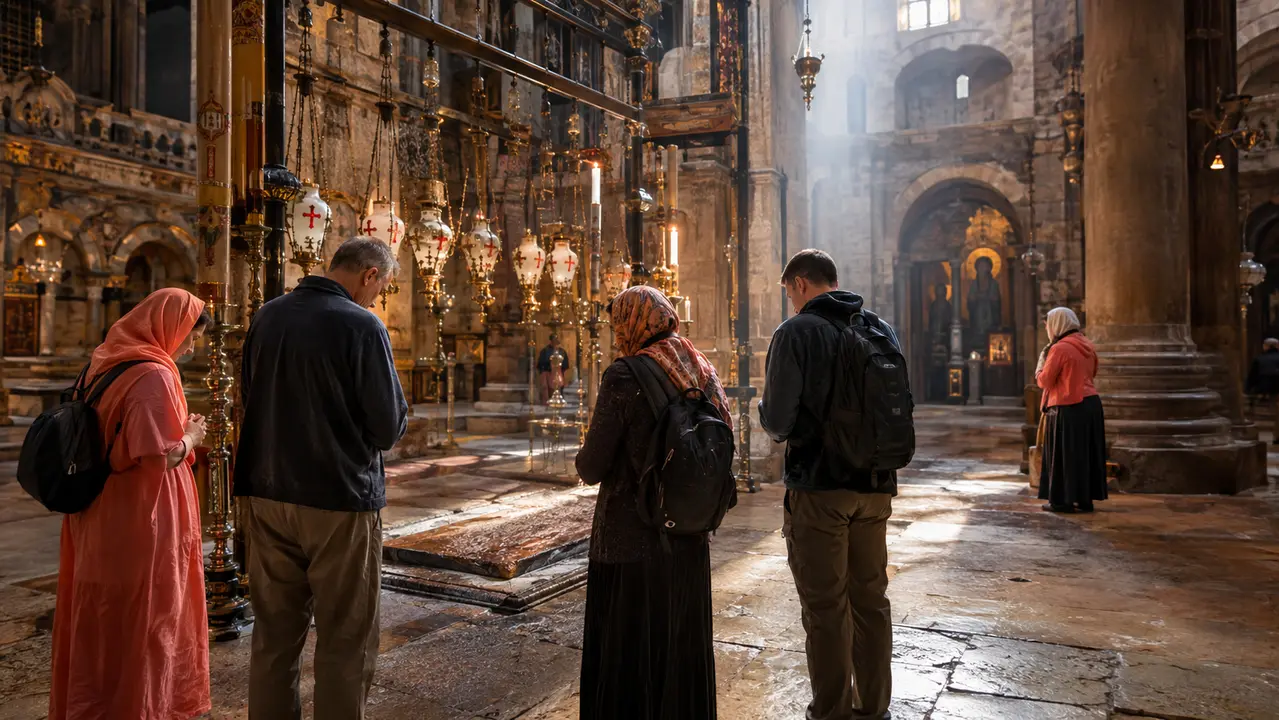
The classic view over the Old City opens the morning of a combined tour.
Yes, if the itinerary concentrates on the signature holy locations instead of trying to collect every minor stop. The mistake we see from first-time American groups is the checklist approach. Fourteen sites in one day means an average of twenty minutes each, with no time to actually stand still anywhere. What you get instead is a blur of stone and queues.
The approach we use concentrates the core time on four anchors: the Mount of Olives (Zechariah 14:4), the Old City Christian Quarter with the Church of the Holy Sepulchre (John 19:41-42), and the basilica complex in Bethlehem. Depth over volume. A group that spends forty unhurried minutes at the Holy Sepulchre, with a short Scripture reading and silence, will remember it for the rest of their lives. A group that sprints through it at 11:50 will remember the queue.
Do You Need a Passport to Travel from Jerusalem to Bethlehem?
Yes, without exception. Every international visitor must carry the original, valid passport and the Israeli entry slip received at the airport when traveling from Jerusalem to Bethlehem. The route crosses from Israeli jurisdiction into Palestinian Authority territory, Area A, where checkpoints operate and spot inspections are routine.
We say this plainly because American travelers sometimes assume a day trip within a small country does not require documents. It does. Copies, photographs on a phone, and driver’s licenses are not accepted, and a traveler presenting them will be turned back at the crossing. The standard for travel documents at land crossings requires validity of at least six months, per official border crossing requirements. Keep the passport in a secure zip pocket, not at the bottom of the bus.
What Essential Items Should You Pack Beside Your Passport?
Keep the day-pack simple. Modest clothing layers, your printed booking confirmation, a refillable water container, some Israeli Shekels for small purchases and gratuities, a portable power bank, sun protection, and a light wrap for the cold stone interiors of the churches. On summer days, follow the official health guidance on heat protection with 8 to 10 cups of water across the day and a wide-brimmed hat. Jerusalem stone reflects heat, and the Old City alleys offer less shade than people expect.
What Does the Border Crossing from Jerusalem to Bethlehem Look Like in Practice?
The crossing itself is shorter than the anxiety around it. The coach or private vehicle drives south from Jerusalem toward crossings such as Checkpoint 300 or the Rachel’s Tomb area. Depending on current regulations and the day’s arrangements, some groups continue in the same vehicle while others transition to a local Bethlehem vehicle and a local Christian guide at the perimeter. This is not improvised; it is coordinated in advance between our office and our Bethlehem partners.
On a professional tour, the process is standard, organized, and handled by drivers and coordinators who do it daily. From the traveler’s side, it usually amounts to a few minutes of waiting and a document check. We monitor the crossings each morning and adjust departure times when queues build.
Will Passengers Be Required to Walk Through the Checkpoint on Foot?
Organized group coaches with the appropriate tourism permits generally remain on the bus for vehicle inspection. Independent travelers and smaller vans may occasionally be asked to pass through an inspection lane on foot, depending on the real-time security protocol that day. Either way, the process is routine. Groups we bring through this crossing every week of the year rarely describe it as a highlight, but they never describe it as an obstacle either.
Is It Safe to Take a Christian Tour to Jerusalem and Bethlehem?
Organized religious tourism between Jerusalem and Bethlehem is a daily, established occurrence, and it has been for decades. Pilgrimage routes on both sides of the city depend on visitors, and everyone along the route, from merchants to clergy to municipal authorities, has a direct stake in keeping them welcoming and orderly.
We do not treat safety as an assumption. Our office continuously monitors the local security situation, maintains direct communication with our regional operators on the ground in Bethlehem, and adjusts routing whenever conditions call for it. In 35 years of running Christian tours between Jerusalem and Bethlehem for American churches, this discipline has never once been optional. Our travelers’ peace of mind is the product, as much as the sites themselves.
Which Holy Sites in Jerusalem Are Featured on This Pilgrimage Route?
The Jerusalem phase of the day traces the final chapters of Jesus’ ministry. It opens on the Mount of Olives (Acts 1:9-12), looking down over the Temple Mount and the golden gates of the Old City. The route then descends to the Garden of Gethsemane and the Church of All Nations (Matthew 26:36-46), where the ancient olive trees predate every building around them.
Entering the Old City, the walk follows the Via Dolorosa (John 19:17), the Stations of the Cross, through winding stone alleys to Golgotha and the empty tomb inside the Church of the Holy Sepulchre (John 19:41-20:18). For Catholic groups, these devotional stops anchor the entire day, and we give them proportionally more time. Travelers planning a longer devotional journey can review our curated Catholic pilgrimage itineraries for the full multi-day version. For Evangelical groups, the balance often shifts, with more time for Scripture reading at Gethsemane and in some programs a Garden Tomb visit on a separate morning. The geography is fixed. The emphasis is not.
How Does an Organized Christian Route Provide Greater Context Than a General Sightseeing Tour?
A general sightseeing tour shows you old buildings and tells you their age. A faith-centered route does something different. At each site, the guide connects the location to the specific Scripture it belongs to, explains the historical theology of what happened there, and protects a few minutes of silence for prayer. The difference shows most at the smaller stops. A group standing at the Pools of Bethesda (John 5:1-15) with the text open in their hands has a different experience than a group that walks past it on the way to somewhere older.
What Can You Experience Inside Bethlehem’s Most Sacred Sites?
The afternoon drive from Jerusalem to Bethlehem takes roughly 20 to 30 minutes, and the transition is striking. Suddenly you are in Manger Square, facing the low, fortress-like entrance of the Church of the Nativity (Luke 2:1-7). The basilica is one of the oldest continuously operating churches in the world, first built in the 4th century and reconstructed in the 6th, and it is inscribed as a UNESCO World Heritage site.
Beyond the basilica itself, the standard route includes the Franciscan Church of St. Catherine, the Milk Grotto, and the pastoral terraces of Shepherds’ Field in nearby Beit Sahour (Luke 2:8-20), a site under Franciscan custody. The sequence closes the arc the day opened, with the Passion in the morning and the birth in the afternoon.
Is Access to the Nativity Grotto Guaranteed During the Visit?
We will be straight with you, because we have to be. Entry into the Grotto of the Nativity, the small subterranean chamber with the 14-pointed silver star marking the traditional birthplace, cannot be unconditionally guaranteed by any tour operator, including us. The reasons are operational. Enormous pilgrim queues in peak months, prayer services held spontaneously by the Orthodox, Armenian, and Catholic custodial authorities, and liturgical restrictions on particular mornings all play a role. The sanctuary’s own published visiting regulations note that the Grotto has defined opening windows and can close for services, especially on Sunday mornings.
What we can do is plan around it. Groups we bring through consistently enter the Grotto, because the day is built to arrive outside the peak windows.
What Practical Steps Improve the Chances of Entering the Grotto?
Three tactics work. Arrive early, before the midday tour buses from Tel Aviv and Herzliya reach Bethlehem. Visit on weekdays rather than Sundays and major feast days, when liturgical schedules constrain access. And if your group is small, use that advantage, because smaller parties descend the narrow marble steps and clear the Grotto far faster than a group of 45. A group of 12 can be through in 20 minutes what takes a large group an hour.
Private Tour vs. Group Tour: Which Option Best Fits Your Travel Style?
Most American travelers plan this day in one of two formats, and the right choice depends on what your group actually needs.
| Dimension | Shared Group Tour | Private Tour |
|---|---|---|
| Cost per person | Lower, costs shared across the group | Higher, but fixed regardless of headcount |
| Departure | Fixed time and pickup point | Direct hotel pickup, your schedule |
| Routing | Set sequence, same for all travelers | Adjustable on the day |
| Prayer and photo time | Managed for the whole group | Extended whenever the group wants |
| Guide attention | Shared with the full coach | Dedicated senior guide |
A shared group tour suits solo travelers, couples, and small church parties who want the structure and the lower price. A private tour with Talya Tours suits groups that need control over tempo, where to linger, when to pray, and when to move.
When Is a Private Journey Well Worth the Investment?
Three profiles justify it almost every time. Multi-generational families traveling with elderly grandparents or small children, who need a slower pace and vehicle proximity. Church groups that want a private communion service or devotional time arranged at a specific site. And travelers with only two or three days in the country who cannot afford to wait on anyone else’s schedule.
What Is Included in the Pricing of a Jerusalem and Bethlehem Day Tour?
We lay this out plainly, because ambiguity here is how travelers get surprised. The standard Jerusalem and Bethlehem tour price includes the air-conditioned vehicle, the government-licensed guide, the border transfer logistics and local guide coordination in Bethlehem, and standard church entrance fees.
The typical exclusions are the midday lunch and beverages, discretionary gratuities for the driver and guide, and personal travel and health insurance. That is the full picture. There are no hidden surcharges added on the day, and if you are comparing a single day against a full multi-day Holy Land package with accommodation and meals included, we will show you both cost structures side by side before you decide anything.
Pre-Booking Checklist: Five Practical Details to Confirm
Before you confirm any booking, get answers to five questions. What are the cancellation policy terms. Where exactly is the pickup point. What language will the guide work in. What is the scheduled return hour. And does the lunch stop mean a local restaurant or a quick cafeteria meal. Any operator who cannot answer these five clearly is telling you something.
What Is the Appropriate Dress Code for Holy Sites in Jerusalem and Bethlehem?
The dress code is strict and consistent across all churches in Bethlehem and Jerusalem. Shoulders must be covered. Knees must be covered, which rules out short shorts and mini-skirts. Low-cut necklines will be refused at the door, and a traveler turned away at the Church of the Nativity has no second entrance to try.
The rules apply equally to men and women. Long lightweight trousers or modest dresses work best in every season. On footwear, sturdy, non-slip walking shoes are essential. The limestone alleys of the Old City are polished smooth by centuries of feet, and they are slippery, especially after rain. We have seen more twisted ankles on polished Jerusalem stone than on any hiking trail in the country.
Can Seniors or Travelers with Reduced Mobility Enjoy This Tour?
Honestly, and with the caveats that matter, yes. Thousands of senior travelers complete this day every year, and we host many of them. But the historical centers of both cities were not built for wheels. Ancient stone stairs, steep inclines, and cobbled passages make manual wheelchairs and standard strollers genuinely difficult. The Mount of Olives descent to Gethsemane is a sustained downhill walk on uneven pavement.
Seniors who travel with us succeed by keeping a measured pace, using handrails, and accepting that one or two optional sections can be skipped with no loss to the core of the day.
How Can Mobility-Challenged Visitors Modify the Itinerary?
The private format solves most of it. Vehicle access points can be maximized so the walking distance to each basilica is minimized. The steeper sections, like the Mount of Olives footpath, can be replaced with a short drive to a lower gate. And the itinerary can concentrate on the central basilica plazas, which have direct curb access, rather than the back alleys. Tell us the mobility situation when you book, not on the morning of the tour, and we will build the day around it.
Are There Shopping Stops for Authentic Olive Wood Handicrafts?
Most itineraries include one, and there is a reason beyond shopping. Bethlehem has been a center of olive wood carving for centuries, and the craft today is sustained largely by local Christian artisan cooperatives. A typical stop runs 30 to 45 minutes at a verified workshop, where travelers can see the wood-turning demonstrations and purchase nativity sets, crosses, and rosaries certified as locally hand-carved.
No one is obligated to buy anything. Travelers who prefer not to shop rest in the air-conditioned lounge with Arabic coffee, watch the carvers work, or simply sit. We do not run commission-driven shopping circuits. One workshop stop, clearly scheduled, is enough.
Where Are the Central Pickup and Drop-Off Points Located?
Morning pickups run through central Jerusalem, covering the major hotel areas, including the David Citadel area, King David Street, and the Grand Court area near the Old City walls. If your hotel sits outside the pickup radius, we will tell you the nearest central point at booking, and it will be within a short taxi ride.
Drop-off in the early evening returns to the same central access points, with convenient connections to the light rail, taxis, and the downtown dinner options. For travelers planning the rest of their week, this single day pairs naturally with our extended ten-day Holy Land expedition, which adds the Galilee and the coastal plain to the same journey. We encourage groups to secure dates early, especially around Easter and Christmas, when licensed guides and premium vehicles are booked months in advance.
Plan a Jerusalem and Bethlehem Day Built Around Your Congregation
Tell us your denomination, your group size, and your dates, and we will shape the itinerary around what matters to your church, from worship arrangements to site selection.
Frequently Asked Questions
Is one day really enough for both Jerusalem and Bethlehem?
Yes, when the itinerary concentrates on the core anchors rather than a long checklist of minor stops. The day covers the Mount of Olives, Gethsemane, the Via Dolorosa, the Church of the Holy Sepulchre, the Church of the Nativity, and Shepherds’ Field, with time for prayer at each. Groups wanting more depth can extend to a multi-day program.
How is the itinerary adapted to our denomination?
Every itinerary we build starts with the group’s tradition. Catholic and Orthodox groups receive more time at devotional sites like the Holy Sepulchre and the Nativity Grotto, with Mass or liturgy arranged where possible. Evangelical and Baptist groups often add Scripture-focused stops such as the Garden Tomb. The routing, worship arrangements, and even guide selection reflect the denomination of the visiting group.
Do American citizens need a visa to enter Israel and Bethlehem?
U.S. passport holders receive an entry permit on arrival in Israel, and no advance visa is required for a standard tourist visit. For the Bethlehem portion, travelers must carry the original passport and the entry slip issued at the airport, because the route crosses into Palestinian Authority territory at a staffed checkpoint.
Can we arrange a communion service or group worship during the tour?
Yes. Private groups can have a communion service or devotional time arranged at a chosen site, and we coordinate the venue, timing, and any local permissions in advance. The format follows your congregation’s practice, whether that is a Catholic Mass, a Protestant communion service, or a quiet Scripture reading.
What happens if the Nativity Grotto is closed when we arrive?
The day is built to arrive outside peak windows, so this rarely affects our groups. If an unexpected liturgical service closes the Grotto, the guide adjusts the sequence and returns to the basilica later in the visit, or extends time at Shepherds’ Field and St. Catherine’s Church.
Planning Your Day
A combined Jerusalem and Bethlehem day works when three things line up. The itinerary concentrates on the anchor sites instead of a checklist. The logistics, from checkpoint handover to church timing, are planned in advance by people who run the route daily. And the plan itself reflects the tradition of the group, because a Southern Baptist congregation from Texas, a Catholic parish from Ohio, and a non-denominational church group from Georgia each deserve a different version of this day. If you are starting to plan yours, we are happy to talk through dates, sites, and logistics before you commit to anything. Reach Talya directly at [email protected] or through our contact page.
Start the Conversation Today
American pastors and group leaders can email [email protected] or use the contact page, and receive a proposed itinerary shaped to their congregation’s denomination, schedule, and pace.
About the Author

Talya Felner is the Owner and CEO of Talya Tours Services (TTS), a leading professional tour operator in Israel. With over 35 years of experience and more than 90,000 travelers served, Talya has built TTS into a trusted name for Christian pilgrimages, biblical tours, and conferences for groups visiting Israel and the Holy Land. Her team designs each itinerary around the specific Christian denomination of the visiting group, whether Protestant, Catholic, Evangelical, Baptist, Methodist, Pentecostal, Lutheran, Presbyterian, Anglican, Orthodox, or another tradition, ensuring that sites, worship arrangements, and guides reflect what matters most to that congregation. From visas and accommodations to guides, transportation, and on-site coordination, TTS handles every detail so American pastors and group leaders can focus on the spiritual experience of their travelers.