
A youth pastor from Nashville sent us a draft schedule in April with ninety minutes marked for the Old City, squeezed between a museum stop and a one o’clock lunch. Forty-one people, one coach, one guide. We asked him to open the map again.
The walled Old City covers roughly 0.35 square miles. On paper that reads like a short stroll. In practice, forty Americans moving through stepped alleys, passing a security check at the Western Wall plaza and waiting in line at the Church of the Holy Sepulchre (John 19:41-42), will need three and a half hours to do the minimum honestly. He moved the museum. The group got four hours inside the walls and came out of it with something they still write to us about.
Reading time: 9 minutes
Key points in this article
- The Old City covers about 0.35 square miles but requires three to six hours on foot to visit properly, since everything happens at walking pace on stone and stairs.
- Talya Tours builds each Old City route around the visiting group’s Christian denomination, adjusting time at the Via Dolorosa, the Garden Tomb, or the Western Wall accordingly.
- Jaffa Gate, Zion Gate, and Dung Gate each set up a different morning route, and the right starting gate depends on where the group’s day continues.
- Licensed guides check same-day access windows for the Holy Sepulchre, the Western Wall Tunnels, and the Temple Mount, since all three can change access without notice.
Table of Contents
What a Jerusalem Old City tour actually is
The four quarters, walked in order
Three hours, five hours, or the whole day
Jaffa Gate, Zion Gate, Dung Gate
Why the self-guided walk fails
Denomination-specific itineraries
Heat, stairs, dress code, and the Temple Mount
What a Jerusalem Old City tour actually is, in operational terms
A Jerusalem Old City tour is a guided walk inside the sixteenth-century Ottoman walls, normally lasting between three and six hours, covering some or all of the four quarters on foot. There is no vehicle access to most of the route. Everything happens at walking pace, on stone, with stairs.
The walk crosses about three thousand years of layers, and it also crosses about thirty-five thousand people who live and work inside those walls today. That combination is the reason self-navigation goes wrong. Groups miss the context, or they miss the turn, and in the alley network behind the Damascus Gate market both mistakes happen within the same five minutes. The official overview of Jerusalem’s Old City lists the main monuments clearly enough, but a list of monuments is not a route.
What a licensed Israeli guide adds is sequence, timing, and explanation across three religious traditions plus the political present tense. At Talya Tours we work only with government-licensed guides, and most American visitors combine this walk with other guided daily tours in Israel across Bethlehem, Masada, and the Galilee during the same week.
The four quarters, walked in the order that actually holds together
Most first-time groups from the U.S. assume the quarters are neighborhoods with borders. They are not. You cross from the Christian Quarter into the Muslim Quarter without any sign telling you so, and the shift is in the shop fronts, the language on the doorposts, and the smell of the street.
Our standard route enters at Jaffa Gate, drops through the Armenian Quarter past St. James Cathedral (Acts 12:1-2), where the Armenian community has held the same compound since the Middle Ages and the courtyard goes quiet in a way nothing else inside the walls does. From there into the Jewish Quarter, the Roman Cardo with its standing columns, the Hurva Synagogue square, and then the overlook at the top of the steps where the Western Wall and the Dome of the Rock appear together in one frame. That overlook is where we stop talking for a minute and let people look.
The Jewish Quarter is also the most excavated ground in the country. Infrastructure work near the descent to the Western Wall plaza has produced published Israel Antiquities Authority excavation reports, which is why sections of the route occasionally shift behind fencing with no notice.
Then down to the Western Wall, up through the Muslim Quarter along the Via Dolorosa (Luke 23:26-32), past the Pool of Bethesda and the Church of St. Anne (John 5:1-9), and west into the Christian Quarter to the Church of the Holy Sepulchre. That order matters. Reverse it and you arrive at the Sepulchre at eleven in the morning with four other groups ahead of you.
Markets, rooftops, and the courtyards groups walk straight past
The Arab souk between the Damascus Gate and David Street is a working market, not an attraction. Spice merchants, bakeries turning out ka’ak with sesame from six in the morning, tailors, butchers. We build in twenty minutes there rather than rushing through, because it is usually the part American travelers describe first when they get home.
Two things almost nobody finds alone. The rooftops above the souk, reached by a small staircase off the Jewish Quarter side, where you stand level with the domes and see how densely the quarters actually interlock. And the residential courtyards fifteen meters off the main lanes, where laundry hangs above Crusader stonework and there is no one selling anything.
Three hours, five hours, or the whole day
The honest answer to how long a Jerusalem Old City walking tour takes depends on how much you are willing to leave out. Nobody covers everything. In thirty-five years we have never met a group that did.
Factors that eat time and that first-time organizers never budget for include the security check at the Western Wall plaza, which takes eight minutes for a couple and twenty-five for a group of forty, Friday prayers in the Muslim Quarter, which change the crowd flow entirely from around eleven to one, Shabbat, which closes the Jewish Quarter shops and the Cardo galleries from Friday afternoon, and midday heat in July and August, when the stone radiates and an older group slows by roughly a third.
| Format | Duration | What it realistically covers | Best for |
|---|---|---|---|
| Introductory walk | 3 to 4 hours | Two or three quarters, Western Wall overlook, one major church interior | Groups with a packed multi-day schedule, first visit |
| Intensive half day | 4 to 5 hours | All four quarters, Via Dolorosa in sequence, Holy Sepulchre with time inside | Church groups wanting Scripture reading at stations |
| Full day inside the walls | 6 to 8 hours | Four quarters plus Western Wall Tunnels or Ramparts Walk, market time, lunch stop | Repeat visitors, study groups, theology students |
A half-day walk slots cleanly into day four or five of a multi-day Holy Land itinerary, after the Galilee section, when the group has already absorbed Capernaum (Mark 1:21-35) and the Mount of Beatitudes (Matthew 5:1-16) and is ready for the density of Jerusalem.
Jaffa Gate, Zion Gate, Dung Gate – the start point decides the whole morning
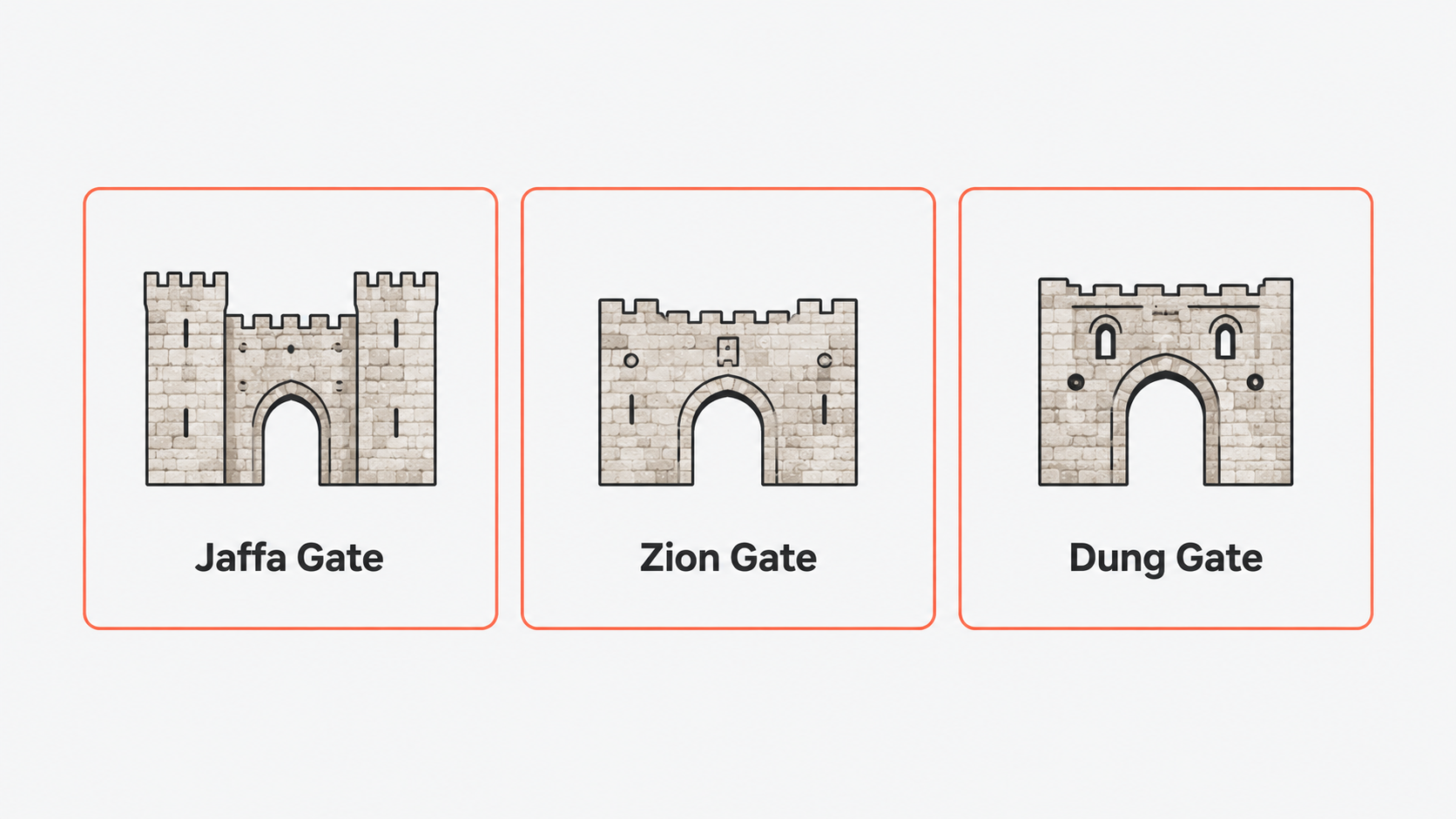
There are eight gates in the wall, and only three of them work as group meeting points. Jaffa Gate is the default for a reason. The light rail stops at City Hall, four minutes’ walk away, taxis can pull in at the plaza, and the Mamilla car park sits directly below it, which matters when your coach cannot wait. Details on access, opening seasons, and parking near the walls are published by the Jerusalem Walls National Park.
Zion Gate puts you thirty seconds from Mount Zion and the Upper Room (Acts 1:12-14), and drops you straight into the Armenian and Jewish Quarters without crossing the market. Dung Gate is the shortest approach to the Western Wall and the City of David, and it is the gate we use when a group has mobility limits, because it removes the steepest descent from the route.
Matching the meeting point to the rest of your day
If your afternoon is at Yad Vashem or the Israel Museum, start at Jaffa Gate and finish there. If the afternoon is at the Mount of Olives (Acts 1:9-12) and the Garden of Gethsemane (Matthew 26:36-46), start at Jaffa Gate and end at Lions’ Gate, where the coach meets you on the far side. Walking back to your start point wastes forty minutes of daylight, and in winter you only have until about half past four.
The self-guided walk fails for a reason nobody expects
People assume the risk of a self-guided walking tour of Jerusalem’s Old City is getting lost. Getting lost is recoverable. Ask anyone in the souk and you will be pointed to Jaffa Gate within a minute.
The real failure is arriving at a closed door. The Holy Sepulchre closes for cleaning and liturgy at hours that shift by season and by which community holds the altar that morning. The Western Wall Tunnels run on pre-booked timed slots and regularly sell out ten days ahead. The Armenian compound opens to visitors for a narrow window around midday. A licensed guide checks all of it the night before, which sounds trivial until it is your only day in Jerusalem.
The second failure is theological. Standing at the fourth station of the Via Dolorosa with no one to explain why Catholic and Evangelical traditions locate the tomb in two different places produces confusion, not meaning. That explanation is most of what a good Old City guide is being paid for.
| Format | Route and pace | Guide attention | Cost profile | Suits |
|---|---|---|---|---|
| Private tour | Built to your request, flexible start time, stops adjusted on the day | Full, with room for questions at every site | Flat guiding fee for the whole party | Church groups, families, seniors, specialist interests |
| Small group tour | Fixed schedule and fixed stops | Shared across the group | Per person | Couples and solo travelers on a budget |
| Self-guided | Complete freedom, no route logic | None | Nothing beyond entrance tickets | Repeat visitors who already know the alleys |
What actually drives the price
Small group walking tours are priced per person and generally sit in the tens of dollars for a half-day slot. Private guiding is a flat fee for the party, which is why a family of five and a group of thirty pay the same guide rate and the per-head cost collapses as the group grows. Above that baseline, price moves with duration, season, whether you want a private vehicle bringing the group to the gate, and whether you need a guide with academic or theological depth rather than a general license.
Judge value on the license, the group size cap, and how much the itinerary can be adapted on the day. The cheapest quoted walking tour is often a fifty-person group with an unlicensed leader, and you will spend the morning at the back straining to hear.
A Catholic parish and a Southern Baptist congregation do not walk the same Old City
This is the part we build every itinerary around, and it is the first question Talya asks on the phone, which tradition is the group, and what does the pastor want them to come home with.
A Catholic parish from Cincinnati walks the Via Dolorosa station by station, with a Mass arranged at a chapel along the route or inside the Church of the Holy Sepulchre (John 19:41-42), and the Old City morning connects later in the week to the Basilica of the Annunciation (Luke 1:26-38) and the Church of the Nativity (Luke 2:1-7). A Southern Baptist congregation from Houston will usually spend less time under the Sepulchre’s domes and considerably more at the Garden Tomb (John 20:1-18), with open Bibles, a communion service, and a longer Jordan River element at Yardenit (Matthew 3:13-17) later in the trip.
A Pentecostal ministry asks for extended prayer and worship time, so we schedule fewer stops and protect an hour at Gethsemane (Matthew 26:36-46). United Methodist and Presbyterian groups tend to want the historical and textual background laid out carefully, with quiet time built in rather than more sites added. Non-denominational congregations usually want broader coverage and flexibility to stop and sing when the moment arrives.
Same four quarters. Four different mornings. Anyone who hands every American church the identical eight-day program has not asked the question.
Three themed tracks that work inside the walls
The Christian heritage track runs the Via Dolorosa, the Holy Sepulchre, and a viewpoint from the Mount of Olives, and folds naturally into wider biblical travel packages covering Galilee and Judea. The Jewish heritage track takes in the Western Wall, the Southern Wall excavations, the Cardo, and the restored synagogues of the Jewish Quarter. The culinary and cultural track moves through the spice stalls, a working bakery, and the Armenian ceramic workshops.
One point we repeat to every trip organizer. Four sites explained properly beat nine sites glimpsed. Overloading the schedule is the most common planning error we correct.
If your congregation has a specific denominational focus, whether Catholic, Baptist, Pentecostal, Methodist, Presbyterian, Lutheran, Anglican, Orthodox, or another Christian tradition, we plan the Old City route and the surrounding itinerary around that focus before anything else is confirmed.
Heat, stairs, dress code, and the Temple Mount window
Modest dress is required at the holy sites in all four quarters. Shoulders and knees covered, no low necklines, and a scarf in the day bag for women entering churches, the Western Wall plaza, and the Temple Mount compound. Shoes matter more than people think. The paving has been polished by centuries of foot traffic and is genuinely slippery, particularly on the descent through the Armenian Quarter after rain. The national parks authority makes the same practical points in its official route guidance for walking around the Jerusalem walls, water, walking shoes, a hat, sun protection.
For a four-hour walk, bring 1.5 liters of water per person, breathable modest clothing, a sun hat, sunglasses, a shawl or scarf, your passport or photo ID, and a small amount of shekel cash for the market, since many stalls do not take cards.
| Time window | Crowds and conditions | Best used for |
|---|---|---|
| 08:00 to 10:30 | Low to moderate density, comfortable temperatures | Church interiors, Western Wall, Holy Sepulchre before the queues |
| 10:30 to 14:30 | Peak group volume, full midday sun | Shaded souk lanes, Cardo, indoor complexes, lunch |
| 14:30 to 17:30 | Softer light on the stone, market at full energy, closing hours approaching | Rooftops, photography, market time, Armenian Quarter |
Temple Mount access, honestly
Non-Muslim visitors enter the Temple Mount compound (Matthew 21:12-14) only through the Mughrabi Bridge beside the Western Wall plaza, and only during limited morning and early afternoon windows, Sunday through Thursday. It is closed to tourists on Fridays, Saturdays, and religious holidays, and access can be suspended at short notice on public order grounds. Entry to the mosques and the Dome of the Rock is not permitted for non-Muslims. Free access to holy places is anchored in Israeli law under the Protection of Holy Places Law, 1967, but daily conditions still change. We verify status the same morning, every time.
Children, seniors, and travelers who cannot manage steps
Be realistic about the terrain. There are hundreds of steps, several steep inclines, and lanes too narrow for a standard wheelchair to turn. For families with young children we keep the walk to about three hours and build in stops with something to touch or taste, an ancient cistern, a sweet shop in the souk. For older travelers we plan shaded seating roughly every forty minutes, add water stops, and arrange vehicle drop-off at Dung Gate so the day starts on level ground.
A step-free corridor does exist. It runs through parts of the Jewish and Armenian Quarters and reaches the Western Wall plaza, and we have taken groups with wheelchairs along it many times. It cannot reach the Via Dolorosa or the upper Muslim Quarter, and we say so before anyone books.
On safety, the Old City is patrolled continuously, with tourism police, municipal security, and camera coverage across the main thoroughfares, and the David precinct station sits inside the walls. A guide’s job here is practical rather than dramatic. They know which lane is congested at prayer times, which day the market is heaviest, and when to shift the route two streets over without the group noticing anything happened.
Choosing the right walk for your group
Work backwards from three things. How many hours you can give the Old City without stealing them from Bethlehem or Masada. What your group is here for, whether that is Scripture at the stations, archaeology, or the market. And how far the least mobile person in your party can comfortably walk on uneven stone.
Three or four hours with a licensed private guide covers a first visit properly. A congregation with a specific tradition should ask the operator directly how the route changes for their denomination, because if the answer is vague, the itinerary is off the shelf. Book early. April, May, September, and October fill first, and the good guides in Jerusalem are committed months ahead. Our comprehensive Jerusalem touring guide is a useful next step for planning the rest of the city, since half of what your group will want to see sits outside the walls.
Frequently Asked Questions
How much time should we set aside for the Old City in a multi-day Israel itinerary?
Plan for a half day, four to five hours, if your group wants all four quarters plus time inside the Holy Sepulchre. If your schedule is tight, three to four hours covers two or three quarters and the Western Wall overlook, but something will be left out. We help groups decide what to trim before the trip, not on the day.
Can the route be adjusted for our congregation’s specific Christian tradition?
Yes, and this is the starting point of our planning conversation, not an afterthought. Catholic groups typically want Mass arranged along the Via Dolorosa or inside the Holy Sepulchre. Baptist and Evangelical groups often prioritize the Garden Tomb and open Scripture time. Pentecostal groups usually want protected worship time at Gethsemane. Methodist, Presbyterian, and Lutheran groups tend to favor a slower pace with historical context. Tell us your denomination and your pastor’s goals, and we build the route around that.
What should our group wear and bring for a half-day walk inside the walls?
Modest dress with shoulders and knees covered, since this is required at churches, the Western Wall plaza, and the Temple Mount. Bring flat, closed walking shoes for slippery stone, 1.5 liters of water per person, a hat, sunglasses, a scarf for women, photo identification, and some shekel cash for the market, since many stalls do not accept cards.
Can older members of our group or those using wheelchairs join the walk?
A step-free corridor runs through parts of the Jewish and Armenian Quarters and reaches the Western Wall plaza, and we route wheelchairs through it regularly. It does not reach the Via Dolorosa or the upper Muslim Quarter, since those lanes are too narrow and stepped. For older travelers we build in shaded seating roughly every forty minutes and arrange vehicle drop-off at Dung Gate to start the day on level ground.
Is it possible to visit the Temple Mount as part of the tour?
Non-Muslim visitors can enter the Temple Mount compound through the Mughrabi Bridge during limited windows, Sunday through Thursday, and it is closed on Fridays, Saturdays, and religious holidays. Access can change without notice, so we verify the status the same morning rather than promising it in advance. Entry to the mosques and the Dome of the Rock itself is not open to non-Muslim visitors.
What is the difference between a private tour and a small group tour for our congregation?
A private tour is priced as a flat guiding fee for your whole party, with the route, pace, and stops built around your group and your denomination. A small group tour follows a fixed schedule shared with other travelers and is priced per person. Most church groups, families, and congregations with denominational requirements choose private guiding, since the flexibility to adjust on the day matters more than the per-person savings.
The Old City rewards groups who plan for its pace rather than fight it. Four quarters, three religious traditions, and a route that changes meaning depending on whether your congregation is Catholic, Baptist, Pentecostal, Methodist, or another Christian tradition. The gate you start at, the hours you choose, and the sites you protect time for should all follow from what your pastor wants the group to carry home.
If you are putting together a group walk inside the Old City, or a full pilgrimage around it, we are glad to go through dates, gates, denominational requirements, and pacing before anything is confirmed.
Plan your Old City visit with Talya Tours
Or write directly to Talya at [email protected].

About the Author
Talya Felner is the Owner and CEO of Talya Tours Services (TTS), a professional tour operator in Israel. With over 35 years of experience and more than 90,000 travelers served, Talya has built TTS into a trusted name for Christian pilgrimages, biblical tours, and conferences for groups visiting Israel and the Holy Land. Her team designs each itinerary around the specific Christian denomination of the visiting group, whether Protestant, Catholic, Evangelical, Baptist, Methodist, Pentecostal, Lutheran, Presbyterian, Anglican, Orthodox, or another tradition, ensuring that sites, worship arrangements, and guides reflect what matters most to that congregation. From visas and accommodations to guides, transportation, and on-site coordination, TTS handles every detail so American pastors and group leaders can focus on the spiritual experience of their travelers.