
The Old City of Jerusalem covers less than one square kilometer, and almost none of it is open to vehicles, which makes a walking tour the only practical way to reach the holy sites and archaeological remains inside the walls. The four quarters, Jewish, Christian, Muslim, and Armenian, sit within minutes of one another, yet each carries its own sounds, scents, and building styles that can only be absorbed on foot. This guide lays out the main walking routes with accurate distances, the logistical decisions that shape a walking day, and the way route planning changes depending on the Christian tradition of your group.
A pastor from Dallas who recently arrived with thirty-eight congregants assumed the walk from Jaffa Gate to the Western Wall would take ten relaxed minutes. He soon learned that the ancient stone lanes allow no vehicles, and that every step involves steep slopes, worn staircases, and security checkpoints. Over thirty-five years of guiding American church groups, we have seen repeatedly that no single walking day suits everyone. A Baptist congregation from Texas needs different pacing and reflection time than a Catholic parish from Ohio that hopes to celebrate Mass inside the Church of the Holy Sepulchre (John 19, 17-42). The sections below cover the routes, the distances, and the choices that will define your group’s day in the Old City.
Reading time: 4 minutes
Key Points
- The Old City spans under one square kilometer and is closed to almost all vehicle traffic, so walking is the only way to reach most sites.
- Four main routes range from 1.2 to 3.2 kilometers, each with distinct terrain, effort levels, and key sites.
- Security checkpoints and holy day schedules can add delays of thirty minutes or more, so timing and sequence matter.
- Talya Tours builds each walking day around the denomination of the visiting American group, from Catholic Mass arrangements to Baptist scripture readings.
Table of Contents
- Why Walking Is the Only Way to See the Old City
- Four Recommended Walking Routes in and Around the Old City
- Guided Tour or Independent Walking
- Walking the Via Dolorosa, Planned Around Your Denomination
- Is a Walking Tour Suitable for Families and Older Travelers?
- How Security Checks and Holy Day Schedules Affect Your Route
- Frequently Asked Questions About Walking Tours in Jerusalem
Why Walking Is the Only Way to See the Old City
The Old City was originally built for pedestrians and pack animals, and its traffic arteries remain too narrow and too stepped for motor vehicles. Walking the lanes reveals hidden details such as Mamluk-era inscriptions, Roman-period stone columns, and shopfronts that have operated continuously for centuries.
UNESCO has declared the Old City and its walls a World Heritage Site, as documented on the official UNESCO listing page. This designation protects a historic street network that has not changed in any fundamental way since the Middle Ages.
The close geography between the central places of worship also makes walking the only way to understand how three faiths share such a dense urban space. Poor route planning, however, costs travelers valuable hours standing at bottlenecks or arriving at gates that locked in the early afternoon. A well-sequenced route avoids both problems.
Four Recommended Walking Routes in and Around the Old City
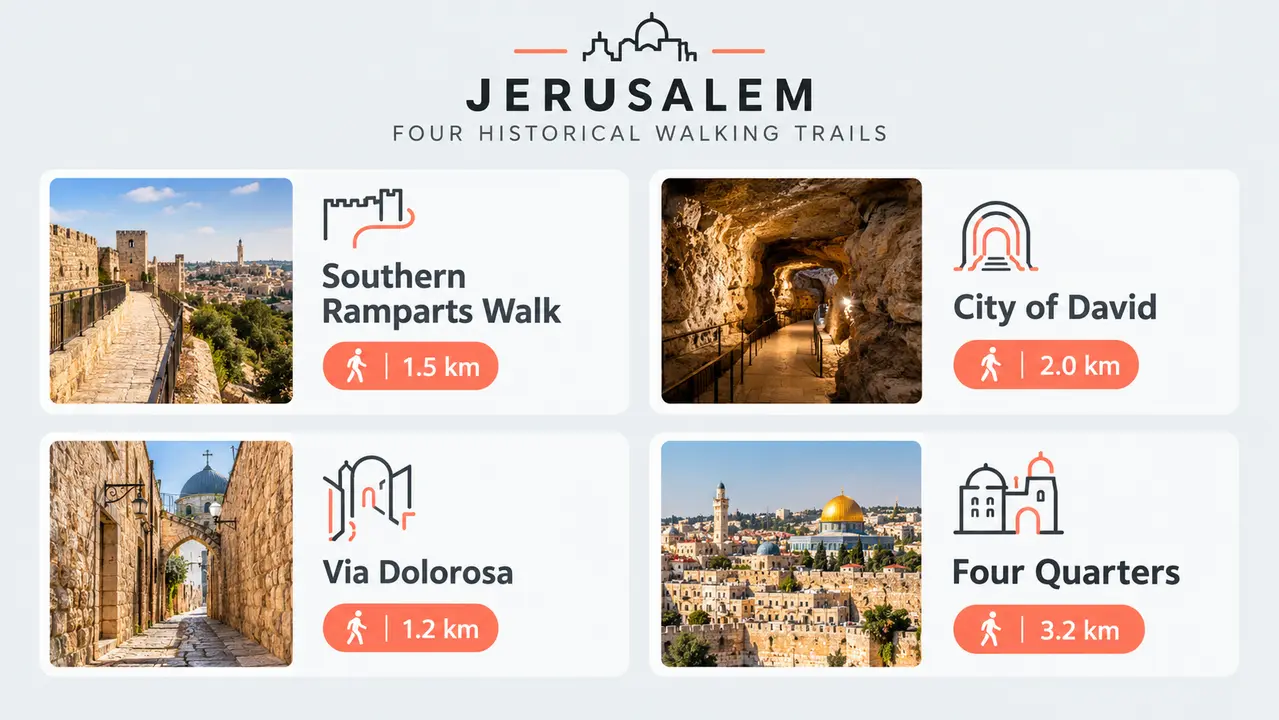
The four main walking routes compared by distance, duration, and terrain.
Dividing the Old City into defined routes prevents physical exhaustion and keeps movement logical, with no repeated backtracking over the same streets. The four routes below are based on accurate distances and different effort levels, matched to the character of the group and the time available.
Southern Ramparts Walk
Distance 1.5 kilometers, roughly ninety minutes. The route leaves Jaffa Gate, passes above the homes of the Armenian Quarter, and ends at the Dung Gate, with striking viewpoints toward Mount Zion and the Sultan’s Pool. Terrain involves narrow stone staircases, elevated passages, and no shade.
City of David and Jerusalem’s Ancient Water Sources
Distance 2.0 kilometers, three to four hours. The route descends from the Dung Gate through subterranean excavations and First Temple period remains, continues through the wet Hezekiah’s Tunnel, and ends at the Pool of Siloam (John 9, 1-7). Terrain involves a steep descent, walking through shallow water, and underground passages.
Via Dolorosa and the Stations of the Cross
Distance 1.2 kilometers, two to three hours. The route runs from the Lions’ Gate past the Church of Saint Anne and the fourteen traditional stations to the Church of the Holy Sepulchre (John 19, 17-42). Terrain involves crowded market lanes and moderate stairs in both directions.
Classic Four Quarters Route
Distance 3.2 kilometers, four to five hours. The route connects the Byzantine Cardo, the rooftop viewpoint above the markets, the Western Wall plaza, and the quiet alleys of the Armenian Quarter. Terrain mixes stairs and level ground, with smooth paving stones and several shaded areas.
Guided Tour or Independent Walking
An independent walk gives full control over pacing and costs nothing, but it presents a real navigation challenge. In the covered alleys, satellite reception is blocked completely, and the high stone walls and winding passages defeat most phone mapping apps, which often leads to long wandering in dead ends.
A licensed guide supplies historical context for every stone, identifies remains from different periods, and knows how to route around sudden security barriers in real time. A guide also times entry to sensitive sites for the right hours and prevents long waits in line.
Free tip-based walking tours operate in the Old City, but their groups often exceed thirty-five participants. That size makes hearing difficult in busy lanes and prevents orderly entry to interior sites that require advance coordination or entrance fees. The customary tip on such tours runs between forty and eighty shekels per person.
For groups that want the layers of the city explained properly and smooth movement between sites, a comprehensive guided tour of Jerusalem’s Old City with private guiding provides a complete and professional answer.
If your congregation is planning a walking day in the Old City, we will build the route around your denomination, your group’s walking pace, and the sites that matter most to your tradition. Write to [email protected] or reach us through the Talya Tours contact page to start planning.
Walking the Via Dolorosa, Planned Around Your Denomination
The traditional walk in the footsteps of Jesus usually begins at the summit of the Mount of Olives, descends to Gethsemane (Matthew 26, 36-46), enters the Old City through the Lions’ Gate, and continues along the fourteen stations of the Via Dolorosa to the Church of the Holy Sepulchre. Many groups open the morning at the panoramic viewpoint near the Church of Dominus Flevit (Luke 19, 41-44), where the Temple Mount esplanade appears in full view.
The differences between Christian traditions in the United States reshape this route on the ground. Catholic parishes stop for prayer at each station of the cross and ask us to arrange a scheduled Mass inside the Church of the Holy Sepulchre in advance. Baptist and Evangelical congregations from North Carolina and elsewhere usually prefer extended scripture reading at Gethsemane and conclude their walk at the quiet Garden Tomb outside the walls. Lutheran, Presbyterian, Methodist, and Anglican groups each bring their own liturgical rhythm, and we assign guides and worship arrangements to match the tradition of the visiting congregation rather than forcing one itinerary on every group.
It is worth checking the Patriarchate’s schedule of church services in advance to plan the hour of entry to the central rotunda. Groups seeking a deeper spiritual dimension arrange dedicated Christian tours of Jerusalem built specifically around their congregation’s beliefs.
Is a Walking Tour Suitable for Families and Older Travelers?
A walking tour works well for families with children and for mixed-generation groups, but it requires advance adjustments to pace and the complete abandonment of standard strollers. Stone staircases appear at nearly every transition, which turns any stroller into an exhausting physical burden, so a quality baby carrier is the right choice for toddlers.
Jerusalem paving stones have been polished by millions of walkers over centuries and become especially slippery in rain or under summer dust. The Ministry of Health’s fall prevention guidance for older adults recommends closed, supportive walking shoes with grooved rubber soles. For older travelers who struggle with steep climbs, a shuttle cart service connects the Jaffa Gate area with the Western Wall and cuts the climbing effort considerably.
Multi-generational American families planning a shared route often choose to arrange tours of the Holy Land tailored for seniors, which include organized rest points and routes that avoid steep staircases.
How Security Checks and Holy Day Schedules Affect Your Route
Entry to the Western Wall plaza and the Temple Mount compound requires passage through strict security checkpoints with metal detectors and bag screening. In the early morning hours and on holidays, these checkpoints develop heavy congestion that can delay a group by thirty minutes or more. The operational guidelines of the Israel Police for the Old City allow certain gates to close temporarily during mass events or specific alerts.
The Western Wall prayer plaza is open to visitors at all hours of the day throughout the year, according to the Western Wall Heritage Foundation’s visitor information. Entry for non-Muslim visitors to the Temple Mount, by contrast, is permitted only during set morning and midday windows from Sunday through Thursday, via the Mughrabi Bridge, with an absolute prohibition on bringing sacred books or religious items, and with full modest dress required.
On Fridays around midday, the lanes of the Muslim Quarter fill with tens of thousands of worshippers heading to prayer, while many shops in the Jewish Quarter close before the Sabbath begins. Mental flexibility and a willingness to reorder the sites are fundamental conditions for a successful route.
Frequently Asked Questions About Walking Tours in Jerusalem
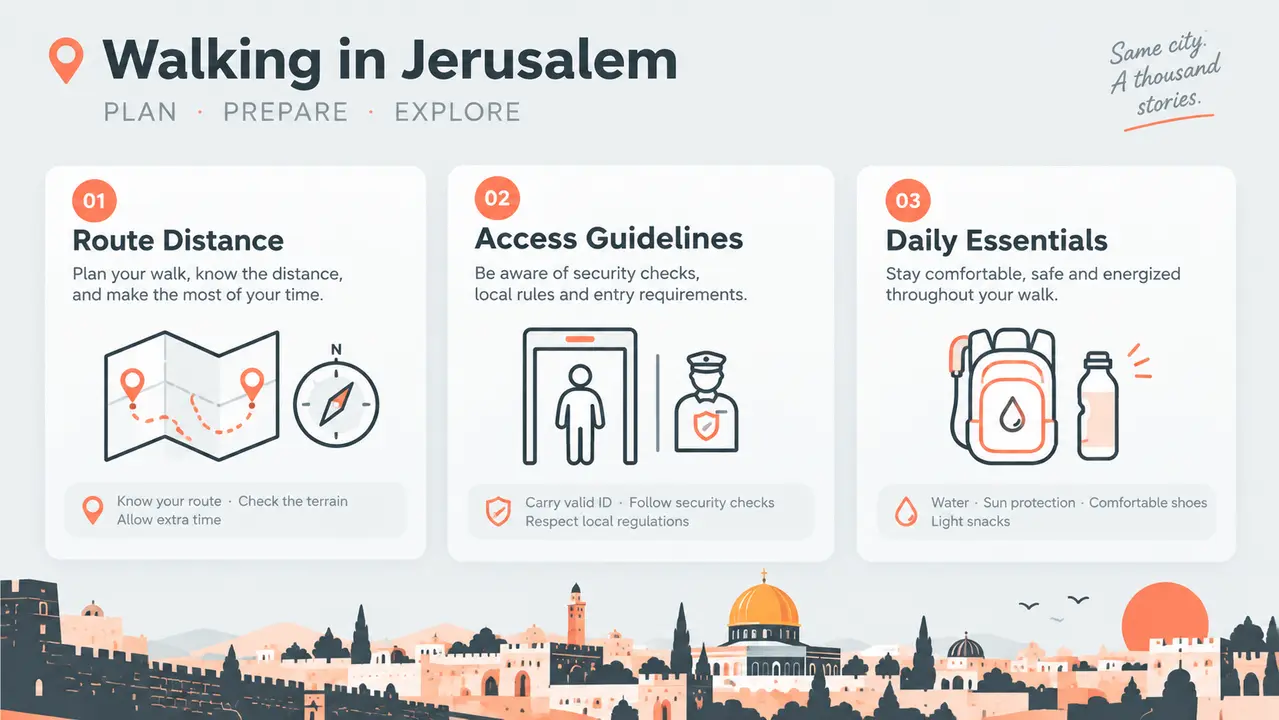
Answers to the questions American group leaders ask most often before a walking day in the Old City.
How many kilometers does a typical walking day in the Old City cover?
A comprehensive day involves four to seven kilometers of walking, combining moderate ascents with hundreds of ancient stone steps.
Can non-Muslim visitors enter the Temple Mount during an independent walk?
Non-Muslim visitors may enter only through the Mughrabi Bridge near the Western Wall, during the defined morning and midday visiting hours from Sunday through Thursday, wearing fully modest clothing and carrying no signs of prayer or religious items.
What is the easiest way to reach the starting point at Jaffa Gate?
The fastest option is the light rail to the City Hall stop at Safra Square, followed by a five-minute walk to the gate. Drivers can park at the Carta or Mamilla garages, both a short walk from the entrance.
What should we pack in the day bag for walking the lanes?
Plan on one and a half liters of water per person, a wide-brimmed hat, a phone charger, and modest clothing that covers shoulders and knees, with a head covering for women at holy sites. The Ministry of Health’s summer safety recommendations offer further detail on heat precautions.
Why coordinate a private walking tour with Talya Tours?
Private guiding lets your group set the walking pace to match its members, bypass bottlenecks during peak hours, and hear explanations shaped by your congregation’s own faith tradition. Requesting a customized private tour of Jerusalem gives you direct access to decades of practical experience in the city’s lanes.
The Old City rewards careful planning. Choose the route that matches your group’s stamina, schedule holy sites around security hours and worship times, and let the denomination of your congregation shape the stops, the readings, and the worship arrangements along the way. That combination turns a demanding walk through stone lanes into the remembered center of a pilgrimage.
Ready to plan a walking day in Jerusalem built around your congregation’s tradition and pace? Contact Talya Tours at [email protected] or through the contact page, and we will begin shaping a route matched to your group.

About the Author
Talya Felner is the Owner and CEO of Talya Tours Services (TTS), a leading professional tour operator in Israel. With over 35 years of experience and more than 90,000 travelers served, Talya has built TTS into a trusted name for Christian pilgrimages, biblical tours, and conferences for groups visiting Israel and the Holy Land. Her team designs each itinerary around the specific Christian denomination of the visiting group, whether Protestant, Catholic, Evangelical, Baptist, Methodist, Pentecostal, Lutheran, Presbyterian, Anglican, Orthodox, or another tradition, ensuring that sites, worship arrangements, and guides reflect what matters most to that congregation. From visas and accommodations to guides, transportation, and on-site coordination, TTS handles every detail so American pastors and group leaders can focus on the spiritual experience of their travelers.