
A pastor in Nashville called us last January. His congregation of 38 had voted to travel to Israel together, he had promised them a spring departure, and he had not booked a single hotel room. Church group trips to Israel start this way more often than one might expect, with a committed group and very little idea of where the logistics actually begin. This guide walks through what a pastor or group leader needs to know before booking, from cost structure and timing to how an itinerary is built around a congregation’s specific Christian tradition.
Reading time: 9 minutes
Key Takeaways
- Group size and hotel tier are the two largest drivers of per-person cost, more than any other factor.
- A ten-day itinerary is the practical minimum for covering Galilee, the Jordan Valley, and Jerusalem without exhausting the group.
- Itineraries are built around the specific denomination of the traveling congregation, not a generic Christian template.
- Planning should begin 10 to 12 months before departure to secure guides, hotels, and preferred dates.
Table of Contents
- What Is Actually Included in an All-Inclusive Package
- How Much Do Church Trips to Israel Cost a Congregation
- Trip Duration and Why Ten Days Works Best
- What a Premier 10-Day Itinerary Looks Like
- Essential Sites, and How Denomination Shapes the Itinerary
- When Is the Best Time of Year to Travel
- How Does a Pastor Ensure Safety on the Ground
- Step-by-Step, How a Pastor Organizes the Pilgrimage
- Private Custom Group or an Existing Tour
- Choosing the Operator, Guide, and Transport
- Border and Entry Requirements for U.S. Groups
- Frequently Asked Questions
When a congregation moves from reading Acts 10:9-16 on a Sunday morning to standing on the rooftop tradition of Joppa where Peter received his vision, something happens that a sermon alone cannot deliver. The ground does part of the teaching. For church group trips to Israel, that shift from Scripture on the page to Scripture underfoot is the entire point, and it is why group leaders keep bringing their congregations back.
We have organized tours in Israel for over 35 years and hosted more than 90,000 travelers, the vast majority of them American. In that time we have learned that the difference between a rushed, exhausting trip and a lasting spiritual milestone comes down to decisions made ten months before departure. This guide walks a pastor through those decisions, and for congregations ready to move from individual study to a shared journey, our range of Israel group tour packages is the practical starting point.
What Is Actually Included in an All-Inclusive Package
Pastors ask us to define “all-inclusive” before they trust the term, and they are right to ask. For church group trips to Israel, a genuine package covers a dedicated private motorcoach for the group alone, a government-licensed English-speaking guide who specializes in Christian history, all pre-booked site entry fees, and either half-board or full-board dining depending on the plan.
The line separating an ordinary operator from a true pilgrimage coordinator is what happens beyond the bus. We arrange private devotional time, reserved prayer areas at busy sites, and baptism renewal at the Jordan River. These are not add-ons. For most groups, they are the reason the trip is happening at all.
Watch the exclusions closely. For most church trips to Israel, international flights when booked independently, personal travel insurance, gratuities for the driver and guide, and midday lunches sit outside the quoted price. Knowing this before building a congregation flyer keeps the per-person number honest from the start.
How Much Do Church Trips to Israel Cost a Congregation
Price is driven by three factors, and group size is the first. The bus and the guide cost roughly the same whether a group has 20 travelers or 42, so those fixed costs divide down as the group grows. A group of 40 almost always pays less per person than a group of 18.
The second factor is accommodation tier. Christian guesthouses and biblical study centers sit at one end, premium four and five-star hotels at the other, and the gap between them can be significant across a ten-night stay. The third factor is season, covered further below.
Quotes are given per person in double occupancy. A traveler who wants a room alone pays a single supplement, and for planning purposes a pastor should assume a handful of travelers will request one. When building the congregation budget, leave room for group gratuities, any local ministry donation the church wants to make, and a small contingency fund. Groups that skip this buffer feel it the moment something shifts on the ground.
Trip Duration and Why Ten Days Works Best
A common planning error is compressing the trip to save on cost. A 5 to 7-day itinerary looks efficient on paper. On the ground it means rushed drives, tired travelers, and little time to actually process standing where Jesus taught.
Ten days is the number that works reliably. It divides cleanly into three to four days in the Galilee and the north, one day transitioning through the Jordan Valley and the Dead Sea, and four to five days in Jerusalem and the surrounding Judean sites. That rhythm gives church group trips to Israel enough margin for coverage and reflection alike.
Groups with more time available can stretch to 12 or 14 days, opening up deeper biblical geography, a wilderness stop in the Negev, or a historical extension to Jordan for Petra and Mount Nebo. This is not required. But when a congregation can give the extra days, it changes the character of the trip from tour to pilgrimage.
What a Premier 10-Day Itinerary Looks Like
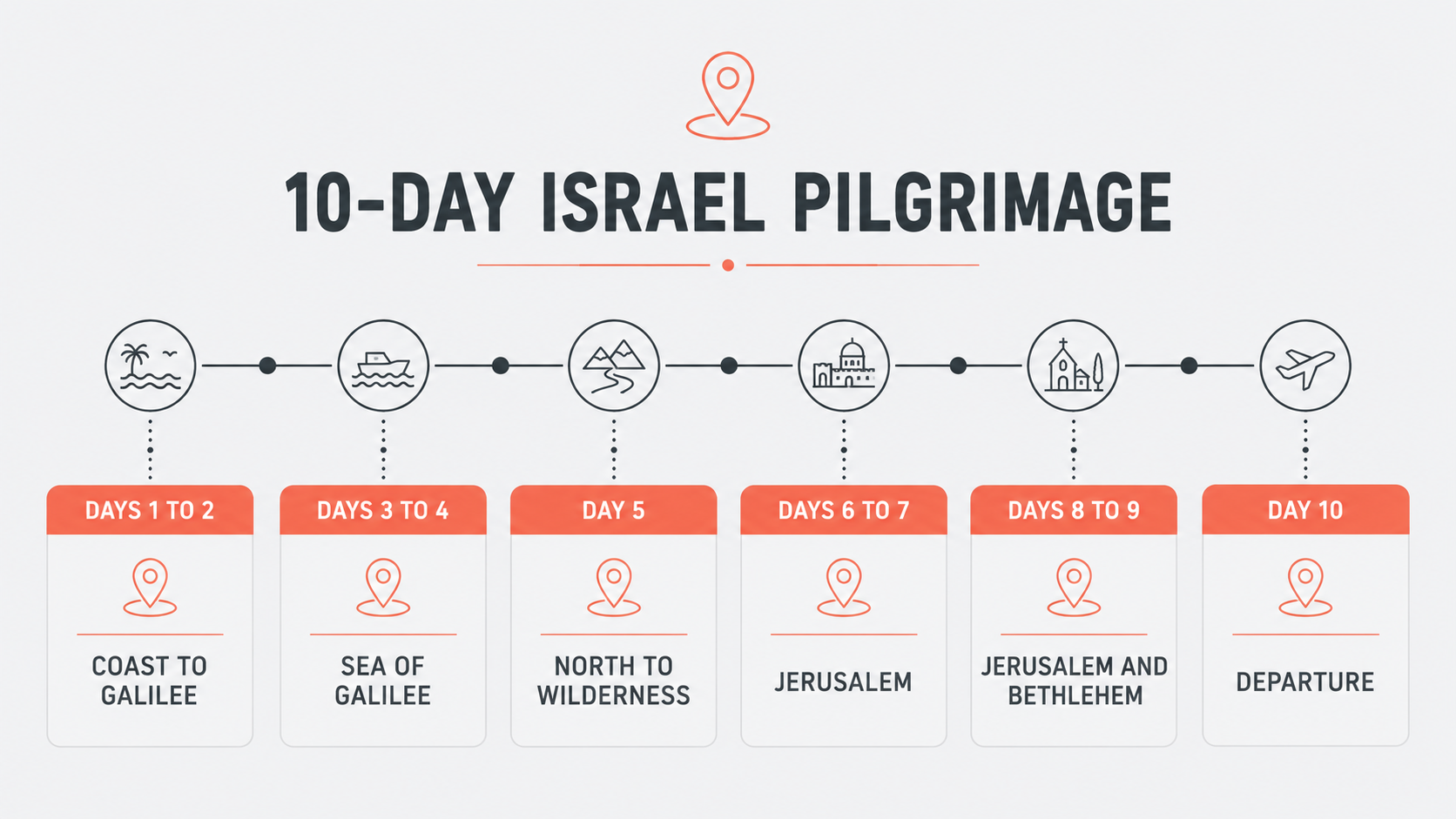
A balanced ten-day progression across Galilee, the Jordan Valley, and Jerusalem.
We build the ten-day plan chronologically and thematically. It opens with the early life and Galilean ministry of Jesus, moves toward Jerusalem, and closes with the Passion, the Resurrection, and Pentecost. That flow is why aligning geography with scriptural history is the foundation of any real biblical tour of Israel.
Daily Geographic and Spiritual Progression
Here is how a balanced ten days lands for most church group tours to Israel.
| Days | Region | Key Sites |
|---|---|---|
| 1-2 | Coast to Galilee | Ben Gurion arrival, Caesarea Maritima (Acts 10:1-8), Mount Carmel (1 Kings 18:16-40), Sea of Galilee |
| 3-4 | Sea of Galilee | Capernaum (Mark 1:21-35), Mount of Beatitudes (Matthew 5:1-16), Magdala, boat ride, baptism renewal at Yardenit |
| 5 | North to Wilderness | Nazareth (Luke 1:26-38), Tel Megiddo, Jordan Valley drive, Jericho, Dead Sea |
| 6-7 | Jerusalem | Mount of Olives, Garden of Gethsemane (Matthew 26:36-46), Pool of Bethesda (John 5:1-15), Via Dolorosa, Church of the Holy Sepulchre |
| 8-9 | Jerusalem and Bethlehem | Southern Steps, Western Wall, Upper Room on Mount Zion (Acts 2:1-4), Church of the Nativity, Shepherds’ Fields (Luke 2:8-20), Garden Tomb |
| 10 | Departure | Emmaus Road (Luke 24:13-35), Joppa (Acts 9:36-43), farewell dinner, evening flight |
The single instruction we give every pastor is simple. Do not fill every hour. Build in devotionals, real rest periods, and group reflection sessions. A schedule that leaves no room to sit and read Scripture at the site works against the reason the group came.
If your congregation is weighing a private group trip against joining an existing tour, we can walk through both options and how each fits your denomination, schedule, and budget.
Essential Sites, and How Denomination Shapes the Itinerary
Treating “Christians” as one uniform audience quietly undermines a trip. It does not work that way. The sequence of sites, the ceremonies included, and the emphasis given to particular locations differ sharply between traditions, and building each itinerary around the specific denomination of the requesting group is the first question we ask a pastor.
A Catholic parish will want meaningful time at the Church of the Holy Sepulchre, the Basilica of the Annunciation, the Church of the Nativity, and the stations of the Via Dolorosa, often with Mass arranged at appropriate locations. A Southern Baptist or non-denominational Evangelical congregation more often emphasizes the Garden Tomb over the Holy Sepulchre, Yardenit for baptism renewals, the Mount of Beatitudes, and Capernaum, with extended Scripture reading at each stop. A Pentecostal ministry may hold extended worship at the Mount of Olives. A Methodist, Lutheran, or Presbyterian fellowship usually values quieter, contemplative time paired with theological context from the guide.
The essential sites still group by region regardless of tradition. In the Galilee, Capernaum, the Mount of Beatitudes, and Magdala with its first-century synagogue. In Jerusalem and Judea, the Garden of Gethsemane, the Southern Steps where Peter preached at Pentecost, and the Garden Tomb or Holy Sepulchre depending on the group. In the wilderness, Masada, Qumran, and the Jordan River baptismal sites.
The operational detail is timing. We schedule reflective locations in early morning slots before the crowds arrive, and we reserve areas for group prayer or communion in advance. That scheduling discipline is often the difference between a photograph and a genuine moment. Group leaders can review pre-built options through our Christian tour packages to Israel.
When Is the Best Time of Year to Travel
Spring, March through May, brings green Galilee hillsides and wildflowers, but Easter and Passover crowd the sites and lift prices. Autumn, September through November, is the season we quietly favor for church trips to Israel, offering comfortable trekking weather and thinner crowds, with the one caveat that a pastor should plan around the Jewish High Holy Days, when some local services close. Israeli travel coverage such as this Mako feature on autumn touring reflects why late October and November work so well outdoors.
Winter, December through February, is cost-effective and uncrowded, with shorter daylight and occasional rain. Summer, June through August, fits school calendars for family-oriented church trips, but Jerusalem and the desert turn punishing. Before booking a July departure, it helps to review long-term temperature data from the Israel Meteorological Service and plan for hydration stops. A well-prepared group thrives in August heat, while an unprepared one can lose an entire afternoon to it.
How Does a Pastor Ensure Safety on the Ground
Safety for a pastor is an operational question, not a slogan. A serious operator stays in real-time contact with national safety committees and local authorities, adjusting itineraries the same day when official guidance changes. We coordinate directly with the Ministry of Tourism Department of Emergency, Security and Cyber, which is how a group’s plan adjusts without travelers ever feeling disrupted.
The driver and guide function as the group’s first responders. They know the alternative routes and which roads move freely, and their local knowledge matters far more in a real situation than any printed plan.
A group leader’s own checklist is short. Register every traveler with the U.S. embassy, set up one digital communication group for the whole party, and require travel insurance that includes broad medical evacuation coverage. That last item is not optional, and we say so to every pastor from Atlanta to Phoenix who asks.
Step-by-Step, How a Pastor Organizes the Pilgrimage
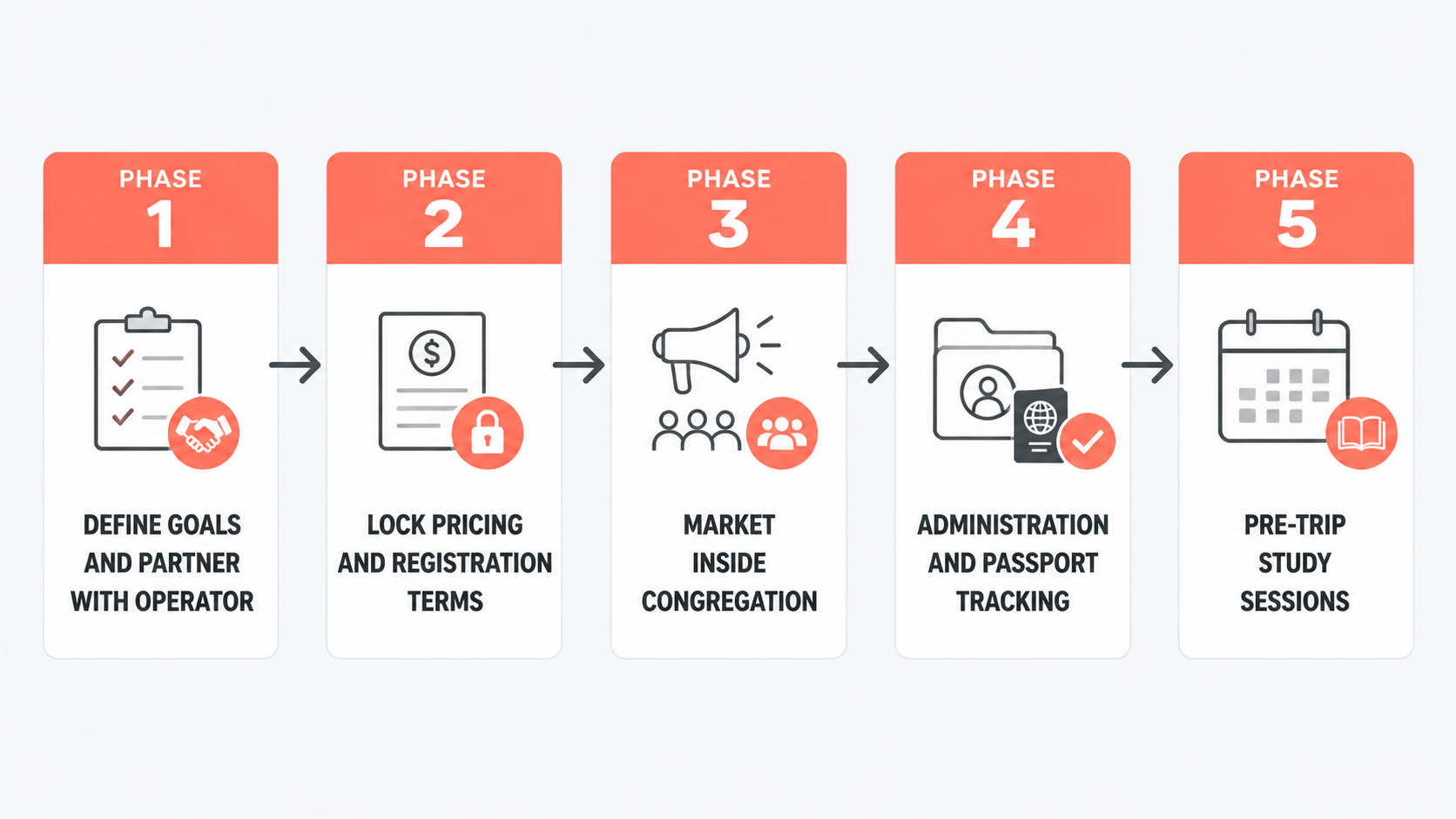
The five planning phases that carry a congregation from decision to departure.
The planning window is 10 to 12 months. A pastor who calls six weeks before departure can sometimes still be helped, but the strongest hotels and dates are usually already booked.
The Planning Timeline
- Phase 1 – Define the spiritual goals, choose the itinerary’s core focus by tradition, and partner with an experienced wholesale operator who can carry the logistics.
- Phase 2 – Lock the per-person price, build a clear one-page package flyer, and set registration terms with a firm deposit.
- Phase 3 – Market inside the congregation with information Sundays, printed brochures, and short preview videos.
- Phase 4 – Handle administration, including holding the registration deadline, collecting passport copies, and tracking monthly payment installments.
- Phase 5 – Run pre-trip study sessions so the group arrives already knowing the ground they are about to walk.
One detail pastors appreciate more than they expect is that at the end of the trip we can arrange official Ministry of Tourism Pilgrimage Certificates for every traveler, a small physical marker of a milestone they carry home.
Private Custom Group or an Existing Tour
Two models produce two very different trips. A private custom group gives a congregation full control of schedule, theological emphasis, pacing, and hotels. Joining an existing tour costs less and suits a smaller ministry or a pastor previewing the land, at the cost of conforming to a fixed itinerary alongside other groups.
| Factor | Custom Private Group | Joining an Existing Tour |
|---|---|---|
| Customization | Full control by denomination | Fixed, pre-set |
| Pricing | Higher per person | More cost-effective |
| Minimum participants | 15 or more | Individuals welcome |
| Spiritual intimacy | High, group alone | Shared with others |
For most congregations with 15 or more committed travelers, the private model is worth the difference. The itinerary becomes theirs, shaped around their own denomination and priorities rather than a shared schedule.
Choosing the Operator, Guide, and Transport
The guide is the trip. Insist on current credentials issued through the Ministry of Tourism guide registry, which confirms rigorous historical, archaeological, and safety training. A pastor should verify this before signing anything.
Training alone is not enough for a spiritual journey. A guide leading a church group trip must respect denominational nuance and know how to hold a quiet devotional space, not just recite dates. That is a different skill, and it is the one we screen for hardest.
On transport, confirm the motorcoach company operates under strict safety regulation with a modern, climate-controlled, Wi-Fi-equipped fleet. Ask directly. A reputable operator answers without hesitation.
Border and Entry Requirements for U.S. Groups
Passports must remain valid for at least six months beyond the departure date. Check every traveler’s passport during Phase 4 of planning, not at the airport.
U.S. citizens receive a standard B/2 tourist visa free of charge on arrival, as set out in the Population and Immigration Authority guidelines. Israel no longer stamps passports; travelers receive a paper gate-pass slip through biometric border control, which should be kept for the duration of the stay. Groups can get immediate help at the Ministry of Tourism information desks at Ben Gurion Airport, though groups traveling with us are met by our airport assistance before reaching them.
Frequently Asked Questions
How far in advance should our congregation start planning?
Ten to twelve months before departure. This secures the guide, preferred hotels, and travel dates before other groups book the same season.
Will the itinerary actually reflect our specific denomination?
Yes. Site sequencing, worship arrangements, and guide assignment are built around the group’s tradition, whether Protestant, Catholic, Evangelical, Baptist, Pentecostal, Methodist, Lutheran, Presbyterian, Anglican, Orthodox, or another Christian stream. A Catholic parish and a Baptist congregation traveling the same week will receive different itineraries.
What is the minimum group size for a private custom tour?
Fifteen travelers is the practical minimum for a fully private itinerary. Smaller groups or individual travelers typically join an existing scheduled tour instead.
Do American travelers need a visa before departure?
No advance visa is required. U.S. citizens receive a standard tourist entry permit free of charge on arrival, provided the passport remains valid for at least six months beyond the travel dates.
Are gratuities for the driver and guide included in the price?
No. Gratuities, along with international flights when booked separately and personal travel insurance, are typically quoted outside the base package price.
What happens if plans need to change once the group has arrived?
The guide and driver are the group’s first line of response and can adjust routes or timing the same day. Operators also stay in contact with national tourism safety authorities so itineraries flex without disrupting the group’s experience.
Church group trips to Israel are more than a vacation. They represent a lasting investment in the spiritual foundation of a congregation and the leadership that guides it. Handling the security, logistics, and historical depth of such a journey, while building the plan around a group’s specific denomination, is what a specialized operator exists to do.
If your congregation is ready to talk through dates, sites, and a draft itinerary shaped around your tradition, we are glad to help before anything is booked.
Or reach Talya directly at [email protected]

About the Author
Talya Felner is the Owner and CEO of Talya Tours Services (TTS), a leading professional tour operator in Israel. With over 35 years of experience and more than 90,000 travelers served, Talya has built TTS into a trusted name for Christian pilgrimages, biblical tours, and conferences for groups visiting Israel and the Holy Land. Her team designs each itinerary around the specific Christian denomination of the visiting group, whether Protestant, Catholic, Evangelical, Baptist, Methodist, Pentecostal, Lutheran, Presbyterian, Anglican, Orthodox, or another tradition, ensuring that sites, worship arrangements, and guides reflect what matters most to that congregation. From visas and accommodations to guides, transportation, and on-site coordination, TTS handles every detail so American pastors and group leaders can focus on the spiritual experience of their travelers.