
When a pastor from Dallas called our office asking whether forty-four church members could walk the entire Passion Week route in a single morning, the question sounded simple. On a map of Jerusalem the distance from the Mount of Olives to Golgotha measures less than two miles. Walking those two miles without understanding the terrain, the crowd patterns, and the opening hours of each sanctuary leads to exhaustion and missed prayer opportunities. This guide breaks the route down in chronological order so American pastors and group leaders can plan with clarity.
A Jerusalem Jesus tour is a dedicated faith-based itinerary covering the holy sites associated with the life, passion, and resurrection of Jesus within Jerusalem and its immediate surroundings. First-time visitors from the United States often expect quiet cobblestones and simple transitions between Gospel passages. They instead find active city streets, steep limestone stairs, and sanctuaries where several Christian traditions gather at once. A structured, denomination-aware plan is what turns those realities into a meaningful pilgrimage rather than a logistical struggle.
Reading time: 5 minutes
Key Points
- A chronological route from the Mount of Olives to the Church of the Holy Sepulchre traces Passion Week in historical order and eliminates backtracking.
- Every itinerary is built around the denomination of the group, from Catholic Mass arrangements to Evangelical communion services at the Garden Tomb.
- Starting at 7:30 AM at the Mount of Olives keeps groups ahead of both the crowds and the midday heat.
- Vehicle drops, wireless audio receivers, and firm footwear are core logistics rather than extras because the Old City is pedestrian only.
Table of Contents
- What a Jerusalem Jesus Tour Is
- The Sites and Route of a Classic Jesus Tour
- The Mount of Olives and the Garden of Gethsemane
- The Via Dolorosa and the Church of the Holy Sepulchre
- Practical Logistics and Frequently Asked Questions
What a Jerusalem Jesus Tour Is
A biblical tour is not a standard sightseeing walk with Scripture verses attached. A purposeful itinerary connects the geography of the Kidron Valley and the Old City to the actual movements of Christ, and it sequences the day around historical chronology rather than convenience. Without that structure, groups waste hours backtracking between city gates while missing visiting times at major sanctuaries.
American churches come from distinct theological backgrounds, so their priorities at holy sites naturally differ. A Southern Baptist congregation from Tennessee usually requests quiet locations for Bible reading, personal prayer, and communion. A Roman Catholic parish from Chicago prioritizes daily Mass times at Franciscan altars and prayers along the traditional Stations of the Cross. Our team builds each schedule from scratch around the specific tradition of the group instead of handing over a generic program. Jerusalem is the geographical heart of the holy Christian sites in Israel, and proper pacing matters for every denomination that visits them.
The Sites and Route of a Classic Jesus Tour
A comprehensive itinerary follows the historical sequence of Passion Week from the eastern ridge into the historic center. The route begins at the Mount of Olives (Luke 19:28-40), where Jesus looked over the city before His entry. Pilgrims then descend the Palm Sunday road toward the Garden of Gethsemane (Matthew 26:36-46) beside the ancient olive trees. The path crosses the Kidron Valley to the House of Caiaphas at Saint Peter in Gallicantu (Matthew 26:57-75) on Mount Zion, continues to the Praetorium area near Lions’ Gate (John 18:28-40), and finishes with the Via Dolorosa and Calvary inside the Church of the Holy Sepulchre (John 19:16-42).
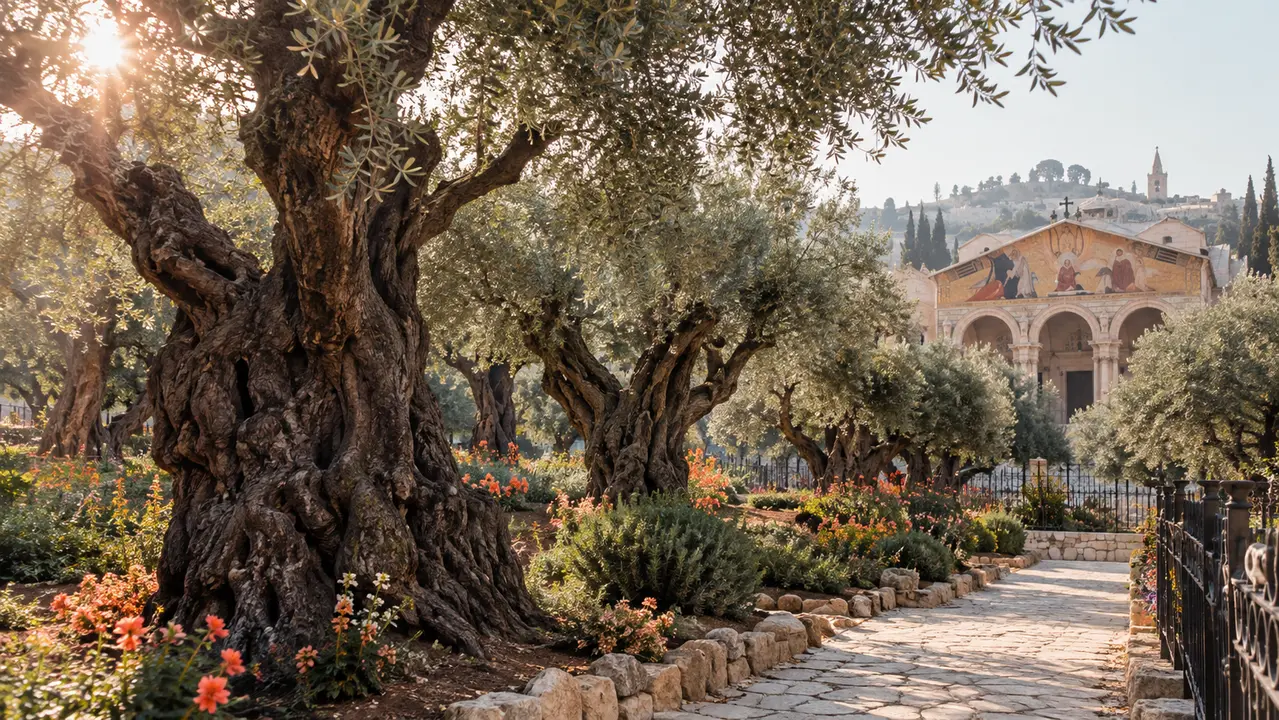
Time allocation at the Garden of Gethsemane is one of the most common planning questions we receive from American group leaders.
Suggested Route Flow for an Efficient Day
Moving through Jerusalem in chronological order requires discipline because tourist traffic peaks between nine in the morning and two in the afternoon. Stage one begins at 7:30 AM atop the Mount of Olives to review the geography in cool morning light. Stage two descends the paved road to Gethsemane for prayer before the tour buses arrive. Stage three passes through Lions’ Gate to reach the Pools of Bethesda (John 5:1-9) and the traditional start of the Via Dolorosa. Stage four moves through the stations and finishes at Golgotha before noon.
Starting Location
A chronological route begins at the Mount of Olives ridge at 7:30 AM. A conventional tour starts at Jaffa Gate parking at 9:00 AM, already behind the crowds.
Biblical Alignment
The chronological route traces Palm Sunday through the crucifixion in order. Conventional tours visit sites based on bus parking availability.
Gethsemane Access
An early chronological arrival allows private prayer time inside the garden before public entry. Conventional stops last about twenty minutes amid large crowds.
Teaching Rhythm
A chronological plan allows extended Scripture reading at each recorded Gospel event rather than a hurried overview above street noise.
The Mount of Olives and the Garden of Gethsemane
Standing on the ridge of the Mount of Olives (Acts 1:9-12) provides the single most important orientation point in the Holy Land. From roughly 2,700 feet your group can see the whole layout of the Temple Mount and the eastern walls, and trace the route of Jesus into the city while reading the Gospel passages together. Morning visits add practical advantages. The eastern sun lights the Old City walls for clear photographs while temperatures stay comfortable, and key sanctuaries along the slope including the Chapel of the Ascension (Luke 24:50-53) and the Pater Noster Church (Luke 11:1-4) as well as Dominus Flevit (Luke 19:41-44) can be reached on the way down rather than climbed later. Pastors who coordinate their Christian pilgrimage tours in Israel through our office know that starting at the summit protects the group’s energy for the rest of the day.
At the foot of the slope lies the Garden of Gethsemane, where olive trees still grow from roots dating back centuries. For many American church groups, this grove is the emotional high point of the pilgrimage. Beside the trees stands the Church of All Nations, where dim alabaster windows filter daylight over the bare Rock of the Agony in front of the high altar. We recommend scheduling thirty-five to forty-five minutes on site so travelers are not rushed during prayer. Our staff coordinates advance entry permissions with the Franciscan custodians so that groups can secure private devotional time in the reserved garden areas.
The Via Dolorosa and the Church of the Holy Sepulchre
After crossing the Kidron Valley, groups enter the Old City through Lions’ Gate to reach the start of the Via Dolorosa. Fourteen stations commemorate the Passion, beginning near the modern Omariya School and finishing inside the Holy Sepulchre. The distance from the praetorium to Calvary is remarkably short, measuring less than seven hundred yards through the market streets, yet it often surprises first-time American visitors. Pastors sometimes expect an open corridor of prayer and instead find bakeries, spice merchants, and residential doorways. That contrast does not diminish the spiritual weight of the walk; it reflects how Christ actually moved through a crowded provincial capital during Passover.
Keeping the Group Together in the Old City
Keeping forty church members together in narrow alleys demands clear logistics. We provide every traveler with a wireless audio receiver so the guide is heard without shouting over street vendors. Starting the walk before ten in the morning lets groups complete the first eight stations before supply carts and buses fill the alleys, and our guides know which interior courtyards allow quiet Scripture readings.
The route concludes at the Church of the Holy Sepulchre, which houses both the hill of Calvary and the Aedicule enclosing the empty tomb. Just inside the entrance sits the Stone of Anointing (John 19:40), and a steep staircase leads to the Chapel of Golgotha. Six historical Christian communities share custodianship under the Status Quo agreement, and lines to enter the tomb chamber can exceed two hours in peak spring months, so experienced leaders arrive early or use the quiet midday transfer window. Different traditions also focus differently here. Catholic parishes from American dioceses often arrange a private Mass at an altar near Golgotha, while Evangelical and Baptist groups frequently continue to the Garden Tomb outside Damascus Gate, an outdoor setting with space for communion and hymns. Our itineraries match these visits to the theological convictions of each group.
Church of the Holy Sepulchre
A fourth-century basilica over the traditional Golgotha and tomb, shared by six Christian communities. Mass is available by formal advance permit at designated altars. A typical visit runs ninety to one hundred twenty minutes including queues.
The Garden Tomb
A rock-cut tomb and garden with quiet outdoor pathways and English signage. Private garden alcoves can be reserved for communion and hymns. A typical visit runs sixty to seventy-five minutes including a service.
If your church or ministry in the United States is planning a Jerusalem itinerary, our team will build it around your denomination and worship preferences as well as your travel dates. You send us the group details and we return a proposed route with guiding, transportation, and site access arranged.
Practical Logistics and Frequently Asked Questions
Every group walks the stone streets between Lions’ Gate, the Holy Sepulchre, and the Western Wall because the ancient core of Jerusalem is entirely pedestrian. A vehicle-assisted itinerary provides the practical middle ground. Our private coach drops groups at the summit of the Mount of Olives, transfers older members across the valley to Mount Zion or Dung Gate, and protects everyone’s energy for the walking portions. Polished Jerusalem limestone becomes slippery when dry and dangerous in rain, so non-slip walking shoes are mandatory, and religious sites require shoulders and knees to be covered. Sanctuaries can deny entry to pilgrims who do not meet these dress requirements, so carrying a light shawl is a simple safeguard.
Private guided Christian Jerusalem tours also let your group set the start time, choose how long to pray at each site, and avoid sharing a bus with strangers. Our licensed guides speak native English and understand how American pastors lead congregations through biblical passages on location. The questions below come up in nearly every planning conversation.
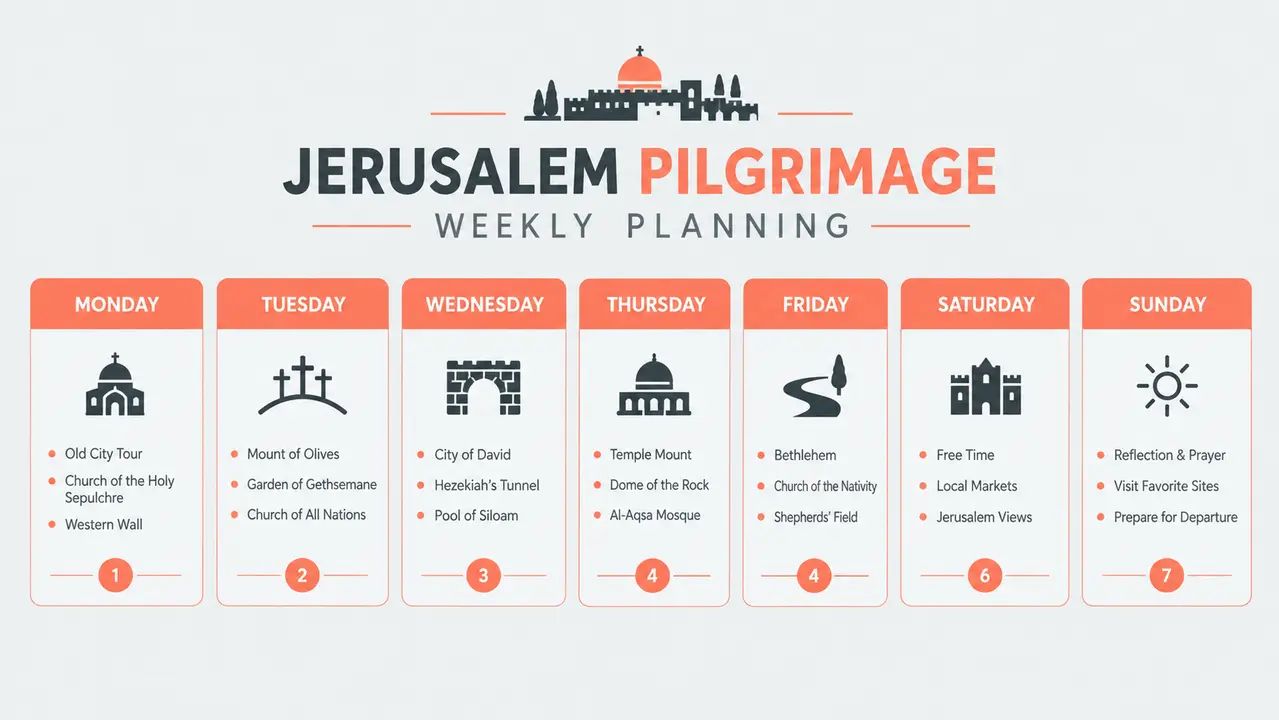
Can you combine Jerusalem with Bethlehem in one day?
Yes, our team regularly organizes a combined Jerusalem and Bethlehem tour for groups with limited travel days. The most efficient schedule covers the Mount of Olives and Old City sites in the morning, then transfers the group six miles south after lunch to visit the Church of the Nativity (Luke 2:1-20). Our drivers handle checkpoint crossings smoothly so the group experiences no delays between regions.
How long does a full Jesus tour in Jerusalem take?
A comprehensive Passion Week itinerary generally requires seven to eight hours from morning pickup to hotel return. That allows about two hours on the Mount of Olives and at Gethsemane, three for the Via Dolorosa and Holy Sepulchre, and time for lunch. Express programs can cover the highlights in four hours, but they leave little room for personal prayer or a communion service.
Which days of the week work best for the Passion route?
Tuesday, Wednesday, and Thursday offer the smoothest flow through the Old City. Friday brings heavy local worship traffic and the Franciscan procession along the Via Dolorosa, so it requires a start before 9:00 AM. Saturday marks Shabbat, which closes many businesses outside the Christian Quarter, while Sunday brings crowded liturgies across the basilicas and is better suited to attending local worship services.
Is it safe for American church groups to walk this route?
Central Jerusalem and the traditional pilgrimage corridors inside the Old City remain secure and actively protected by local authorities, and large numbers of pilgrims walk these streets every month under the care of experienced operators. Our operational staff monitors daily municipal conditions in real time so groups move through transit gates without disruption.
What is included in the tour price?
Standard packages include a licensed Ministry of Tourism guide, private air-conditioned coach transportation, and pre-arranged site access permissions. Most primary Christian sanctuaries charge no admission, though optional archaeological parks sell modest municipal tickets. Personal meals, shared lunches, and gratuities for the driver and guide are budgeted separately by the group coordinator.
Planning a Passion Week pilgrimage requires careful alignment of Gospel chronology, church tradition, and daily city logistics. The route from the Mount of Olives to the Holy Sepulchre rewards groups that start early, walk in sequence, and match worship arrangements to their own denomination. The two miles of Passion Week become a day your congregation will remember for years with a chronological plan, private coach support, and a guide who understands your tradition.
Ready to plan a Jerusalem Jesus tour for your church or ministry in the United States? Contact Talya Felner directly at [email protected] or send your travel dates and denomination details through our contact page. We will respond with a proposed itinerary built specifically for your group.

About the Author
As Owner and CEO of Talya Tours Services (TTS), Talya Felner leads a professional tour operator in Israel with over 35 years of experience and more than 90,000 travelers served. TTS is a trusted name for Christian pilgrimages, biblical tours, and conferences for groups visiting Israel and the Holy Land. Her team designs each itinerary around the specific Christian denomination of the visiting group, whether Protestant, Catholic, Evangelical, Baptist, Methodist, Pentecostal, Lutheran, Presbyterian, Anglican, Orthodox, or another tradition, ensuring that sites, worship arrangements, and guides reflect what matters most to that congregation. TTS handles every detail from visas and accommodations to guides, transportation, and on-site coordination so American pastors and group leaders can focus on the spiritual experience of their travelers.
Visit Talya Tours to learn more about custom Holy Land itineraries